



Education Content Expert
Sampling Methods are the techniques used in Statistics to obtain a sample of data from a specific population for research and analysis.
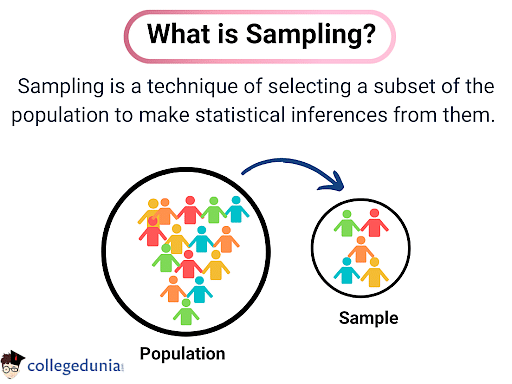
- Sampling is the technique of selecting a group out of the population to derive statistical inferences from them.
- This data is then used to estimate the characteristics of the whole population.
- Sampling Methods are used by researchers where they do not need to research the entire population to collect data.
- Sampling is time-convenient and a cost-effective method.
Probability Sampling and Non-probability Sampling are the two major types of Sampling Methods that are used as per the specific target or approach of the study.
Read More: NCERT Solutions For Class 11 Maths Statistics
Key Terms: Sampling Methods, Sampling, Statistics, Probability Sampling, Non-Probability Sampling, Judgmental Sampling
What are Sampling Methods?
[Click Here for Sample Questions]
Sampling Methods are an integral instrument for data collection and research in Statistics.
- They are the techniques used to collect required data from a specific group of individuals representing the entire population.
- These methods form the basis of the data where the sample space is huge.
- Sampling methods are used when it is extremely difficult, expensive, and time-consuming to collect data from the entire population.
- The number of individuals to be included in the sample depends on various factors such as the size and variability of the population and the research design.
- Sampling methods are also referred to as Sampling Techniques.
![Sampling]()
Read More:
Types of Sampling Methods
[Click Here for Sample Questions]
In statistical research, there are two forms of sampling methods namely
- Probability Sampling
- Non-probability Sampling
Probability sampling is a technique in which the members of the sample are chosen randomly from the population. Every member has an equal opportunity to be a part of a sample of this type. In non-probability sampling, the researcher chooses the sample based on subjective judgment rather than random selection.
What is Probability Sampling?
[Click Here for Sample Questions]
Probability Sampling is a sampling approach in which a researcher establishes a selection benchmark based on a few criteria and randomly selects individuals of a large population.
- In Probability Sampling, all members have an equal chance of participating in the sample.
- It is a sort of conclusive sampling based on the theory of probability.
- For example, in a community of 10,000 people, each member has a 1/10,000 chance of being picked to be a part of a sample.
- There is no bias and everyone has an equal opportunity to participate in the sample based on a predetermined process.
Types of Probability Sampling
[Click Here for Sample Questions]
There are four types of Sampling Methods under Probability Sampling:
Simple Random Sampling
- It is one of the best probability sampling approaches for saving time and resources.
- The data is collected n such a manner that every single member of the population has the same chance of being chosen to be a part of a sample.
Example: If the Facilities Head decides to conduct sanitization operations in a society of 1000 people, it is very likely that they would prefer plucking chits out of a box. Each of the 1000 residents has an equal probability of getting chosen in this situation.

Systematic Sampling
- Systematic sampling approach is used by survey producers to pick sample members of a population at regular or systematic intervals.
- It necessitates the selection of a starting point for the sample as well as a sample size that may be repeated at predictable intervals.
- This sampling technique has a predetermined range and hence takes the least amount of time.
Example: A researcher may wish to gather a systematic sample of 1000 persons from a population of 20,000. Each component of the population is numbered from 1-20000, and every tenth individual is chosen to be a part of the sample.
Total population/Sample Size = 20000/1000 = 20
Read More: Population Mean Formula
Cluster Sampling
- Cluster sampling is a strategy in which researchers divide the entire population into groups or clusters that represent the population.
- A sample's clusters are determined by demographic factors like as age, gender, geography, education, and so on.
- This makes obtaining productive derivation from feedback much easier.
Example: If the Indian government wants to assess the number of foreign immigrants living in the country, they can divide it into clusters based on states like Maharashtra, Karnataka, Tamil Nadu, Andhra Pradesh, West Bengal, Uttar Pradesh, Uttarakhand, and so on. This method of survey is more effective because the results are organized into states and provide insightful immigration data.
Stratified Random Sampling
- It is a sampling method in which the surveyor divides the population into smaller groups that do not overlap but represent the entire population.
- While sampling, these groups can be sorted and a sample drawn from each group separately.
Example: A surveyor may wish to assess the purchasing preferences of people from various yearly income categories and develop strata (groups) based on annual family income. For example, less than 5-6 lacs, 10-15 lacs, 20-30 lacs, and so on. The surveyor can then draw conclusions about the characteristics of people from various income groups.
Read More: Statistics Formulas
What is Non-probability Sampling?
[Click Here for Sample Questions]
Non-probability Sampling is another sampling strategy in which the researcher selects the sample based on subjective judgment rather than random selection.
- All the members of the population do not have an equal chance to participate in the study with this method.
- This type of sampling is used for exploratory research.
- Methods used in non-random sampling consume less time and effort.
Types of Non-Probability Sampling
[Click Here for Sample Questions]
Non-Probability Sampling is further classified into four other types as follows:
Convenience Sampling
- This strategy focuses on the ease of access, such as surveying mall purchasers or passers-by on a crowded street by contacting the subjects.
- The sample elements are chosen primarily for their accessibility rather than their characteristics.
- It is a practical sampling method when time and money are limited.
Example: Travel agencies typically conduct convenience sampling in malls or public places to publicize upcoming events by randomly handing out leaflets.
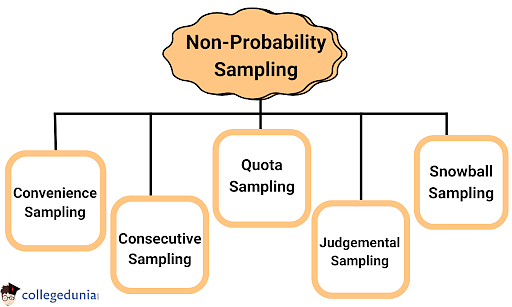
Judgmental or Purposive Sampling
- A judgemental sample is drawn depending on the researcher's judgment.
- There are chances of obtaining highly accurate answers as the knowledge of the researcher is instrumental in creating the samples.
Example: When researchers want to learn about the cognitive processes of persons eager to work in other countries. "Are you willing to work abroad...?" is the parameter, and those who respond with a "YES" are included in the sample.
Read More: Statistics Revision Notes
Quota Sampling
- In Quota Sampling, the members are chosen based on a predetermined standard.
- A sample is constructed based on a specific trait.
- The characteristics of the sample will be comparable to those seen in the overall population.
Snowball Sampling
- When the subjects are difficult to locate, the sampling technique is frequently used.
- This sampling method is also extensively employed in situations where the issue is exceedingly sensitive and not generally discussed, such as when collecting data on HIV and AIDS.
Example: Illegal immigrants are extremely difficult to track down. In this scenario, using the snowball theory can assist researchers in tracking particular divisions in order to probe and extract results.
Check More:
Difference between Probability Sampling and Non-probability Sampling
The difference between Probability Sampling and Non-probability Sampling is listed below:
| Probability Sampling Methods | Non-probability Sampling Methods |
|---|---|
| It is a sampling method in which the samples are chosen based on the theory of probability. | It is a sampling method in which the samples are chosen based on subjective judgment, preferably random selection. |
| It is also known as the Random Sampling Method. | It is also called the Non-random Sampling Method. |
| This method is used for research that is conclusive. | This method is used for research that is exploratory. |
| Time consumed in this method is more in comparison to Non-probability Sampling Methods. | They consume less time in comparison to Probability Sampling Methods. |
| The hypothesis is already derived before the study in probability sampling. | The hypothesis is derived later in the case of non-probability sampling. |
Things to Remember
- Sampling Methods are the techniques used to collect samples from a given population.
- Sampling Methods are of two types namely Probability Sampling and Non-probability Sampling.
- All members have an equal chance of getting selected as a sample in probability sampling.
- Simple Random Sampling, Systematic Sampling, Stratified Sampling, and Clustered Sampling are the types of Probability Sampling.
- Non-probability Sampling is a method in which the researcher selects the sample based on subjective judgment.
- Convenience Sampling, Quota Sampling, Judgmental Sampling, and Snowball Sampling are the types of Non-probability Sampling.
Sample Questions
Ques. What is Sampling and what are its types? (3 Marks)
Ans. Sampling is a strategy for selecting individual representatives or a subset of the population in order to derive statistical information from them and represent the characteristics of the population.
Sampling is categorized into two types of sampling methods which are
- Probability Sampling Methods
- Non-probability Sampling Methods
Ques. What are the types of Probability Sampling Methods? (2 Marks)
Ans. There are four types of Probability sampling methods which are as follows:
- Simple Random Sampling
- Systematic Sampling
- Stratified Sampling
- Clustered Sampling
Ques. What are the methods of Non-probability Sampling? (2 Marks)
Ans. The methods of Non-probability Sampling are
- Convenience Sampling
- Consecutive Sampling
- Quota Sampling
- Purposive or Judgmental Sampling
- Snowball Sampling
Ques. What is a Sample? (2 Marks)
Ans. A sample is a subset of people drawn from a larger group. Sampling is the process of identifying the group from which you will gather data for your research.
For example, if one wants to know what students think at a university, one may poll 100 of them. In statistics, sampling allows for testing a hypothesis about a population's characteristics.
Ques. Explain Systematic Sampling. (1 Mark)
Ans. The systematic sampling approach is used by survey producers to pick sample members of a population at regular or systematic intervals. There is a predetermined range in this technique thus making it the most time-effective sampling method.
Ques. Explain Simple Random Sampling with an example. (3 Marks)
Ans. A simple random sample is a subset of a population chosen at random. Each member of the population has an exactly equal probability of getting chosen using this sampling procedure.
For example, Simple random sampling is used in the Indian Community Survey (ACS). Officials from the India Census Bureau follow a random sample of individual Indian residents for a year, asking extensive questions about their lives in order to make conclusions about the entire Indian population.
Ques. What is Probability Sampling? (2 Marks)
Ans. The term "probability sampling" refers to a sampling method where each member of the target population has an equal chance of being included in the sample. Simple random sampling, systematic sampling, stratified sampling, and cluster sampling are all types of probability sampling.
Ques. What is Non-Probability Sampling? (2 Marks)
Ans. Non-probability sampling involves selecting a sample based on non-random criteria, and not every member of the population has an equal chance of being included. Convenience sampling, voluntary response sampling, purposive sampling, snowball sampling, and quota sampling are examples of non-probability sampling procedures.
Ques. Explain Snowball sampling with an example. (3 Marks)
Ans. Snowball sampling method is used when the subjects of the study are difficult to find or locate. This method is usually used when the topic of the research is sensitive or not that common.
Example: You are conducting a study on homeless people in your city. Probability sampling is not practicable because there is no list of all homeless persons in the city. You meet one individual who agrees to take part in the study, and she connects you with additional homeless persons in the region.
Ques. What is Convenience Sampling? (2 Marks)
Ans. A convenience sample consists of people who are most easily accessible to the researcher. This is a simple and affordable technique to collect preliminary data, but there is no way to know if the sample is representative of the population, therefore the results are not generalizable.
Check-Out:



Comments