



Content Writer
Secondary growth is an increase in girth or thickness of the axis due to the activity of lateral meristem. The tissues involved in the process are two lateral meristems, vascular cambium and cork cambium.
- Secondary growth is mainly seen in dicots.
- Monocots don’t have this type of growth.
- Although the dicot stem and root both show growth, there is a difference in steps and ultimate resultant.
- The process is initiated from cell division in cambia or meristem tissues.
- Growth refers to an increase in size, length, width, changing of shape and mass of an organism.
- Potato tuber, tomato and carrot taproot are some examples of secondary growth in plants.
Key Terms: Secondary Growth, Cambium, Vascular Cambium, Cork Cambium, Dicot Stem, Dicot Root, Xylem, Phloem, Cell Division, Meristem Tissue, Root, Stems
Secondary Growth in Plants
[Click Here for Sample Questions]
Growth in plants refers to the process of lengthening the roots and stems. It is a form of irreversible rise in the size of plants. Primary and secondary are two types of growth in plants.
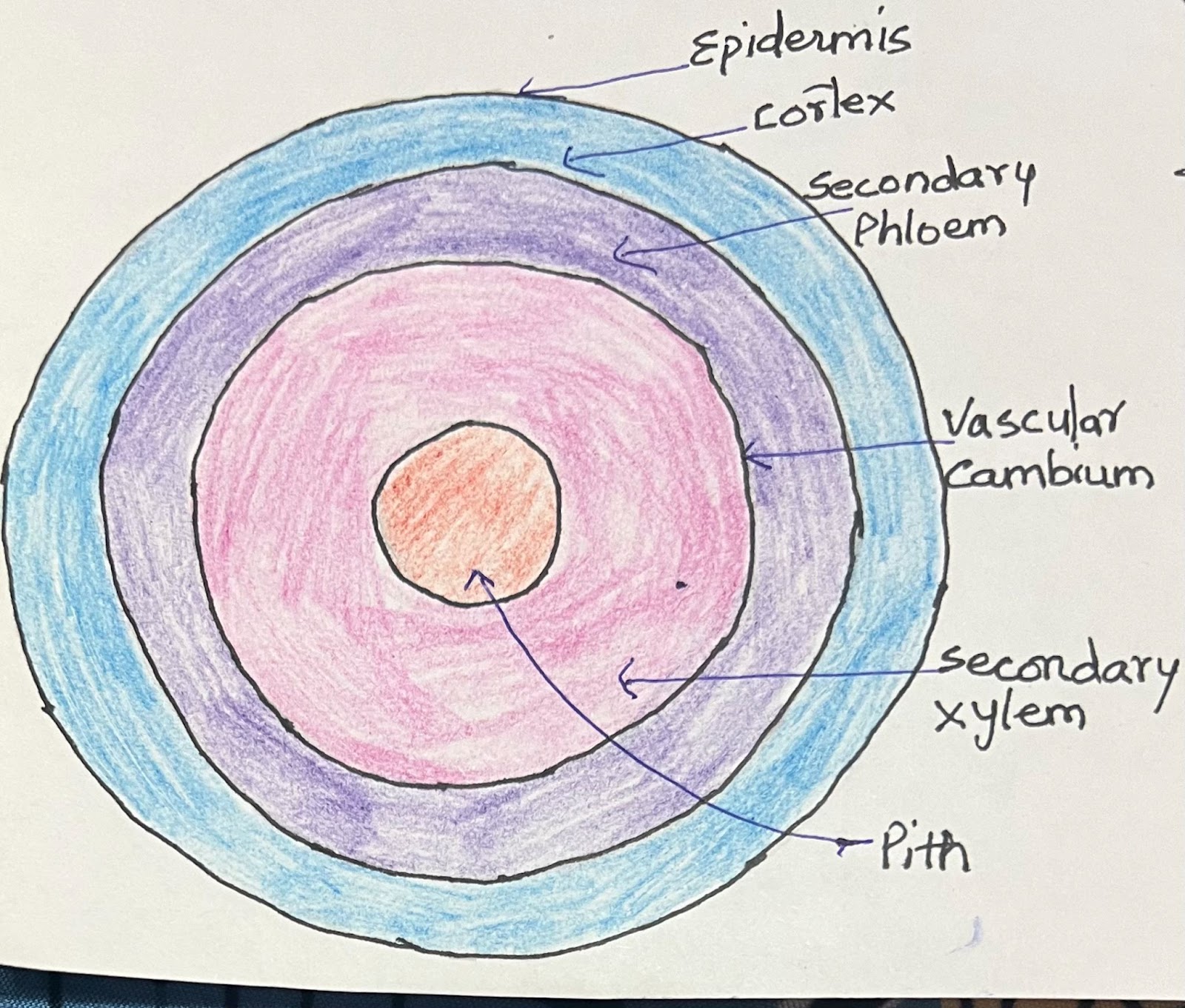
- Secondary growth is a process of increasing the diameter of plants due to the addition of secondary tissue.
- The secondary tissue involves the secondary cortex, secondary phloem, and secondary xylem.
- It is formed by the process of vascular cambium in the stelar region and cork cambium in the extrastelar region
- The process provides protection to the plants and increases the conduction of water and nutrients.
- It increases the mechanical strength of the plants.
Secondary growth
Also Read:
| Related Articles | ||
|---|---|---|
| Cell | Two kingdom classification | Animal Kingdom |
| Flower Structure | Cell division | Difference Between Tissues and Organs |
Secondary Growth in Dicot Stem
[Click Here for Sample Questions]
Secondary growth in the dicot stem increases in the diameter or girth of the axis of the stem due to the activity of the vascular cambium.
Formation of Cambium Ring
The primary step in the secondary growth involves the formation of a cambium ring whose functions are as follows:
- The cambium is present between the xylem and phloem in vascular bundles.
- It is also known as Fascicular or Intrafascicular cambium.
- In secondary growth, a few medullary ray cells that are located between vascular bundles also become meristematic.
- This is known as Interfascicular cambium.
- Interfascicular cambium and intrafascicular cambium collectively constitute a complete ring known as the cambium ring.
- The cambium ring acts to give rise to secondary growth.
Formation of the Secondary Tissues
The second step in the secondary growth of the dicot stem involves the following steps:
- In this process, the cambium ring cuts off cells on both sides.
- It produces a secondary phloem outwardly and a secondary xylem inwardly.
- The number of secondary xylems cut off is more than the number of secondary phloems.
- Next, the cambium ring moves towards the periphery as more secondary xylem cells are formed towards the centre.
- The primary xylem and primary phloem were initially closed.
- They move apart due to the formation of the secondary xylem and secondary phloem.
- The secondary tissue layers are continuously added to the cambium's inner and outer sides.
Secondary Growth in Dicot Root
[Click Here for Sample Questions]
Secondary growth occurs in all dicotyledonous plants, the root increases in girth by cambium and extrasellar cambium activity.
Vascular Cambium
The process of vascular cambium is as follows:
- Cambium is absent initially but develops later at the time of secondary growth.
- The pericycle cells are lying outside the protoxylem.
- Conjunctive parenchyma cells on the lateral side of the bundle become meristematic to form cambial strips.
During development, these strips become continuous laterally because of tangential divisions of pericycle cells opposite to each protoxylem layer. This results in a wavy, continuous cambium ring.
- This ring is present below the phloem but above the protoxylem.
- It is considered a secondary meristem of the bundle.
- The cambial cells divide tangentially again and again.
- It produces secondary tissues, joined with the first formed cambium strips.
- The process will form a complete but wavy continuous ring of the vascular cambium.
Cork Cambium
The process of cork cambium is as follows:
- The cork cambium develops because of the tangential division of cells of the pericycle.
- It produces cork cells or phellem towards the outside and phelloderm or secondary cortex towards the inside.
- Suberin is a lipid-like substance secreted from the cork cells' protoplasm deposited in the walls.
- The cork cambium in the dicot root develops from the pericycle cells.
- All tissues lying outside the cork (endodermis, cortex) are completely sloughed off.
- These cells die due to further deposition of suberin.
- The lenticels may also be formed.
Abnormal secondary growth
[Click Here for Sample Questions]
Due to the absence of the cambium in monocots, monocots don’t show secondary growth and the vascular system is totally composed of primary tissues. The vascular bundles are irregularly scattered in the ground tissues.
- The cortex and other ground tissues can’t be differentiated.
- Dracaena, Yucca, and Agave are examples of monocots that exhibit a peculiar type of secondary growth in thickness.
- This growth can be called anomalous because of an unusual phenomenon.
The activity of the cambium is said to be abnormal since instead of forming phloem and xylem on the outward and inward, respectively, the cambial ring produces secondary tissues to the inner side first and later new tissues on the outer side.
- Dracaena is a common example of anomalous secondary growth in monocots.
- The cambium appears in the parenchymatous region outside vascular bundles, in the cortex or pericycle.
Things to Remember
- Secondary growth in plants provides support to increase the weight of the aerial growth.
- It protects the interior of the plants from abrasion, heat, cold and infection.
- Vascular cambium and cork cambium are two types of lateral tissues involved in secondary growth.
- Secondary growth depends upon the meristem tissues for its growth.
- It is most commonly found in dicotyledons.
- Phellogen, phellem, and phelloderm are collectively called periderm.
Also Read:
Sample Questions
Ques: Write a brief about vascular cambium? (4 marks)
Ans: Cells present between primary xylem and primary phloem constitutes the interfascicular vascular cambium. The medullary ray cells become active and form the interfascicular cambium.
- Consequently, interfascicular cambium and interfascicular cambium joined to form a complete cambium ring.
- The complete vascular cambial ring becomes active and begins to cut off new cells both toward inward and outward.
- Cells produced toward the pith mature to form secondary xylem. Cells produced towards the periphery mature to form secondary phloem.
- At some places, the vascular cambium produces a narrow band of parenchyma, which passes through secondary xylem and phloem is called secondary medullary rays.
Ques: What is cork cambium? (3 marks)
Ans: Cork cambium or phellogen forms usually in the cortex region. Phellogen is few layers in thickness. It’s made up of narrow, thin walled and rectangular cells.
- Phellogen cut new cells both inwardly and outwardly.
- The cells formed outwardly differentiate into cork or phellem.
- The inner cells develop into secondary cortex or phelloderm.
- The cork has suberin deposition.
Ques: Explain “Bark” with diagram? (2 marks)
Ans: Bark is a term given to all tissue exterior to the vascular cambium, therefore it includes secondary phloem and periderm. At certain locations the phellogen cuts off parenchymatous cells instead of cork. These parenchymatous cells ruptured the epidermis layer and formed lens-shaped openings called lenticels. Lenticels permit the gaseous exchange between the atmosphere and internal tissues of the stem.
Ques: Explain Heartwood and Sapwood? (4 marks)
Ans: The secondary wood loses the capacity of conduction of water and minerals in older trees where enough secondary growth has occurred. The central region of the stem is dark, hard, and tough because of tannins, resins, gums, and essential oils.
- This area is called the Heartwood or Duramen.
- The heartwood ceases the function of conduction.
- This is due to the formation of tyloses in vessels.
- This heartwood provides mechanical support to the tree.
- The outer region of the stem is lighter and soft, which performs the functions of conduction of water and minerals.
- This region is called Sapwood or Alburnum.
Ques: How annual rings form? (4 marks)
Ans: The activity of cambium gets affected by the change in season. During springtime, due to favourable weather there is more activity of cambium, Springwood or earlywood is formed.
- The lumens are wider in springwood. In winter or autumn, the cambium activity is less, and it forms narrower and smaller vessels.
- The wood formed in winter or autumn is called Winter or Autumn wood or Latewood. A
- lternate formation of Springwood and Autumn wood of a year constitutes Annual ring or Growth ring.
- To find the age of a tree, the number of annual rings is counted.
- The science dealing with counting the age of trees is called Dendrochronology.
Ques: Difference between primary and secondary growth? (4 marks)
Ans: Following are the differences:
| Primary Growth | Secondary Growth |
|---|---|
| Primary growth is the growth that occurs due to activity of the primary meristem, which increases the length of the stem and general increase in size. | Secondary growth is the growth that occurs because of the cambium, which increases the diameter(girth) of the plant. |
| It occurs by the activity of the apical meristem, present in the apical region. | It occurs by the activity of the lateral meristem, present in the trunk. |
| The primary growth results in the growth in the longitudinal axis(height). | The secondary growth leads to radial growth(girth). |
| The epidermis, cortex, and the primary vascular tissues are formed during the primary growth phase. | The bark, periderm, lenticels, secondary phloem, and secondary xylem are the result of secondary growth. |
Ques: Write a note on primary growth? (3 marks)
Ans: Primary growth is the first phase of growth in all plants. Primary growth is the rapid division of cells, primarily in the apical meristems of plants, located at the tips of roots and stems.
- Primary growth in plants results in the enlargement and elongation of these organs, both upward in stems, and outward in roots.
- It helps the plant establish itself in the environment, so it is capable of acquiring both the water and nutrients it needs from the soil and the ideal height required for photosynthesis.
Ques: Explain the process of cork cambium? (2 marks)
Ans: The cork cambium develops because of the tangential division of cells of the pericycle. The activity of cork cambium is like that found in the dicot stem, so it produces cork cells or phellem towards the outside and phelloderm or secondary cortex towards the inside. As the cork cambium in the dicot root develops from the pericycle cells, all tissues lying outside the cork (endodermis, cortex) are completely sloughed off.
Ques: What is the function of cambial cells? (3 marks)
Ans: The cambial cells produce more xylem elements than phloem elements, producing secondary xylem and secondary phloem like the secondary growth in stems.
- Due to this, the depressed parts of the vascular cambium move outward.
- Ultimately, the cambium becomes circular.
- Thus, after secondary growth, a central cylinder of wood is developed.
Ques: Explain secondary growth in dicot root? (4 marks)
Ans: The process is initiated behind the root hair zone. There is no main cambium in the root. Initially, the conjunctive tissue cells beneath the phloem area, followed by the pericycle cells across from the protoxylem and the conjunctive tissue cells between the phloem and xylem regions, dedifferentiate to become meristematic and create strips of cambia.
- Cambusum in roots is therefore a secondary meristem.
- The quantity of phloem/xylem bundles determines how many of these strips there are.
- Between xylem and phloem bundles, these strips stretch in both directions before coming together to form a wavy ring of vascular cambium.
Ques: Give example of abnormal secondary growth? (2 marks)
Ans: A secondary cambium grows in the hypodermal region of arborescent monocot stems, forming conjunctive tissue and patches of meristematic cells. This is example of abnormal secondary growth. These cell patches develop into vascular bundles that are secondary. The cortical and pith areas are where the bundles are seen.
For Latest Updates on Upcoming Board Exams, Click Here: https://t.me/class_10_12_board_updates
Check-Out:



Comments