



Content Curator
Dicotyledonous and Monocotyledonous are two different types of seeds. The embryonic stage of the cycle of plant life is the seed. The embryo, endosperm, and seed coat are the three sections of most seeds. A little plant with a root, a stem, and one or more leaves is the embryo. The endosperm is the seed's nutritional component, usually a mixture of starch, oil, and protein. The seed coat works as a protective layer that helps seeds survive for more extended periods.
Key Takeaways: Dicotyledonous, monocotyledonous, gymnosperms, embryo, endosperm, and seed coat
Seeds
[Click Here for Sample Questions]
Seed plants first occurred in the fossil record some 300 million years ago, and now, with nearly 400,000 species, they are the most abundant and diverse plant group on the planet. Gymnosperms, or "naked-seeded" plants like conifers and cycads, and angiosperms, flowering plants with seeds enclosed in ovaries, are classified into spermatophytes or seed plants. Ferns and mosses are examples of plants that do not produce seeds.
Types of Seeds
There are two sorts of seeds. The two types are as follows:
- Monocotyledonous seed
- Dicotyledonous seed
What is Monocot Seed?
[Click Here for Sample Questions]
A Monocotyledonous seed has only one cotyledon, as the name implies. The seed coat has only one layer on the outside.
Examples- Monocot seeds include rice, wheat, maize, bamboo, palm, banana, ginger, onion, garlic, lilies, daffodils, iris, and tulips.
Structure Of A Monocot Seed
[Click Here for Sample Questions]
The structure of monocot seeds can be explained by-
- The seeds of monocots are predominantly endospermic.
- The thin seed coat merges with the pericarp.
- It has a single cotyledon termed scutellum and a shoot axis.
- The radicle is the lowest section of the axis, covered by a sheath termed coleorhiza.
- The plumule is the upper section of an axis, surrounded by a sheath termed the coleoptile.
- The aleurone layer, which separates the endosperm from the outer covering, is proteinaceous.
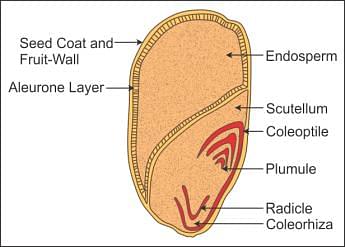
Structure of a Monocot Seed
Characteristics of Monocot Seeds
[Click Here for Sample Questions]
Here are some characteristics of Monocot Seeds-
- Monocot seeds have a single cotyledon with one embryo.
- It has single pollen with pores.
- It includes scattered stem vascular bundles.
- Monocot seed has adventitious roots.
- It does not have secondary growth.
What is Dicot Seed?
[Click Here for Sample Questions]
Dicotyledonous seeds, in contrast to monocotyledonous seeds, have two cotyledons.
Examples- Bitter gourd seeds, Castor seeds, Mango seeds, Neem seeds, Night Jasmine seeds, Papaya seeds, and Tamarind seeds are some of the seeds found in bitter gourds.
Structure Of A Dicot Seed
[Click Here for Sample Questions]
The structure of the Dicot seed includes-
- A seed coat protects a dicotyledonous seed. There are two layers to a seed coat: an exterior testa and an inner tegmen.
- On the seed coat, there is a scar called hilum. The growing seeds are linked to the fruit via the hilum.
- The little pore right above the hilum is known as a micropyle.
- The seed coat protects the embryo.
- The embryo has two cotyledons and an embryonal axis. The cotyledons are fleshy and serve as food reserves for the embryo as it develops.
- The plumule and radicle are located at the two ends of the embryonal axis.
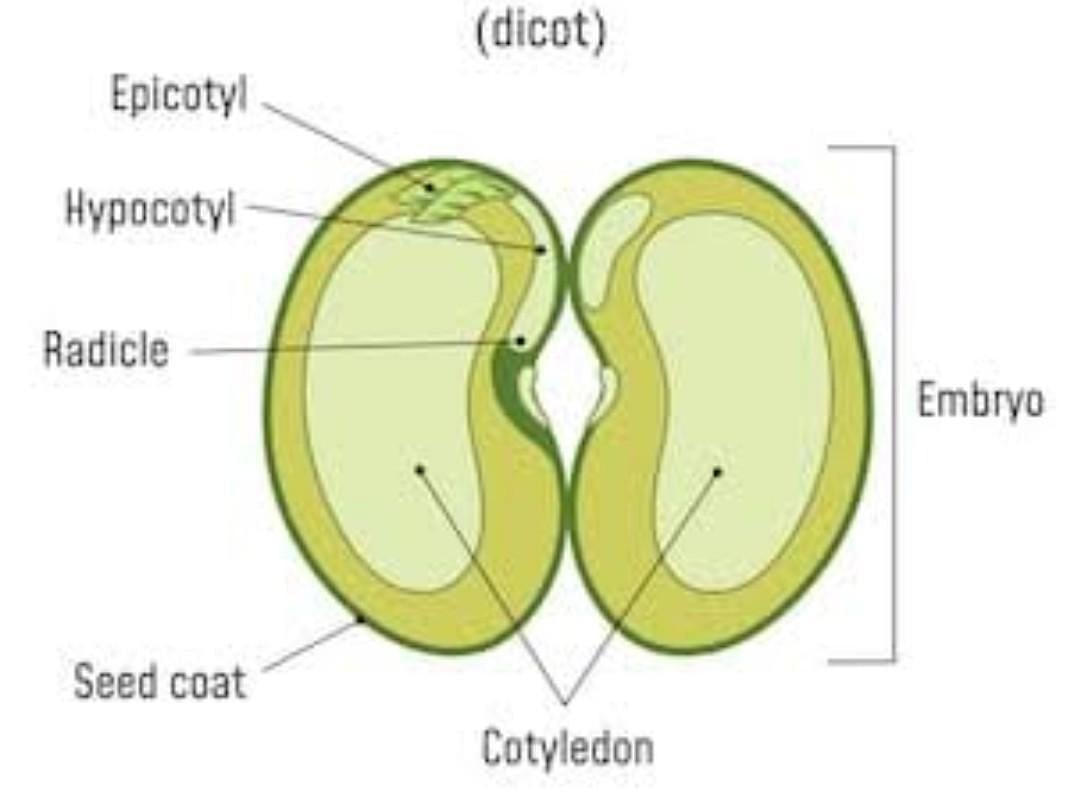
Structure of a Dicot seed
Characteristics of Dicot Seeds
[Click Here for Sample Questions]
Here are some characteristics of Dicot seeds-
- Dicot seed includes two cotyledons.
- The seed coat in this case has two layers, testa (the outer layer), and tegmen (the inner layer).
- In the case of the Dicot seed, the embryo has an embryonic axis and two fleshy cotyledons.
Also Read:- Seed Dispersal
Difference Between Monocots and Dicots
[Click Here for Sample Questions]
Here are the differences between Monocot and Dicot seeds-
| Monocots | Dicots |
|---|---|
| Monocots are herbaceous; some are occasionally arboraceous. | Dicots are either herbaceous or arboraceous. |
| The embryo contains only one cotyledon. | The embryo contains two cotyledons. |
| Contains a large endosperm inside the seed which feeds the embryo plant. | Contains a tiny endosperm inside the seed. |
| Produces a single leaf, which is long and narrow during the germination of the seed. | Produces two leaves, which are in a different shape from the true leaf. |
| Usually contains long and narrow leaves. | Usually contains wider leaves, but their shapes are highly varied depending on the species. |
| Contains a parallel venation system. | Contains a reticulate venation system. |
| The stem is unbranched and fleshy. | The stem is branched and hard. |
| Contains a fibrous root system. | Contains roots growing from the main taproot. |
| Seed germination is hypogeal. | Seed germination is either hypogeal or epigeal. |
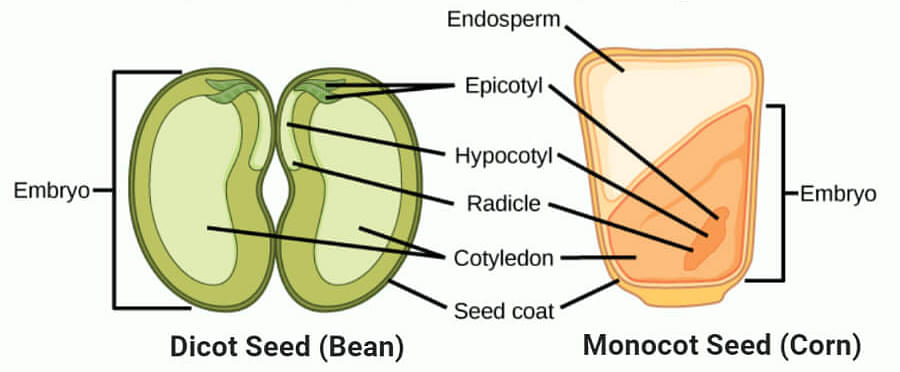
Differences between Monocot and Dicot seeds
Also Read:- Imbibition In Seeds
Importance of Understanding Dicotyledonous and Monocotyledonous Seeds:
Here are the importance of understanding the seeds properly-
- The importance of studying Dicotyledonous Seed stems from the fact that Dicotyledonous plants are adapted to live in bogs and are the second most dominant.
- The importance of studying Monocotyledonous Seed is that it can be found in widely distributed plants, are the second dominating category of plants, and grow broader than Dicotyledons.
Things to Remember
- A seed is a reproductive component of the plant that contains the embryo of the tiny future plant. This resource discusses the exterior and internal characteristics of dicot and monocot seeds.
- Angiosperm plants bear fruit, but Gymnosperm plants bear seeds straight on the plant.
- Seeds are divided into Monocotyledonous and Dicotyledonous seeds based on the number of cotyledons present.
- Monocotyledonous seeds, such as maize, rice, and wheat, have a single cotyledon. Like beans, peas, and gram, Dicotyledonous seeds have two cotyledons.
- Albuminous and Exalbuminous seeds are distinguished by the presence or absence of endosperm tissue in their seeds.
Sample Questions
Ques: Can you tell just by looking at a seed whether it is a monocot or dicot? (2 Marks)
Ans: Flowering plants are classified into two types: monocots and dicots. Recognizing which of these two groups a plant belongs to saves time when trying to identify a plant with a key in the field. The names of these groups are derived from the number of cotyledons or seed leaves included within the embryonic seedling. A monocot has one cotyledon, whereas a dicot has two cotyledons. However, this distinction will not assist you in establishing which category a plant belongs to if it is no longer a seedling.
Ques: Describe the structure of dicot seeds. (4 Marks)
Ans: Dicotyledons are another name for dicots. All flowering plants, also known as angiosperms, are classified into categories. To date, around 200,000 cotyledon species have been found.
- The embryo of a dicot will have an embryo axis and two cotyledons.
- Cotyledons appear bloated because they store food for budding seedlings.
- The embryo axis is divided into two ends.
- The plumule is the formation of the shoot tip, and the radicle is the formation of the root tip at the lower end.
- This material is protected by a seed coat composed of Testa and Tegmen.
Ques: Write down some of the properties of Monocot seeds. (4 marks)
Ans: Some of the properties of Monocot seeds are:
- Cotyledon has a single embryo.
- Adventitious roots.
- Pollen is paired with a pore.
- The flower's parts are in multiples of three.
- The parallelism of main leaf veins.
- Vascular bundles are scattered throughout the stem.
- Secondary growth is not present.
Ques: How are angiosperms classified? (2 Marks)
Ans: Depending on the number of cotyledons in a seed, angiosperms are classified as monocots or dicots. The seed is made up of an embryo surrounded by a protective outer coating called the seed coat. Some seeds have been found to have triploid endosperm. A radicle, an embryo axis, and cotyledons are the three components of an embryo.
Ques: What are Albuminous seeds and Exalbuminous seeds? (2 Marks)
Ans: Albuminous seeds have thin membrane cotyledons but a dense endosperm. Dicot seeds, such as poppy, castor, and custard apple, are albuminous seeds. Rice, wheat, and millets are monocot seeds that are also albuminous.
Exalbuminous seeds have thick cotyledons but no endosperm. Dicot seeds are albuminous like gram, mango, pea, and mustard. Monocot seeds like Vallisneria, Orchids and Amorphophallus are exalbuminous.
Ques: Can one differentiate between dicot and monocot on the basis of flowers? (2 Marks)
Ans: Yes, it is possible. If your plant is in bloom, the number of petals and other floral parts will indicate whether it is a monocot or a dicot. Flower parts in monocots are in threes or multiples of threes. Dicots' flower components are in multiples of fours or fives, such as the five-petaled dicot flower.
Ques: Define Micropyle. (2 Marks)
Ans: A tiny pore on one side of the hilum through which the seed absorbs water during germination is known as a micropyle. It opens up the water enabling the embryo to become active and germinate. The micropyle will also aid in exchanging breathing gasses, which is critical for the seed's survival.
Ques: What are seed coats and cotyledons? (3 Marks)
Ans: After removing the seed coat, we see two fleshy white kidney-shaped cotyledons in which the embryo is found. The cotyledons in the seed are enriched with nutrients to sustain the embryo as it develops into a miniature plant.
The seed coat is the leathery solid protective covering on the outside of the bean seed. The seed coat protects the seed's delicate interior sections from harm. It also protects the seed from bacterial, fungal, and insect attacks. The seed coat has two layers: a thick exterior testa and an inner thin membrane tegmen.
Ques: Compare bean seed with maize seed. (5 Marks)
Ans: Comparison between bean and maize seed:
- Bean is an exalbuminous (non-endospermic) seed, whereas maize is an endospermic (albuminous) seed.
- In bean seed, the seed coat is not bonded to the fruit wall, whereas in maize grain, the fruit wall and seed coat are permanently joined.
- Hilum and micropyle are visible in bean seeds but not in maize grains.
- Food in bean seed is kept in two cotyledons, whereas food in maize grain is stored in the endosperm.
- Bean seed embryos are huge, but maize seed embryos are tiny.
- Plumule leaves are folded in bean seed, whereas maize grain is rolled in plumule leaves.
- Radicle and plumule are not protected in bean seed but are in maize grain.
Ques: Differentiate between monocots and dicots based on the root system. (2 Marks)
Ans: Dicots have a taproot system, consisting of one main root at the plant's base and smaller roots that branch out from it. The taproot was the first root to grow from the radicle, the seed. The root system of monocots comprises a network of fibrous roots. These roots, which all sprang from the plant's stem, are adventitious roots.
Check-Out:



Comments