



Exams Prep Master
Silicon carbide is commonly called Carborundum, which is a compound of both silicon and carbon. Silicon carbide is described as a semiconductor material as an emerging material for the applications of semiconductor devices. Silicon carbide was discovered in 1891 by Pennsylvanian scientist Edward Acheson. It is one of the most essential industrial ceramic materials. It plays a key role in the industrial revolution or industrial sector and is used widely as a steel additive, abrasive and structural ceramic. Let’s have a closer look at the topic and discuss some important questions.
| Table of Contents |
Key Takeaways: Silicon carbide, silicon, carbon, semiconductor material, industrial ceramic materials.
Silicon Carbide Structure – SiC
[Click Here for Sample Questions]
Silicon carbide is a close packed structure covalently bonded to each other. The atoms are arranged in such a way that two primary conditions are tetrahedral where four carbon and four silicon atoms are bonded to Si and C atoms are formed.
Basically, silicon carbide exists in about 250 crystalline forms. Pure silicon carbide is colourless. But due to the presence of some impurities, it appears yellow to green to bluish-black.
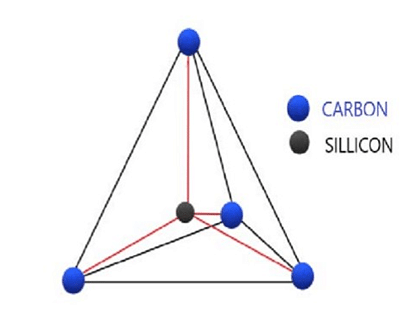
Silicon Carbide Structure
Read More:
| Related Articles | ||
|---|---|---|
| Electrical properties of solids | Conductors | Insulators |
| Classification Of Crystalline Solids | Density of Unit Cell | Metallic Bonds |
Properties of Silicon Carbide - SiC
[Click Here for Sample Questions]
| Density | 3.21 g/cm³ |
| SiC | Silicon Carbide |
| Melting Point | 2,730 °C |
| Molar Mass /Molecular Weight | 40.11 g/mol |
| Compound Formula | SiC |
Physical Properties of Silicon Carbide – SiC
| Appearance | Grey solid, black grey to green powder |
| Odour | Odourless |
| Solubility | Insoluble in alcohol, water, and acid |
| Specific Density | 3.21 g/cm3 |
Chemical Properties of Silicon Carbide – SiC
- It possesses interesting electrical properties because of its properties of semiconductors, the resistance of various compositions differing by as seven orders of magnitude.
- It is resistant to many organic and inorganic acids, salts, and alkalis in a variety of concentrations except to acid fluorides and hydrofluoric acid.
Occurrence of Silicon Carbide - SiC
[Click Here for Sample Questions]
Naturally-occurring substance moissanites are present only in small numbers in specific forms of meteorites and in kimberlite and corundum deposits. Virtually all the silicon carbide sold in the world is in the form of plastic, like moissanite jewellery.
In 1893, natural moissanite was first found in Arizona as a small component of the Canyon Diablo meteorite by Dr Ferdinand Henri Moissan, after that, the material name was changed in 1905. The naturally occurring SiC discovered by Moissan was initially disputed because his sample may have been contaminated by the silicon carbide saw blades that were already available on the market at that time.
Silicon carbide is rare on the earth, silicon carbide is defined remarkably as common in space. Silicon carbide is also a common form of stardust found around the carbon-rich stars, and examples of this stardust have been found in pristine conditions in unaltered (primitive) meteorites. Silicon carbide can be found in space and meteorites are beta-polymorph, which is almost exclusively. The SiC grain analysis can be found in the Murchison meteorite, which is a carbonaceous chondrite meteorite and it revealed the anomalous isotopic ratios of silicon and carbon. It indicates that these grains have originated outside the solar system.
Production of Silicon Carbide - SiC
[Click Here for Sample Questions]
Due to the fact that natural moissanite is an extremely scarcest element, most of the silicon carbide is synthetic. It can be used as an abrasive and diamond simulant and semiconductor of gem quality as well. Combining carbon and silica sand in electric resistance of an Acheson graphite furnace at a high temperature, ranging from 1,600 °C (2,910 °F) and 2,500 °C (4,530 °F) is the simplest process to manufacture the silicon carbide.
The fine particles of SiO2 present in plant materials such as rice husks can be converted to SiC by heating the compound in the excess carbon from the organic material. The silica fume is a byproduct of producing ferrosilicon alloys and silicon metal and it can also be converted to SiC by heating with graphite at a temperature of 1,500 °C (2,730 °F).
Colourless, green, and pale yellow crystals indicate the highest purity and can be found closest to the resistor. The colour changes to black and blue at a greater distance from the resistor and these darker crystals represent less pure. Aluminium and Nitrogen are the most common impurities, and they affect the silica carbides' electrical conductivity.
Uses of Silicon Carbide
[Click Here for Sample Questions]
- Abrasive and Cutting Tools
Silicon carbide is a popular abrasive in the arts in modern lapidary due to its low cost and durability of the material. It is used for its hardness in the abrasive machining processes including honing, grinding, sandblasting, and water-jet cutting.
- Automobile Parts
The carbon-carbon composite of Silicon-infiltrated can apply for high performance "ceramic" brake disks since they can withstand extreme temperatures. Silicon reacts with the graphite in the composite of carbon-carbon to form carbon-fibre-reinforced silicon carbide (C/SiC).
The brake disks can be used on a few supercars, road-going sports cars, and other performance cars as well, including the Bugatti Veyron, Porsche Carrera GT, the McLaren P1, Ferrari, Bentley, Lamborghini, and a few Audi cars, which have a specific high-performance that means it has automobile sectors applications are important.
Silicon carbide can also be used for diesel particulate filters. Silicon carbide is used as an oil additive to reduce emissions, harmonics, and friction which means it has environmental applications
- Foundry applications
Silicon Carbide is utilised in crucibles for holding the melting metal in the applications of both small and large scale foundries.
- Electronic industry
Silicon carbide is used in light-emitting diodes and detectors in early radios.
Things To Remember
- Silicon carbide was discovered in 1891 by Pennsylvanian scientist Edward Acheson.
- Silicon carbide is used as an oil additive to reduce emissions, harmonics, and friction
- Silicon carbide is a popular abrasive in the arts in modern lapidary due to its low cost and durability of the material
- Silicon carbide is rare on the earth, silicon carbide is defined remarkably as common in space.
- It plays a key role in the industrial revolution or industrial sector and is used widely as a steel additive, abrasive and structural ceramic.
- Colourless, green, and pale yellow crystals indicate the highest purity and can be found closest to the resistor.
Read More:
Sample Questions
Que 1- Write the formula of silicon carbide. Calculate the molar mass of silicon carbide (2 Marks)
Ans: Formula- SiC
(1×Si) = 1×18.08 = 18.08 g
(1×C) = 1×12 = 12 g
Molecular weight = 18.08 + 12 = 40.08 g
Que 2- Write the properties of silicon carbide? (5 Marks)
Ans:
- It possesses interesting electrical properties because of its properties of semiconductors, the resistance of various compositions differing by as seven orders of magnitude.
- It is resistant to many organic and inorganic acids, salts, and alkalis in a variety of concentrations except to acid fluorides and hydrofluoric acid.
- It is odourless and insoluble in water and alcohol
- Pure silicon carbide is colourless
- The molecular weight is 40.08 g and the formula is SiC.
Que 3- How is silicon carbide produced? (3 Marks)
Ans:
- Due to the fact that natural moissanite is an extremely scarcest element, most of the silicon carbide is synthetic.
- It can be used as an abrasive and diamond simulant and semiconductor of gem-quality as well.
- Combining carbon and silica sand in electric resistance of an Acheson graphite furnace at a high temperature, ranging from 1,600 °C (2,910 °F) and 2,500 °C (4,530 °F) is the simplest process to manufacture the silicon carbide .
Que 4- What is the source of silicon carbide? (3 Marks)
Ans:
- The silicon carbide can be found in space and meteorites are beta-polymorph, that is almost exclusively.
- Silicon carbide is also a common form of stardust found around the carbon-rich stars, and examples of this stardust have been found in pristine condition in unaltered (primitive) meteorites.
- Naturally-occurring substance moissanites are present only in small numbers in specific forms of meteorites and in kimberlite and corundum deposits.
- The silicon carbide can be found in space and meteorites are beta-polymorph, that is almost exclusively.
Que 5 – How silicon carbide is formed from rice husks? (3 Marks)
Ans:
- The fine particles of SiO2 present in plant material such as rice husks can be converted to SiC by heating the compound in the excess carbon from the organic material.
- The silica fume is a byproduct of producing ferrosilicon alloys and silicon metal and it can also be converted to SiC by heating with graphite at a temperature of 1,500 °C (2,730 °F).
Que 6 – Write the foundry and electronic applications of silicon carbide (2 Marks)
Ans:
- Foundry applications – Silicon Carbide is utilized in crucibles for holding the melting metal in the applications of both small and large scale foundry.
- Electronic industry – Silicon carbide is use in light emitting diode and detectors in early radios
Que 7 – Write any three applications of silicon carbide (3 Marks)
Ans:
- It is used for its hardness in the abrasive machining processes including honing, grinding, sandblasting, and water-jet cutting.
- Silicon carbide can be used for diesel particulate filters. Silicon carbide is used as an oil additive to reduce emissions, harmonics, and friction that means it has environmental applications.
- Silicon carbide is use in light emitting diodes and detectors in early radios.
For Latest Updates on Upcoming Board Exams, Click Here: https://t.me/class_10_12_board_updates
Check-Out:



Comments