



Education Journalist | Study Abroad Lead
Light-emitting diode (LED) is a semiconductor device which is known to emit light when electric current flows via it. Light-emitting diode (LED) is a common standard source of light used in a variety of ways, from your phone to billboards. They are commonly seen in devices that display time and various forms of data. Light-emitting diodes (LEDs) are most extensively used in various types of semiconductor diodes available today. When linked in forward biased, it emits either visible light or invisible infrared light.
Light-emitting diode, or LED, has heavily doped p-n junctions. Depending on the semiconductor material that is used and the amount of doping, a LED emits a coloured light at a certain spectral wavelength when forward-biased. There are several types of Light-emitting diodes (LED), some of them include:
- Aluminium Gallium Arsenide Phosphide (AlGaAsP) – high-brightness red, orange-red, orange, and yellow
- Silicon Carbide (SiC) – blue as a substrate
- Zinc Selenide (ZnSe) – blue
- Gallium Phosphide (GaP) – red, yellow and green
- Gallium Arsenide (GaAs) – infra-red
- Gallium Arsenide Phosphide (GaAsP) – red to infra-red, orange
| Table of Content |
Key Terms: Light-Emitting Diode, Semiconductors, Infrared LEDs, Optical Fibre, p-n Junction Diode, Telecommunication System, Light
What is LED?
[Click Here for Sample Questions]
LED (Light-emitting Diode) is a semiconductor device that, when charged with an electric current, generates infrared or visible light.
- LED (Light-Emitting diode) produces light when an electric current passes via it.
- Many pieces of equipment use Light-emitting Diode (LED), such as indicator lamps, automobile brake lights, billboards and signs (in form of alphanumeric displays or full-colour posters).
- Infrared LEDs are used in autofocus cameras and television remote controls, as well as in fibre-optic telecommunication systems as light sources.
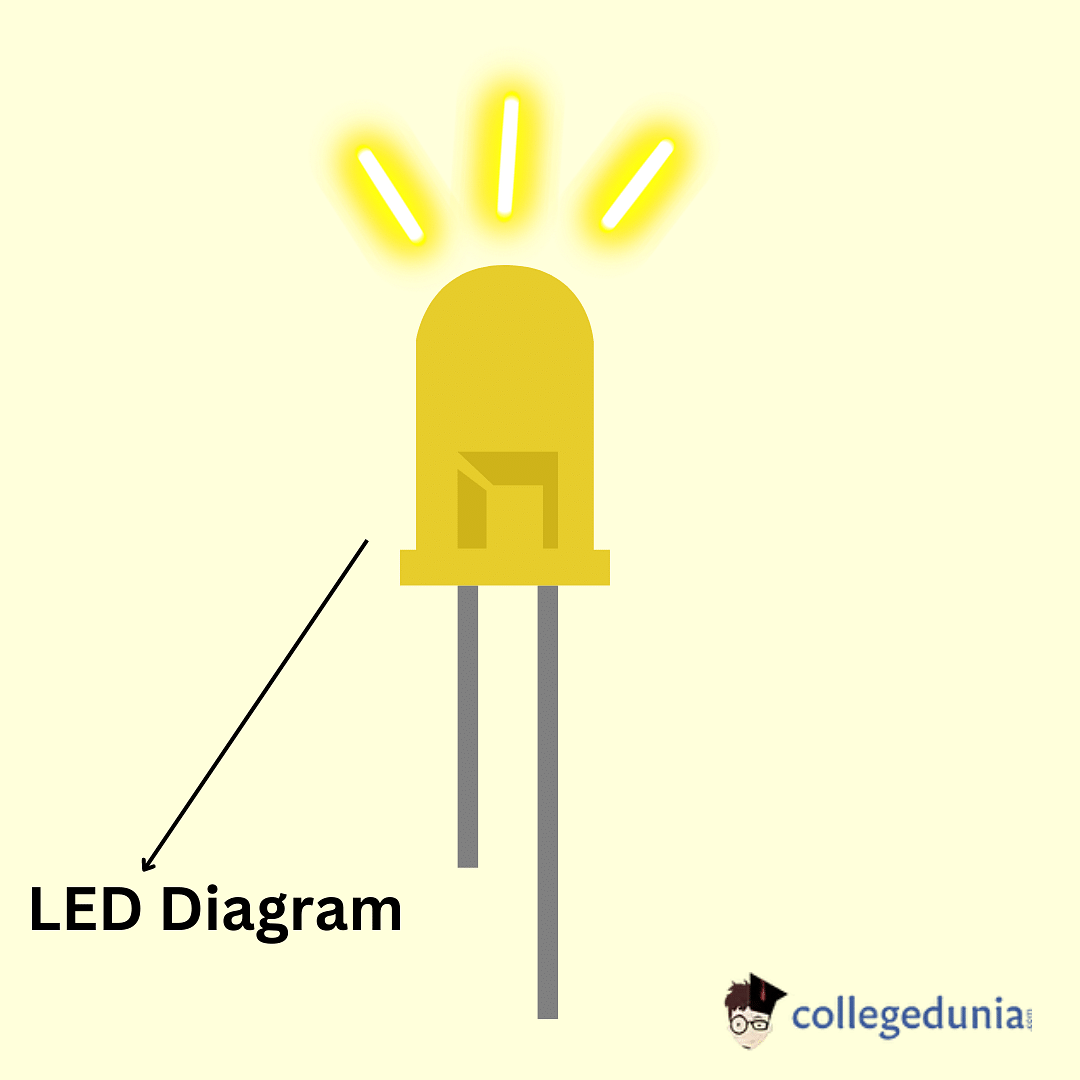
- Remote controls use infrared light-emitting LEDs, which are invisible.
- A Light Emitting Diode is a semiconductor device that emits light when a voltage is applied to it (LED).
- It's an electronic gadget that converts electrical energy into light energy.
LED Symbol
The difference between the Led Symbol and a typical p-n junction diode is that the Led Symbol has an arrow pointing away from the diode, indicating that the diode is emitting light. LEDs come in a variety of colors, with red, yellow, green, and orange being the most prevalent.
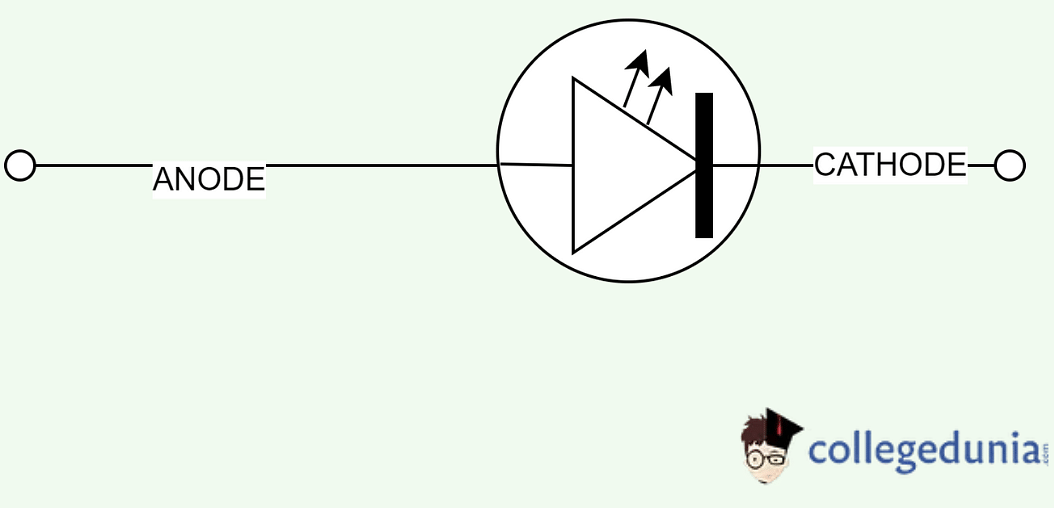
The color of the light emitted by an LED cannot be represented in its schematic symbol, which is the same for all LED colors. As a result, the hue of an LED cannot be determined only by its sign.
Simple LED Circuit Diagram
A simple LED circuit is shown in the diagram below. An LED, a voltage supply, and a resistor to regulate current and voltage make up the circuit.

Simple LED Circuit Diagram
Construction of LED
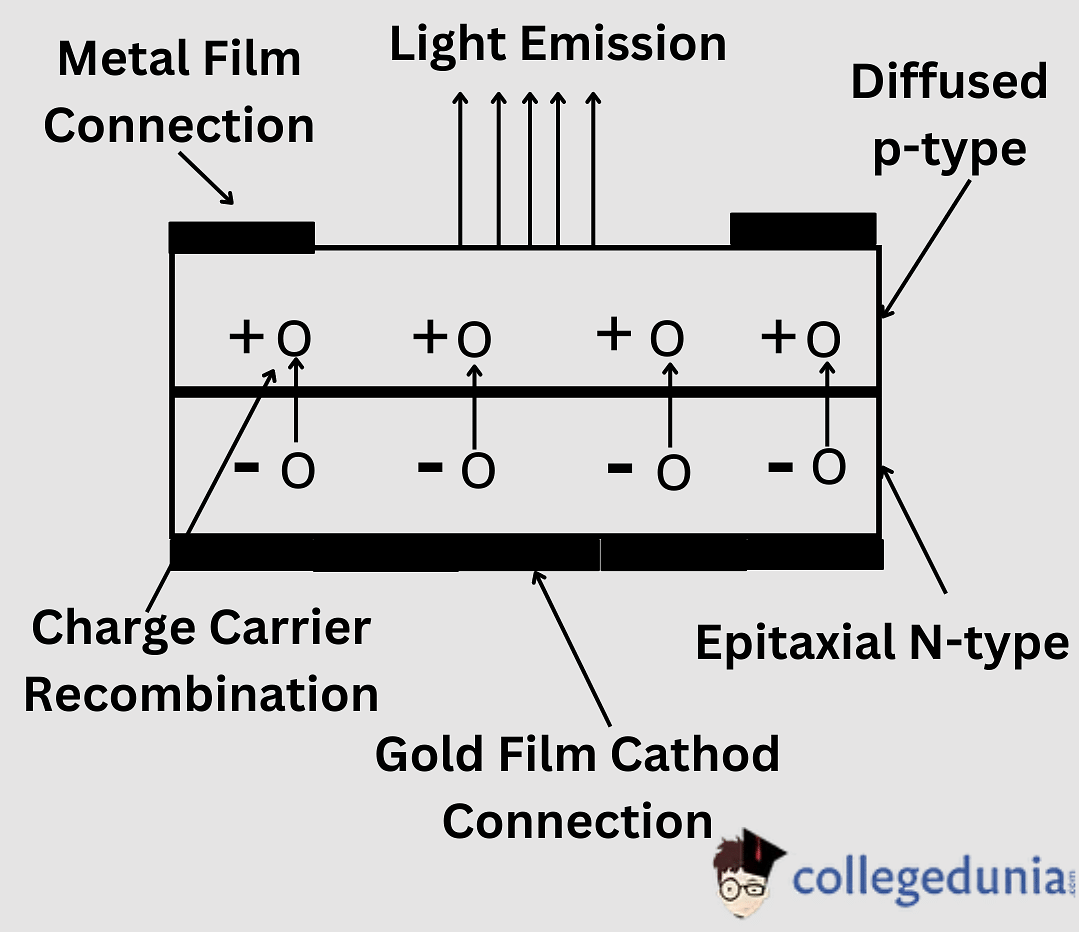
Gallium arsenide is the most common material used in LEDs, however, there are several variations in this fundamental combination, including aluminium gallium arsenide and aluminium gallium indium phosphide. These compounds belong to the so-called III-V group of semiconductors, which are made up of elements from the periodic table's columns III and V. The wavelength (and thus the color) of the produced light can be modified by changing the exact composition of the semiconductor.
Read More:
Working of LED
[Click Here for Previous Year Questions]
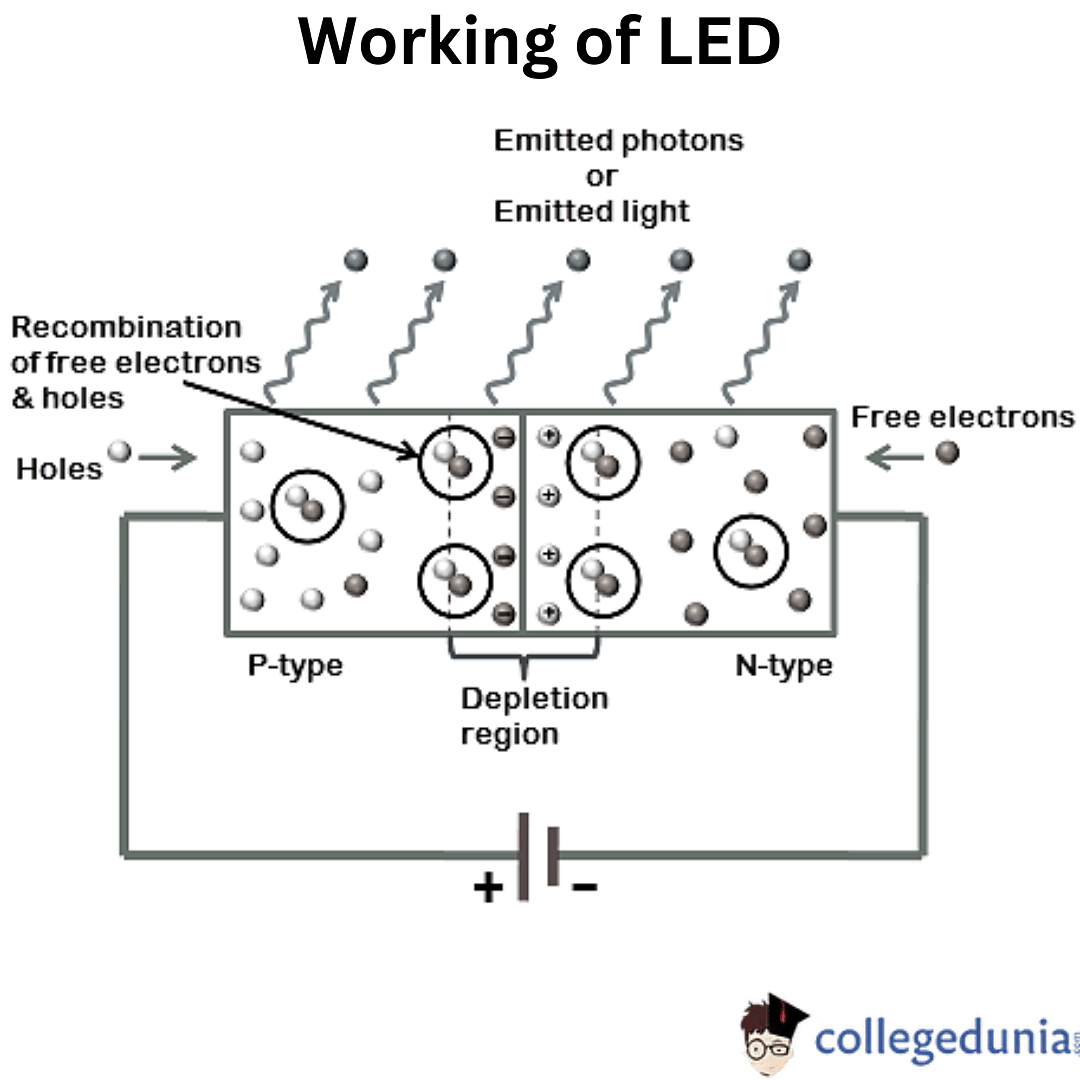
Because of the arrangement of two semiconductor materials between the electrodes, an LED (Light-Emitting diode) may generate light. Below are the details of the actions performed between two semiconductor materials
- Extra electrons, often known as extra negatively charged particles, are present in N-type semiconductors.
- Extra holes, often known as extra positively charged particles, are present in P-type semiconductors.
Working Principle of LED
The electron flow across the junction from the negative to positive layer is activated when an N-type semiconductor is connected to the negative electrode and a P-type semiconductor is linked to the positive electrode. Negatively charged electrons emit light when they pass through positively charged particles.
How do LEDs work?
The working principle of LEDs is on the basis of Electroluminescence. When current passes via the diode, the minority charge carriers and majority charge carriers recombine at the junction. Energy is released upon recombination in form of photons. With the increase in forward voltage, light intensity increases and reaches a maximum.
What determines an LED’s color?An LED’s, or Light emitting Diode's color can be determined by the material that is used in the semiconducting element. Two of the major materials used in LEDs are aluminium gallium indium phosphide alloys and indium gallium nitride alloys. Aluminium alloys are often utilised to get red, orange and yellow light, while indium alloys are utilised to get green, blue and white light. In fact, even the minute changes in the composition of alloys change the color of the emitted light. |
Types of LED
[Click Here for Sample Questions]
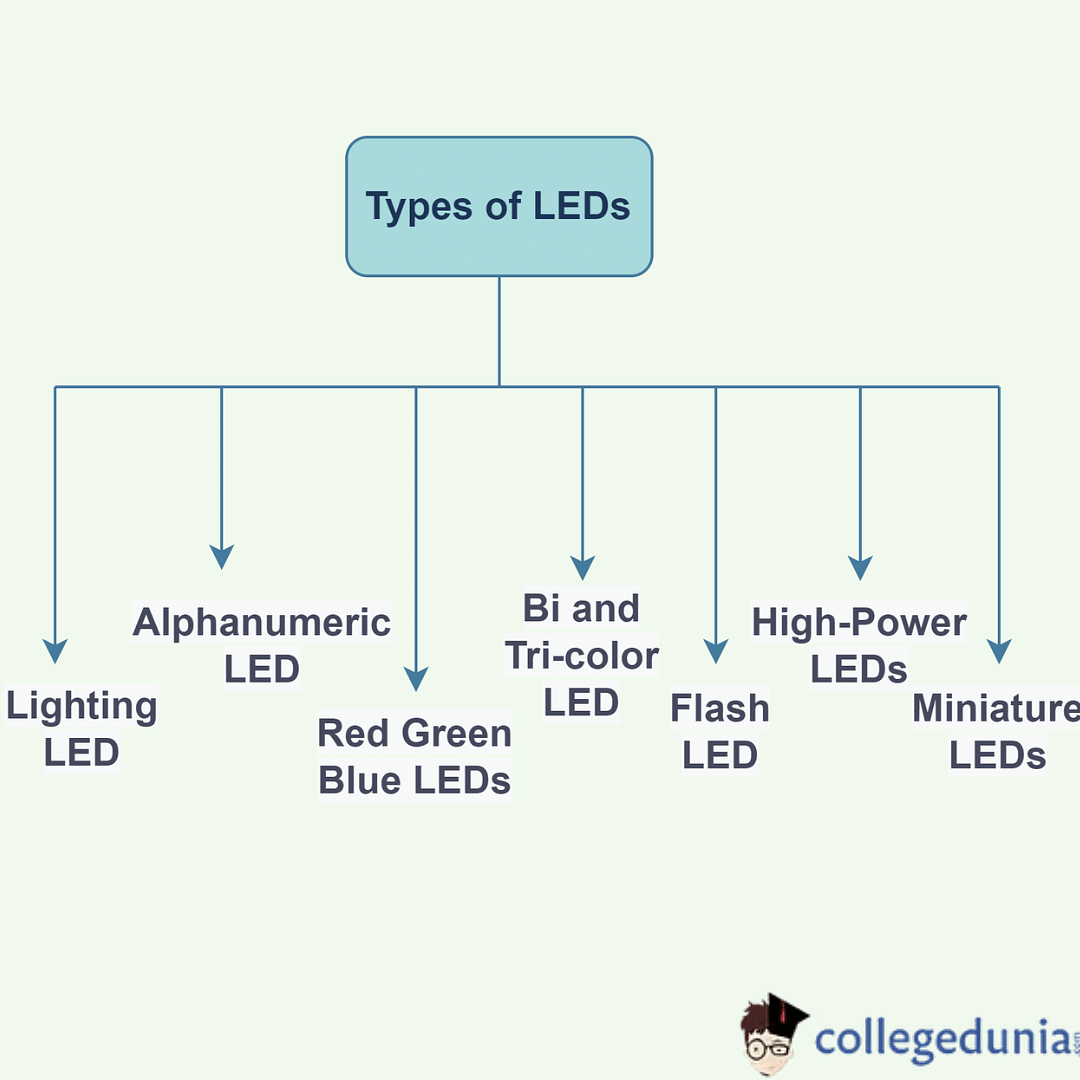
There are several types of Light-emitting diodes. The following are the different types of LEDs:
Through-Hole LEDs
Through-Hole LEDs come in a variety of sizes and shapes, but the most popular are 3 mm, 5 mm, and 8 mm. They come in a variety of colors, including red, blue, yellow, white, and green.
SMD LEDs (Surface Mount Light-Emitting Diodes)
These are a type of surface mount LED that may be readily installed on the surface of a PCB. They are usually classified according to their physical dimensions. The most common SMD LEDs, for example, are 3528 and 5050.
Bi-color LEDs
Bi-color LEDs are LEDs that can emit two different colors. Three leads, two anodes, and a common cathode are included. The color is activated based on the configuration of the leads.
RGB LED (Red-Blue-Green LED)
RGB LEDs (Red-Blue-Green LEDs) are the most popular among designers and enthusiasts. RGB LEDs are popular among computer specialists for use in motherboards, RAM, computer casings, and other components.
High-Power LEDs
When the power rating of an LED is greater than or equal to 1 Watt, it is referred to as a High-Power LED, while regular LEDs only dissipate a few milliwatts of power. High-power LEDs are extremely bright and are commonly used in flashlights, spotlights, and automotive headlamps, among other applications.
Alphanumeric LED
Alphanumeric LED Displays are devices which show information in the form of characters, i.e., alphabets and numbers. It normally displaces character as well as numerical data.
Miniature LED
Mini-LEDs, or Miniature LED, are small diodes, usually less than 0.2mm. Devices like TV have LCD panels with LEDs for the purpose of backlighting. There panel here is used to navigate where the light is displayed on the screen.
Uses of LED
[Click Here for Previous Year Questions]
The uses of LED are as follows:
- LED bulbs are utilized in both homes and businesses.
- Motorcycles and automobiles employ light-emitting diodes.
- These are used to display messages on mobile phones.
- LEDs are utilized at traffic light signals.
Properties of Laser LightLaser light is a device or tool which is known to stimulate the atoms or molecules in order to emit light at specific wavelengths and amplify it, generating a narrow beam of radiation. Laser Light is MonochromaticLaser light is made of a single colour, unlike white light which has seven colours. Laser Light is DirectionalLaser light is usually directional. Laser Light is CoherentLaser light is also coherent due to the wavelengths of laser light that are in phase in space and time. |
Advantages of LED
[Click Here for Sample Questions]
The following are some of the benefits of using a light-emitting diode.
- LEDs are less expensive and have a smaller footprint.
- Electricity is controlled by employing LEDs.
- With the help of the microprocessor, the LED intensity can be changed.
- A long lifespan.
- Effective in terms of energy usage.
- There will be no warm-up session.
- Rugged.
- Cold temperatures do not affect it.
- Excellent Directional Colour Rendering.
- Controllable and environmentally friendly.
Also check:
Previous Year Questions
- An extrinsic semiconductor with electrons as majority carriers … [JKCET 2017]
- An intrinsic semiconductor at … [JKCET 2008]
- An intrinsic semiconductor has a resistivity of … [AMUEEE 2011]
- An n−p−n transistor is biased to work as an … [AMUEEE 2010]
- Any digital circuit can be realised by repetitive use of only … [AMUEEE 2010]
- The V-I characteristic of a diode is shown in the figure … [VITEEE 2018]
- A diode detector is used to detect an amplitude modulated wave … [JEE Mains 2013]
- The current-voltage relation of diode is given … [JEE Mains 2015]
- A zener breakdown occurs in a zener diode when … [JKCET 2019]
- What is the conductivity of a semiconductor sample having electron concentration … [JEE Mains 2017]
- A junction diode has a resistance of … [WBJEE 2009]
- A p−n photodiode is made of a material with a band gap of 2eV … [NEET 2008]
- A zener diode is used … [JKCET 2014]
- Avalanche breakdown in … [AMUEEE 2010]
- In the given circuit, the current through zener diode is … [JEE Mains 2018]
Things to Remember
- The LED is a type of diode that produces light.
- The LED is made of gallium phosphide and gallium arsenide, both of which include electrons that can generate light while transmitting energy.
- The voltage is converted into light by the LED.
- Its reverse breakdown voltage is modest.
- LEDs have an on-state voltage that ranges from 1.2 to 2.0 V.
- LEDs are used in traffic lights, automobile headlights, medical gadgets, camera flashes, and other applications.
Sample Questions
Ques: What is LED? (1 mark)
Ans: A light-emitting diode (LED) is a semiconductor device that generates light when an electric current is conducted through it in its most basic form. When the current-carrying particles (known as electrons and holes) collide within the semiconductor material, light is created.
Ques: What causes LEDs to glow? (2 marks)
Ans: When compared to halogen or incandescent lights, an LED bulb has a substantially higher resistance on the integrated power supply unit count. As a result, the LED driver experiences a low voltage drop, and the LED bulb begins to glow dimly.
Ques: What is the distinction between an LED and a diode? (1 mark)
Ans: The most fundamental distinction between an LED and a diode is that an LED generates light, whereas a diode permits current to flow in just one direction and opposes it in the other.
Ques: What are the benefits of using LEDs? (2 marks)
Ans: Some of the benefits of using LEDs are:
- LEDs use less energy and require a low operating voltage.
- LEDs do not require any warm-up time.
Ques: What are some of the LED's uses? (3 marks)
Ans: Some uses of LEDs are:
- Electronic calculators
- Watches with digital displays
- Used in TV/LCD remote controls.
- Cellular phones
- Heat lights for automobiles
- Lights used in aviation
- Digital computers
- Digital multimeters
Ques: What is electroluminescence, and how does it work? (2 marks)
Ans: Electroluminescence is an optical and electrical phenomenon in which a material emits light in reaction to the passage of an electric current through it. In the process of Electroluminescence (EL), photons are produced when the excess electron-hole pairs are developed by an electric current, which is caused by an externally applied bias.
Ques: What distinguishes LED from other light-emitting diodes? (2 marks)
Ans: "Light Emitting Diode," or LED, as it is more widely known, is essentially a specialized sort of diode with electrical characteristics that are very similar to those of a PN junction diode. This indicates that an LED will pass current in one direction but will not allow current to flow in the opposite direction.
Ques: What are the different varieties of LEDs? (2 marks)
Ans: The following is a list of various LED types.
- Switches for Dimming
- SMD LED
- COB LED
- Color LED
- Tubes for Lighting
- Traditional and inorganic LEDs made of graphene
Ques: What are the three major properties of Laser lights? (3 marks)
Ans: The three major properties of laser lights are:
- Coherent
- Directional
- Monochromatic
Ques: How is the color of a LED determined? (2 marks)
Ans: An LED’s colour can be determined by the material that is used in the semiconducting element. Two of the major materials used in LEDs are aluminium gallium indium phosphide alloys and indium gallium nitride alloys. Aluminium alloys are often utilised to get red, orange and yellow light, while indium alloys are utilised to get green, blue and white light. In fact, even the minute changes in the composition of can alloys change the color of the emitted light.
Ques: Define Through-hole LED. (2 marks)
Ans: Through-hole LEDs come in a variety of sizes and shapes, but the most popular are the 3 mm, 5 mm, and 8 mm. They come in a variety of colors, including red, blue, yellow, white, and green.
For Latest Updates on Upcoming Board Exams, Click Here: https://t.me/class_10_12_board_updates
Also check:



Comments