



Content Curator
Snakes are limbless, carnivorous, elongated reptiles that are part of the Serpentes suborder. These are the creatures that have scales on their bodies that help them to crawl.
| Table of Contents |
Key Terms: Snakes, Taxonomy, Binomial Nomenclature , Zoology, Zoological Terminology, Animalia,Serpentes
What are Snakes?
[Click Here for Previous Year Questions]
Snakes are limbless, carnivorous, elongated reptiles that are part of the Serpentes suborder. Snakes are amniote, ectothermic animals with overlapping scales. Many snake species have more joints in their skulls than their lizard predecessors had, allowing them to swallow food that is much larger than their heads. Most snakes only have one functional lung, and their paired organs (such kidneys) appear one in front of the other rather than side by side to fit their tiny bodies.
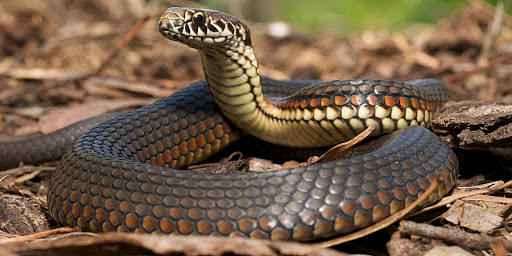
Snakes
Also read: DNA Genetic material
Scientific Name of Snake
[Click Here for Sample Questions]
The scientific name of Snakes is Serpentes.
- The classification of more than 3,500 species of reptiles is based on their lack of limbs and noticeably elongated bodies and tails.
- Nearly 520 genera and 3600 species of snakes have been found worldwide.
- Snakes may be found all over the world, with the exception of Antarctica, a few small islands, and a few larger ones like the islands of New Zealand, Ireland, and Iceland.
What do Snakes eat?
All of these reptiles are carnivores, which means that a variety of tiny creatures can serve as their prey. Based on the animal's species, their nutrition is determined. Food options include insects, amphibians, earthworms, snails, fish, rodents, rabbits, and birds. A few snakes consume eggs.
What is the Habitat and Origin of Snakes?
Given their diversity and ability to adapt to many conditions, snakes are highly useful.
- Although the only continent devoid of snakes is Antarctica, a few nations, including Ireland, New Zealand, and Iceland, lack any native snakes.
- Only a few states, including Alaska, lack native species.
- Similar to where they can reside, the normal environment is rather diverse.
- Tropical regions are another place where these reptiles may be found, both on land and in water.
- While most snakes live on land, the water moccasin and the water snake frequently inhabit areas that are near or under water. Snakes can reside in the desert, the grasslands, or the rainforest, depending on the species.
Learn More About:
Taxonomy of Snakes
[Click Here for Previous Year Questions]
Biology defines the class of Snakes as Class Reptilia in taxonomy.The following are the taxonomic classifications-
| Classification | |
|---|---|
| Kingdom | Animalia |
| Phylum | Chordata |
| Order | Squamata |
| Class | Reptilia |
| Suborder | Serpentes |
Different Species of Snakes
[Click Here for Previous Year Questions]
There are a lot of species of Snakes prevalent in the world,Some of which are mentioned below:
Pythons
- There are 42 identified species of snakes in the family Pythons.
- The majority of these reptiles are located in Asia, Australia, and Africa
- However, the Burmese python, which was imported to Florida's Everglades and is now regarded as an invasive species, may also be found there.
- The majority of the species in this family are "ambush predators," which means they wait until their prey passes by before striking.

Python
Elapids
- The majority of elapids are frequently called "cobras."
- Elapids distinguished by small fangs that are set in the upper jaw's front.
- There are both terrestrial and aquatic varieties of these snakes, which may be identified by the upright, poisonous fangs at the front of their jaws.
- The world's tropical and subtropical areas are home to elapids.

Elapids
Rattlesnakes
- The rattle at the end of their tails, which they employ to frighten off predators, distinguishes rattlesnakes, which are found across the American continents.
- While rattlesnake bites are the most common reason for snake bite injuries in North America
- Rattlesnake attacks on humans are uncommon unless provoked.
- They are an illustration of a pit viper from the snake family Viperidae.

Rattlesnakes
Garter Snakes
- In North and Central America, garter snakes are mostly harmless snakes.
- Long thought to be non-venomous, these snakes are now known to produce a neurotoxic venom that is too mild to seriously harm or even kill a human.
- They are snakes of the genus Thamnophis of the family Colubridae that range in size from tiny to medium.

Garter Snake
Behavior of Snakes
[Click Here for Sample Questions]
Snakes have an exceptional sense of smell that they rely on when hunting. They search for airborne substances as they flip their tongues out. The capability of other snakes to sense body heat will be used.
Most often, the prey is defeated by constriction and poison.Since their cold-blooded bodies are incapable of controlling their temperature, these reptiles search for the ideal environment to keep their bodies warm. Snakes often use natural sunlight to keep warm, but they may also conceal to stay chilly.
Snakes lose their skin as they mature. When the shedding takes place, some of them get eyes that are lighter than usual.
Appearance of snakes
[Click Here for Previous Year Questions]
Snakes are reptiles, yet you can tell they don't have legs. Not every legless reptile, nevertheless, is recognised as a snake. A snake's head and tail, which extend the whole length of its body, appear to be its sole parts.
The reticulated python, the largest snake in the world, is over 20 feet long, although other snakes are as little as 4.1 inches (like the Barbados thread snake).These reptiles' teeth will differ depending on the species as well.
While some species have fangs, others have many needle-like teeth. Venom is naturally stored in the sacs behind the eyes of snakes with fangs. There are just around 600 species that have the toxic venom. a snake, formerly known as
Also Check:
Things to Remember
- The scientific name of Snake is Serpentes.
- Biology defines the class of Red Fox as Class Reptilia in taxonomy.
- While most snakes live on land, the water moccasin and the water snake frequently inhabit areas that are near or under water
- Reptiles have scales on their bodies that help them to crawl.
- The reticulated python, the largest snake in the world, is over 20 feet long, although other snakes are as little as 4.1 inches (like the Barbados thread snake)
Previous Year Questions
|
Sample Questions
Ques. What is the scientific name for a snake? (1 mark)
Ans. The scientific name of Snake is Serpentes.
Ques. What is genus and class of Snakes? (1 mark)
Ans. The genus is and class is Reptilia.
Ques.Which is the most aggressive snake in the world? (1 mark)
Ans. The black mamba, saw-scaled viper, coastal taipan, and bushmaster snake are the four most dangerous snakes in the world.
Ques.Why are scales important for snakes? (2 marks)
Ans. Scales are crucial for two reasons: first, they stop the body from losing water, and second, they shield the body from harm since lizards' ventral surfaces rub against the ground, causing skin damage.
Ques.Are Garter snakes poisonous? (2 marks)
Ans. They aren't regarded as toxic to people, no. With the exception of a few species, which are still not regarded as harmful to humans but are capable of producing anaphylaxis in certain people who are bitten owing to their weak venom.
Ques.What is a family of snakes called? (2 marks)
Ans. A group of snakes is generally called a bed, den, pit or nest, but a group of rattlesnakes is referred to as a rhumba or rumba
Ques.Do snakes drink water? (3 marks)
Ans. Snakes do consume water, although not as frequently as you might imagine. A snake derives the majority of its water from food, such as the blood of rodents, and from the moisture found in the hair. Snakes use a more peculiar manner to consume water. They have creases in their skin that resemble mouth openings.
Ques. Do snakes have bones? (3 marks)
Ans. It may be tempting to believe that snakes have no bones because of how flexible they are. Snakes do, however, have bones. They have hundreds, which is more than humans have.
They possess a unique cranium; more on this later. and their spine, which consists of hundreds of vertebrae, is extremely lengthy (the bones that make up our backbone). To protect their internal organs, they also have several ribs that extend nearly the whole length of their bodies.
Ques.What are Baby snakes called ? (1 mark)
Ans. Baby snakes are called snakelets.
Also check:



Comments