



Education Journalist | Study Abroad Lead
Cockroaches belong to the class Insecta of the kingdom Animalia. They belong to phylum Arthropoda and are known to exist for more than 300 million years. They have adapted themselves best for the environment and are generally found in dirty and unhygienic places. There are about 4000 species of cockroaches found around the world. They belong to order Blattodea which also includes termites. The scientific name of cockroach is Periplaneta americana. The morphology and anatomy of cockroach is as follows –
- Cockroaches have a flattened, oval-shaped body with long antenna and legs adapted for running.
- They have specialized mouthparts for chewing.
- The anatomy of a cockroach includes a hard exoskeleton, digestive system, and respiratory system.
Key Terms: Species, Insecta, Diseases, Multiple Nervous System, Blood, Plasma, Hemocoel, Sensory Receptors
Cockroaches
[Click Here for Sample Questions]
Cockroaches are the most primitive living Neopteran insects and are commonly found in our households.
- They are the carrier of most of the infectious diseases such as typhoid fever, cholera, dysentery and diarrhoea.
- Cockroaches are known to have multiple nervous systems.
- Hence, the survival of a cockroach without its head is definite as even without the head, the rest of the body continues to function properly and separately.
- The morphology and anatomy of cockroaches are complex.

| Cockroaches | |
|---|---|
| Phylum | Arthropoda |
| Class | Insecta |
| Order | Dictyoptera |
| Family | Blattidae |
| Genus | Periplaneta |
| Species | americana |
Read More:
Morphology of Cockroach
[Click Here for Sample Questions]
The common household cockroaches are about 34 - 53 mm long and have wings that extend beyond the tip of the abdomen for males. The entire body of the cockroach is composed of a hard chitinous exoskeleton. Morphology of cockroach is such that its body is divided into three parts Head, Abdomen, and Thorax. Cockroaches have significantly complex morphology and anatomy.

Schematic Representation of Morphology of Cockroach
Head
It consists of the compound eye, the pair of antennae, brain, and mouth. Photoreceptor cells constitute the eye with a ring called ocular sclerite.
- The head of a cockroach is in a triangular shape and lies at right angles to the longitudinal body axis. It has great flexibility.
- The antennae is called antennal flagella which consist of sensory receptors to sense the change in the environment.
- The mouth of the cockroach helps in both chewing and biting and has labium and labrum which form the lips.

Schematic Representation of Head of Cockroach
Abdomen
The abdomen of a cockroach is divided into ten segments which consists of the heart, digestive organs, trachea, respiratory system and reproductive system.
- The heart pumps blood to its body parts through a hollow space called hemocoel.
- The blood is colourless as it lacks haemoglobin.
- The digestive system consists of the digestive organs and the alimentary canal which is further divided into 3 sections, namely foregut, midgut, and hindgut.
The abdomen also contains sensory organs which detect air movements. Cockroaches have a very versatile digestive system as they can digest any kind of food from cellulose to wood. Excretion in cockroaches is performed through Malpighian tubes.
Thorax
Thorax of a cockroach is subdivided into three sections, namely, prothorax, mesothorax and metathorax.
- Prothorax: It produces ecdysteroids mainly in larvae of cockroaches and is found near the head.
- Mesothorax: These legs help the cockroach to increase or decrease its movement speed.
- Metathorax: These legs are found in the backside of the body. These are responsible for forward movement.
The head and thorax of the cockroach are connected by prothorax, which is a short extension known as the neck. The first pair of wings are attached to the mesothorax and the other pair is attached to the metathorax. The thorax region also has a pair of legs and forewings known as tegmina.
Checkout: Human Body
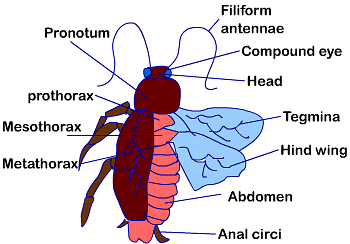
Morphology of Cockroach
Anatomy of Cockroach
[Click Here for Sample Questions]
The anatomy of a cockroach is as follows –
Digestive System
Cockroaches have a long alimentary canal with all of its digestive organs such as oesophagus, mouth, buccal cavity, proventriculus, etc. The alimentary canal has three segments:
- Foregut: It consists of the buccal chamber, oesophagus, pharynx, crop, and gizzard. Gizzard helps in grinding food particles.
- Midgut: It is short compared to foregut.
- Hindgut: The hindgut is broader than the midgut has 3 sections namely - ileum, colon, and rectum. The rectum opens through the anus.
Read More: Human Digestive System

Digestive System of Cockroach
Blood Vascular System
Blood vascular system of cockroaches is of open type. Blood vessels are poorly developed and are open outside. The blood of a cockroach is called hemocoel which is made up of colourless plasma and hemocytes. An elongated tube with muscular wall regulates blood in hemocoel.
Read More: Open Type Circulatory System

Circulatory System of Cockroach
Respiratory System
The respiratory system of cockroaches comprises a network of trachea present on the lateral side of the body. The trachea consists of 10 pairs of small holes called spiracles. Thin branching tubes also known as tracheal tubes which are further subdivided into tracheoles supply oxygen to all the parts of the body. Tracheoles is the location for the exchange of gases by diffusion.
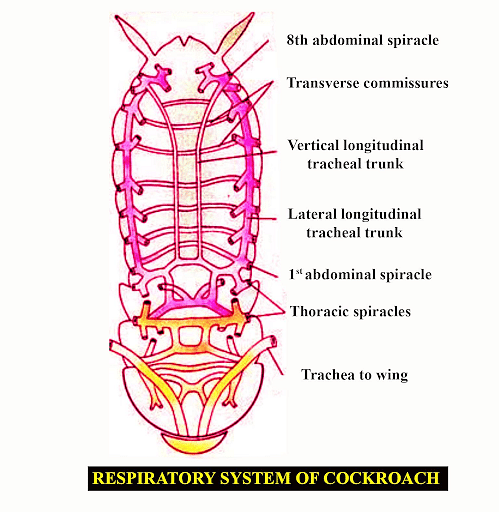
Respiratory System of Cockroach
Nervous System
Nervous System of cockroaches consists of a series of fused, segmentally ganglia joined by paired longitudinal connectives on the ventral side. The nervous system is spread across its body. It is subdivided into three subsystems:
- Central Nervous System which comprises the brain of the cockroach.
- Peripheral Nervous System which consists of all the nerves in the body.
- Sympathetic Nervous System which consists of frontal ganglion.

Nervous System of Cockroach
Excretory System
The organic waste from the body is removed through Malpighian tubes. The glandular and ciliated cells absorb the nitrogenous waste and are present in the lining of each tubule. This nitrogenous waste is converted to uric acid and passes out through hindgut. Cockroaches are uricotelic.
Checkout: Excretion in Human Beings
Sensory Organs
[Click Here for Sample Questions]
The sensory organs of a cockroach which constitutes the anatomy of cockroach includes:
- Thigmoreceptors: These are receptors that provide the sense of touching something. Human skin is a type of thigmoreceptor. In cockroaches, these are present on the body, legs, antennae and maxillary palps.
- Olfactory Receptors: These are receptors which provide a sense of smell and are mainly present in antennae and palps.
- Gustatory Receptors: These receptors can provide a sense of taste and can be found in labial palps and maxilla.
- Thermoreceptors: These receptors can provide a sense of change in temperature.It is found in the pads between the first four tarsals.
- Auditory Receptors: These are receptors that can provide sense of hearing and is found in anal cerci.
Reproductive System
[Click Here for Sample Questions]
Cockroaches reproduce sexually, with males and females having distinct reproductive systems.
- The male reproductive system consists of testes in the 4th and 6th segments of the abdomen, seminal vesicles, and accessory glands, which produce and store sperm.
- The female reproductive system consists of ovaries, oviducts, and a pair of spermathecae, which store sperm after mating.
- The ovaries are present in the 2nd and 6th segment of the abdomen.
- Oviducts of each ovary are connected forming a single median oviduct.
- The male transfers sperm to the female through an external genital structure called the aedeagus during copulation.
- Sperms are transferred through spermatophores.
- After mating, the female lays eggs in a protective casing called an ootheca, which contains several eggs.
- The ootheca is deposited in a suitable location for the eggs to develop, and the young cockroaches hatch out of the eggs after a few weeks.
Read More:
Things to Remember
- Morphology is the study of the structure and form of plants and animals.
- Cockroaches have a flattened body with a hard exoskeleton for protection.
- They have six legs, wings, and antennae for sensing the environment.
- The morphology and anatomy of cockroaches are significantly complex due to their adaptation to various environments.
- Cockroaches have a respiratory system that utilizes small tubes called tracheae.
- The nervous system of a cockroach is well-developed, with a brain and a ventral nerve cord.
- Cockroaches have a complex reproductive system, with males using specialized structures called claspers to mate with females.
Sample Questions
Ques. What are morphology and anatomy? (2 marks)
Ans. The term morphology generally refers to the study and understanding of form and structure of various animals and plants whereas Anatomy is a subdiscipline of morphology where an organism’s body is dissected to study its various organs and systems. The position of organs, shape, functions, etc is studied and compared with its related species to get a better understanding.
Ques. What do cockroaches eat? (2 marks)
Ans. Cockroaches can eat any kind of organic food. Cockroaches can eat foods such as starch, sweet, grease, meat products, etc. They can also eat cheese, beer, glue, decayed matter, hair, and even dried skin! They eat wallpaper, calendars, and stamps because of the glue in them. The variety of food they consume helps them in surviving in the most extreme conditions.
Ques. How are cockroaches hazardous to humans? (2 marks)
Ans. Cockroaches live mostly with humans. They are in some ways hazardous too.
Secretions are produced by cockroaches that can stain surfaces and affect the flavour of foods. When cockroaches get on the utensils, tables, etc they provide the bacteria to the food and ultimately will end up on our body and cause illness like food poisoning.
Ques. How is digestion carried out in cockroaches? (2 marks)
Ans. Cockroaches are omnivorous and eat every type of organic food available. It has a long alimentary canal with all of its digestive organs such as the oesophagus, mouth, buccal cavity, proventriculus, etc. The alimentary canal has three segments: Foregut, midgut, and hindgut. Digestion first starts from the mouth. After entering the mouth, the food is treated by digestive enzymes secreted by gastric caeca.
Ques. Account for the survival of cockroach species for a long time. (3 marks)
Ans. Cockroaches are insects of the family Blattodea. Fossils are evidence that cockroaches have been on earth for more than 300 million years. It has a greater adaptive ability than any other insect. Cockroaches can eat almost all organic food available to them. Since cockroaches are very small in size, they can live in small holes and cracks on the walls and can reproduce a vast amount of offspring. Cockroaches are nocturnal, which means they spend their daytime hiding in their habitats and venture out at night for food. So these populations can build large numbers without getting harmed by any means. They mostly live with humans in their homes and therefore are safe from other creatures. This accounts for the survival of species for a long time.
Ques. Explain the process of reproduction in cockroaches. (3 marks)
Ans. The process of reproduction in cockroaches is as follows:
- Male cockroaches are found to have a pair of testes, ejaculatory duct, utricular gland and phallic gland.
- Sperms are found in seminal vesicles and are transferred through spermatophores.
- Female cockroaches have a pair of ovaries, vagina, oviduct, genital chambers, and collateral glands.
- There is a single median ovary duct to which the ducts of both the ovaries meet. The fertilised eggs are found in a case covering a structure called ootheca.
Ques. Describe the life cycle of cockroaches. (3 marks)
Ans. The life cycle of cockroaches is mentioned below:
- Cockroaches have a typical life span of 2 months to 2 years.
- Adult cockroaches reproduce sexually.
- The life cycle of cockroaches is divided into three stages, namely, egg, nymph and adult.
- They are omnivorous in nature and live in dark, warm and dirty places for their survival.
Read More:



Comments