



Content Curator
Stereoscopic vision is the ability of human eyes to view an object in a three dimensional mannerism. It creates two different images and sends them to the brain. The brain, as a result, analyses these images and creates an accurate picture. This picture, thus received, helps us interpret distance. Apart from humans, animals also have the ability of binocular vision. It helps them hunt and catch their prey. It also helps us in understanding danger, and reacting to it in a proper way. Before we hop on, let us first understand what stereoscopic vision is, and how humans and animals depend on it.
Read Also: The Human Eye and The Colourful World Formula
| Table of Content |
Keyterms: Stereoscopic, vision, Human Eye, images, distance, Brain, Human, binocular vision, animals, nerve
Read Also: Why do we have two eyes
What is vision?
[Click Here for Sample Questions]
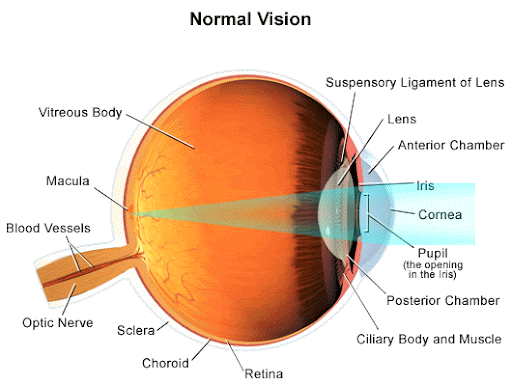
Vision is a series of events and happenings which occur when light enters and reflects on our eyes. We are able to perceive this as an image, thereby seeing the picture. The light waves hit our retina’s surface with a stable focus. There are a million nerve receptors present in the eye which start emitting signals when the light enters and hits. These signals are sent to the brain, where the brain tries to analyse this information.
The brain studies these different images and finally gives one as a result, which is the most accurate. It also saves this information for future use. We are able to distinguish shapes, colours because of this ability to see. We can easily track movement, and also assess any kind of threat.
The video below explains this:
Human Eye One Shot Detailed Video Explanation:
What is Stereoscopic Vision?
[Click Here for Sample Questions]
The name comes from the Greek word ‘stereo’ which means solid, while ‘scopic’ means to examine. When a person looks or examines his surroundings in a three-dimensional view, his capability to do so is known as ‘stereoscopic vision’.
The pair of eyes are expected to be intact and synchronized so as to view an object in a different mannerism. This ability helps us perceive the true and accurate depth. Stereoscopic vision also enables us to interpret distance so we can fulfill our basic needs. These may be contemplating danger remotely or hunting food for survival.
The positions of eyes in every single human and animal varies differently, a binocular vision develops and results in two distinct images projected in the retina. This is also termed as ‘retinal disparity’. It helps the human brain to analyze these different images without any kind of physical movement.
The brain, at this point, starts monitoring the two pictures/images so as to find the differences between them. After this is done, the disparity thus obtained can be called the most accurate version of the image. This accuracy level of the image is because of the depth perception.

Stereoscopic Vision in Humans
[Click Here for Sample Questions]
In the present day, humans can see things because of their eyes. Human eyes capture a 2-dimensional image and send two separate versions of it to the brain. After the brain has processed this piece of information, it helps develop synchronisation. This helps us assess or interpret distance.
As we know that our eyes are located 2 inches apart from each other, whenever we look at something, two different images are formed automatically. Retinal disparity is the condition where the brain analyses this and reaches a final outcome regarding the image. It gives a better sense of understanding about the distance of objects.

The brain further saves this valuable piece of information so as to be able to reuse it in the future, whenever necessary. The ability of synchronization between eyes and brain helps to create the exact image after processing different versions of images sent by the eyes.
Hence, synchronization becomes highly essential.
Also Read:
Stereoscopic Vision in Animals
[Click Here for Sample Questions]
Animals and humans are two entirely different species, which is why both of them have e extremely different stereoscopic visions. They acquire information by devising a ‘spatial locus’. It helps them obtain a binocular vision of the image, meaning a wider view.
Animals use this concept in many ways. This largest possible or wide-angle view helps them catch their prey. They also are able to defend or protect themselves from other animals by analyzing their distance from them.

Eyes are positioned differently in different animals. Some aerial animals are blessed with a 360-degree view. In some animals, eyes are positioned at the frontal position of their head. It helps aerial animals like birds mostly, giving them the widest possible view. They have the ability to fix one eye on their prey and move the other one on a different object. These two different images are sent to the brain.
Scavengers like eagles, vultures, and crows have this ability. Even chameleons are known to use this tactic for hunting their prey.
Advantages of Stereoscopic Vision
[Click Here for Sample Questions]
- Helps analyse threats quickly.
- Gives a true sense of depth perception.
- In humans, stereoscopic vision helps manage small objects.
- Enables humans to travel through dense forests.
- Helps in quickly reacting to outside threats.
- Provides a greater degree of accuracy which is often required in manufacturing industries, research, medicine, or even aviation.
- It allows us to pour some liquids into containers properly.
- Throwing, catching, and hitting a ball.
- Enables selective vision, especially in aerial animals.
- Helps manage small gadgets effectively.
- Threading and sewing.
- Stepping on or off a ladder.
- Helps in devising and planning three-dimensional type objects.
Things to Remember
- The ability of human eyes to look at an object or surroundings in a three-dimensional view is known as stereoscopic vision. It is derived from the Greek word ‘stereo’ meaning solid, and ‘scopic’ which means looking. The eyes should remain intact and synchronized so as to produce two different images. This is sent to the brain which in return gives a more accurate image.
- Stereoscopic vision in humans is definitely a blessing. We are able to view things with our eyes. Retinal disparity enables us to interpret distance and get a deeper sense of depth perception. Stereoscopic vision in humans is very different from that in animals. In humans, the eyes are placed almost two inches apart. When we look at something, we are able to look at two different things, which is why two different images are sent to the brain.
- Animals also have a stereoscopic vision but it has a different mechanism as compared to humans. Some have the ability to view things with a 360 degrees wide angle. This helps them fix one eye on their prey and they move the other one around to examine other things. It helps them hunt better and even respond to danger effectively. Animals like chameleons, hyenas, vultures, and eagles are blessed with this ability.
- The benefits of stereoscopic vision are very crucial. They enable humans to handle smaller objects well by giving them a deeper sense of depth perception. It is also used in manufacturing industries. Stereoscopic vision helps us in assessing threats quickly and responding to it. It enables selective vision in some animals as well.
Also Read:
Sample Questions
Ques. What is stereoscopic vision? (2 Marks)
Ans. The ability of human eyes to view their surroundings in a 3 dimensional manner, is known as stereoscopic vision. The eyes are expected to work in a synchronized manner. Both the eyes view the surroundings differently and send two different images to the brain. The brain then processes this information and gives a final resultant image, which is the most accurate. This helps animals and humans to interpret distance, hunt their prey, and other primary activities.
Ques. Do humans have stereoscopic vision? (2 Marks)
Ans. Yes, humans are blessed with stereoscopic vision. The eyes in humans are positioned differently. Therefore, when they place their focus on something, two different images are sent to the brain. The brain then monitors this information and comes to a conclusion by preparing another image, which is the most accurate. Stereoscopic vision helps us understand and interpret depth perception.
Ques. How does stereoscopic vision work in animals? (2 Marks)
Ans. In some animals the eyes are present in the front of their head. This provides a very wide angle of the view they want to capture. Stereoscopic vision enables some aerial animals, like birds, providing them with a 360 degree view. They are able to spot their prey easily. With one eye they keep a fixed focus on their prey, while they can move the other one around. Scavenger birds like eagles, and vultures are known to use this method to hunt their prey.
Ques. Why are certain people unable to see the stereograms? (2 Marks)
Ans. Answer: The basic principle behind a stereogram depends on the capacity for a body to merge multiple objects in one. Many factors could inhibit a person’s ability to see the object hidden beneath the first surface. This concept is called eye dominance. Sometimes the brain will close one eye, and rely on the dominant eye if the object to be viewed doesn’t focus. Many people need corrected vision that doesn’t realize it because of the human ability to adapt.
Ques. Why do we need stereoscopic vision? (3 Marks)
Ans. Stereoscopic vision is highly essential to both humans and animals. Having a stereoscopic vision, enables us to assess danger quickly and thereby respond to it in an effective way. It provides a true and accurate sense of depth perception and helps in managing small things well.
Having a stereoscopic vision allows humans to traverse through dense jungles. It also helps animals to understand any threat and hence protect themselves. It also helps them hunt their prey. Applications of stereoscopic visions are used extensively in manufacturing units, medicine and also many aviation industries.
Ques. Name some animals blessed with stereoscopic vision. (3 Marks)
Ans. Stereopsis was earlier thought to be confined only to beings with eyes present on the frontal region of the head. However, this isn't true. Other than human beings, some mammals, amphibians and birds and animals also have been blessed with stereoscopic vision. Some of them are,
- Chameleons
- Eagles and vultures
- Crows
- Cats
- Hyenas
Ques. Explain Viewing In Three-Dimensions with respect to stereoscopic vision. (3 Marks)
Ans. Stereoscopic vision or stereopsis vision enables humans to see the surroundings through a three-dimensional view with two eyes. The movement helps humans interpret distance and evolve their ability to have a real sense of their perception of depth. Each eye in humans and animals views images slightly differently, which is known as retinal disparity.
Thus, enabling the brain to process images without any physical movement. It is brought about by complementing matches of different images obtained and then calculating the difference, i.e., the retinal disparity of the two images. The disparity hence obtained varies by a tiny margin, but the final outcome is the most accurate version of the image that is attainable of the ambient depth perception.
Also Read:



Comments