


The Earth rotates from east to west direction around the Sun (a) True (b) False

Collegedunia Team logo

Collegedunia Team

Content Curator

Earth rotates from West to East direction around the Sun in a counter-clockwise motion. Earth moves in an elliptical path around the sun in a counterclockwise direction, taking 365.25 days to complete one revolution.

Earth’s movement is referred to as orbit and is part of the natural motion of planets in the solar system. This motion is influenced by the sun's gravitational pull on the earth and the earth's own momentum. The orbit of the earth is not a perfect circle, but an ellipse, with the sun at one of the two foci of the ellipse.
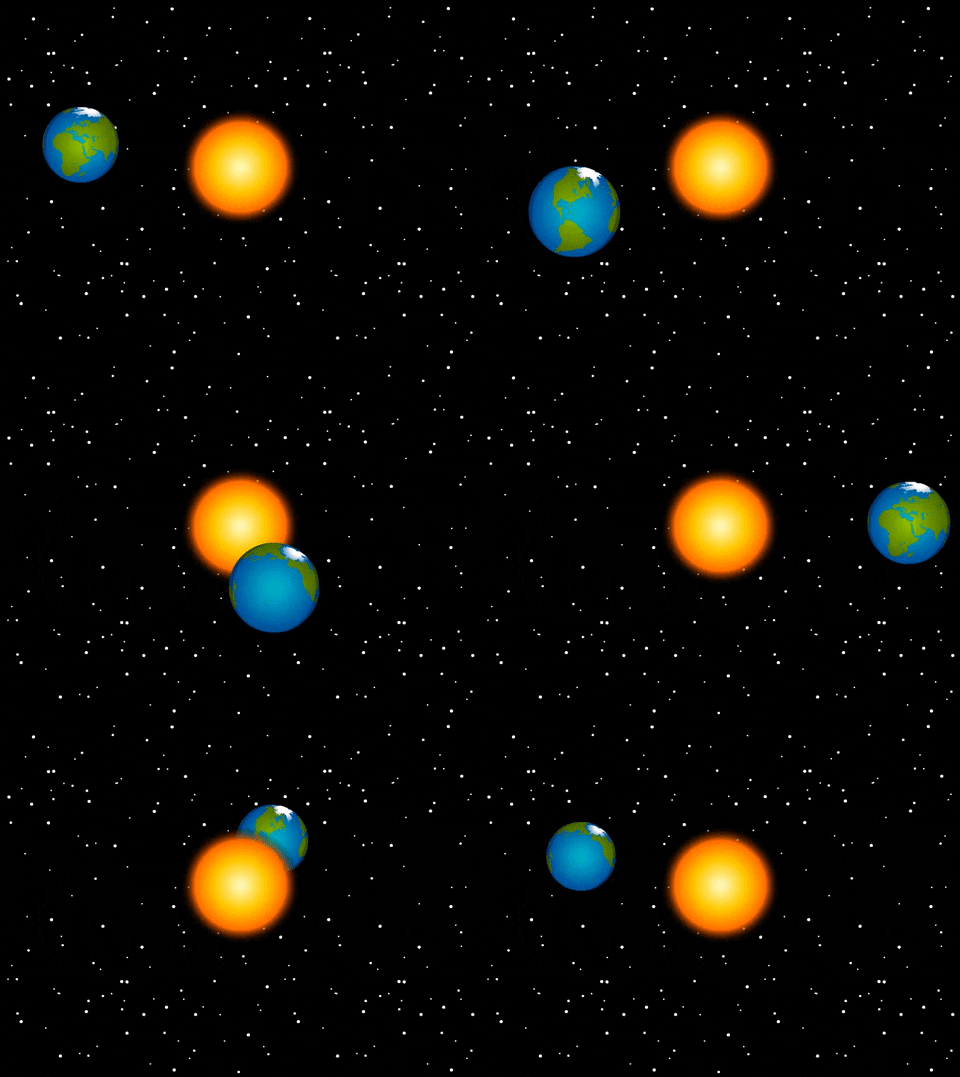
Earth's rotation around sun

Earth’s Rotation Around The Sun

Also read:

CBSE CLASS XII Related Questions

  • 1.

    Find the ratio $\dfrac{\lambda_\alpha}{\lambda_p}$ of the de Broglie wavelength $\lambda_\alpha$ associated with an alpha particle to the de Broglie wavelength $\lambda_p$ associated with a proton if both are moving with the same velocity.


      • 2.

        A magnet held vertically, with its north pole down, is dropped along the axis of a closed solenoid placed vertically on a table. If the observer looks down from the top,

          • the induced current will flow in the anticlockwise direction.
          • the induced current will flow in the clockwise direction.
          • no induced current will flow in the solenoid.
          • the magnet will fall with a constant velocity.

        • 3.
          A current of \(4.0\,\text{A}\) flows through a wire of length \(1\,\text{m}\) and cross-sectional area \(1.0\,\text{mm}^2\), when a potential difference of \(2\,\text{V}\) is applied across its ends. Calculate the resistivity of the material of the wire.


            • 4.

              A ray of light MN is incident normally on the face corresponding with side AB of a prism with an isosceles right-angled triangular base ABC. Trace the path of the ray as it passes through the prism when the refractive index of the prism material is (i) $\sqrt{2}$, and (ii) $\sqrt{3}$.


                • 5.
                  A galvanometer of resistance $27 \Omega$ is converted into an ammeter of range (0 – 10 mA) using a resistance of $3 \Omega$. The galvanometer will show full scale deflection for a current of about –

                    • 10 mA
                    • 100 mA
                    • 1 mA
                    • 3 mA

                  • 6.

                    An electron is revolving around a proton in a circular orbit of radius $r$. Using classical physics, prove that the ratio of value of the angular momentum and the value of magnetic moment of electron revolving in the orbit is a constant.

                      CBSE CLASS XII Previous Year Papers

                      Comments


                      No Comments To Show
