


The Earth rotates from east to west direction around the Sun (a) True (b) False

Collegedunia Team logo

Collegedunia Team

Content Curator

Earth rotates from West to East direction around the Sun in a counter-clockwise motion. Earth moves in an elliptical path around the sun in a counterclockwise direction, taking 365.25 days to complete one revolution.

Earth’s movement is referred to as orbit and is part of the natural motion of planets in the solar system. This motion is influenced by the sun's gravitational pull on the earth and the earth's own momentum. The orbit of the earth is not a perfect circle, but an ellipse, with the sun at one of the two foci of the ellipse.
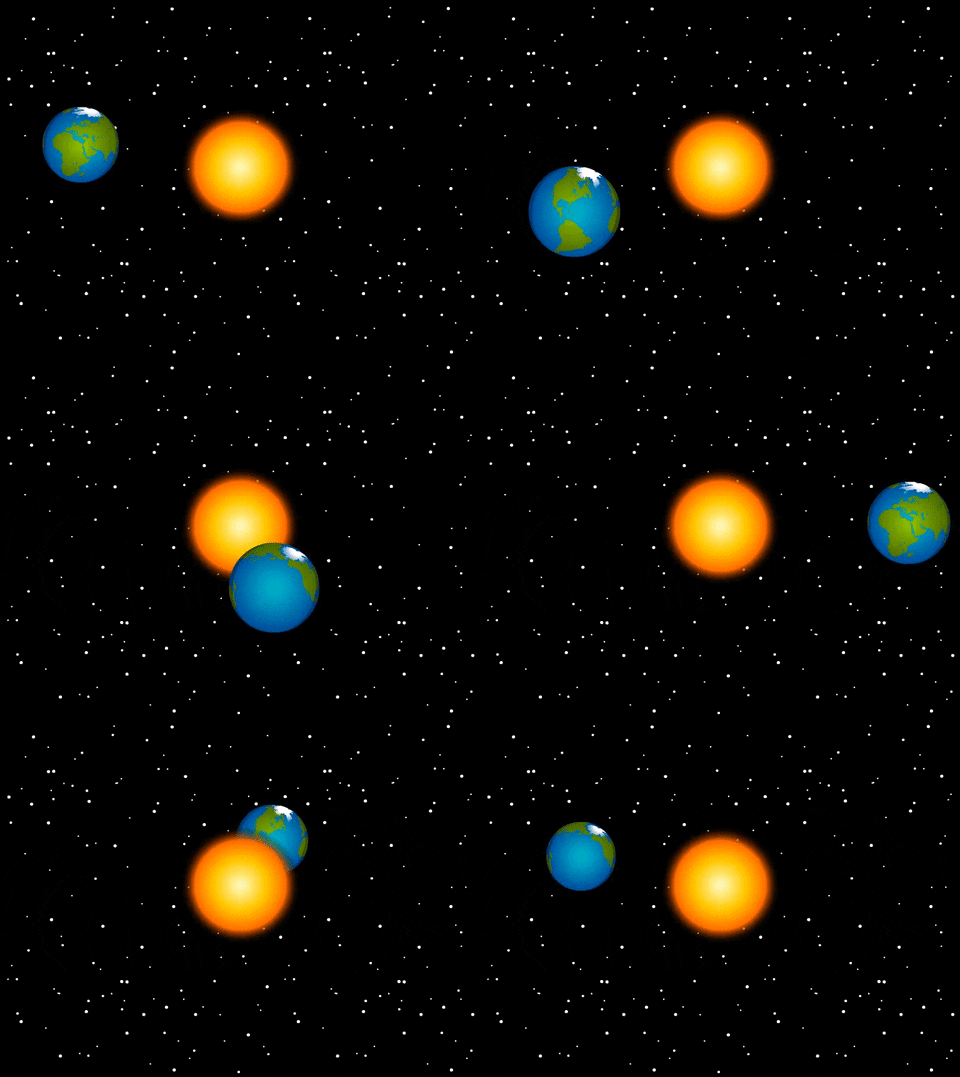
Earth's rotation around sun

Earth’s Rotation Around The Sun

Also read:

CBSE CLASS XII Related Questions

  • 1.
    Capacitors are manufactured with certain standard capacitances and working voltages. However, these standard values may not be the ones that are actually needed in a particular application. Two or more capacitors can be grouped in series or in parallel to achieve desired capacitance and voltage. When connected in series, the total capacitance decreases while the voltage rating increases, whereas in parallel connections, the total capacitance increases and maintains the same voltage rating. A capacitor stores energy in the electric field between its plates and stored energy is proportional to the square of the voltage and capacitance $U = \frac{1}{2}CV^2$, where symbols have their usual meanings.
    Two capacitors, one of $3 \ \mu$F and the other of $6 \ \mu$F, are connected in series in the circuit as shown in the figure, for a long time. }


      • 2.
        Read the following paragraph and answer the questions that follow.
        A p-type or n-type semiconductor can be converted into a p-n junction by doping it with suitable impurity. The motion of majority charge carriers causes diffusion current across the junction while the barrier electric field causes motion of minority carriers for drift current. In case of unbiased diode, the diffusion and drift currents are equal. This equilibrium is disturbed by the biasing batteries. Diodes, therefore, allow currents in one direction. This property of diode is used in making rectifiers.


          • 3.
            Write two advantages of reflecting telescope over refracting telescope.


              • 4.
                Two metal spheres of radii $r_1$ and $r_2$ ($> r_1$) having charges $q_1$ and $q_2$ respectively kept in air, are brought in contact. Which of the following statements is not correct ?

                  • The total charge of the two spheres is conserved.
                  • Both spheres attain the same potential.
                  • The final potential of the system equals $\frac{1}{4\pi\epsilon_0} \frac{(q_1 + q_2)}{(r_1 + r_2)}$
                  • The final potential of the system equals $\frac{1}{4\pi\epsilon_0} \frac{(q_1 + q_2) (r_1 + r_2)}{r_1 r_2}$

                • 5.
                  An electric field $\vec{E}$ is established across the ends of a cylindrical conductor of length L and area of cross-section A. Discuss how electrons attain an average velocity, independent of time. Hence, obtain a relation between current in the conductor and this ‘average velocity’ of electrons.


                    • 6.
                      This ‘average velocity’ is found be few mm/s for currents in range of a few amperes. How then is current established almost the instant a circuit is closed ?

                        CBSE CLASS XII Previous Year Papers

                        Comments


                        No Comments To Show
