



Content Writer
A polygon with three sides and three corners is a triangle. In geometry, it is one of the fundamental themes of geometry. A triangle with vertices A, B, and C is represented as △ABC. In Euclidean geometry, any three non-collinear points simultaneously determine a unique triangle and plane. There are three angles in a triangle. Any angle is formed when any two sides of the triangle meet at a common point called the vertex.
Read more: Euclid’s division lemma
| Table of Content |
KeyTerms: Triangle, Isosceles triangle, Scalene Triangle, Area of Triangles, Perimeter of Triangles, Pythagoras Theorem.
Triangle
[Click Here for Sample Questions]
A triangle is a three-sided polygon composed of three edges and three vertices. The most important property of a triangle is that the sum of the interior angles of a triangle equals 180 degrees. This property is called the angle sum property of the triangle. If ABC is a triangle, then it is referred to as ABC, where A, B, and C are the vertices of the triangle. A triangle is a two-dimensional shape in Euclidean geometry viewed as three non-collinear points in a unique plane
Pythagorean Theorem An equation relating the lengths of the sides of a right triangle, a2 + b2 = c2, where a and b are the lengths of the sides closest to the right form angles, and c is the length of the hypotenuse.
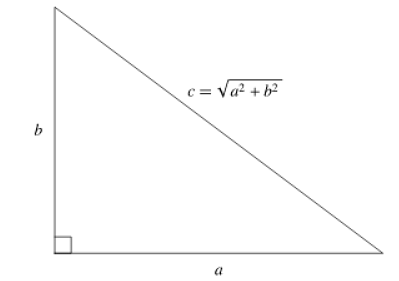
Pythagorean theorem
Perimeter of Triangle Formula
[Click Here for Sample Questions]
The perimeter of a polygon is the sum of the edge lengths.
In a triangle, perimeter = the sum of the three sides.
Perimeter (P) = a + b + c
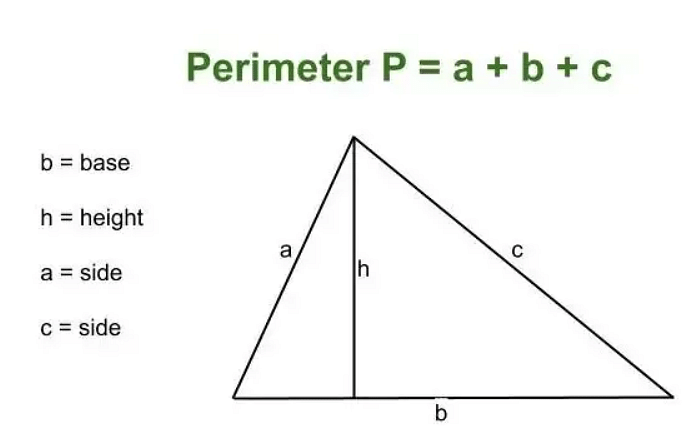
Perimeter of triangle
Area of a Triangle
[Click Here for Sample Questions]
The triangle area is the total area enclosed by the three sides of a given triangle. It corresponds to half the height of the basic periods. Therefore, in order to find the box of a three-sided polygon, we need to know the base and height of it. The area of different types of triangles are as follows:
Area of Isosceles Triangle
In an isosceles triangle, two sides are equal in length. Also equal are the two angles opposite the two equal sides.
- In case base and height are given, we use the following formula:
A = ½ × height × base
- If three sides are given :
A = ½[√(a2 − b2/4) × b]
- Using 2 sides of the triangle and an angle between them :
A = ½ × b × c × sin(α)
- Using two angles between two sides and their length :
A = [c2 × sin(β) × sin(α)/ 2 × sin(2π−α−β)]

Area of Isosceles Triangle
Area of Scalene Triangle Formula
An uneven triangle is a type of triangle that has different lateral measurements on all three sides is known as scalene triangle . This makes the three angles different from each other.
A = ½ × height × base

Area of scalene triangle
Area of Equilateral Triangle Formula
In an equilateral triangle, all three sides are equal. Consequently, all interior angles are equal, i.e. each angle is 60°.
A = (√3)/4 × side2
where,
A is the area of the triangle.
a is the length of the triangle.
b is the base of the triangle.
c is the third side of the triangle.
h is the height of the triangle.
α and β are the angles between two sides.

Area of equilateral triangle
Things to remember
- Area of triangle, A = [(½) b × h]; where 'b' is the triangle's base and 'h' is the triangle's height.
- The perimeter of a triangle, P = (a + b + c), where a, b, and c are the triangle's three sides.
- A triangle has three sides and three angles.
- The sum of the angles of a triangle is always 180 degrees.
- The outer angles of a triangle always add up to 360 degrees.
- Area of an equilateral triangle is A = (√3)/4 × side2).
Solved Questions
Ques. Determine a triangle area with a base of 12cm and a height of 10cm (2 marks)
Ans. Area of a triangle = ½ × height × base
= ½ × 12 × 10
= 6 × 10
= 60 cm2
Ques. Find the area of a triangle with a base of 20 cm and a height of 10 cm (2 marks)
Ans. Area of triangle = (1/2) × b × h
A = 1/2 × 20 × 10
A = 1/2 × 200
Thus, the area of a triangle is 100 cm2.
Ques. Find the area of a triangle with a base of 6 cm and a height of 3 cm (2 marks)
Ans. Area of triangle = (1/2) × b × h
A = 1/2 × 6×3
A = 1/2 ×18
Thus, the area of a triangle is 9 cm2.
Ques. Find the area of a triangle with a base of 12 cm and a height of 16 cm (2 marks)
Ans. Area of triangle = (1/2) × b × h
A = 1/2 × 12 × 16
A = 96
Thus, the area of the triangle is 96 cm2.
Ques. Find the area of an equilateral triangle with a side of 12 cm (3 marks)
Ans. Area of an Equilateral Triangle = A = (√3)/4 × (side)2
Given the side of equilateral triangle = 12cm
A = (√3)/4 × (side)2
A = (√3)/4 × (12)2
A = (√3)/4 × 144
A = 36√3 cm2
Ques. Find the area of a triangle with base 60 cm and height are 10cm (2 marks)
Ans. Area of triangle=1/2×base×height
=1/2×60×10
=60×5
=300 cm2
Therefore, the area of triangle is 300 cm2
Ques. The total area of triangle has 3 sides (3 marks)
Ans. Therefore we have only 2 sides, so our third side will be x
Area of triangle = l × b × h
60cm + 10cm + x = 180°
70cm + x = 180°
x = 180° - 70 cm
x = 110°
Therefore the third side of the triangle will be 110 cm / 110°
Ques. Find the height of a triangle whose base is 60cm and area is 0.06sq.m base = 60 cm =0.6 m (2 marks)
Ans. Area of a triangle = ½ x b x h
= ½ × 0.6 × h
h = 0.06/0.3
h = 0.2 m = 20cm
Ques. Find the height of a triangle whose area is 60cm2and base is 12 cm (2 marks)
Ans. Area of a triangle = ½ × base × height
60=½ ×12×h
60=6h
h=10cm.
Ques. Find the height of triangle whose area=300cm2 base=60cm (2 marks)
Ans. Area of triangle = ½ × base ×height
=> 300 cm2 = ½ ×60cm×h
=>300cm2= 30cm×h
=>h=300cm2/30cm
=>h=10cm
Ques. Find the area of a triangle whose base is 2 cm and height is 60cm (5 marks)
Ans. Given,
Base of triangle = 2 cm
Height of triangle = 60 cm
As known,
Triangle is a three sided figure,
Sum of all angles of the triangle is 180 degrees.
The area of triangle can be determined by using formula
area of triangle = ½ × base ×height
=½ x 2 x 60
= 60 cm2
Check out:



Comments