



Content Curator
Unicellular organisms are single-celled organisms like the amoeba. In biology, the term "unicellular organisms" refers to the type of living entity that they are. They are single-celled organisms in which the single cell performs functions such as feeding, locomotion, waste elimination, reproduction, and so on. In most cases, they are so small that they require a microscope for viewing purposes.
| Table of Content |
Keyterms: Organisms, amoeba, feeding, locomotion, waste elimination, reproduction, microscop, cyanobacteria
Check More: Cell Membrane and Plasma Membrane
What are Unicellular Organisms?
[Click Here for Sample Questions]
Unicellular organisms are living organisms with only one cell. In this type of organism, the cell is responsible for all functions. Amoeba, paramecium, bacteria, and cyanobacteria are some examples.
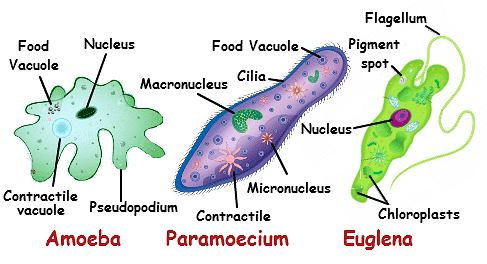
Unicellular organisms
This category includes the vast majority of life on Earth, with bacteria accounting for the vast majority. Bacteria, archaea (both prokaryotes), and Eukaryota are the major groups of single-celled life.
Multicellular organisms, on the other hand, are organisms that have more than one cell. All plants and animals that can be seen with the naked eye are examples of multicellular organisms.

Unicellular and Multicellular organisms
Also Read:
| Related Articles | ||
|---|---|---|
| Cytoplasm and Protoplasm | Fundamental Unit of Life | Animal Cell |
| Animal Cell Diagram | Endoplasmic Reticulum | Protoplasm |
Characteristics of Unicellular Organisms
[Click Here for Sample Questions]
The following are the characteristics of unicellular organisms:
- Unicellular organisms generally reproduce through asexual means.
- They can be either prokaryotes or eukaryotes.
- They can be found in almost any environment, from hot springs to frozen tundra.
- For movement, they have whip-like structures.
- Diffusion allows nutrients to enter and exit the cell.
Classification of Unicellular Organisms
[Click Here for Sample Questions]
Organisms with a single cell are classified into two types based on the complexity of the cell:
- Prokaryotes
- Eukaryotes
Prokaryotes and Eukaryotes
[Click Here for Sample Questions]
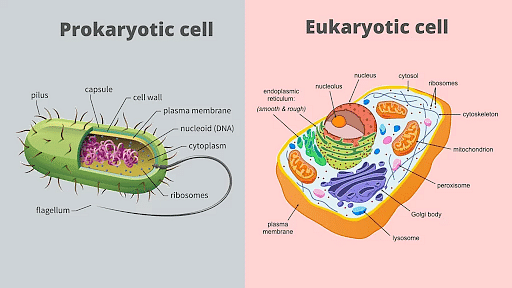
The differences between prokaryotes and eukaryotes are significant. Eukaryotes have a nucleus, whereas prokaryotes do not, and eukaryotes have a variety of subcellular organelles, whereas prokaryotes have very few.
Characteristics of Prokaryotes
- Prokaryotes are single-celled entities that do not have a true nucleus.
- They are extremely small, ranging in size from 0.1 to 5.0 m. This allows ions and molecules to diffuse to different parts of the cell.
- They possess a cell wall made up of peptidoglycan.
- The cell wall helps to keep the cell shape and prevents dehydration.
- Flagella are used for locomotion.
- They have fimbriae for attachment to the host cell and pili for genetic material exchange during conjugation.
- Examples of Prokaryotes include archaebacteria and eubacteria.
Prokaryotic Cell and Eukaryotic Cell
Characteristics of Eukaryotes
- Eukaryotes have a membrane-bound nucleus and are larger than prokaryotes.
- The nucleus of the cell contains DNA.
- Plant cells and animal cells are also eukaryotes.
- Vacuoles, chloroplast, and a big central vacuole are all found in plant cells. Animal cells do not contain them.
- Animal cells have lysosomes and centrosomes, while plant cells have not.
- Protozoa and Protista are examples of Eukaryotes.
Key Differences between Prokaryotes and Eukaryotes
| Prokaryotes | Eukaryotes |
|---|---|
| Prokaryotes do not have a nucleus. | All Eukaryotic cells have a nucleus. |
| The DNA is present in the nucleoid region. | Eukaryotes store the DNA in the nucleus. |
| Prokaryotic DNA consists of double-stranded and circular DNA. | Eukaryotic DNA consists of double-stranded linear DNA. |
Functions of Unicellular Organisms
[Click Here for Sample Questions]
- Unicellular organisms reproduce faster than multicellular organisms due to their asexual nature.
- Unicellular organisms adapt to changing environments more quickly because only one cell needs to change rather than multiple.

Functions of Unicellular Organisms
- Unicellular organisms have metabolism and nutritional requirements.
- Unicellular organisms must maintain internal cell conditions.
- The cell moves with a flagellum, or small motor, and performs multicellular organism functions such as finding food, producing energy, reproduction and performing various other tasks.
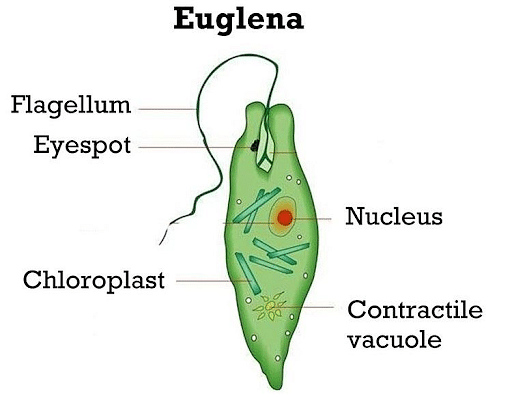
Euglena
- Like multicellular organisms, unicellular organisms have a variety of organelles ranging from cilia to the macro and micronucleus.
- Some single-celled organisms, such as Euglena, use chloroplasts to generate energy.
Read More: Phospholipid
Examples of Unicellular Organisms
[Click Here for Sample Questions]
According to evolution theory, unicellular organisms were the first to evolve on Earth. Their origins can be traced back to 3.8 billion years. Each of them has some distinguishing characteristics that aid in adaptation to a wide range of environmental conditions. These single-celled organisms can be found in any habitat, even the most hostile.
Amoeba
Amoeba is a unicellular, eukaryotic protozoan that can be found in almost all freshwater environments. It is well-known for its unique mode of locomotion. It does not have a specific shape.
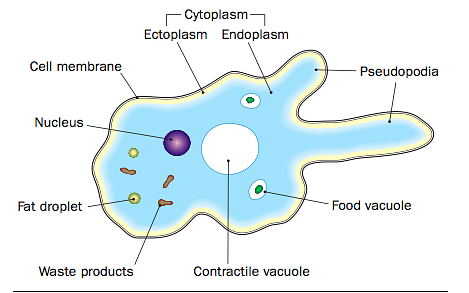
Amoeba
In fact, the shape of its cells is determined by environmental conditions. When necessary, an amoeba extends false feet (pseudopodia) and uses them for phagocytosis and locomotion.
Paramecium
Paramecium is a single cell eukaryotic protozoan with a slipper shape. Its body is covered in minute hair-like cilia that aid in locomotion and feeding.

Paramecium
The reproduction of Paramecium is being studied in-depth in order to better understand the multiplication rate. Under favourable conditions, it reproduces asexually, whereas, under stressful conditions, it reproduces sexually.
Bacteria
Bacteria can be found everywhere in the environment, from the formation of curd to the transmission of infectious diseases. They are tiny and come in a variety of shapes (rod, spherical, spiral, etc.).

Bacteria
Some of the bacterial strains have evolved to survive in harsh environments such as deep within the earth's crust and hot springs. They play an important role in nutrient recycling.
Cyanobacteria
Cyanobacteria, also known as blue-green algae (BGA), is a unicellular organism. It has characteristics of both bacteria and algae, thus the name.

Cyanobacteria
Cyanobacteria and algae are similar in that they both use photosynthesis to produce food. BGA's prokaryotic nature makes it similar to bacteria.
Read More:
Things to Remember
- In nature, unicellular organisms are heterotrophs.
- A well-defined capacity for regeneration exists in a unicellular organism.
- It is only visible under a microscope and not with the naked eye.
- The unicellular organism has an irregular shape.
- Extremophiles are these unicellular organisms that are resistant to temperature and pH extremes. This unicellular organism is uniquely adapted to live in environments where multicellular organisms cannot. For example, phytoplankton is a type of unicellular organism found deep in the ocean.
Sample Questions
Ques. Do single-celled organisms have brains? (2 marks)
Ans. There is no brain in an individual cell. However, single cells must continue to "make decisions." They must react to the changing environment around them, as well as engage in growth and cell division, among other processes.
Ques. What is the digestion process of single-celled organisms? (2 marks)
Ans. Food particles are sequestered in food vacuoles by some single-celled organisms, such as protista, where enzymes break them down. Simple multicellular organisms with one-opening digestive systems, such as hydra and flatworms, have one-opening digestive systems. Enzymes in the tube break down the food, and nutrients are absorbed into the body fluids from there.
Ques. What exactly is excretion, and how do unicellular organisms perform the profess of excretion? (2 marks)
Ans. The removal of waste from the body is referred to as excretion. Diffusion allows unicellular organisms to remove waste directly through the cell membrane. When particles spread, this is referred to as diffusion.
Ques. What is the world's largest single-celled organism? (2 marks)
Ans. Caulerpa taxifolia is a species of Caulerpa. Biologists studied the nature of structure and shape in plants using the world's biggest single-celled organism, an aquatic alga called Caulerpa taxifolia. It is a single cell that can grow from six to twelve inches in length.
Ques. Are algae a single cell or a multicellular organism? (2 marks)
Ans. Algae are chlorophyll-containing organisms that range in size from microscopic and unicellular (single-celled) to very large and multicellular. There are no true roots or leaves, and the algal body is relatively undifferentiated.
Ques. Why is the cell referred to as the basic unit of life? (2 marks)
Ans. Unicellular organisms are made up of a single cell that performs all of the life processes necessary for survival and independence. As a result, the cell is referred to as the basic structural and functional unit of life.
Ques. What is Phagocytosis? (2 marks)
Ans. Phagocytosis is a process by which unicellular entities meet their nutritional needs.
Ques. Amoeba and Paramecium belong to which category of organisms? (2 marks)
Ans. Amoeba and Paramecium are unicellular prokaryotic organisms, i.e. they are made up of a single cell and their nucleus is not well defined. No cell organelle is present.
Ques. Is the following statement correct? If it is wrong, correct the statement. “Unicellular organisms do not respire, only multicellular organisms respire” (2 marks)
Ans. The above-mentioned statement is wrong. The unicellular organisms also respire, reproduce and carry all metabolic functions like multicellular organisms.
The difference is that all the functions are performed by a single cell in a unicellular organism. Similar functions in multicellular organisms are performed by various organs (organ systems) which are made up of many different types of cells.
Ques. The size of the cells of an organism has no relation with the size of its body. Do you agree? Give a reason for your answer. (2 marks)
Ans. The size of the cells of an organism is not related to the size of its body. This can be understood with the example of an elephant and a rat.
The cells in elephants are not bigger as compared to the cells of small animals like rats. Hence, proving that cells are not related to the size of the organism.
However, the size of a cell is related to the function it performs. The nerve cells in both rats and elephants are long and branched and perform the same function of transferring and receiving messages. Thus, helps in the coordination of different functions of body parts.
Ques. How are the modes for reproduction different in unicellular and multicellular organisms? (2 marks)
Ans.
| Unicellular Organism | Multicellular Organism |
|---|---|
| Asexual reproduction takes place in unicellular organisms. | Sexual reproduction takes place in multicellular organisms. |
| Only one organism is required in this method. | A male and a female both are required in this method. |
| No special cells are present for reproduction. | Special cells are present for reproduction. |
| No special organs are present for reproduction. | Special organs are present for reproduction located at the fixed position in the body. |
Ques. Cells consist of many organelles, yet we do not call any of these organelles structural and functional units of living organisms. Explain. (2 marks)
Ans. The cell organelles like mitochondria, Golgi complex, ribosomes, nucleus, etc., have specific functions and carry out specific functions in a cell but they cannot be called as the structural and functional units of living organisms.
This is because they can function only when present inside a living cell. They cannot act as independent units. The cell, on the contrary, has independent existence. It is the smallest, structural and functional unit of life.
Ques. In a cell, where are the genes located? (2 marks)
Ans. Genes are located on thread-like structures called chromosomes. These are present inside the nucleus. These are units of inheritance in living organisms, that control transfer of hereditary characteristics from parents to offspring.
Also Read:



Comments