



Education Content Expert
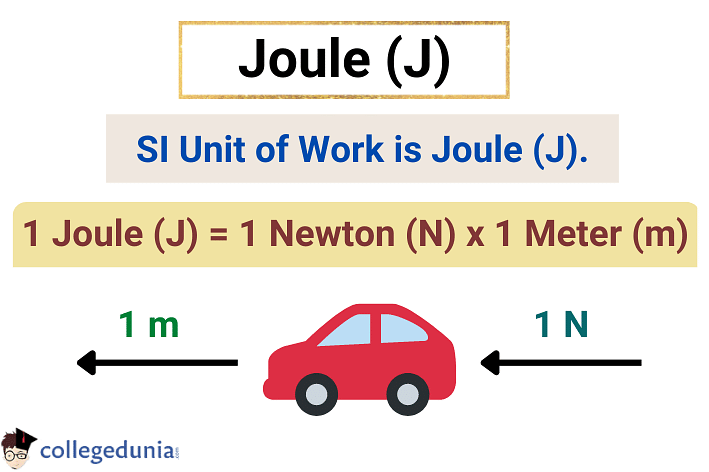
Unit of Work in Physics is Joule (J). One Joule is defined as the work done by 1 Newton of force to cause a displacement of 1 meter. Work is defined as the displacement of an object when a force (push or pull) is applied to it. It is denoted as W.
- When a force is applied to an object and a displacement occurs, work is said to be done.
- Work done is considered negative if the component of the force is opposite to the direction of the displacement.
- Work is a scalar quantity as it has only magnitude and no direction.
- Work transfers energy from one place to another or from one form to another.
- 1 Joule = 1 Newton x 1 Meter
Read More: NCERT Solutions for Class 11 Physics Work, Energy, and Power
Key Terms: Work, Joule, Force, Displacement, SI Unit, Work Formula, Work Done, CGS Unit, Newton, Positive Work
What is Work?
[Click Here for Sample Questions]
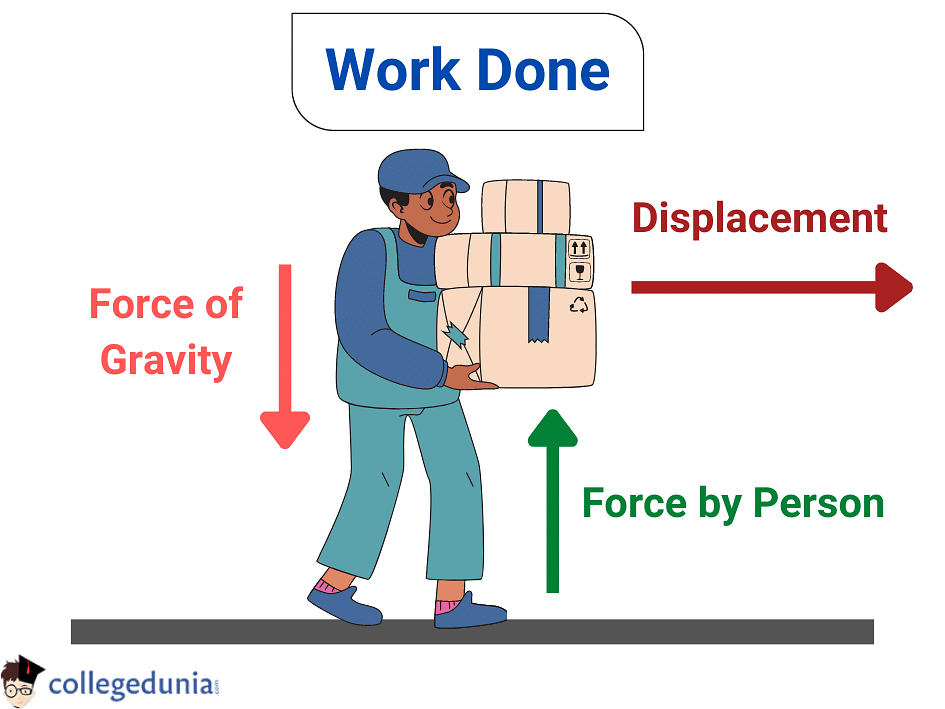
Work in Physics is defined as the displacement of an object due to the force applied to it. Carrying a pot of water uphill, riding a bicycle down a steep slope, or lifting a heavy object are all examples of work.
Types of Work
Work in Physics can be classified into three main categories:
- Positive Work: When force, as well as displacement, are both in a similar direction, the work done is said to be positive work.
- Negative Work: When the displacement is in the opposite orientation of the force, the work done is called negative work.
- Zero Work: When force and displacement, are perpendicular to one another, or one of them is zero, the work done is zero.
Read More:
SI Unit of Work
[Click Here for Previous Years' Questions]
The SI unit of work is the Joule (J).
- One joule is defined as the energy needed to accelerate 1 kg of a body by a force of 1 N over a distance of 1m.
- 1 Joule = 1 Newton x 1 Meter
- Newton-metre (N-m) is another way of expressing the work done and it is dimensionally equivalent to a joule.
- However, Nm is also used to express the torque, and thus it restricts the use of this unit for work done.
Consider the following examples to understand the unit of work:
- When 1 N of force is applied to an object to lift it to a height of 1 m, then the work done will be 1 J.
- When a force of 10 N is applied on a carton box to move it 2 m away from a state of rest, the work done will be 20 J.
Read More: Work Energy & Power Important Questions
Other Units of Work
[Click Here for Sample Questions]
The work done can also be measured using units like erg, the foot-pound, foot-poundal, kilowatt-hour, liter-atmosphere, and horsepower-hour.
- The CGS unit of work is erg (dyn cm).
- Work and energy have similar dimensions.
- Occasionally units of heat or energy such as therm, BTU, and Calorie, are also used to measure the work done.
- At the atomic level, an electron volt (eV) is used to express the work done at a molecular level.
Read More: Difference between Work and Energy
Conversion of Unit of Work
[Click Here for Previous Years' Questions]
The conversion of the different units of work into the SI Unit of Work, i.e. Joules is as follows:
| Unit | Conversion to Joules |
|---|---|
| British Thermal Unit (BTU) | 1055.06 Joule |
| 1 erg | 10-7 Joule |
| 1 horsepower-hour | 2684519.5377 Joule |
| 1 foot-pound | 1.36 Joule |
| 1 Kilo-watt hour | 3.6 million Joule |
| 1 Newton-meter | 1 Joule |
Read More: Work Energy & Power MCQs
Work Formula
[Click Here for Sample Questions]
When a constant force F is acting on an object, it produces a displacement d in that body. This work done by the force is the scalar product of the force and displacement.
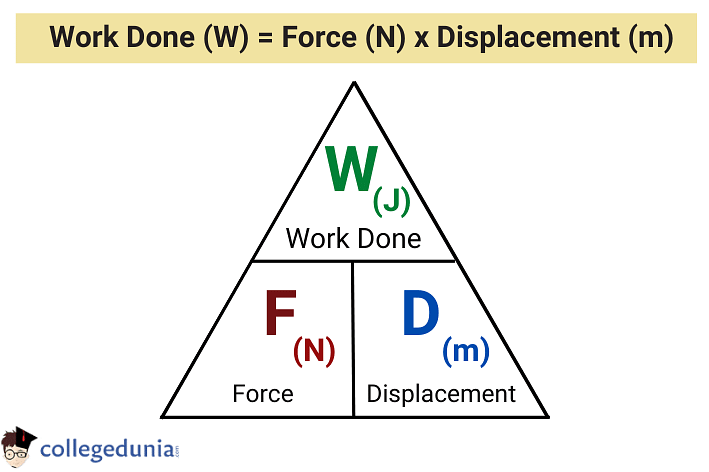
Mathematically, work done is represented as
| W = F x d |
If θ is an angle between F and S, then
| W = (F cos θ) d |
Where
- F: Force applied to the object.
- d: Displacement of the object.
- θ: Angle between Force and Displacement Vector.
Solved ExampleExample: A force of 30 N acts on an object to move it to 8 m in the direction of the force. Determine the work done by the force. Solution: Given that
Force is acting in the direction of displacement. Thus, work done will be W= F.d cosθ W= 30 x 8 cos 00 W = 240 J Thus, the work done is 240 J. |
Also Check:
Things to Remember
- Work done is equal to the product of the force and the displacement of the object in the direction of the force.
- Mathematically, work done is expressed as W = f x d.
- The SI Unit of Work is Joule (J).
- 1 Joule is the work done by the force of one newton (N) causing a displacement of one meter (M).
- 1 Joule = 1 N x 1 M
- Other units of work are erg, horsepower-hour, newton meter, foot-pound, kilowatt-hour, foot-poundal, and liter-atmosphere.
- The unit of work Joule is named in honor of English physicist James Prescott Joule.
Previous Years’ Questions (PYQs)
- What is the work done to pull the hanging part on the table... [JIPMER 2000]
- What is the work done in taking charge of Q once along the loop... [NEET 2005]
- Calculate the work done by the force in displacing the particle... [KEAM]
- Find the unknown angle between the force and displacement vector... [AMUEEE 2011]
- The area under the displacement curve gives... [JKCET 2008]
- The work done by a given force only depends on...[JKCET 2018]
- Calculate the work done by the applied force... [DUET 2011]
- Calculate the work done to accelerate the particle in 10 seconds...
- What is the work done to drag the 60 kg weight...
- Calculate the work done by the cord...
- What is the work done by the force of gravity when the particle goes up...
- Calculate the work done when the spring is stretched from 0.1 to 0.2 m...
Sample Questions
Ques. What is the SI Unit of Work? (1 Mark)
Ans. The SI unit of Work is Joule (J). Joule is defined as the work done by the force of one newton through a distance of one meter.
Ques. What is Work? (3 Marks)
Ans. Work is defined as the force that causes an object to be displaced. In the case of a constant force, work is the scalar product of the force exerted on an object and the displacement generated by that force. Work is a scalar quantity as it has only magnitude and no direction. If an applied force produces a movement in an object across a distance, work is said to be done.
Ques. What is Work Formula? (3 Marks)
Ans. The work formula is given as:
W = Fxd
W = (Fcos θ) d
Where
- W: Work done.
- F: Force applied.
- d: Displacement in the direction of the force.
- θ: Angle between the vectors: force and displacement.
Ques. What is zero work? (2 Marks)
Ans. Work done by the force on an object is zero if the direction of the force and the displacement are perpendicular to each other. In this situation, the work done is said to be zero work. For instance, when we push forcefully against a wall, the force we are exerting on the wall is ineffective since the wall’s displacement equals d = 0.
Ques. A rope pulls a box along the floor, creating a 30° angle with the surface. If the box is dragged for 20 meters, with a force of 90 N, what will be the work done by the force? (3 Marks)
Ans. It is given that
- Angle between force and displacement, θ = 30°
- Displacement of the box, d = 20 m
- Force applied on the box, F = 90 N
Work done by the force will be
W = F d cosθ
W = 90 × 20 × 0.866 J = 1558.8 J = 1560 J
Thus, the work done by the force is 1560 J.
Ques. What are the types of work? (3 Marks)
Ans. There are two major kinds of work, namely positive work, and negative work.
Positive Work: Positive Work is described by the equation W= FS Cos θ. When θ is acute, that is, θ is less than 90 degrees, work is considered positive.
Examples:
- When a lawn roller is pulled by applying force along with the handle, the work done by the applied force F is positive.
- Work done by the stretching force in spring is positive.
Negative Work: Negative Work happens when θ is obtuse, that is, θ is more than 90 degrees. The angle between the force F and displacement S is 180 degrees. Therefore, the work done by gravity on moving a body upwards is negative.
Examples:
- Rocket propulsion
- Work done in pulling a load
- Pulling water from a well
- Flying an airplane.
Ques. The sign of work done by a force on a body is vital to know. State carefully if the following quantities are positive or negative:
(a) Work done by a person in lifting a bucket out of a well by means of a rope tied to the bucket,
(b) Work done by gravity in the above case,
(c) Work done by friction on a body sliding down an inclined plane,
(d) Work done by an applied force on a body moving on a rough horizontal plane with uniform velocity,
(e) Work done by the resistive force of air on a vibrating pendulum in bringing it to rest. (5 Marks)
Ans. Work done, W = T.S = Fs cos θ
(a) Work done ‘positive’, because force is acting in the direction of displacement i.e., θ = 0°.
(b) Work done is negative, because force is acting against the displacement i.e., θ = 180°.
(c) Work done is negative because the force of friction is acting against the displacement i.e., θ= 180°.
(d) Work done is positive, because the body moves in the direction of applied force i.e., θ= 0°.
(e) Work done is negative, because the resistive force of air opposes the motion i.e., θ = 180°.
Ques. State if the following statement is true or false. Give a reason for your answer.
Work done in the motion of a body over a closed-loop system is zero for every force in nature. (2 Marks)
Ans. The given statement is false.
The work done in the motion of a body over a closed-loop system is zero for a conservation force only.
Ques. Mention the right alternative and explain your answer. (3 Marks)
a. When a conservative force does positive work on a body, the potential energy of the body increases/decreases/remains unaltered.
b. Work done by a body against friction always results in a loss of its kinetic/potential energy.
Ans. a. Correct Alternative: Decreases
A conservative force does positive work on a body when it displaces the body in the direction of a force. As a result, the body advances toward the center of force. It decreases the separation between the two, thereby decreasing the potential energy of the body.
- Correct Alternative: Kinetic Energy
The work done against the direction of friction reduces the speed of a body. Hence, there’s a loss of kinetic energy in the body.
Ques. A body of mass 2 kg initially at rest moves under the action of an applied horizontal force of 7 N on a table with a coefficient of kinetic friction = 0.1. Compute the following:
(a) Work done by the applied force in 10 s
(b) Work done by friction in 10 s
(c) Work done by the net force on the body in 10 s
(d) Change in kinetic energy of the body in 10 s (5 Marks)
Ans. Given that,
- Mass of the body, m= 2 kg
- Applied force, F = 7 N
- Coefficient of kinetic friction, μ = 0.1
- Initial velocity, u = 0
- Time, t = 10 s
Now, calculate the required values,
- The acceleration is given by Newton's second law of motion: a = F/m = 7/2 = 3.5 m/s2
- The frictional force is given as: f = μmg = 0.1 x 2 x 9.8 = -1.96 N
- the acceleration produced by the frictional force: an = - 1.96/2 = -0.96 m/s2
Total acceleration of the body:
a = a1 + an
= 3.5 + (-0.98) = 2.52 m/s2
The distance traveled by the body is given by the equation of motion:
s = ut +½ at2
= 0 + ½ x 2.52 x (10)2 = 126 m
(a) Work done by the applied force, W3= F ×s = 7 ×126 = 882 J
(b) Work done by the frictional force, Wt = F x s = - 1.96 x 126 = -247J
(c) Net force = 7 + (-1.96) = 5.04 N
Work done by the net force, Wnet = 5.04 ×126 = 635 J
(d) From the first equation of motion, the final velocity can be calculated as:
v = u + at
= 0 + 2.52 ×10 = 25.2 m/s
Change in kinetic energy
= ½ mv2 - ½ mu2
= ½ x 2(v2 - u2) = (-25.2)2 - 02 = 635 J
Ques. A man walks 2 m carrying a mass of 15 kg in his hands. He then walks the same distance pulling a rope behind him. The rope goes over a pulley, and a mass of 15 kg hangs at its other end. In which case is the work done greater? (5 Marks)
Ans. Calculating the work done for both cases,
Case I
- Mass, m = 15 kg
- Displacement, s = 2 m
Work done, W = Fs cos θ
Where, θ =Angle between force and displacement
W = mgs cos θ = 15 x 2 x 9.8 cos 90°
Case II
- Mass, m = 15 kg
- Displacement, s = 2 m
Here, the direction of the force applied on the rope and the direction of the displacement of the rope is the same.
Therefore, the angle between them, θ = 0°
Since cos 0° = 1
Work done,W = F1 cos θ = mgs
= 15 x 9.8 x 2 = 294 J
Hence, more work is done in the second case.
Check-Out:



Comments