



Content Curator
Graphite is also known as plumbago. It is an allotrope of carbon that we use extensively in our daily life. In our day-to-day life, we use graphite as a pencil lead, lubricant, conductor, anode, and so on due to its high availability and properties.
| Table of Contents |
Key Terms: Pencil Lead, Conductor, Carbon Atoms, Neutron, Electron, Allotropes, Compound, Electrochemistry
What Is Graphite?
[Click Here for Sample Questions]
Graphite is a crystal carbon and half-metal with renowned carbon allotropes. Graphite is a very common and stable allotrope of carbon used in electrochemistry as the standard state for defining the heat of the formation of carbon compounds.
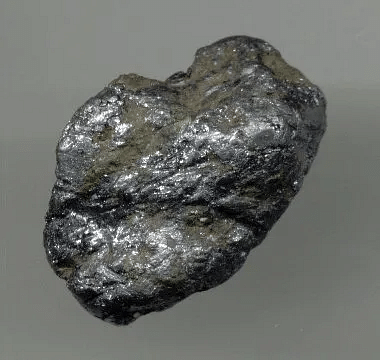
Graphite
Uses Of Graphite
[Click Here for Previous Year Questions]
The extensive uses of graphite are:
- Graphite In Refractories: Graphite’s tolerance level of heat and unchangeability, is a widely used refractory material. It is used in the manufacturing industry to manufacture glass, steel, iron processing, etc.
- Graphite In Writing: In education, and industry graphite plays a vital role as the lead of pencils made up of graphite.
- Graphite In Lubricants: Lubricants made of graphite can be used in both high and low temperatures. Graphite is also used in car brakes and clutches. The powdered form of graphite lump is used in paints.
- Graphite In Nuclear Reactors: Graphite has the property to absorb fast-moving neutrones so is used as a reactor to stabilize nuclear reactions.
- Graphite In Electrical Industry: The crystalline flake graphite is used in the manufacturing of carbon electrodes, and plates required in the dry cell batteries and the electrical industry.
- Graphite As Graphene Sheet: These graphene sheets are 100 times stronger and 10 times lighter than sheets made up of steel.
- Other Uses Of Graphite: In miscellaneous uses, graphite is used for electric motor brushes, zinc-carbon batteries, smokebox, the lower part of the firebox, and so on.
Do Check Out:
| Concept Related To Graphite | ||
|---|---|---|
| Allotropes of carbon | Carbon and Its Compounds | Classification of Crystalline Solids |
Structure Of Graphite
[Click Here for Sample Questions]
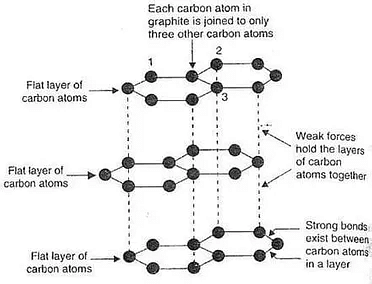
Graphite is a covalent structure with a carbon atom joined into three other carbon atoms by forming a covalent bond. Each carbon atom is sp2 hybridized. The carbon atoms form a layer-like structure with a hexagonal arrangement of carbon atoms.
These layers have a weak force in between them. Due to the weak forces, the layers can easily slip over. And each carbon atom has one non-bonded electron, which later becomes delocalized.
Properties Of Graphite
[Click Here for Previous Year Questions]
The properties of graphite are:
- Graphite can be prepared artificially.
- Graphite is a crystalline solid
- The carbon atoms in graphite are sp2 hybridized.
- Graphite is a greyish black opaque substance.
- While compared with diamond it is lighter, smooth and slippery to touch.
- Graphite is soft due to its weak van der wall forces
- Graphite is also a good conductor of heat and electricity
- Graphite melts at 1800K.
- Graphite is non-inflammable.
Do Check Out:
| Chapter Related Topics | ||
|---|---|---|
| Earth | Difference between Rocks and Minerals | Rock Cycle |
Things To Remember
[Click Here for Sample Questions]
- Graphite is also known as plumbago.
- Graphite is a crystal carbon and half-metal with renowned carbon allotropes.
- It is used in the manufacturing industry to manufacture glass, steel, iron processing etc.
- The powdered form of graphite lump is used in paints.
- Each carbon atom has one non-bonded electron, which later becomes delocalized.
- The carbon atoms in graphite are sp2 hybridized.
- Graphite is non-inflammable.
Previous Year Questions
- 6g Of Graphite Is Burnt In A Bomb Calorimeter At… [AP EAPCET 2019]
- The Densities Of Graphite And Diamond At 298 K Are…. [NEET 2003]
- In Graphite Electrons Are… [NEET 1997]
- The Hybridisation Of C In Diamond Graphite And Eth… [KCET 2016]
- The Values If H And S For The Reaction C Graphite… [KEAM]
- Graphite Is Soft While Diamond Is Hard Because…
- Graphite Is A Soft Solid Lubricant Extremely Diffi… [JEE Advanced 2003]
- With Respect To Graphite And Diamond Which Of The… [JEE Advanced 2012]
- Which Of The Following Is Similar To Graphite….
Sample Question
Ques. What is graphite made up of? (3 Marks)
Ans. Graphite has two main procedures first it's natural and second can be prepared artificially. Graphite is the crystalline allotropic form of carbon that occurs in a free state in nature. Graphite can also be prepared artificially in laboratories by heating a mixture of sand and coke in an electrical furnace at about 3300 K.
Ques. Illustrate the structure of graphite. (4 Marks)
Ans. Graphite is a covalent structure with a carbon atom joined into three other carbon atoms by forming a covalent bond. Each carbon atom is sp2 hybridized. The carbon atoms form a layer-like structure with a hexagonal arrangement of carbon atoms.
These layers have a weak force in between them. Due to weak forces, the layers can easily slip over. And each carbon atom has one non-bonded electron, which later becomes delocalized.
Ques. Name three types of natural graphite. (2 Marks)
Ans. The natural graphites are named flake, high crystalline, and amorphous.
Ques. Where can we find natural graphite? (2 Marks)
Ans. Natural graphite occurs can be found in metamorphic rocks like marble, schist, gneiss so on. Thermodynamically this state is the most stable allotropic form of carbon. There is a color variation from steel grey to black depending upon the origin of graphite.
Ques. What are the five uses of graphite? (5 Marks)
Ans. The extensive uses of graphite are:
- Graphite In Refractories: graphite’s tolerance level of heat and unchangeability, is a widely used refractory material. It is used in the manufacturing industry to manufacture glass, steel, iron processing, etc.
- Graphite In Writing: in the education, industry graphite plays a vital role as the lead of pencils made up of graphite.
- Graphite In Lubricants: lubricants made of graphite can be used in both high n low temperatures. Graphite is also used in car brakes and brakes. The powdered form of graphite lump is used in paints.
- Graphite In Nuclear Reactors: graphite has the property to absorb fast-moving neutrons so is used as a reactor to stabilize nuclear reactions.
- Graphite In Electrical Industry: the crystalline flake graphite is used in the manufacturing of carbon electrodes, and plates required in the dry cell batteries and the electrical industry.
Ques. List five properties of graphite. (5 Marks)
Ans. The properties of graphite are:
- Graphite can be prepared artificially.
- Graphite is a crystalline solid
- The carbon atoms in graphite are sp2 hybridized.
- Graphite is a greyish-black opaque substance.
- While compared with diamond it is lighter, smooth, and slippery to touch.
Ques. State two medical uses of graphite. (2 Marks)
Ans. The medical uses of graphite are:
- Graphite is used as an ointment to treat keloid, fibroma, pimples, and acne.
- Graphite is used in the preparation of prosthetic limbs in orthopedics.
Ques. How are graphene sheets better than steel sheets? (1 Mark)
Ans. The graphene sheets are 100 times stronger and 10 times lighter than sheets made up of steel.
Ques. In which country is graphite produced abundantly? (2 Marks)
Ans. In China graphite is produced abundantly. Worldwide, China was the leading graphite-producing. In the year 2020, they produced approx 650,000 metric tons of graphite.
Ques. State most common use of graphite. (4 Marks)
Ans. The most common use of graphite are:
- Electrodes for electrolytic cells.
- As lubricants
- Moderate neutrons in the nuclear cycle
- Pencil leads
Also check:



Comments