


What is spore formation?

Jasmine Grover logo

Jasmine Grover

Education Journalist | Study Abroad Lead

Spore formation is a type of asexual reproduction that takes place in spores. Spores are unicellular bodies that are formed due to sexual or asexual reproduction in eukaryotic organisms including bacteria, algae, fungi, and plants.

  • Sporogenesis is the process through which spores are formed.
  • Spores are reproductive cells that form a new organism. They are mostly found in sacs that are called sporangia.
  • The hundreds of spores are collected in the sac by plants until it bursts.
  • These spores are then released into the air where they germinate to form a new plant.
  • Fungi such as Rhizopus, Penicillium, and Mushroom reproduce by spore formation.
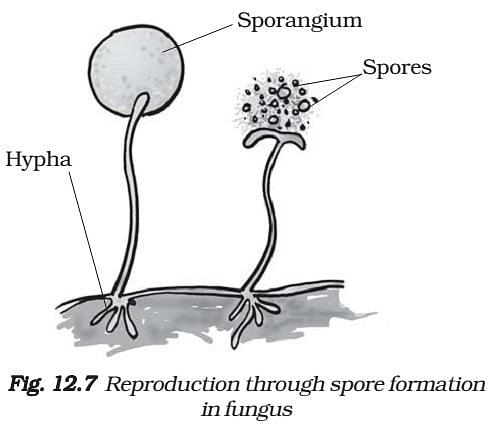
Spore Formation

Examples of Spore Formation

  • Spores are formed in fungi on sporangium. Minute haploid spores are produced that grow into new organisms. E.g. – Penicillium.
  • Bacteria form another type of spore known as endospores. E.g. – Bacillus
  • Plants solely reproduce asexually through spore formation. They follow an alternation of the generation life cycles where haploid spores are produced by diploid sporophytes that ultimately produce haploid gametophytes. E.g. – liverworts

Read More:

CBSE CLASS XII Related Questions

  • 1.
    Cow dung and water are mixed and fed into a biogas plant to allow digestion of biowastes. The person performing this process says that there is no need to provide an inoculum.
    Do you agree with him? Justify your answer.
    What happens to the biowaste inside the digester ?
    (c) Name the useful by-products obtained from this process and mention how they are used.


      • 2.
        Work out the crosses between:
        Normal female and Haemophilic male
        Carrier female and Normal male
        (III) Carrier female and Haemophilic male
        Write the conclusions you draw from these crosses. Comment on the type of inheritance of the disease.
        (Use: $X$ - Normal, $X^h$ - Haemophilic)


          • 3.
            Oogenesis is a discontinuous process that begins before birth and is completed after puberty.
            Trace the development of a gamete mother cell till its release from the ovary during ovulation.
            Name the two pituitary hormones that play an important role in the process.


              • 4.
                Read the following passage and answer the questions that follow:
                India is one of the megadiverse countries housing around 8·1 per cent of global species diversity, although its land area is only 2·4 per cent of the world’s land area. Many of the species are highly threatened due to human activities like deforestation, mining and habitat fragmentation. Laws like Wildlife (Protection) Act, 1972 were enacted by the Government of India to preserve our biological wealth. Various conservation measures are being implemented to save the threatened species. The following bar graph shows the number of species conserved under different biodiversity conservation methods.

                Which other methods shown in the diagram are opposite to the one identified by you in question ? How are these two conservation approaches different?
                (c) Write two features of Biodiversity hotspots.
                (c) To which category do sacred groves belong and how do they help in bio-conservation?


                  • 5.
                    Draw a neat diagram of a maize grain showing the internal structure and label any five parts.


                      • 6.
                        What is the carrying capacity of a species in a habitat?
                        Explain the growth curve that takes this capacity into account.

                          CBSE CLASS XII Previous Year Papers

                          Comments


                          No Comments To Show
