



Content Curator
Rhizopus is a genus of common saprophytic fungi on dead and decaying organic matter, live plants and also specialized parasites on animals and humans. They are found in a wide variety of commercial organic substances, including mature fruits and vegetables, jellies, syrups, leather, bread, peanuts, tomato and tobacco.
They are multinucleated and coenocytic without septal walls. Some Rhizopus species are opportunistic human pathogens that generally cause a dangerous disease called mucormycosis. This genus includes at least eight species. This genus consists of a characteristic mycelium that is differentiated into stolons, rhizoids and sporangiophores. It is reproduced by vegetative, asexual and sexual means.
Read Also: Heterotrophic Bacteria
Key Terms: Rhizopus, Mycelium, Hypha, Sporangium, Spores, Fungi, Microorganisms, Asexual Reproduction, Vegetative Reproduction, Sexual Reproduction
What is Rhizopus?
[Click Here for Sample Questions]
Rhizopus is both a saprophytic and parasitic fungi. The species of Rhizopus are found in moist or damp places. They are also found in living substances like vegetables, fruits, moist bread, jellies, etc.
- The vegetative structure of this fungus is made up of coenocytic (aseptate and multinucleated) and branched hyphae.
- These species are applied to produce various chemicals and alcoholic substances.
- Some species of Rhizopus cause certain plant and human diseases. Human diseases are known as mucormycosis.
![Rhizopus]()
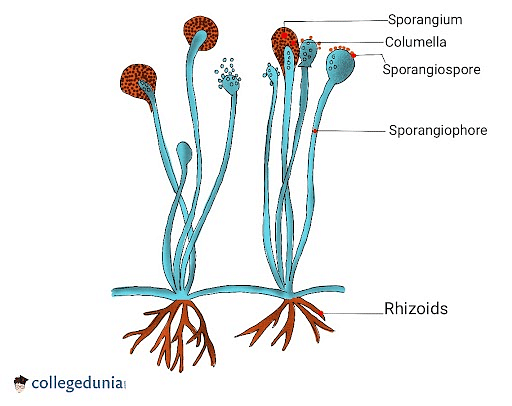
Rhizopus
Read More:
Classification of Rhizopus
[Click Here for Previous Year Questions]
Rhizopus is a fungus under the phylum Zygomycota. They are so classified due to the production of zygospores during sexual conjugation. They are generally known as black bread mould, pin mould, etc.
The classification of Rhizopus can be shown as:
| Type | Classification |
|---|---|
| Domain | Eukaryota |
| Kingdom | Fungi |
| Phylum | Zygomycota |
| Class | Zygomycetes |
| Order | Mucorales |
| Family | Mucoraceae |
| Genus | Rhizopus |
Some common species of Rhizopus is as follows:
- Rhizopus Stolonifer: It is a common black bread mould. It is commercially used in the production of chemicals like cortisone, fumaric acid, etc. It causes fruit rot disease in several plants.
- Rhizopus Oryzae: It is used in the production of alcoholic beverages.
- Rhizopus Microsporus: It is used in the fermentation of soybean.
Read Also: Spore Formation
Rhizopus Structure
[Click Here for Sample Questions]
The structure of Rhizopus can be depicted as:
- The vegetative thallus is a fast-growing with a cottony appearance.
- The main body of rhizopus thallus consists of a well-branched mycelium.
- The mycelium is coenocytic without septa and with many nuclei.
- The mycelia are composed of three types of hyphae like stolons, rhizoids and sporangiophores.
![Rhizopus under microscope]()

Rhizopus Under Microscope
- Stolon is the horizontally growing aerial hypha. The subterranean root-like rhizoids are formed where the stolons touch the substratum.
- They are also branched and useful in anchoring the remaining mycelium to the substratum and also to absorb food and water.
- Sporangiophores are vertically growing aerial and reproductive mycelia. They consist of sporangiospores terminally.
- The cell wall of hyphae is made up of chitin.
- The cytoplasm is aseptate and multinucleated and consists of other cell organelles like mitochondria, endoplasmic reticulum, Golgi bodies, vacuoles and oil droplets, but without plastids.
Lifecycle of Rhizopus
[Click Here for Previous Year Questions]
Rhizopus reproduces by all three methods i.e. vegetative, asexual and sexual methods.
Vegetative reproduction
It is by fragmentation of hyphae. Each of the fragments of the stolon develops separately into an independent and complete mycelium.
Asexual reproduction
It is by the formation of both sporangiospores and chlamydospores
- Sporangiospores: Sporangiospores are formed terminally in a special spherical structure called sporangium on an aerial hypha called sporangiophore. They are formed during favourable conditions.
Sporangiophores generally develop from the upper side of the rhizoidal nodes. The apical part of the hypha swells up to form a spherical sporangium, as nuclei and cytoplasm move in abundance.
The cytoplasm of the sporangium differentiates into the denser peripheral zone with fewer vacuoles and more nuclei; and the lighter central columella region with fewer nuclei and more vacuoles. Minute sporangiospores develop inside the sporangium. Spores are multinucleated and non-motile.
The wall of the sporangium ruptures after maturation and sporangiospores are liberated as powdery dust. After reaching a substratum, each spore germinates into a new mycelium.
- Chlamydospores: Chlamydospores are mostly formed during unfavourable conditions. An intercalary segment of the mycelium develops with the formation of septae and the accumulation of dense protoplasm.
The resultant spore is thick-walled and detaches from the mycelium on dehydration. They will remain dormant until favourable conditions return to the region and germinate to form a new independent mycelium.
Sexual reproduction
It is the conjugation or fusion of two compatible hyphae. Most of the Rhizopus species (R. stolonifer) are reported to be heterothallic, i.e. have different strains of mycelia as + and – mating strains. But R. sexualis is homothallic.
- The compatible hyphae come together during unfavourable conditions.
- On both the mycelia, a small apical outgrowth develops. It is termed as progametangia.
- Many nuclei and cytoplasm move towards the apical outgrowth and progametangia make contact with each other.
- The apical region is secluded from the rest of the hyphae by septal formation. It is termed gametangia.
- Gametangia conjugate or fuse to form a multinucleated structure called a zygospore.
- Here, plasmogamy is followed by karyogamy to form a diploid (2n) zygote. It is now known as a zygospore.
- Zygospores soon enlarge and become thick-walled and resistant to adverse unfavourable environmental conditions. On the return of the favourable conditions, zygospores germinate to give out a new mycelium.
- The inner wall of the zygospore protrudes into a promycelium-forming germ sporangiophore, with germ sporangium formed apically.
- Meiotic division occurs and haploid meiospores will be formed. They come out after the rupture of the germ sporangium wall and develop into new mycelia.
Also Read:
Economic Importance of Rhizopus
[Click Here for Sample Questions]
Many Rhizopus species are commercially exploited to manufacture several chemicals and alcoholic products.
- R. oryzae is used in the commercial production of cortisone and lactic acid.
- R. oryzae is used for the biosorption of heavy metals in waste polluted water.
- R. stolonifer is used to produce chemicals like lactic acid, fumaric acid and cortisone
- R. delemar is used to produce organic substances like biotin and fumaric acid
- Tempeh is a traditional soybean fermented product of Asia. It is prepared using some Rhizopus species.
- Many traditional alcoholic beverages like Parakari (cassava product) is prepared using Rhizopus species
Things to Remember
- Rhizopus species are saprophytic fungi found on bread, organic matter, living plants and it is parasitic on animals.
- Rhizopus are coenocytic, multicellular fungi, with about 8 species. They cause invasive mucormycosis in humans and animals.
- Some species have industrial importance, such as Rhizopus stolonifer, which caused bread mold.
- Rhizopus has eight species like Rhizopus schipperae, Rhizopus delemar, Rhizopus microsporus, Rhizopus caespitosus, Rhizopus arrhizus (Rhizopus oryzae), Rhizopus reflexus, Rhizopus homothallicus, and Rhizopus stolonifer.
Previous Year Questions
- Coenocytic mycelium is…
- BGA (blue green algae) are included in which of the following groups?..[NEET 1996]
- Ciliates differ from all other protozoans in.[NEET 2018]
- Curing of tea leaves is brought about by the activity of -….[NEET 2006]
- Which one of the following is wrong for fungi ?..[NEET 2016]
- Which one of the following is a slime mould?...[NEET 2007]
- Which one of the following organisms is not an example of eukaryotic cells ?….[NEET 2011]
- Which one of the following fungi contains hallucinogens?...[NEET 2014]
- Which one of following is used as vector for cloning genes into higher organisms ?...[NEET 2010]
- Which one belongs to monera?.[NEET 1990]
Sample Questions
Ques: Where is Rhizopus found? (2 marks)
Ans: Rhizopus is both a saprophytic and parasitic fungi. The species of Rhizopus are found in moist or damp places. They are also found on living substances like vegetables, fruits, moist bread, jellies, etc.
Ques: Describe the mycelium of Rhizopus? (2 marks)
Ans: The vegetative structure of this fungus is made up of coenocytic (aseptate and multinucleated) and branched hyphae. The mycelium is differentiated into stolons, rhizoids, and sporangiophores.
Ques: What is the systematic position of Rhizopus? (2 marks)
Ans: Systematic Position:
- Domain: Eukaryota
- Kingdom:Fungi
- Phylum: Zygomycota
- Class: Zygomycetes
- Order: Mucorales
- Family : Mucoraceae
- Genus: Rhizopus
Ques: Describe the structure of Rhizopus. (3 marks)
Ans: The vegetative thallus is fast-growing with cottony appearance The main body of rhizopus thallus consists of a well branched mycelium.
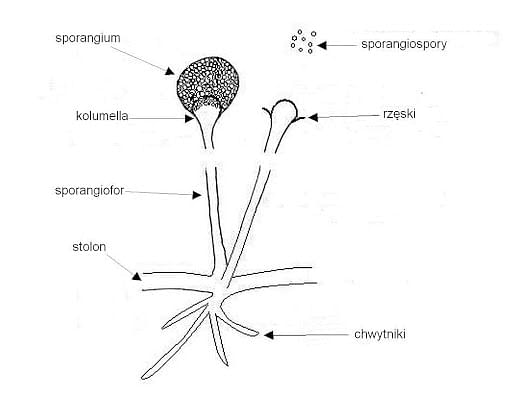
- The mycelium is coenocytic without septa and with many nuclei. The mycelia are composed of three types of hyphae like stolons, rhizoids and sporangiophores.
- Stolon is the horizontally growing aerial hypha.
- The subterranean root like rhizoids are formed where the stolons touche the substratum.
- They are also branched and useful in anchoring the remaining mycelium to the substratum and also to absorb food and water.
- Sporangiophores are the vertically growing aerial and reproductive mycelia. They consist of sporangiospores terminally
Ques: Draw a well labelled diagram of Rhizopus. (3 marks)
Ans: The labelled diagram of Rhizopus is shown below:
Ques: Describe the hyphal structure of Rhizopus. (2 marks)
Ans: The cell wall of Rhizopus hyphae is made up of chitin. The cytoplasm is aseptate and multinucleated and consists of other cell organelles like mitochondria, endoplasmic reticulum, Golgi bodies, vacuoles and oil droplets, but without plastids.
Ques: Describe vegetative method of reproduction in Rhizopus. (2 marks)
Ans: Vegetative reproduction in Rhizopus is by fragmentation of hyphae. Each of the fragments of the stolon develops separately into an independent and complete mycelium
Ques: Explain different asexual methods of reproduction in Rhizopus. (5 marks)
And: Asexual reproduction in Rhizopus is by the formation of both sporangiospores and chlamydospores. Thus,
- Sporangiospores: Sporangiospores are formed terminally in special spherical structure called sporangium on an aerial hypha called sporangiophore. They are formed during favourable conditions.
Sporangiophores generally develop from the upper side of the rhizoidal nodes. The apical part of the hypha swells up to form a spherical sporangium, as nuclei and cytoplasm move in abundance.
The cytoplasm of the sporangium differentiates into the denser peripheral zone with less vacuoles and more nuclei; and the lighter central columella region with fewer nuclei and more vacuoles. Minute sporangiospores develop inside the sporangium.
Spores are multinucleated and non-motile. The wall of the sporangium ruptures after maturation and sporangiospores are liberated as a powdery dust. After reaching a substratum, each spore germinates into a new mycelium.
- Chlamydospores: Chlamydospores are mostly formed during unfavourable conditions. An intercalary segment of the mycelium develops with the formation of septae and accumulation of dense protoplasm.
The resultant spore is thick-walled and detaches from the mycelium on dehydration. They will remain dormant until the favourable conditions return to the region and germinate to form a new independent mycelium.
Ques: Explain sexual reproduction in Rhizopus. (5 marks)
Ans: Sexual reproduction in Rhizopus is done via conjugation or fusion of two compatible hyphae. Majority of the Rhizopus species (R. stolonifer) are heterothallic, which means they have different strains of mycelia as + and – mating strains. But R. sexualis is homothallic.
The compatible hyphae typically come together during unfavourable conditions. On both the mycelia, a small apical outgrowth grows called progametangia. Many nuclei and cytoplasm move toward the apical outgrowth and progametangia make contact with each other.
The apical region is secludes from the rest of the hyphae by septal formation. Now this is termed as gametangia. Gametangia conjugate or fuse to form a multinucleated structure called zygospore. Here, plasmogamy is followed by karyogamy to form a diploid (2n) zygote. It is now known as zygospore.
Zygospores will soon enlarge and become thick-walled and resistant to adverse unfavourable environmental conditions. On the return of the favourable conditions, zygospores germinate to give out a new mycelium.
The inner wall of the zygospore protrudes into a promycelium forming germ sporangiophore, with germ sporangium formed apically. Meiotic division occurs and haploid meiospores will be formed. They come out after rupture of the germ sporangium wall and develop into new mycelia
Ques: Write about economic Importance of Rhizopus. (5 marks)
Ans. Rhizopus species are commercially utilised to manufacture several chemicals and alcoholic products.
- R. oryzae is used in the commercial production of cortisone and lactic acid.
- R. oryzae is used for the biosorption of heavy metals in waste polluted water.
- R. stolonifer is used to produce chemicals like lactic acid, fumaric acid and cortisone
- R. delemar is used to produce organic substances like biotin and fumaric acid
- Tempeh is a traditional soybean fermented product of Asia. It is prepared using some Rhizopus species.
- Many traditional alcoholic beverages like Parakari (cassava product) is prepared using Rhizopus species.
Also Check:



Comments