



Content Curator
Endospores are tough, dormant structures that bacteria develop in response to harsh environmental conditions.
- These are seed-like formations produced within the bacteria.
- Microorganisms are adaptable to their environments; they can sense and adapt to their surroundings.
- When they are in an environment where their natural supply of nutrition has been exhausted, they use a variety of survival methods.
- One such bacterial strategy is the formation of endospores, which are usually formed in situations of nutritional shortage.
- Endospores are highly resistant and formed to ensure survival and the preservation of genetic information under environmental stress.
- Endospores of low Gram-positive bacteria are by far the most resistant to extreme conditions of all the microorganisms.
| Table of Content |
Key Terms: Germination, Sporulation, SASPs, Exosporium, Septa formation, DNA, Anthrax, Tetanus, Gas gangrene, Botulism, Gram-positive bacteria, Microorganism
What are Endospores?
[Click Here for Sample Questions]
Bacterial endospores are tough, dormant, and resistant spores produced by Gram-positive bacteria belonging to the Firmicute family in response to adverse environmental conditions.
- Endospores are formed within the vegetative cells, as the name implies 'endo' means 'within' or ‘inside’.
- They help microorganisms cope with harsh environmental conditions.
- Endospores are also important since they are easily transported by wind, water, and animals' guts.
- The best-studied endospore-forming bacterial genera are Bacillus and Clostridium.
- When the carbon or nitrogen source in the growth medium becomes scarce, Bacillus enters the endospore production cycle.
- Endospores may be able to endure environmental attacks that would normally kill the bacteria.
- These stresses include high temperatures, UV radiation, desiccation, chemical damage, and enzymatic destruction.

Also Check:
| Related Concepts | ||
|---|---|---|
| Binomial Nomenclature | Taxonomy | Biofortification |
| Taxonomic Hierarchy of Plants and Animals | Two Kingdom Classification | Denitrification |
Structure of Endospores
[Click Here for Sample Questions]
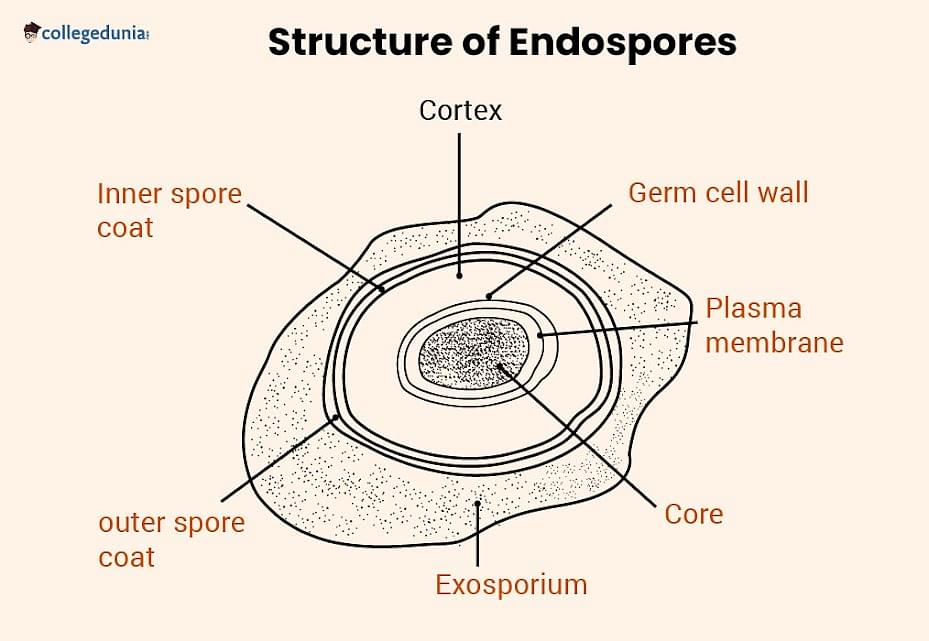
The durability of an endospore is due to its unique cellular structure.
- The outer proteinaceous layer that surrounds the spore provides much of the chemical and enzymatic resistance.
- The cortex is a thick layer of unique peptidoglycan that lies under the coat.
- Dehydration of the spore core, which aids intolerance to high temperatures, requires proper cortex formation.
- A germ cell wall lies underneath the cortex.
- After the endospore germinates, this layer of peptidoglycan will become the bacterium's cell wall.
- Under the germ cell wall, the inner membrane serves as a significant permeability barrier against a variety of potentially harmful substances.
- The endospore's core, which is extremely dry, contains the cell's DNA, ribosomes, and vast amounts of dipicolinic acid.
- This endospore-specific substance can make up to 10% of the dry weight of the spore and appears to have a function in spore dormancy maintenance.
- SASPs (small acid-soluble proteins) are also present solely in endospores.
- These proteins tightly bind and condense DNA, and they play a role in UV radiation and DNA-damaging substance resistance.
- Stalks, toxin crystals, and an extra outer glycoprotein coat called the exosporium are other species-specific structures and substances associated with endospores.
Endospores stains
[Click Here for Sample Questions]
The endospores stain is a differential stain that can be used to see bacterial endospores.
- Endospores can arise in vegetative cells' terminal, subterminal, and central sections.
- These spores have little metabolic activity and are extremely resistant.
- It was created as a protective mechanism to help people survive in harsh environments.
- The endospores and vegetative cells are stained with a malachite green stain, which is a primary stain that is aided by heat to penetrate the endospores.
- Cells are then decolourized, resulting in the elimination of stains from only the vegetative cell.
- Safranin is used to counterstain any cells that have been decolourized.
- Finally, pink vegetative cells and dark green endospores are formed as a result.
Endospores Formation steps
[Click Here for Sample Questions]
A single endospore forms within some bacteria when they are starved, especially when there aren't enough carbon and nitrogen sources.
- The process of producing an endospore is known as sporogenesis or sporulation.
- When bacterium cells are starved of nutrients, the endospore core gets more dehydrated, and this process occurs.
- Sporulation is a seven-phase technique that takes a long time.
These phases are given below.

The S-I Stage: Formation of Axial Filament
The bacterial cell's genetic material is orientated in the exact middle plane of the cell.
The S-II Stage: Formation of Septa
A forespore septum is formed when a plasma membrane invagination extends into the cell lumen and creates a septum. When a septum forms, a small section of the DNA is separated from the rest of the genetic material.
The S-III Stage: Engulfment of the Forespoe
The mother cell's membrane continues to expand until it completely engulfs the freshly created juvenile spore. The forespore is now covered by two plasma membranes and an intermembrane gap as a result of the engulfment.
The S-IV Stage: Formation of Cortex
Cortex development begins between the two membranes' intermembrane spaces. In Stage IV, a lot of calcium and dipicolinic acid is deposited.
The S-V Stage: Formation of Protein Coat
The cortex of the newly produced spore is covered in a protein covering.
The S-VI Stage: Spore Maturation
The cell's centre dehydrates more and more, and it becomes metabolically inactive.
The S-VII Stage: Enzymatic Destruction
Endospores are released once the sporogonium (spore mother cell) is destroyed by enzymes.
Facts about Endospores
[Click Here for Sample Questions]
A few important facts about Endospores are
- For the first time 130 years ago, Cohn and Koch independently examined bacterial endospores.
- Only two bacteria genera can sporulate and produce endospores.
- Endospores can regerminate and become vegetative cells.
- Many sources say that spores have remained viable for over 10,000 years and that spores millions of years old have been revived.
- Endospores can exist without nutrition.
- They are resistant to UV light, desiccation, high temperature, extreme cold and chemical disinfectants.
Also Check:
| Biology Related Concepts | ||
|---|---|---|
| Productivity in Ecosystem | Disadvantages of Dams | Our Environment |
| Enzymes | Excretion in Human Beings | Hypertension |
| Sucrose | Excretion | Excretion in Plants |
Things to Remember
- Endospores are dormant alternative life forms that a few bacteria genera develop.
- Endospores are produced by Bacillus and Clostridium.
- During hunger, a single endospore forms within a bacterium, which is followed by the degradation of the rest of the organism.
- Multiple layers of resistant coatings surround a nucleoid, some ribosomes, RNA molecules, and enzymes in the finished endospore.
- High temperatures (including boiling), most disinfectants, low-energy radiation, and drying are all effective against endospores.
- The endospore persists until germination is triggered by a number of environmental factors, permitting the growth of a plant.
Sample Questions
Ques. What are Endospores? (2 Marks)
Ans. Bacterial endospores are tough, dormant, and resistant spores produced by Gram-positive bacteria of the Firmicute family in the face of adversity. Endospores form inside the vegetative cells (thus the name endo means inside). They assist microorganisms in surviving adverse environmental circumstances.
Ques. Who discovered Endospores? (2 Marks)
Ans. Cohn and Koch independently examined bacterial endospores for the first time 130 years ago, in 1876. Later John Tyndall, a 19th-century scientist, was the first to discover endospores. He developed endospores, which are heat-resistant bacteria spores that can survive temperatures of up to 100°C. He also discovered Tyndallization, a simple and cost-effective method for killing bacterial endospores.
Ques. Define Exosporium. (2 Marks)
Ans. The exosporium is the mature spore's outermost layer. It's also known as the exine in plant spores. Bacillus species, particularly Bacillus cereus and the anthrax-causing bacterium Bacillus anthracis, produce endospores with exosporium, which are the most commonly researched. The exosporium, which may contain spore antigens, is the part of the spore that interacts with the environment or the host organism. Exosporium proteins, such as Cot protein, are also discovered associated with strains of B. anthracis and B. cereus. Other spore coat proteins have comparable sequences to this Cot protein, and their probable determinants are thought to include bxpC, lunA, exsA, and other proteins.
Ques. What are SASPs? (2 Marks)
Ans. Bacillus subtilis spores include a variety of tiny, acid-soluble spore proteins (SASP), which account for up to 20% of the total spore core protein. UV radiation, heat, peroxides, and other sporicidal treatments have all been demonstrated to give resistance to the multiple/-type SASP. Sequence study of proteins separated by acrylamide gel electrophoresis of acid extracts from spores lacking the three major SASP (,, and ) discovered eleven small acid-soluble proteins (SASP) that are present in spores but not in developing cells of Bacillus subtilis.
Ques. Define Sporulation. (2 Marks)
Ans. Sporulation is the process of bacteria becoming nearly sleeping and inactive. When the conditions are severe and tough for the typical form of bacteria, spores can protect the bacteria's genetic material.
Sporulation creates a multilayered structure that can be maintained for an extended period of time. Spores are meant to protect bacteria against dryness, heat, and extreme radiation for an extended period of time, compared to the microorganism's regular life span. Bacillus subtilis endospores have been retrieved from thousands of years of ancient materials. These cells can also be resurrected and transformed into healthy, dividing cells. spores from amber that are more than 250 million years old have been discovered.
Ques. Why are bacterial endospores resistant? (2 Marks)
Ans. The durability of an endospore is due to its unique cellular structure. The outer proteinaceous layer that surrounds the spore provides much of the chemical and enzymatic resistance. Underneath the coat is a thick layer of unique peptidoglycan called the cortex. Dehydration of the spore core, which aids intolerance to high temperatures, requires proper cortex formation.
Ques. Name three infections that endospores can spread to humans. (2 Marks)
Ans. Endospores carry infectious diseases such as anthrax, tetanus, gas gangrene, botulism, and pseudomembranous colitis to people. Bacillus anthracis causes anthrax, a disease that can be transferred to people from domestic animals like cattle, sheep, etc. Food poisoning is caused by Bacillus cereus. Botulism is caused by Clostridium botulinum, a type of food poisoning, whereas tetanus is caused by Clostridium tetani. Food poisoning, anaerobic wound infections, and gas gangrene are all caused by Clostridium perfringens.
Ques. Define Endospore germination. (2 Marks)
Ans. Germination is a complex process that allows endospores to re-enter vegetative growth and cell division. Environmental stimuli cause germination, which is subsequently translated into a series of interconnected degradation events. This eventually leads to the loss of latent endospore characteristics.
Ques. What are the characteristics of Endospores? (5 Marks)
Ans. Endospores differ from bacterial vegetative cells in terms of structure, metabolism, and function. The following are the main properties of bacterial endospores.
- Heat, UV light, gamma radiation, chemical disinfectants, and desiccation are all extremely stressful to endospores.
- The majority of endospores live for many years, even 10,000 years or more.
- Most endospore-producing bacteria are known pathogens due to their lengthy viability and adaptability to stress conditions.
- The bacterial endospores will not be killed by wiping with alcohol or hydrogen peroxide, or by boiling at 100 degrees.
- Under a light and electron microscope, endospores can be seen.
- Endospores will accept bacterial stains like safranin, which is used in Gram-staining.
- Endospore staining necessitates the use of certain stains and staining procedures.
- Malachite Green is the traditional stain for observing endospores, and the staining process is known as Schaeffer–Fulton Staining.
- The sporangium is the endospore-producing mother cell.
Ques. What distinguishes a bacterial endospore from a vegetative cell? (2 Marks)
Ans. Only a few gram-positive genera produce endospores, which give the cell resilience to a wide range of adverse circumstances, including hunger, extremes in temperature, dryness, UV light, chemicals, enzymes, and radiation. The vegetative cell is the active form of the bacterial cell (growing, metabolising, etc. ), whereas the endospore is the dormant form. It helps the cell to survive in harsh environments, but it prevents it from growing or reproducing.
Ques. What is the structure of Endospores? (5 Marks)
Ans. The cellular structure of endospores is unique. It is encased in a proteinaceous outer coating.
- This covering protects the spore from enzymatic and chemical attacks.
- It has a thick inner layer made up of unique peptidoglycan that forms the cortex.
- It is necessary for the appropriate creation of the cortex because it causes the spore to dehydrate, which is necessary for the spore to withstand high temperatures.
- The germ's cell wall is found beneath the cortex.
- This layer is made up of peptidoglycan, which develops into the bacteria's cell wall after endospore germination.
- There is an inner membrane beneath the cell wall that acts as a permeability barrier, shielding the bacteria from damaging substances.
- The dehydrated spore core is located in the centre of the spore.
- It includes the bacteria's genetic information, such as DNA, dipicolinic acid (which accounts for 10% of the spore's dry weight), and ribosomes, and is essential for endospores' dormancy.
- SASPs (Small, Acid Soluble Proteins) are also present, which are responsible for binding and condensing DNA.
- It also gives endospores their UV resilience and protects them from DNA-damaging toxins.
- It also has exosporium, which is a glycoprotein-based outer layer.
Ques. What role does the endospore play in bacteria? (5 Marks)
Ans. A small percentage of Firmicute microorganisms create endospores, which are torpid, intense, and non-regenerative designs. The major role of most endospores is to ensure a bacterium's survival in times of environmental stress.
Bacterial endospores contribute to microorganism survival. The microscopic organisms will change the structure into an endospore when the conditions for endurance become challenging. They are tougher in this form, able to withstand a variety of environmental changes, do not require nutrients or water, and may live for long periods of time (it is trusted it might endure millennia). It transforms its structure to a normal bacterial frame and resumes the division cycle once the endurance criteria are met. The fundamental role of endospore is to ensure the survival of microscopic organisms in harsh environments.Endospore production is most common in Gram-positive bacteria and is usually driven by a lack of nutrients. In an endospore arrangement, the bacteria isolates within its cell wall. At that moment, one side had completely dominated the other. Endospores allow microscopic organisms to slumber for a long time, even hundreds of years. The endospore can reactivate and enter the vegetative state when the climate improves.
For Latest Updates on Upcoming Board Exams, Click Here: https://t.me/class_10_12_board_updates
Also Read:



Comments