




The class 11 biology formula sheet chapter 6 anatomy of flowering plants gathers every key tissue, term and internal structure tested in the CBSE Boards, NEET, CUET and other entrance exams. It lays out the simple and complex tissues, the three tissue systems and the dicot versus monocot plans so students can revise the whole chapter fast.
Anatomy of Flowering Plants studies the internal structure of plants, and its tissue terms return in the transport, photosynthesis and growth chapters that follow.
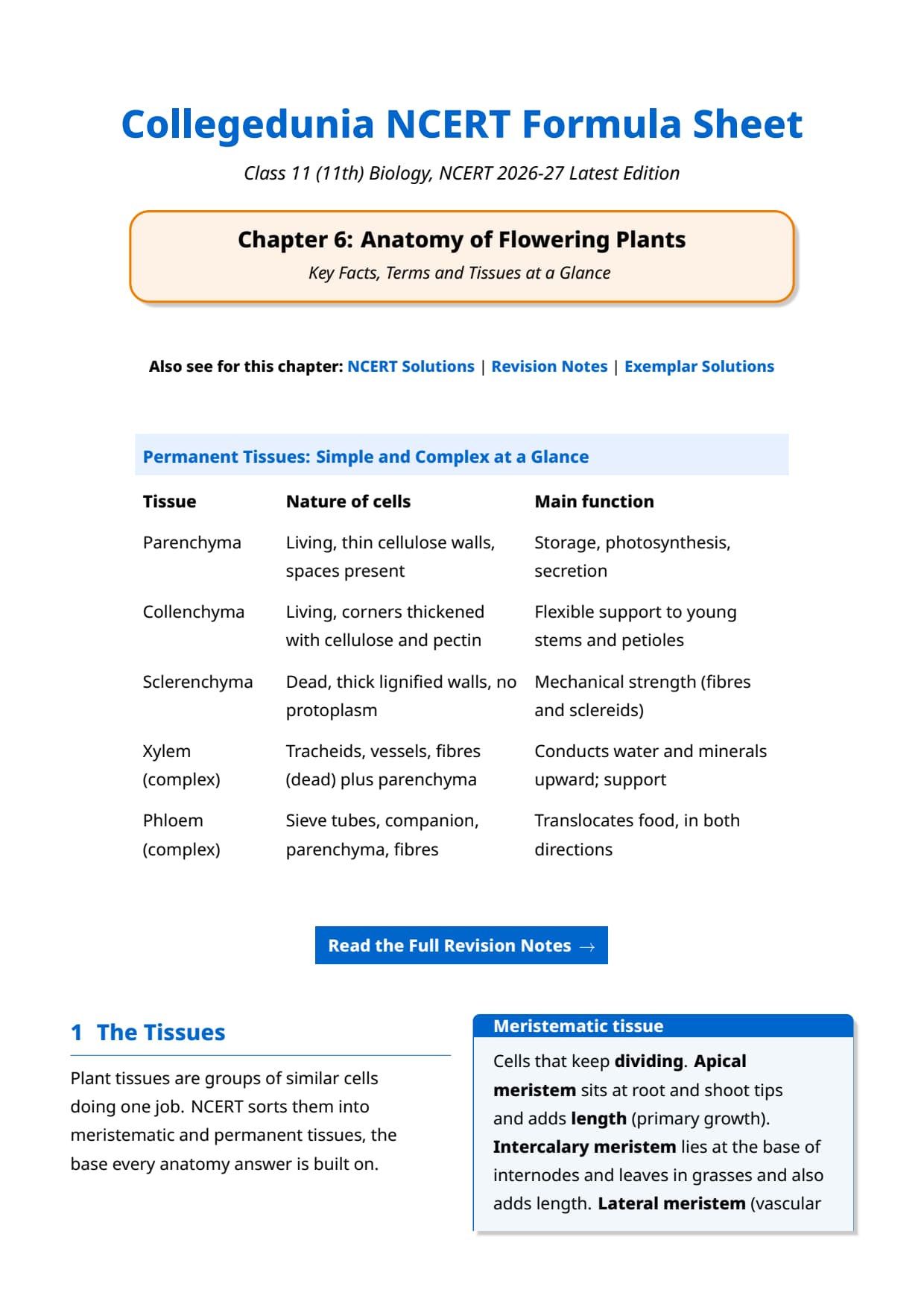
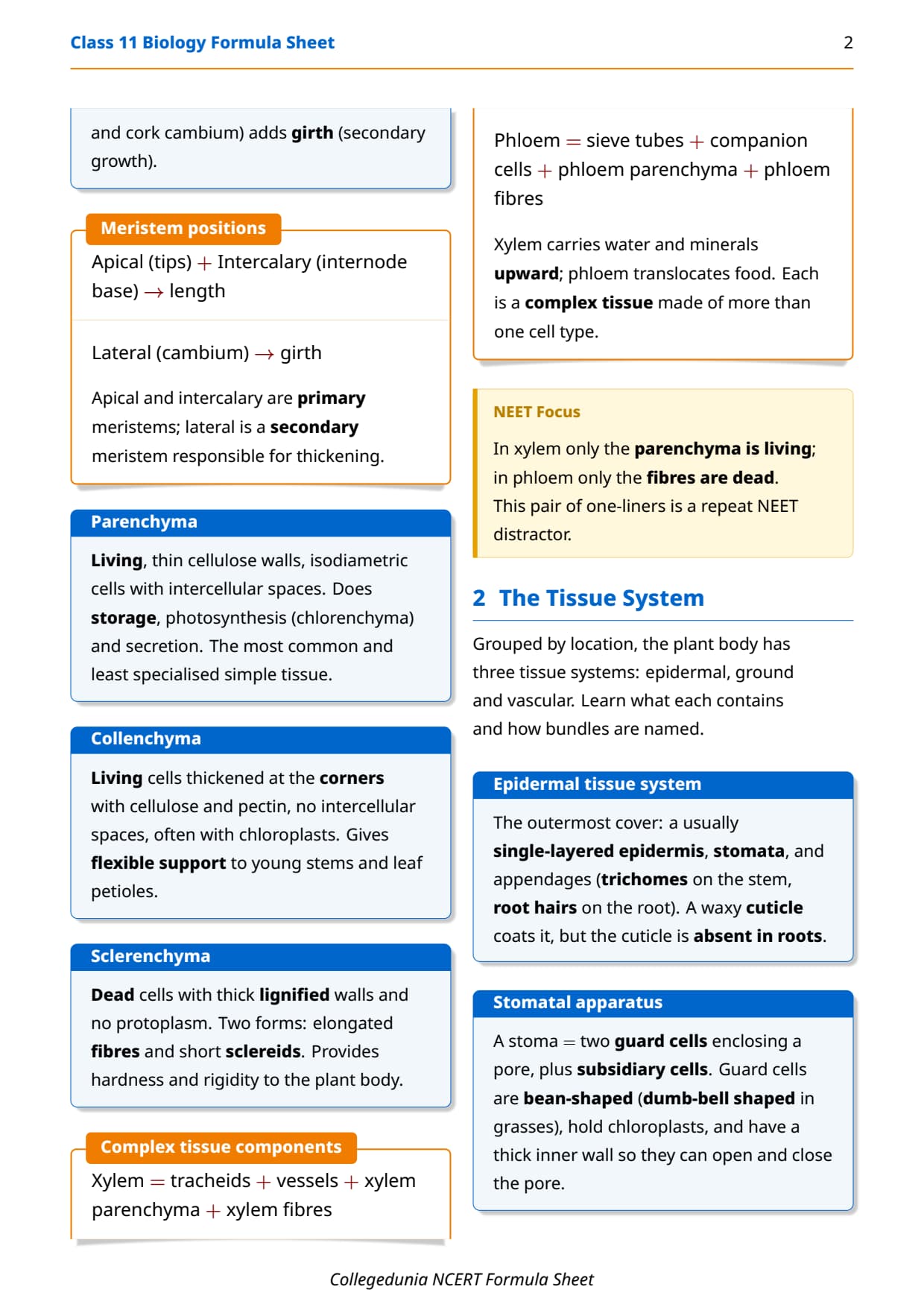
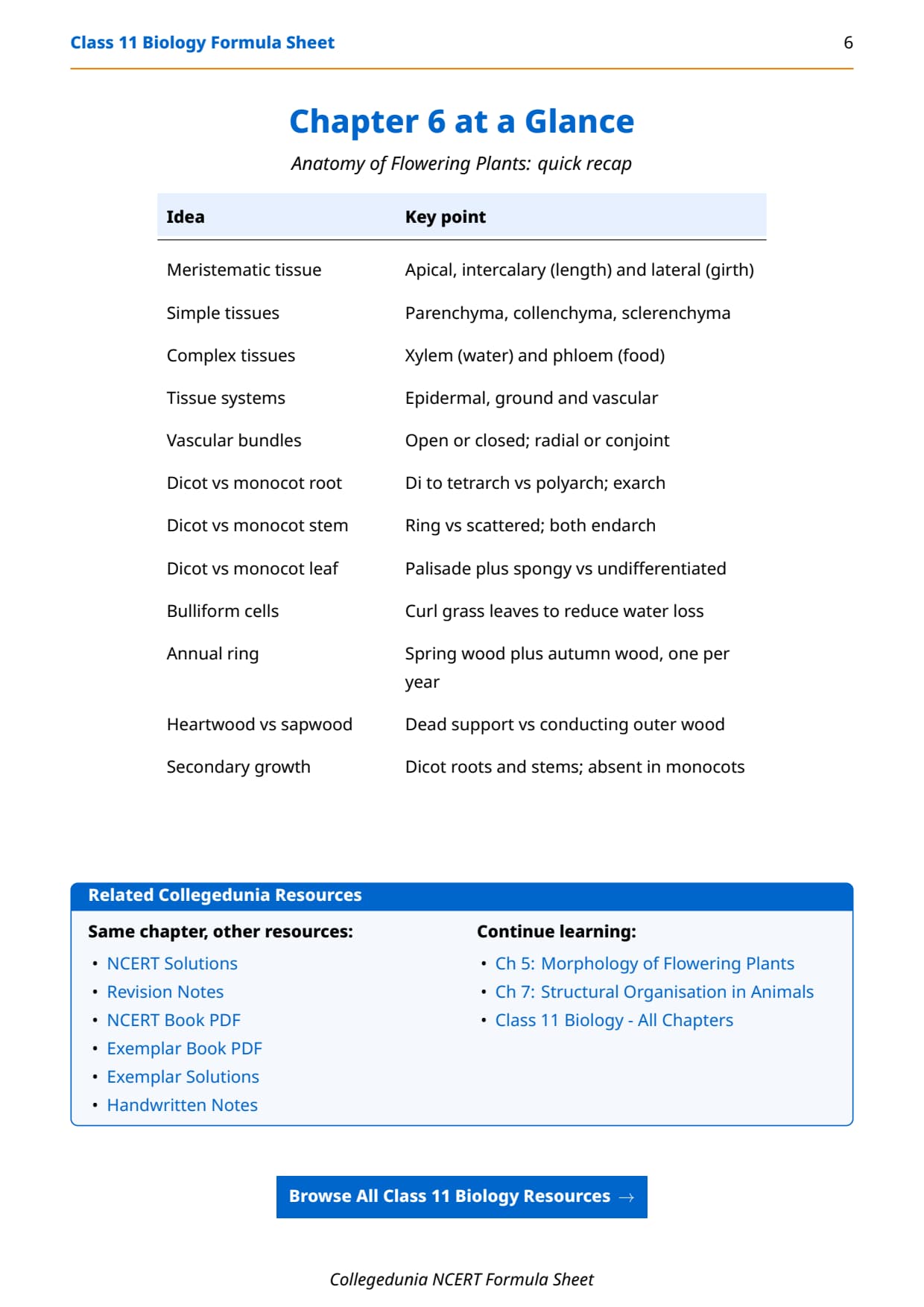
- Covers the simple and complex permanent tissues, with parenchyma, collenchyma, sclerenchyma, xylem and phloem.
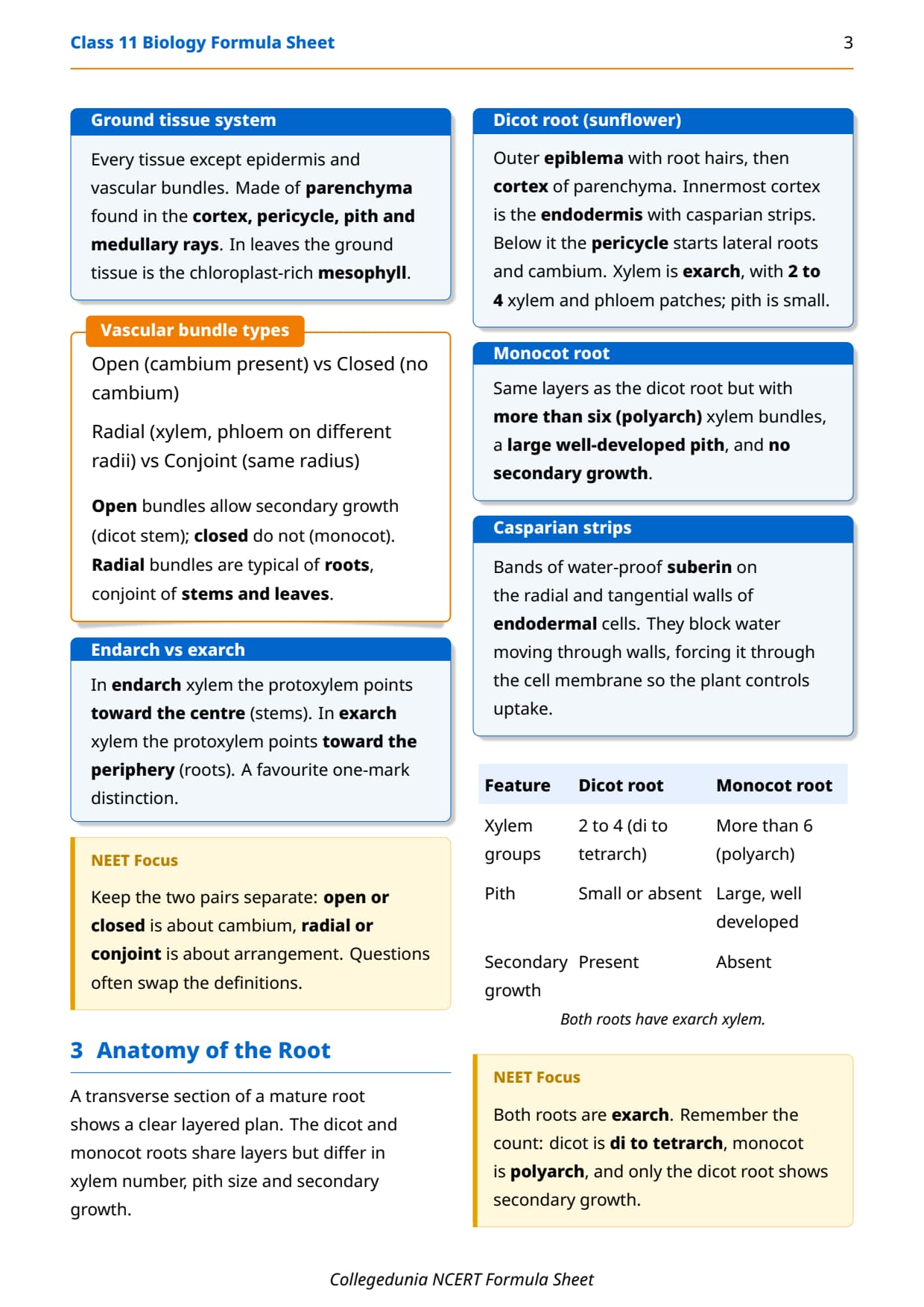
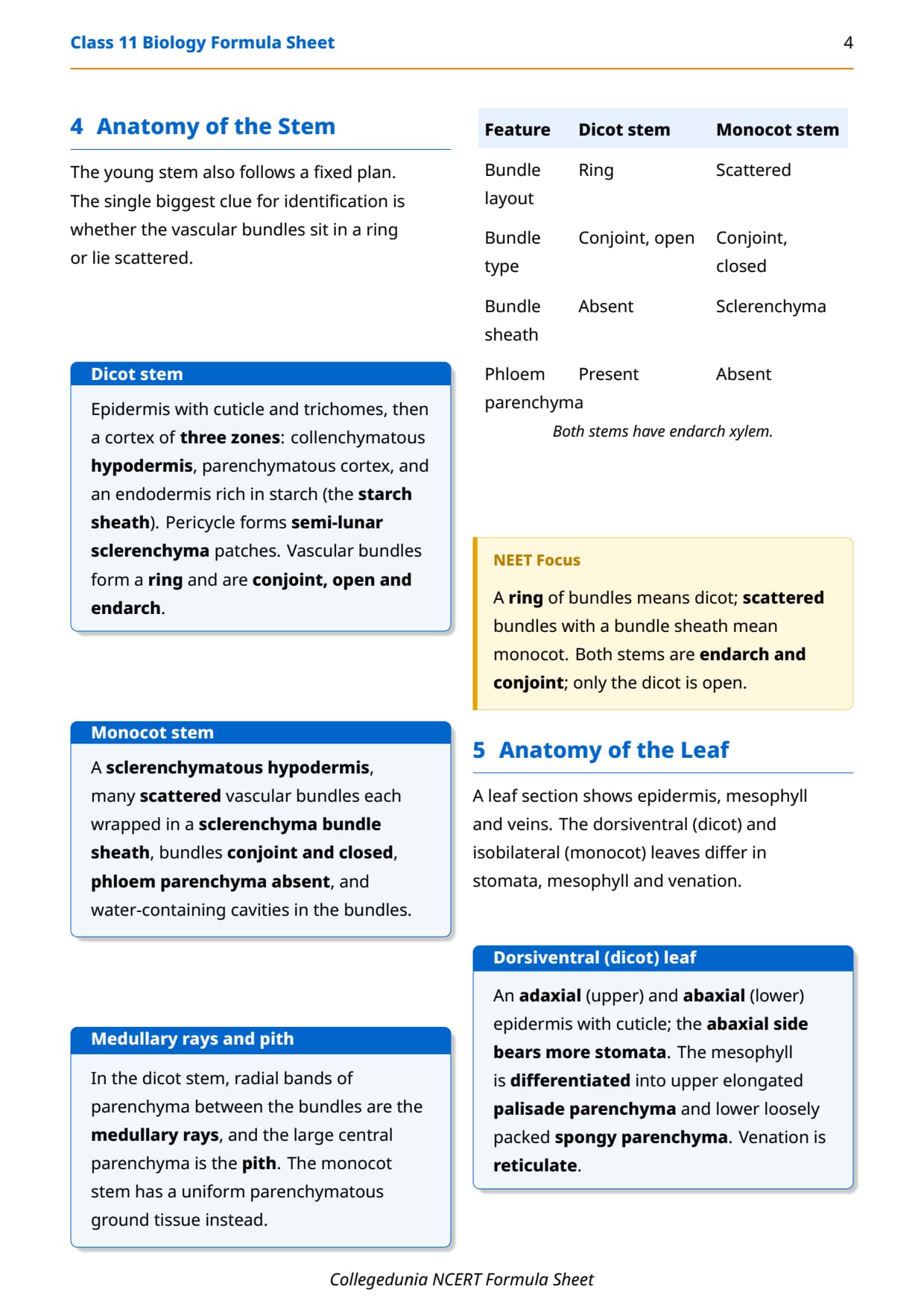
- Lists the dicot versus monocot distinctions for root, stem and leaf in one place.
- Gives the full secondary growth story, from vascular cambium to annual rings, heartwood and bark.
This class 11 biology formula sheet chapter 6 anatomy of flowering plants is curated by subject experts and checked against the 2026-27 NCERT and recent CBSE and NEET papers.
Plant Tissues at a Glance
Permanent tissues are either simple (one cell type) or complex (several cell types working together). Learn which tissues are living and which are dead, since NEET repeatedly tests this one-liner.
| Tissue | Nature of cells | Main function |
|---|---|---|
| Parenchyma (simple) | Living, thin cellulose walls, intercellular spaces | Storage, photosynthesis, secretion |
| Collenchyma (simple) | Living, corners thickened with cellulose and pectin | Flexible support to young stems and petioles |
| Sclerenchyma (simple) | Dead, thick lignified walls, no protoplasm | Mechanical strength (fibres and sclereids) |
| Xylem (complex) | Tracheids, vessels, fibres (dead) plus xylem parenchyma | Conducts water and minerals upward; support |
| Phloem (complex) | Sieve tubes, companion cells, phloem parenchyma, fibres | Translocates food, in both directions |
In xylem only the parenchyma is living; in phloem only the fibres are dead. This pair of one-liners is a repeat NEET distractor.
Monocot vs Dicot Anatomy
A transverse section is identified by a few fixed clues. The stem is the easiest, since a ring of bundles means dicot while scattered bundles mean monocot.
| Organ / Feature | Dicot | Monocot |
|---|---|---|
| Root: xylem groups | 2 to 4 (di to tetrarch) | More than 6 (polyarch) |
| Root: pith | Small or absent | Large, well developed |
| Stem: bundle layout | Ring | Scattered |
| Stem: bundle type | Conjoint, open (endarch) | Conjoint, closed (endarch) |
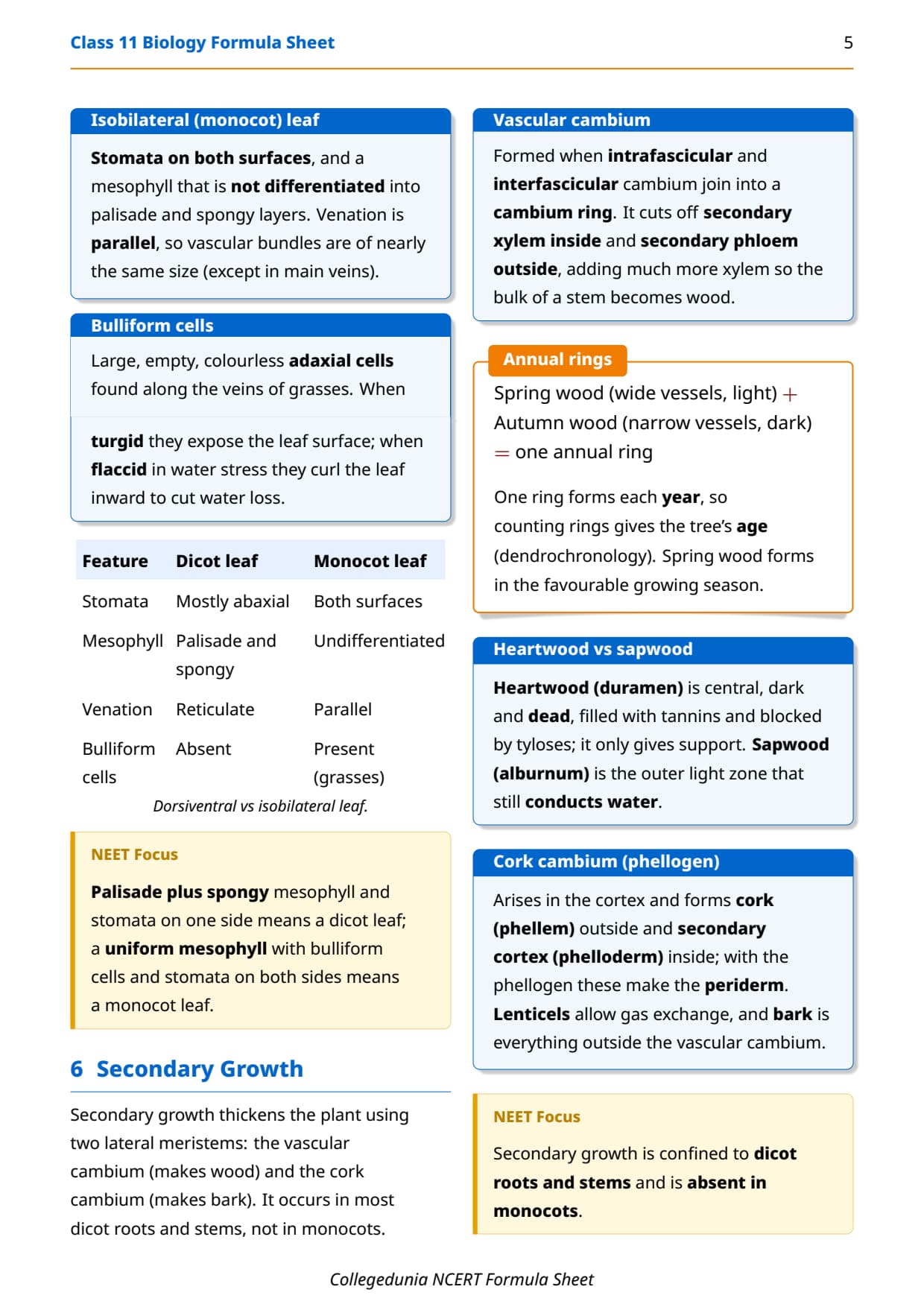
| Leaf: mesophyll | Palisade and spongy | Undifferentiated |
| Leaf: stomata and venation | Mostly abaxial, reticulate | Both surfaces, parallel |
| Secondary growth | Present (root and stem) | Absent |
Both roots are exarch and both stems are endarch. Only the dicot root and stem show secondary growth.
Secondary Growth
Secondary growth thickens the plant using two lateral meristems, the vascular cambium (makes wood) and the cork cambium (makes bark). It occurs in most dicot roots and stems, not in monocots.
| Structure | Key point |
|---|---|
| Vascular cambium | Intrafascicular plus interfascicular cambium form a cambium ring; cuts secondary xylem inside and secondary phloem outside |
| Annual ring | Spring wood (wide vessels, light) plus autumn wood (narrow vessels, dark); one ring per year, so ring count gives age |
| Heartwood (duramen) | Central, dark, dead wood blocked by tyloses; gives only support |
| Sapwood (alburnum) | Outer light wood that still conducts water |
| Cork cambium (phellogen) | Forms cork (phellem) outside and secondary cortex (phelloderm) inside; together with phellogen makes the periderm |
| Bark and lenticels | Bark is everything outside the vascular cambium; lenticels allow gas exchange |
Secondary growth is confined to dicot roots and stems and is absent in monocots.
How to Revise Anatomy of Flowering Plants Before the Exam
This chapter rewards clean terms and a few sharp comparisons more than long answers. A short, ordered revision fixes the tissues and sections in memory.
- List the simple and complex tissues, then note which cells are living and which are dead.
- Draw the dicot versus monocot table for root, stem and leaf, focusing on the one clue that identifies each section.
- Trace the secondary growth sequence from cambium ring to annual rings, heartwood, sapwood and bark.
- Learn the key terms: meristem, casparian strip, endarch and exarch, bulliform cells, tyloses and lenticels.
Student Feedback on the Anatomy of Flowering Plants Formula Sheet
In a survey of 1,200 NEET aspirants who used this sheet, 78% said the single-page dicot versus monocot table made section identification easy to recall. Toppers reported that redrawing the tissue and secondary-growth summaries twice a week made the terms automatic before the exam.
Other Anatomy of Flowering Plants Class 11 Biology Resources
Pair this formula sheet with the solved answers, notes and textbook PDF.
| Resource | Link |
|---|---|
| NCERT Solutions | Anatomy of Flowering Plants Class 11 NCERT Solutions |
| Revision Notes | Anatomy of Flowering Plants Class 11 Notes |
| NCERT Book PDF | Anatomy of Flowering Plants Class 11 Book PDF |
NCERT Formula Sheet for Class 11 Biology: All Chapters
Revise every chapter from one place. Each link opens the formula sheet for that chapter.
| Chapter | Formula Sheet |
|---|---|
| Chapter 1 | The Living World |
| Chapter 2 | Biological Classification |
| Chapter 3 | Plant Kingdom |
| Chapter 4 | Animal Kingdom |
| Chapter 5 | Morphology of Flowering Plants |
| Chapter 6 | Anatomy of Flowering Plants |
| Chapter 7 | Structural Organisation in Animals |
| Chapter 8 | Cell: The Unit of Life |
| Chapter 9 | Biomolecules |
| Chapter 10 | Cell Cycle and Cell Division |
| Chapter 11 | Photosynthesis in Higher Plants |
| Chapter 12 | Respiration in Plants |
| Chapter 13 | Plant Growth and Development |
| Chapter 14 | Breathing and Exchange of Gases |
| Chapter 15 | Body Fluids and Circulation |
| Chapter 16 | Excretory Products and their Elimination |
| Chapter 17 | Locomotion and Movement |
| Chapter 18 | Neural Control and Coordination |
| Chapter 19 | Chemical Coordination and Integration |
FAQs on Anatomy of Flowering Plants Class 11 Biology Formula Sheet
Anatomy of Flowering Plants Formula Sheet - Frequently Asked Questions
Ques. What does the class 11 biology formula sheet chapter 6 anatomy of flowering plants cover?
Ans. This class 11 biology formula sheet chapter 6 anatomy of flowering plants covers the simple and complex permanent tissues, the epidermal, ground and vascular tissue systems, the dicot versus monocot plans of root, stem and leaf, and the full secondary growth story from vascular cambium to annual rings, heartwood, sapwood and bark.
Ques. What is the difference between a dicot stem and a monocot stem?
Ans. In a dicot stem the conjoint, open vascular bundles are arranged in a ring and can undergo secondary growth. In a monocot stem the conjoint, closed bundles are scattered, each wrapped in a sclerenchyma bundle sheath, phloem parenchyma is absent and there is no secondary growth. Both stems have endarch xylem.
Ques. Which tissues are living and which are dead in xylem and phloem?
Ans. Xylem is made of tracheids, vessels and fibres, which are dead, plus living xylem parenchyma, so only the parenchyma is alive. Phloem is made of sieve tubes, companion cells and phloem parenchyma, which are living, plus phloem fibres, so only the fibres are dead. This pair is a common NEET one-mark point.
Ques. What is secondary growth and where does it occur?
Ans. Secondary growth is the thickening of a plant by two lateral meristems, the vascular cambium that forms secondary xylem and phloem, and the cork cambium that forms the periderm. It produces annual rings, heartwood, sapwood and bark, and it occurs in most dicot roots and stems but is absent in monocots.



Comments