




The class 11 biology formula sheet chapter 14 breathing and exchange of gases gathers every value, ratio and gas-transport figure tested in the CBSE Boards, NEET, CUET and other entrance exams. It lists the respiratory volumes and capacities, the partial pressures of oxygen and carbon dioxide, and the transport percentages so students can revise the whole chapter fast.
Breathing and Exchange of Gases is a high-scoring human physiology chapter, and its numbers show up as direct one-mark and assertion-reason questions.
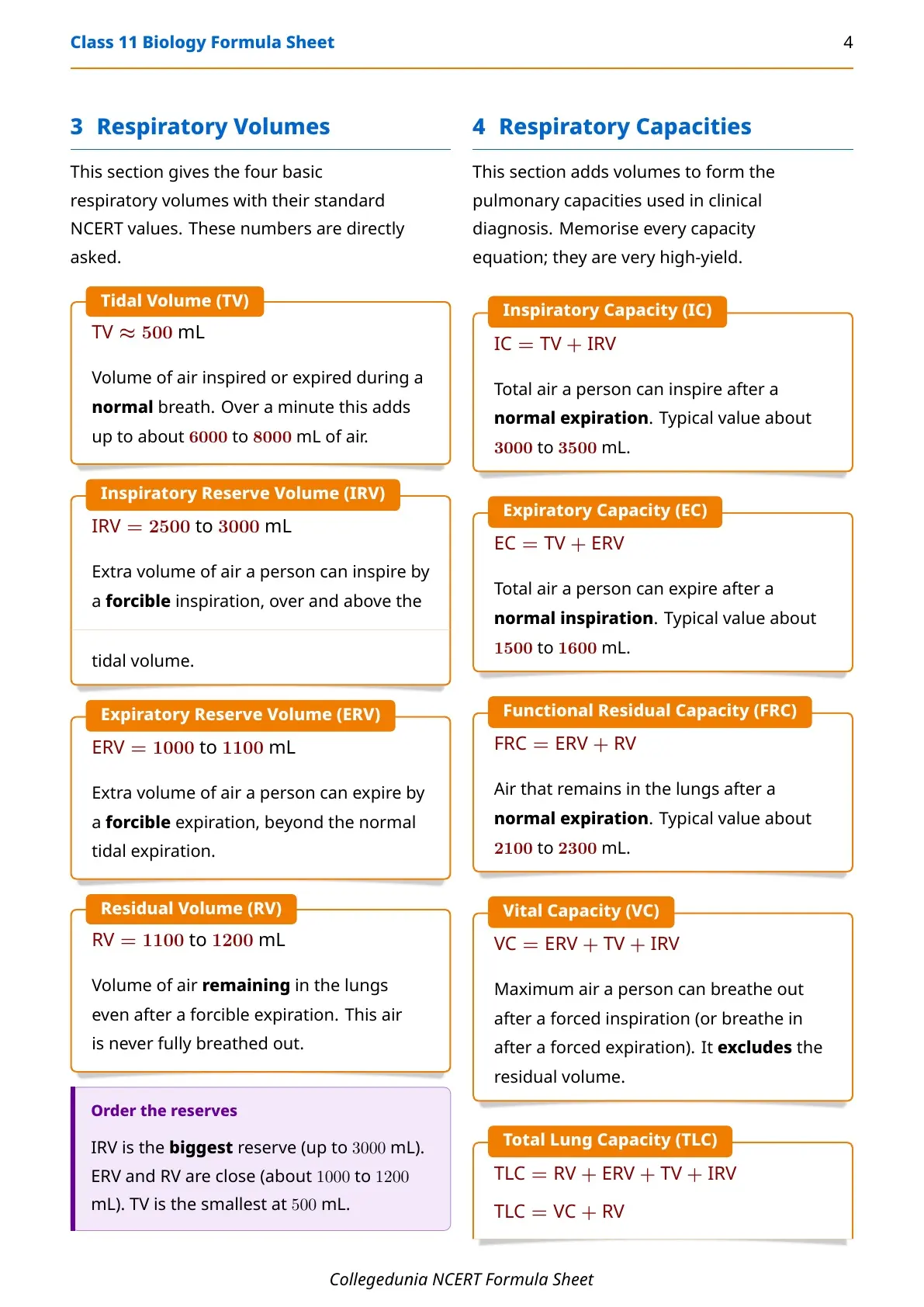
- Covers the four respiratory volumes and five capacities, with TV, IRV, ERV, RV and every capacity equation.
- Lists the partial pressures of O2 and CO2 in the atmosphere, alveoli, blood and tissues.
- Gives the transport percentages for oxygen and carbon dioxide, plus the carbonic anhydrase reaction.
This class 11 biology formula sheet chapter 14 breathing and exchange of gases is curated by subject experts and checked against the 2026-27 NCERT and recent CBSE and NEET papers.
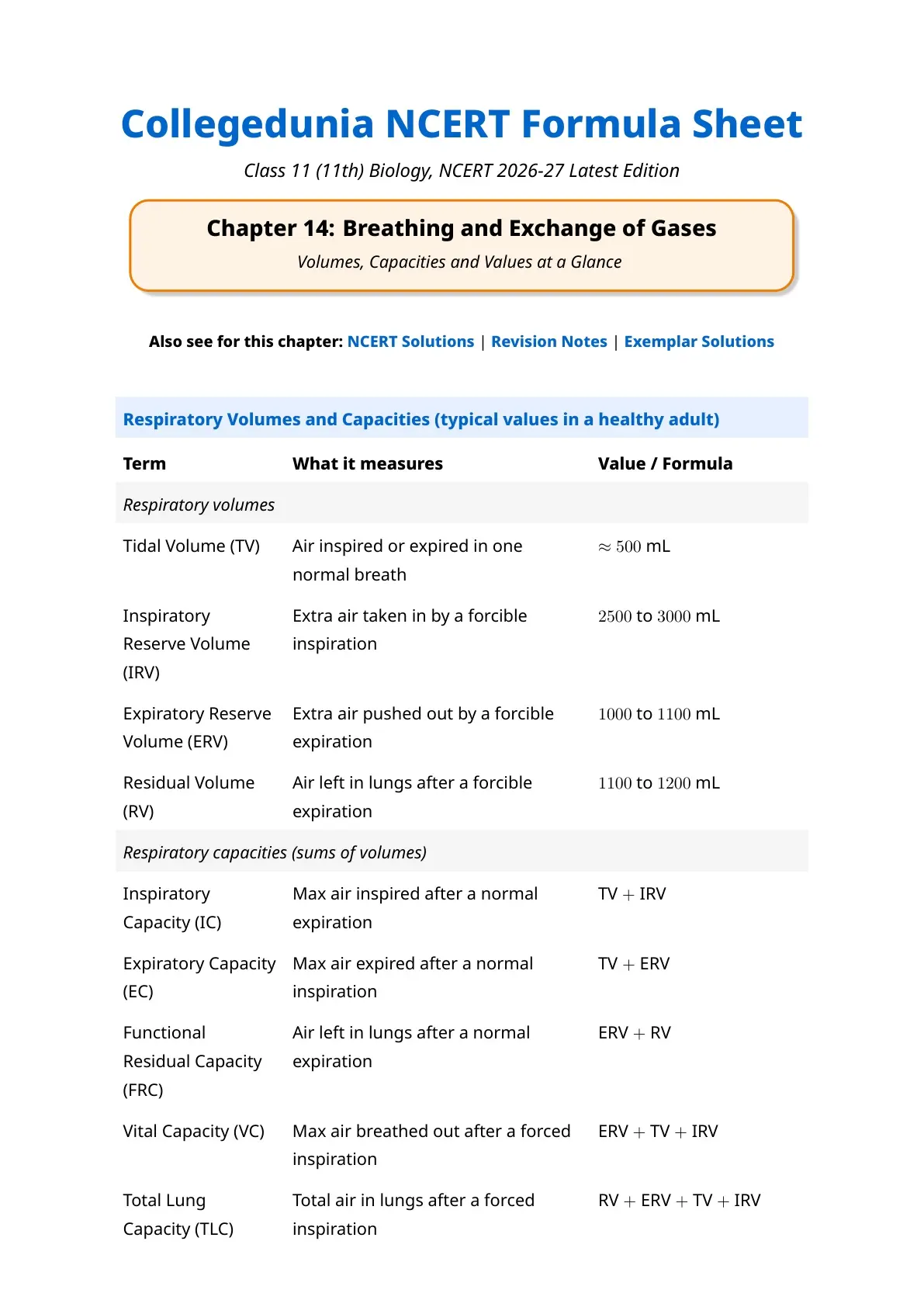
Respiratory Volumes and Capacities at a Glance
Every volume and capacity sits in the table below, with the standard NCERT values and the equations that build each capacity. Learn every capacity equation by heart, since NEET often gives you the volumes and asks you to compute a capacity.
| Term | What it measures | Value / Formula |
|---|---|---|
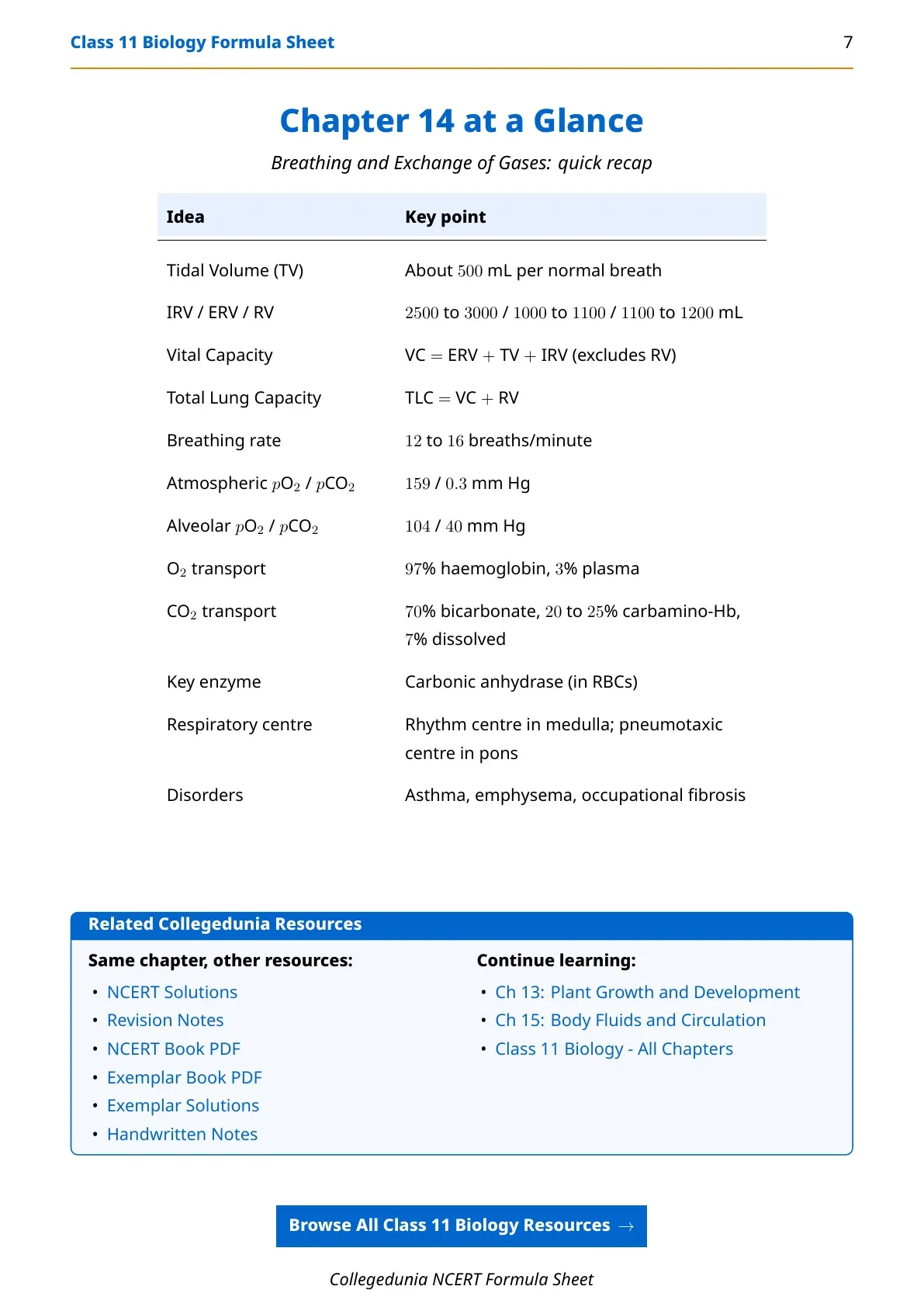
| Tidal Volume (TV) | Air inspired or expired in one normal breath | ≈ 500 mL |
| Inspiratory Reserve Volume (IRV) | Extra air taken in by a forcible inspiration | 2500 to 3000 mL |
| Expiratory Reserve Volume (ERV) | Extra air pushed out by a forcible expiration | 1000 to 1100 mL |
| Residual Volume (RV) | Air left in the lungs after a forcible expiration | 1100 to 1200 mL |
| Inspiratory Capacity (IC) | Max air inspired after a normal expiration | TV + IRV |
| Expiratory Capacity (EC) | Max air expired after a normal inspiration | TV + ERV |
| Functional Residual Capacity (FRC) | Air left in the lungs after a normal expiration | ERV + RV |
| Vital Capacity (VC) | Max air breathed out after a forced inspiration | ERV + TV + IRV |
| Total Lung Capacity (TLC) | Total air in the lungs after a forced inspiration | RV + ERV + TV + IRV = VC + RV |
Only Vital Capacity excludes the Residual Volume, while FRC and TLC both include RV and can never be breathed out fully.
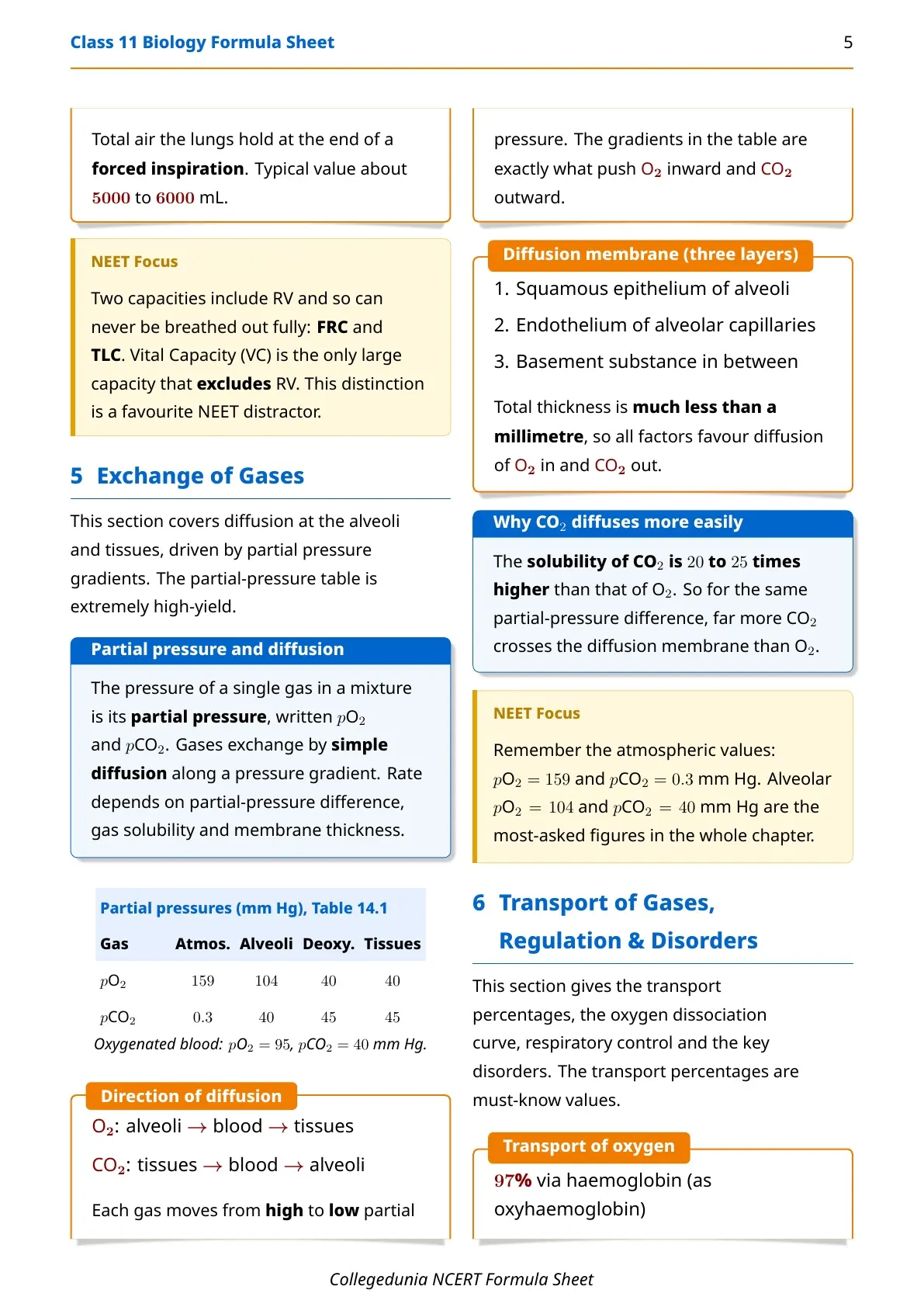
Partial Pressures of Gases
Gases exchange by simple diffusion along a partial-pressure gradient. Memorise this table, since the alveolar and atmospheric figures are the most-asked numbers in the whole chapter.
| Gas | Atmosphere | Alveoli | Deoxygenated blood | Tissues |
|---|---|---|---|---|
| pO2 | 159 mm Hg | 104 mm Hg | 40 mm Hg | 40 mm Hg |
| pCO2 | 0.3 mm Hg | 40 mm Hg | 45 mm Hg | 45 mm Hg |
In oxygenated blood pO2 = 95 and pCO2 = 40 mm Hg; O2 moves alveoli to blood to tissues, while CO2 moves the opposite way. The solubility of CO2 is 20 to 25 times higher than that of O2.
Transport of Oxygen and Carbon Dioxide
Blood carries each gas in more than one form, but one form dominates. Fix these percentages exactly, because swapping the O2 and CO2 splits is a classic NEET trap.
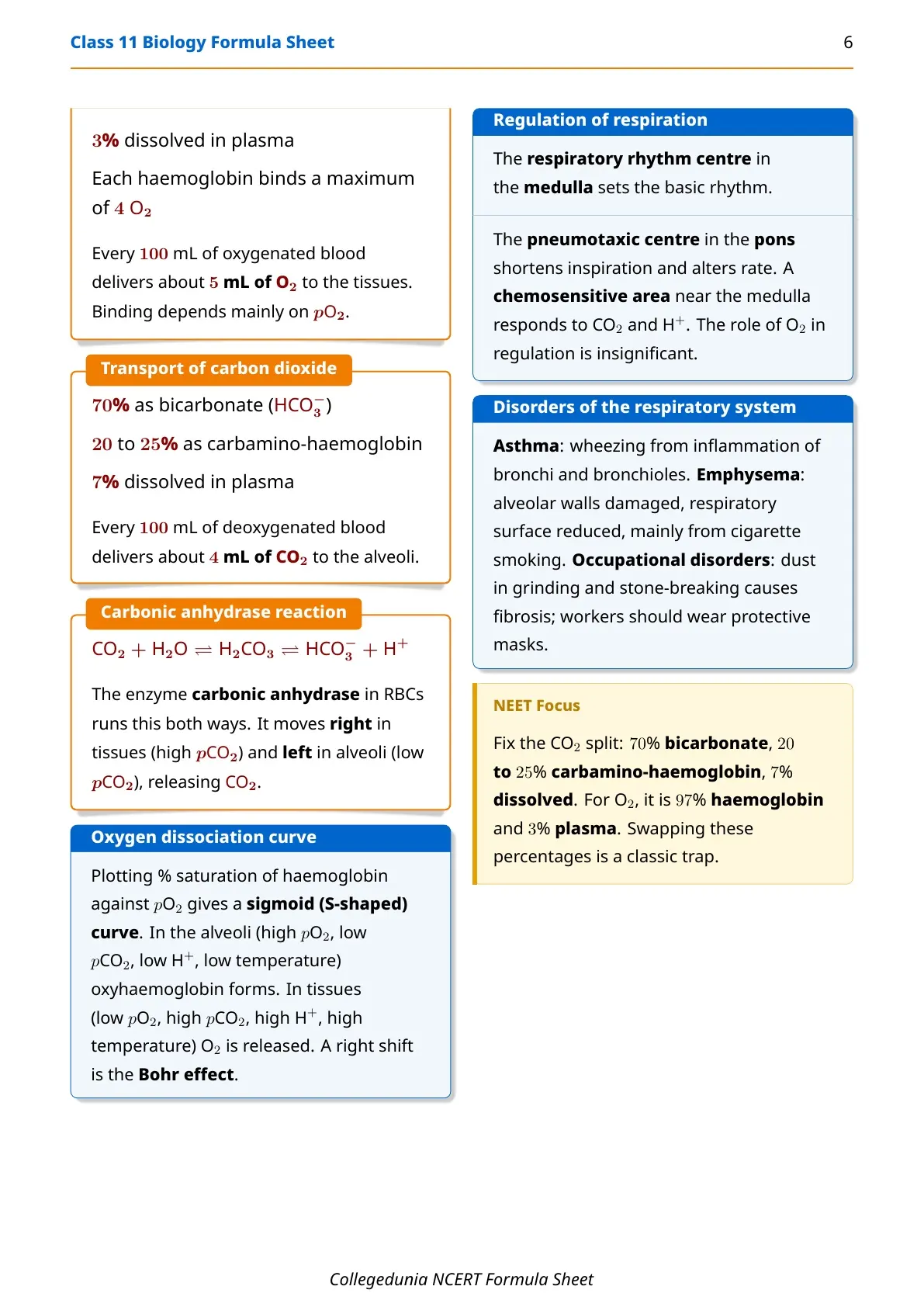
| Gas | Form of transport | Share |
|---|---|---|
| Oxygen (O2) | As oxyhaemoglobin (bound to haemoglobin) | ≈ 97% |
| Oxygen (O2) | Dissolved in plasma | ≈ 3% |
| Carbon dioxide (CO2) | As bicarbonate (HCO3−) | ≈ 70% |
| Carbon dioxide (CO2) | As carbamino-haemoglobin | 20 to 25% |
| Carbon dioxide (CO2) | Dissolved in plasma | ≈ 7% |
The enzyme carbonic anhydrase in the red blood cells drives CO2 + H2O ⇄ H2CO3 ⇄ HCO3− + H+. Each 100 mL of oxygenated blood delivers about 5 mL of O2, and 100 mL of deoxygenated blood delivers about 4 mL of CO2.
How to Revise Breathing and Exchange of Gases Before the Exam
This chapter rewards clean numbers more than long answers. A short, ordered revision fixes the values in memory and keeps the NEET distractors from tripping you up.
- Write the four respiratory volumes with their values, then build every capacity as a sum of volumes.
- Memorise the partial pressures of O2 and CO2 in the atmosphere, alveoli, blood and tissues.
- Learn the transport percentages: 97% and 3% for oxygen, 70% / 20 to 25% / 7% for carbon dioxide.
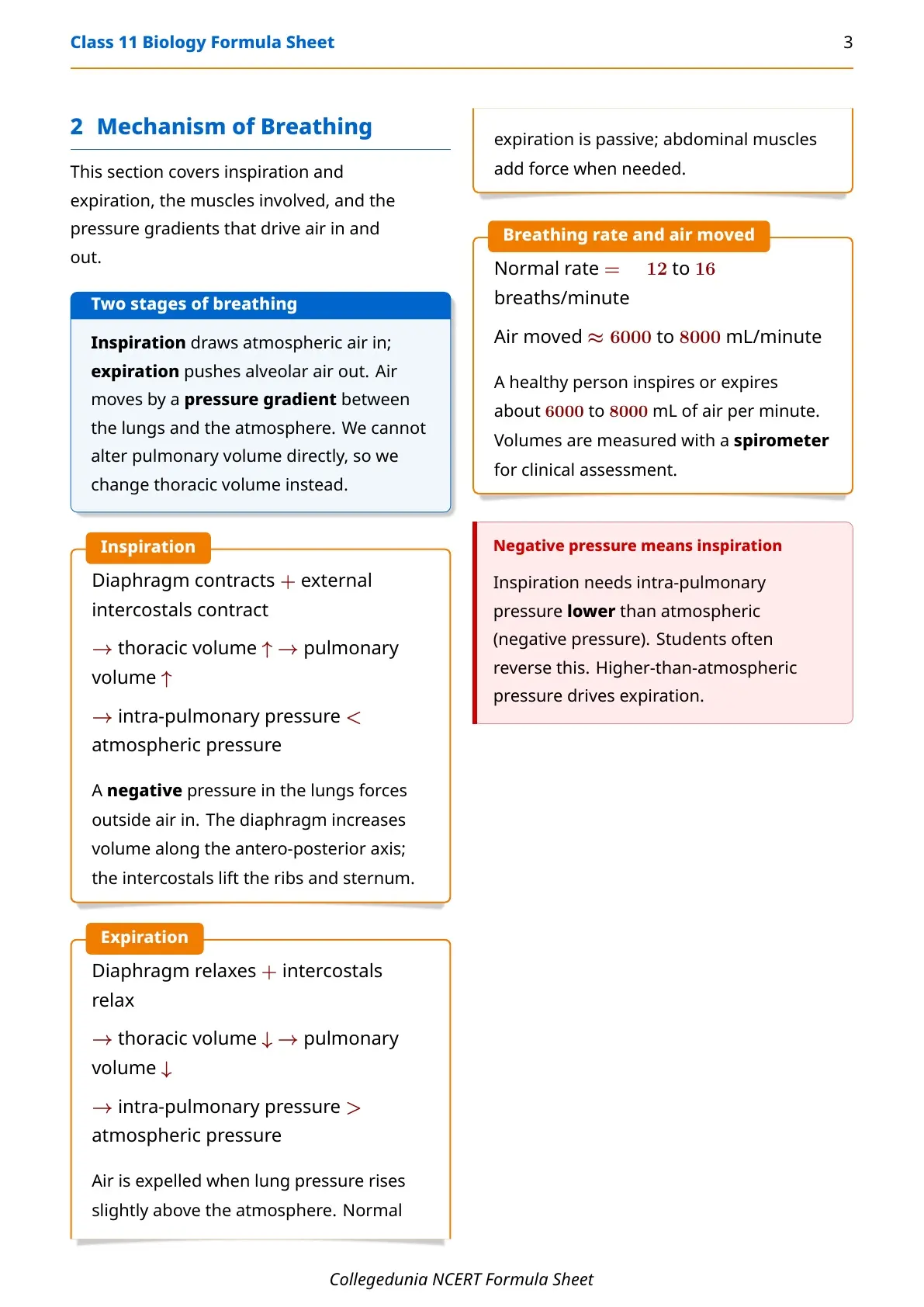
- Note the key facts: normal breathing rate is 12 to 16 per minute, and carbonic anhydrase works in the RBCs.
Student Feedback on the Breathing and Exchange of Gases Formula Sheet
In a survey of 1,200 NEET aspirants who used this sheet, 84% said the single-page volumes-and-capacities table made the equations easy to recall. Toppers reported that reciting the O2 and CO2 transport percentages daily stopped them from swapping the two splits in the exam.
Other Breathing and Exchange of Gases Class 11 Biology Resources
Pair this formula sheet with the solved answers, notes and textbook PDF.
| Resource | Link |
|---|---|
| NCERT Solutions | Breathing and Exchange of Gases Class 11 NCERT Solutions |
| Revision Notes | Breathing and Exchange of Gases Class 11 Notes |
| NCERT Book PDF | Breathing and Exchange of Gases Class 11 Book PDF |
NCERT Formula Sheet for Class 11 Biology: All Chapters
Revise every chapter from one place. Each link opens the formula sheet for that chapter.
| Chapter | Formula Sheet |
|---|---|
| Chapter 1 | The Living World |
| Chapter 2 | Biological Classification |
| Chapter 3 | Plant Kingdom |
| Chapter 4 | Animal Kingdom |
| Chapter 5 | Morphology of Flowering Plants |
| Chapter 6 | Anatomy of Flowering Plants |
| Chapter 7 | Structural Organisation in Animals |
| Chapter 8 | Cell: The Unit of Life |
| Chapter 9 | Biomolecules |
| Chapter 10 | Cell Cycle and Cell Division |
| Chapter 11 | Photosynthesis in Higher Plants |
| Chapter 12 | Respiration in Plants |
| Chapter 13 | Plant Growth and Development |
| Chapter 14 | Breathing and Exchange of Gases |
| Chapter 15 | Body Fluids and Circulation |
| Chapter 16 | Excretory Products and their Elimination |
| Chapter 17 | Locomotion and Movement |
| Chapter 18 | Neural Control and Coordination |
| Chapter 19 | Chemical Coordination and Integration |
FAQs on Breathing and Exchange of Gases Class 11 Biology Formula Sheet
Breathing and Exchange of Gases Formula Sheet - Frequently Asked Questions
Ques. What does the class 11 biology formula sheet chapter 14 breathing and exchange of gases cover?
Ans. This class 11 biology formula sheet chapter 14 breathing and exchange of gases covers the four respiratory volumes with NCERT values, every capacity equation, the partial pressures of O2 and CO2 across the atmosphere, alveoli, blood and tissues, and the transport percentages for oxygen and carbon dioxide along with the carbonic anhydrase reaction.
Ques. What are the values of the respiratory volumes?
Ans. In a healthy adult the Tidal Volume (TV) is about 500 mL per normal breath, the Inspiratory Reserve Volume (IRV) is 2500 to 3000 mL, the Expiratory Reserve Volume (ERV) is 1000 to 1100 mL and the Residual Volume (RV) is 1100 to 1200 mL. Capacities are sums of these, so Vital Capacity is ERV + TV + IRV and Total Lung Capacity is VC + RV.
Ques. How are oxygen and carbon dioxide transported in blood?
Ans. About 97% of oxygen is carried bound to haemoglobin as oxyhaemoglobin and about 3% is dissolved in plasma. Carbon dioxide is carried about 70% as bicarbonate, 20 to 25% as carbamino-haemoglobin and about 7% dissolved in plasma. The enzyme carbonic anhydrase in the red blood cells speeds the bicarbonate reaction both ways.
Ques. What are the partial pressures of oxygen and carbon dioxide in the alveoli?
Ans. In the alveoli the partial pressure of oxygen (pO2) is 104 mm Hg and that of carbon dioxide (pCO2) is 40 mm Hg, compared with 159 mm Hg and 0.3 mm Hg in the atmosphere. These gradients drive O2 from the alveoli into the blood and CO2 from the blood into the alveoli by simple diffusion.



Comments