History Strategist, UPSC Mentor | Updated on - Jul 21, 2026
The NCERT Solutions for History Class 12 NCERT Solutions Chapter 4 Thinkers, Beliefs and Buildings cover every textbook question on the new ideas, beliefs and buildings of c. 600 BCE to 600 CE, as per the latest 2026-27 CBSE syllabus. Each answer explains the Upanishads, Jainism, the Buddha, the sangha, stupas like Sanchi, and early temples in plain points. These solutions help students prepare for the Class 12 History board paper and the UPSC foundation in 2026-27.
Covers all 12 exercise questions from Theme 4, with full source-based, map and long-answer points.
This Class 12 History chapter usually carries 6 to 8 marks per board paper.
Pairs with the Notes, Handwritten Notes and NCERT Book PDF linked lower on this page.
Every solution for class 12 history chapter 4 in this Collegedunia compilation is curated by subject experts, written from the official NCERT Themes in Indian History Part I, and checked against the last five years of CBSE board papers.
Student Feedback: In a Collegedunia poll of 10,260 Class 12 History students conducted before the 2026 boards, 69% of students rated the "how and why stupas were built" question as the toughest part of Thinkers, Beliefs and Buildings. Most students said splitting the answer into "why" and "how" made it click.
Source: 2026-27 Class 12 History student poll. Sample of 10,260 students from CBSE schools across 14 states.
What the Thinkers, Beliefs and Buildings Class 12 Chapter Is About
Thinkers, Beliefs and Buildings is the fourth chapter of Themes in Indian History Part I. It studies the burst of new ideas and religions between roughly 600 BCE and 600 CE, and how those beliefs took shape in stone. The chapter is special because it ties thought, faith and art together, so a single question can move from philosophy to sculpture.
The title itself splits the chapter into three threads students should keep apart:
Thinkers stand for the Upanishadic teachers, the fatalists, the materialists, Mahavira and the Buddha.
Beliefs stand for Jainism, Buddhism, and the growth of Vaishnavism and Shaivism.
Buildings stand for stupas like Sanchi and Amaravati, and the first temples.
So the chapter is really about how ideas became buildings. A student who keeps the three threads in mind can connect almost any question in chapter 4 history class 12 back to a thinker, a belief or a building. This is why history 12 class chapter 4 revision works best when you sort each fact under one of the three heads first.
Sacrifices, Upanishads, Fatalists and Materialists
The chapter opens with the older Vedic sacrificial tradition, where people offered yajnas to gods like Agni, Indra and Soma. Around the sixth century BCE, new thinkers began to question this. Their debates set up the whole chapter, and they come up in the first comparison question.
The main streams of thought students should remember are:
Upanishadic thinkers: asked about the meaning of life, rebirth and the ultimate reality, the self or atman.
Fatalists (Ajivikas): held that everything was already fixed, so human effort could not change one's fate.
Materialists (Lokayata): said only this world is real, with no soul, rebirth or afterlife.
Common ground: all questioned blind ritual, but they answered the big questions in very different ways.
The first exercise question asks whether the Upanishadic thinkers differed from the fatalists and materialists. Yes, they did. The Upanishadic teachers still searched for a deeper truth and accepted rebirth, while the fatalists denied free will and the materialists denied the soul itself. A strong answer names all three streams and shows the exact point of difference.
Jainism and the Teachings of Mahavira
Jainism is the first of the two great new religions in the chapter. It was taught by Mahavira (Vardhamana) in the sixth century BCE, the last of 24 tirthankaras. Its core ideas are simple to list, which is why the summary question is a steady scorer.
Teaching
What it means
Life in everything
The whole world, even stones, water and air, is alive and can feel pain.
Ahimsa
Non-injury to all beings is the central principle of Jain belief.
The cycle of rebirth
Karma binds the soul; only right conduct can free it from rebirth.
Asceticism and renunciation
Freedom needs hard self-denial, so monastic life is highly valued.
Five vows
Not to kill, steal, lie, be unchaste, or hold property; monks keep them fully.
For the summary question, the single most important point is ahimsa, non-injury to every living thing. Jain monks spread these ideas across the subcontinent, and gradual royal and merchant support helped Jainism survive to the present day. Keep the five vows and ahimsa ready, as they earn the marks in the central-teachings answer.
The Buddha, the Sangha and Why People Joined
The Buddha is the heart of the chapter. He taught the middle path between harsh self-denial and easy comfort, and he set up the sangha, an organisation of monks and nuns. Several questions test why men and women joined this community.
Students should be ready with the reasons people joined the sangha:
A search for peace: the Buddha's message of an end to suffering drew many seekers.
Open to all: kings, traders, workers, slaves and craftspeople could all join.
Women too: after Ananda's request, the Buddha allowed women into the sangha as bhikkhunis.
A new equality: inside the sangha, old caste and birth ranks lost their force.
The honest answer to "why did women and men join the sangha" is that the sangha offered a path out of suffering and a community where birth mattered less. For the inscription question, students must read the Madhuvanaka record carefully: Dhanavati dated it by the regnal year of the Kushana king Huvishka, and the inscription shows that nuns, like the bhikkhuni Buddhamita who knew the Tipitaka, were learned and respected.
How and Why Stupas Were Built
The "buildings" of the title begin with the stupa, a mound built over relics of the Buddha. The "how and why stupas were built" question is the chapter's most-asked long answer, so it has its own section here. The trick is to split the answer into purpose and structure.
Half of the answer
Key points to recall
Why stupas were built
To hold relics of the Buddha; relics were shared after his death; later, places linked to his life became sacred too.
How they were funded
Kings like Asoka, guilds, and ordinary devotees gave gifts; donor names are carved on railings and gateways.
How they were built
A hemispherical mound (anda) over a base, with a harmika, a yashti, a railing and carved gateways (toranas).
One sharp exam point is the role of donors. Inscriptions on the railings and pillars name kings, guilds and common people who paid for parts of the stupa. This shows that building a stupa was a shared act of faith, not just a royal project. For the full answer, give both the "why" (relics and sacred sites) and the "how" (funding plus the anatomy of the mound).
Sanchi Sculpture, Vaishnavism, Shaivism and Temples
The chapter then turns to how art and architecture carried these beliefs. The Sanchi carvings, and later the rise of Vaishnavism and Shaivism, link directly to several questions, including the two-scene description and the temple-development essay.
Reading Sanchi: art historians use Buddhist texts, the Jatakas and life-stories of the Buddha, to make sense of the carvings.
Symbols of worship: early art showed the Buddha through an empty seat, a stupa, a wheel or footprints, not a human figure.
Rural and urban scenes: in Figs. 4.32 and 4.33, the thatched huts and trees mark the rural scene, while gateways and buildings mark the urban one.
Vaishnavism and Shaivism: worship of Vishnu and Shiva grew, with avatars of Vishnu and the linga of Shiva shown in sculpture.
For the temple question, the key development is that the first temples, built from about the third century CE, housed a single deity in a small shrine room called the garbhagriha. Over time a tower (shikhara) was added above it, and the walls carried rich sculpture. Linking Buddhist literature to the Sanchi carvings shows how text and image work together, which is the point of Question 4.6.
The Begums of Bhopal and the Rediscovery of Sanchi
The chapter closes with how Sanchi survived when many other sites were lost. This story is the focus of the begums-of-Bhopal question, a steady short answer. The stupa lay in the princely state of Bhopal, and its rulers chose to protect it.
Theme
Key points to recall
The threat
European officers wanted to carry off the gateways; the stupa could have been taken apart and shipped abroad.
The begums' role
Shahjehan Begum and Sultan Jehan Begum funded the museum and the guesthouse, and preserved the stupa in place.
The record
Sultan Jehan Begum also funded John Marshall's volumes on Sanchi, dedicating money to the scholarship.
The takeaway for the begums question is simple. Because the begums kept Sanchi in situ and paid for its upkeep, the best-preserved Buddhist stupa survived for students to study today. This is why Sanchi, and not the better-funded Amaravati, became the model site in the chapter. Note this contrast, since the exam often pairs the two stupas.
Thinkers, Beliefs and Buildings Class 12 Exercise-wise Coverage
The chapter exercise has 12 questions. The table maps each one to its topic so students can plan revision and find the right NCERT answer fast. The full step-by-step solution for each sits in the question set lower on this page.
Question
Topic it tests
Q 4.1
Upanishadic thinkers compared with fatalists and materialists
Q 4.2
The central teachings of Jainism
Q 4.3
The role of the begums of Bhopal in preserving Sanchi
Q 4.4
Source-based reading of the Madhuvanaka inscription
Q 4.5
Why women and men joined the sangha
Q 4.6
How Buddhist literature helps read the Sanchi sculpture
Q 4.7
Describing the rural and urban scenes in Figs. 4.32 and 4.33
Q 4.8
Sculpture and architecture of Vaishnavism and Shaivism
Q 4.9
How and why stupas were built
Q 4.10 to 4.12
Map work and project-style activities
Questions 4.5, 4.6 and 4.9 are the most-asked long answers, so students preparing chapter 4 history class 12 revision should learn those three first. The map and project tasks (4.10 to 4.12) are also useful for the history project file class 12 chapter 4 that many schools assign.
Students who want the offline copy can save the class 12 history chapter 4 pdf from the download card above and tick off each question as they finish it.
Thinkers, Beliefs and Buildings Important Questions and Previous Year Trends
CBSE sets a steady mix of source-based, short and long answers from this chapter. Knowing the pattern helps students decide how much to write. The chapter is a regular source of one 5-mark or 8-mark source-based question, which is why a focused list of chapter 4 history class 12 important questions saves a lot of revision time.
Source-based (often 8 marks): a passage on a stupa, an inscription or a Sanchi scene, with three sub-parts.
Long answer (5 to 6 marks): how and why stupas were built, or the teachings of Jainism and Buddhism.
Short answer (3 marks): the begums of Bhopal, symbols of worship, or why people joined the sangha.
Objective and MCQ: dates, the 24th tirthankara, the parts of a stupa, and the name of the best-preserved site.
For quick recall before the exam, students often practise the class 12 history chapter 4 mcq set and a list of class 12 history chapter 4 important questions. The most repeated history class 12 chapter 4 question answer items are the stupa-building essay and the Jainism teachings, so keep those answer points ready in your own words.
It also helps to attempt a short history class 12 chapter 4 mcq drill and the class 12 history chapter 4 extra questions and answers after you finish the main exercise. These extra sets test the small facts, such as exact dates and the names of stupa parts, that examiners use for one-mark objective questions.
Working through the ncert solution class 12 history chapter 4 set twice, once open-book and once from memory, fixes those facts well before the board exam.
Common Mistakes Students Make in the Thinkers, Beliefs and Buildings Chapter
A few errors cost marks every year in this chapter. Most come from mixing up the thinkers or from giving half an answer on the stupa question. Avoiding them is the fastest way to lift a score.
Mixing up the fatalists and materialists - fatalists deny free will, materialists deny the soul.
Answering only "why" or only "how" stupas were built - the question needs both halves.
Saying early art showed the Buddha as a human figure - it used an empty seat, wheel or stupa instead.
Forgetting that the begums kept Sanchi in situ - this is the heart of the preservation answer.
Confusing the tirthankaras - Mahavira was the 24th and last, not the first.
Students who fix these five points usually move from average to high marks on the long answers. The exam rewards precise wording, so name each thinker and each stupa part exactly as the NCERT does.
Thinkers, Beliefs and Buildings PDF Download Formats and Languages
The solutions are free to download in more than one format, so students can pick what suits their device and revision style. The download card at the top of the page carries each option for this chapter.
Normal and HD PDF: the history class 12 chapter 4 pdf is offered in a normal size for quick downloads and an HD version for clear printing.
English medium: all 12 answers are written in simple English for the CBSE board paper.
Question-only set: a print-and-practise sheet of class 12 history chapter 4 extra questions for self-testing.
Whole-book pack: the chapter 4 history class 12 ncert solutions sit in one set that runs through every theme, so you can revise from Chapter 1 to the final chapter in one place.
Many students search for class 12 chapter 4 history answers on their phone the night before a test, so a saved PDF means you can revise even without internet. Keep both the question set and the solved version handy for a full self-check.
How the Thinkers, Beliefs and Buildings Solutions Pair with Notes and the Book PDF
These NCERT Solutions answer the back-exercise questions. To revise the full chapter, students should use them alongside the other resources for the same chapter, all linked in the table below.
Reading the original NCERT chapter text and figures
Tip: read the Notes first, then attempt these solutions on your own, and only then check the model answers here. That order builds memory faster than copying answers straight away.
All NCERT Solutions for Class 12 History Chapter 4 Thinkers, Beliefs and Buildings
The table links the NCERT Solutions for every chapter in Themes in Indian History so students can move across the book in one click. Chapter 4 is highlighted.
All NCERT Solutions for Thinkers, Beliefs and Buildings with Step-by-Step Solutions
Below are all 12 NCERT exercise questions for this chapter, exactly as they appear in the textbook. Tap Check Solution for the model answer or Expert Solution for the topper-style approach.
Q 4.1
Were the ideas of the Upanishadic thinkers different from those of
the fatalists and materialists? Give reasons for your answer.
Concept used. This question asks you to compare three
streams of thought from around the sixth century BCE. The
Upanishadic thinkers asked about the meaning of life, rebirth and
the ultimate reality (the self, or atman). The fatalists
(Ajivikas) held that everything was predetermined, while the
materialists (Lokayatas) denied any soul or life after death.
Yes, the ideas were clearly different. The reasons:
The Upanishadic thinkers were seekers. They were curious
about life, the possibility of life after death, and rebirth: was
rebirth the result of past actions? They tried to understand the
nature of the ultimate reality, holding that there was an eternal
self (atman) within each person, smaller than a grain yet greater
than the worlds.
The fatalists denied human effort. Makkhali Gosala of the
Ajivika tradition taught that pleasure and pain are fixed and cannot
be altered by penance or wisdom. Just as a thrown ball of string
unwinds to its full length, the fool and the wise alike simply run
their course. So no striving can change one's fate.
The materialists denied the soul itself. Ajita
Kesakambalin of the Lokayata tradition taught that a human being is
made of the four elements (earth, water, fire, air). At death each
element returns to its source, and nothing survives. He dismissed
alms, sacrifice and offerings as "the talk of fools".
So the Upanishadic thinkers believed in an enduring self and in rebirth
shaped by action, while the fatalists made action useless and the
materialists denied any afterlife at all. The three positions point in three
different directions.
Name the school behind each label
Tie "fatalists" to the Ajivikas (Makkhali Gosala) and "materialists" to the
Lokayatas (Ajita Kesakambalin). Linking the label to the school and its
teacher earns the source mark.
Yes. The Upanishadic thinkers believed in an eternal self (atman)
and rebirth driven by past action; the fatalist Ajivikas said everything is
predetermined and effort is futile; the materialist Lokayatas denied any
soul or life after death. All three views differ sharply.
AS
Ananya Sengupta
MA Ancient Indian History, JNU
Verified Expert
Strategic angle. Treat this as a three-way contrast, not a two-way
one. Set up one axis the examiner can follow: does human effort matter,
and does anything survive death? Place each school on that axis and the
difference writes itself.
Open by naming the period and the debate: in the sixth century BCE,
amid 64 schools mentioned in Buddhist texts, thinkers argued over the
self, rebirth and effort. This frames all three views together.
State the Upanishadic position with one quotable idea: the self
"smaller than a grain of millet yet greater than the worlds", reborn
according to past action. Effort and the eternal self both matter.
Contrast the Ajivikas (fatalists): effort is pointless because fate
is fixed, the ball-of-string image. Then the Lokayatas (materialists):
no soul, no afterlife, only the four elements returning to nature.
Why this matters. Add the historian's caution: the words
"fatalist" and "materialist" come from rival traditions, because the
Ajivikas' and Lokayatas' own texts have not survived. We know these two
schools only through Buddhist and other writings that opposed them, so the
labels may be unfair simplifications of what they actually taught. Noting
this shows you understand the problem of one-sided sources, which is exactly
the maturity a Class 12 examiner rewards. You can close on the deeper point:
all three schools were really answering the same questions, the self,
rebirth and the value of action, but arrived at opposite answers, which is
why this ferment of the sixth century BCE produced Jainism, Buddhism and the
later philosophies together.
Yes, the three differ: the Upanishadic thinkers affirmed an eternal
self and action-driven rebirth; the Ajivika fatalists denied that effort can
change a predetermined fate; the Lokayata materialists denied the soul and
any life after death.
Q 4.2
Summarise the central teachings of Jainism.
Concept used.Jainism is the tradition taught by
Mahavira (Vardhamana) in the sixth century BCE, the last of 24
tirthankaras (those who guide men and women across the river of
existence). Its core beliefs are about life in everything, non-injury,
karma, and renunciation.
The central teachings of Jainism are:
The whole world is animated (alive). Even stones, rocks and
water are believed to have life. So Jainism extends respect to every
form of existence.
Non-injury, or ahimsa. Non-injury to living beings,
especially humans, animals, plants and insects, is central. The
principle of ahimsa has left a deep mark on Indian thinking as a
whole.
Karma shapes the cycle of birth and rebirth. The cycle of
birth and rebirth is shaped through karma. Past actions decide future
births.
Asceticism and penance free the soul. To escape the cycle of
karma, one must practise asceticism and penance. This can be achieved
only by renouncing the world, so monastic existence is a necessary
condition of salvation.
The five vows. Jaina monks and nuns took five vows: to
abstain from killing, from stealing and from lying; to observe
celibacy; and to abstain from possessing property.
The basic philosophy of the Jainas existed in north India even before
Mahavira's birth; he gave it its lasting form.
Lead with ahimsa
Ahimsa is the single most marked idea here. State it early, then build the
rest (life in everything, karma, renunciation, the five vows) around it.
Jainism teaches that the entire world is alive; that non-injury
(ahimsa) to all living beings is supreme; that karma shapes the cycle of
birth and rebirth; that asceticism, penance and renunciation free the soul;
and that monks and nuns must keep the five vows (no killing, stealing or
lying, celibacy, and no possessions).
PS
Pranav Sharma
MA History, University of Delhi
Verified Expert
Structural observation. A "summarise" question rewards a tight,
ordered set of points, not a flowing essay. Use five crisp heads: life in
everything, ahimsa, karma, renunciation, the five vows. Five labelled points
read as informed and are easy to mark.
Begin with the framing fact: Mahavira was the 24th tirthankara, and
the Jaina philosophy already existed in north India before him.
Place ahimsa at the centre, and note its wider effect on Indian
thought, this lifts a list into an argument about influence.
Close on practice, not just belief: the five vows and the demand for
a monastic life show Jainism as a path of action, not only ideas.
Why this matters. Connecting the doctrine of life-in-everything to
the rule of ahimsa shows the inner logic of Jainism: if even water has life,
then non-injury must be absolute. Showing that the beliefs hang together,
rather than listing them at random, is what separates a top answer from an
average one.
Mahavira (24th tirthankara) taught that all the world is alive;
ahimsa is supreme; karma drives rebirth; asceticism and renunciation free
the soul; and monks and nuns keep five vows (no killing, stealing or lying,
celibacy, no property).
Q 4.3
Discuss the role of the begums of Bhopal in preserving the stupa
at Sanchi.
Concept used.Preservation of a monument means keeping it
safe and in its original place (in situ). In the nineteenth century
the stupa at Sanchi lay within the princely state of Bhopal, whose rulers
were two women: Shahjehan Begum and her successor
Sultan Jehan Begum. They played a decisive part in saving it.
The role of the begums of Bhopal:
They refused to let the gateways be taken away. European
interest in Sanchi was intense. The French sought Shahjehan Begum's
permission to carry off the best-preserved eastern gateway to a
museum in France, and some Englishmen wanted the same. Both the
French and the English were finally satisfied with carefully prepared
plaster-cast copies, so the original gateway remained at the site.
They funded the preservation of the site. Shahjehan Begum
and Sultan Jehan Begum provided the money for preserving the ancient
site, so it survived where many monuments were looted.
Sultan Jehan Begum funded the scholarship on Sanchi. She
funded the museum built at Sanchi, the guesthouse where the
archaeologist John Marshall lived and wrote, and the publication of
his important volumes on Sanchi. In gratitude, Marshall dedicated
those volumes to her.
Because of these wise decisions, and good luck in escaping the eyes of
railway contractors, builders and collectors, the stupa complex survived.
Today it stands as one of the most important Buddhist centres and a model of
successful preservation.
Contrast with Amaravati
The chapter sets Sanchi against Amaravati, whose sculptures were carried off
to Madras, Calcutta and even London until little was left. Naming this
contrast shows exactly why the begums' choice to keep Sanchi in situ
mattered so much.
The begums of Bhopal, Shahjehan Begum and Sultan Jehan Begum,
preserved Sanchi by refusing to let its gateways be removed (offering plaster
casts instead), by funding the site's preservation, and by paying for the
Sanchi museum, John Marshall's guesthouse and his published volumes. Their
decisions kept the stupa standing in its original place.
MK
Meera Krishnan
MA Archaeology, Deccan College Pune
Verified Expert
Strategic angle. Split the answer into "what they refused" and "what
they funded". The refusal saved the original fabric; the funding saved the
knowledge and the setting. Signpost both halves so the marker sees a full
picture, not a single anecdote.
Refusal first: by giving plaster casts to the French and English in
place of the eastern gateway, the begums kept the most prized piece of
Sanchi on Indian soil. This is the single most decisive act.
Funding next: money for preserving the site, for the museum, the
guesthouse, and the publication of Marshall's volumes. Each item shows
a different kind of support, physical, institutional and scholarly.
Close with the tribute: Marshall dedicated his Sanchi volumes to
Sultan Jehan, proof that contemporaries recognised the begums'
central role.
Why this matters. The deeper point is about the principle of
in situ preservation, keeping a monument where it was found rather than
scattering it across museums. Showing that the begums' patronage embodied
that principle, long before it was widely accepted, places their role inside a
larger story about how India learned to protect its heritage.
The begums, Shahjehan and Sultan Jehan, saved Sanchi by keeping its
gateways in situ (giving casts to European collectors), funding the site's
preservation, and paying for its museum, guesthouse and Marshall's published
volumes, work he honoured by dedicating those volumes to Sultan Jehan.
Q 4.4
Read this short inscription and answer: [4pt]
In the year 33 of the maharaja Huvishka (a Kushana ruler), in the first
month of the hot season on the eighth day, a Bodhisatta was set up at
Madhuvanaka by the bhikkhuni Dhanavati, the sister's daughter of the
bhikkhuni Buddhamita, who knows the Tipitaka, the female pupil of the bhikkhu
Bala, who knows the Tipitaka, together with her father and mother. [4pt]
(a) How did Dhanavati date her inscription?
(b) Why do you think she installed an image of the Bodhisatta?
(c) Who were the relatives she mentioned?
(d) What Buddhist text did she know?
(e) From whom did she learn this text?
Concept used. This is a source-based question: you answer
strictly from the words of the inscription, and only add background where the
question invites your opinion (part b). Take each sub-part in turn.
(a) How she dated it. Dhanavati dated her inscription by the
regnal year of a ruler: "the year 33 of the maharaja
Huvishka", a Kushana king. She also gave the season and day, the first
month of the hot season, the eighth day. So she used the king's
reign, not a fixed era, to fix the date.
(b) Why she installed the image. She set up an image of the
Bodhisatta most likely as an act of religious merit and
devotion, to honour the Buddha and earn merit for herself and her
family. Such donations of images were a common way for devotees to
show faith and gain spiritual reward.
(c) The relatives she mentioned. She named her aunt
(the bhikkhuni Buddhamita, whose sister's daughter she was) and her
father and mother, who set up the image together with her.
(d) The Buddhist text she knew. The text was the
Tipitaka, the "three baskets" of Buddhist teaching. Both
Dhanavati's teacher and her aunt are described as knowing the
Tipitaka.
(e) From whom she learnt it. She was the female pupil of the
bhikkhu Bala, "who knows the Tipitaka". So she learnt the
text from the monk Bala.
Answer all five parts separately
Q4 carries five marks, one per sub-part. Label (a) to (e) and answer each in a
line so you never lose an easy mark by merging them.
(a) By the regnal year of the Kushana king Huvishka (year 33), with
the season and day. (b) As an act of devotion and to earn religious merit.
(c) Her aunt, the bhikkhuni Buddhamita, and her father and mother. (d) The
Tipitaka. (e) From her teacher, the bhikkhu Bala.
AR
Arjun Reddy
MA Ancient History, Banaras Hindu University
Verified Expert
Picture-first. The marks are sitting inside the quotation. Read the
inscription slowly once, underline the date phrase, the verb "set up", and
every named person, then map each underlined item to a sub-part. Five
underlines, five answers.
Date phrase: "year 33 of maharaja Huvishka" gives part (a). This is
regnal dating, counting from a king's accession rather than from a
fixed era, so the date depends on knowing Huvishka's reign.
Action: "a Bodhisatta was set up" by a bhikkhuni. This is the image,
and the obvious motive, devotion and the wish for merit, answers
part (b); donating an image was a recognised pious act.
Names: aunt Buddhamita and "father and mother" answer part (c); the
phrase "knows the Tipitaka" answers part (d); and "female pupil of the
bhikkhu Bala" answers part (e), naming her teacher.
Why this matters. The richest observation, worth slipping into part
(b) or a closing line, is that a woman (a bhikkhuni) commissioned the
image, knew a great Buddhist teacher, and acted alongside her parents. The
inscription quietly shows women as learned, devout donors inside the sangha,
not just followers but patrons of Buddhist art. That single point connects
this source straight to Q5 on why women joined, and it is the kind of "reading
between the lines" that lifts a source answer from full marks on the literal
sub-parts to a genuinely historical reading of the inscription.
(a) Regnal year 33 of the Kushana king Huvishka. (b) Out of
devotion and to gain merit. (c) Her aunt Buddhamita and her father and
mother. (d) The Tipitaka. (e) The bhikkhu Bala, her teacher.
Q 4.5
Why do you think women and men joined the sangha?
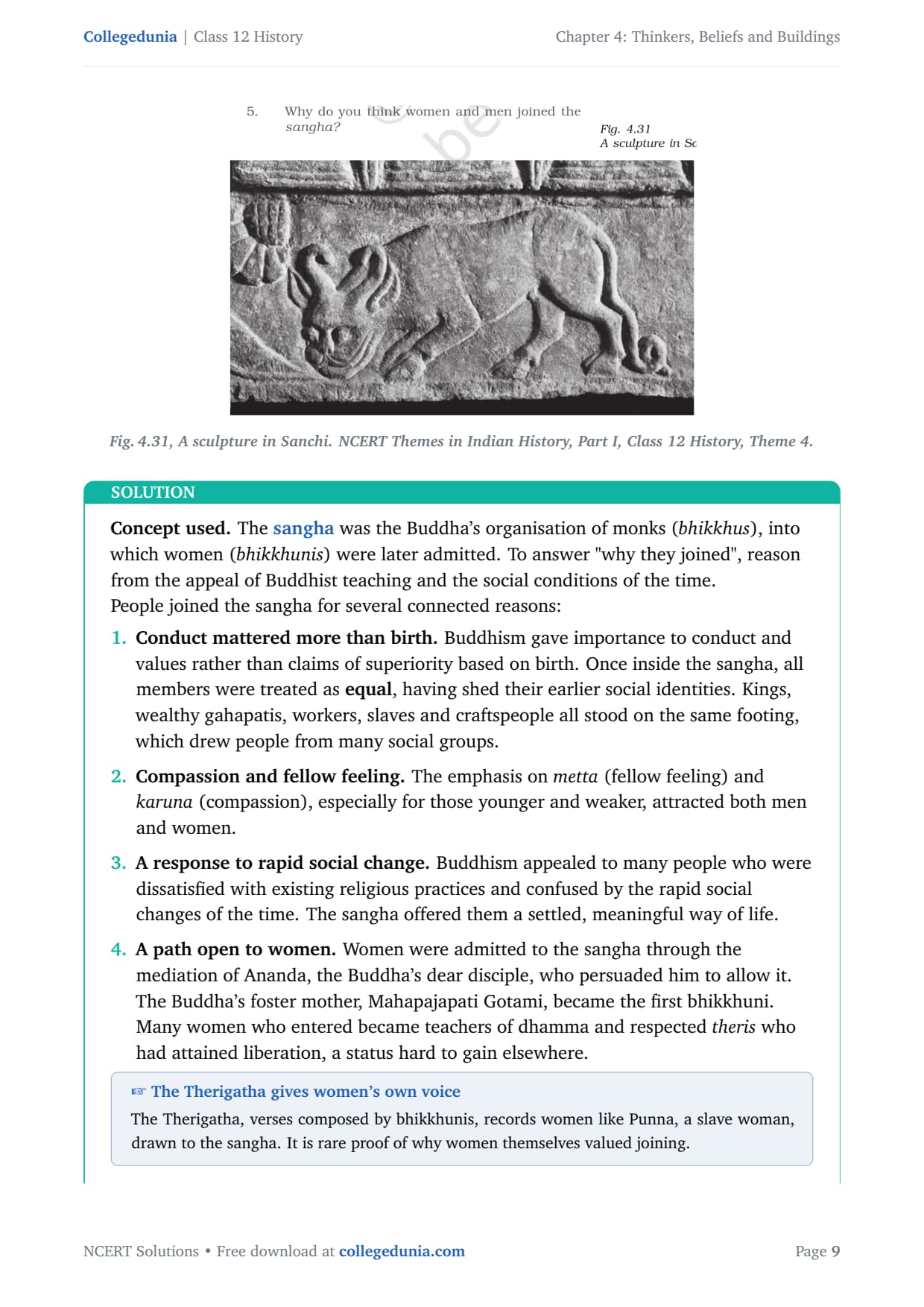
Fig. 4.31, A sculpture in Sanchi. NCERT
Themes in Indian History, Part I, Class 12 History, Theme 4.
Concept used. The sangha was the Buddha's organisation of
monks (bhikkhus), into which women (bhikkhunis) were later
admitted. To answer "why they joined", reason from the appeal of Buddhist
teaching and the social conditions of the time.
People joined the sangha for several connected reasons:
Conduct mattered more than birth. Buddhism gave importance to
conduct and values rather than claims of superiority based on birth.
Once inside the sangha, all members were treated as equal,
having shed their earlier social identities. Kings, wealthy
gahapatis, workers, slaves and craftspeople all stood on the same
footing, which drew people from many social groups.
Compassion and fellow feeling. The emphasis on metta
(fellow feeling) and karuna (compassion), especially for those
younger and weaker, attracted both men and women.
A response to rapid social change. Buddhism appealed to many
people who were dissatisfied with existing religious practices and
confused by the rapid social changes of the time. The sangha offered
them a settled, meaningful way of life.
A path open to women. Women were admitted to the sangha
through the mediation of Ananda, the Buddha's dear disciple, who
persuaded him to allow it. The Buddha's foster mother, Mahapajapati
Gotami, became the first bhikkhuni. Many women who entered became
teachers of dhamma and respected theris who had attained
liberation, a status hard to gain elsewhere.
The Therigatha gives women's own voice
The Therigatha, verses composed by bhikkhunis, records women like Punna, a
slave woman, drawn to the sangha. It is rare proof of why women themselves
valued joining.
Men and women joined the sangha because Buddhism valued conduct over
birth and treated all members as equal, because its message of compassion
(metta and karuna) appealed widely, because it answered people unsettled by
rapid social change, and because, once admitted, women could become respected
teachers and theris.
SQ
Sara Qureshi
MA History, Aligarh Muslim University
Verified Expert
Strategic angle. Separate "men and women in general" from "women in
particular". The general appeal is equality and compassion; the special point
for women is the path to learning and respect the sangha opened. Covering both
shows you read the question's wording closely.
Lead with equality: shedding caste and earlier identity at the
sangha's door is the strongest pull, name the mix of kings, gahapatis,
workers and slaves to prove the point.
Add the emotional appeal: metta and karuna offered belonging to those
confused by social change, a humane alternative to birth-based ritual.
Give women their own beat: Ananda's mediation, Mahapajapati Gotami as
first bhikkhuni, and women rising to become theris and teachers of
dhamma.
Why this matters. Grounding the answer in evidence, the Therigatha
for women's own experience, and the social mix of followers for equality,
turns opinion into argument. The examiner rewards the student who explains
from the sources rather than guessing, and who notices that the sangha
gave women a public, respected role rarely available to them outside it.
They joined because the sangha treated all as equal regardless of
birth, taught compassion (metta, karuna), offered stability amid social
change, and, for women, opened a path to learning and respect as bhikkhunis,
theris and teachers of dhamma.
Q 4.6
To what extent does knowledge of Buddhist literature help in
understanding the sculpture at Sanchi?
Concept used. Art historians read the Sanchi carvings by comparing
them with textual evidence, the Buddhist Jatakas, hagiographies
(life-stories) of the Buddha, and other literature. The essay should show
both how much this literature explains and where it falls short.
1. Literature decodes the narrative panels. Many Sanchi sculptures
tell stories that look puzzling until matched to a text. One panel seems at
first to show only a rural scene of thatched huts and trees. Art historians
who knew the Vessantara Jataka, the story of a generous prince who
gave away everything and went to live in the forest with his family,
recognised it as that very story. Without the Jataka, the carving's meaning
would be lost.
2. Hagiographies explain the symbols of worship. Early sculptors
often did not show the Buddha in human form; they showed his presence through
symbols. To read these you must know the life-story: the
empty seat stands for the Buddha's meditation and enlightenment, the
stupa for his mahaparinibbana (final passing), and the
wheel for his first sermon at Sarnath. Only familiarity with the
hagiographies turns a tree, a seat or a wheel into an event in the Buddha's
life.
3. Literature also reveals the limits. Knowledge of Buddhist texts
does not explain everything at Sanchi. Some carvings, such as the beautiful
woman swinging from a gateway holding a tree, are not directly inspired by
Buddhist ideas. Scholars only understood her after turning to other
literary traditions, which identified her as a shalabhanjika, a
woman whose touch made trees flower, an auspicious, pre-Buddhist figure.
Animals like elephants (signifying strength and wisdom) and motifs like
lotuses also came from popular, non-Buddhist beliefs.
Conclusion: a large but not complete help. Buddhist literature is
essential for the narrative panels and the symbols of worship, but Sanchi
also absorbed popular and non-Buddhist traditions that need other texts, or
no text at all, to explain. So the help is great but partial.
Answer "to what extent" with a balance
The phrase "to what extent" wants a measured judgement. Show where literature
helps a lot (Jatakas, symbols) and where it does not (shalabhanjika, popular
motifs), then conclude.
Buddhist literature helps greatly: the Jatakas identify narrative
panels like the Vessantara Jataka, and the hagiographies decode the symbols
(empty seat, stupa, wheel). But it does not explain everything: motifs like
the shalabhanjika and many animals come from popular, non-Buddhist
traditions. So literature is essential but not sufficient.
TJ
Tara Joshi
MA Art History, Visva-Bharati University
Verified Expert
Structural observation. The verb is "to what extent", so the
structure must be: where it helps, where it does not, then a verdict. Give two
strong "helps" examples and one strong "limit" example, each tied to a named
text or motif.
Helps, narrative: the Vessantara Jataka unlocks a panel that at first
looks like a plain village of huts and trees. Use it to show that the
text supplies the story the sculptor assumed the viewer already knew.
Helps, symbols: the empty seat, the stupa and the wheel mean nothing
until the Buddha's hagiography explains them as his enlightenment, his
final passing and his first sermon. This is the strongest case for the
value of literature, since early sculptors deliberately avoided showing
the Buddha in human form and worked only through such symbols.
Limits: the shalabhanjika, and the popular animal and lotus motifs,
needed non-Buddhist traditions to explain, proving that Sanchi
drew on far more than Buddhist texts alone.
Why this matters. The mature point is that Sanchi was enriched by
many ordinary people who brought their own pre-Buddhist beliefs into it, so a
single body of literature can never decode the whole monument. There is a
method lesson too: art historians had to first learn the hagiographies before
they could even begin to read the panels, which shows that interpreting
sculpture is a skilled, text-dependent craft, not plain looking. Saying
clearly that the help is "large but partial", and proving it with the
shalabhanjika, is the balanced judgement the examiner is looking for in a "to
what extent" essay.
To a large extent: the Jatakas and the Buddha's hagiographies
explain the narrative panels and the symbols of worship. But only partly:
popular, non-Buddhist motifs such as the shalabhanjika and the animal carvings
need other traditions, so Buddhist literature alone cannot decode all of
Sanchi.
Q 4.7
Figs. 4.32 and 4.33 are two scenes from Sanchi. Describe what you
see in each of them, focusing on the architecture, plants and animals, and
the activities. Identify which one shows a rural scene and which an urban
scene, giving reasons for your answer.
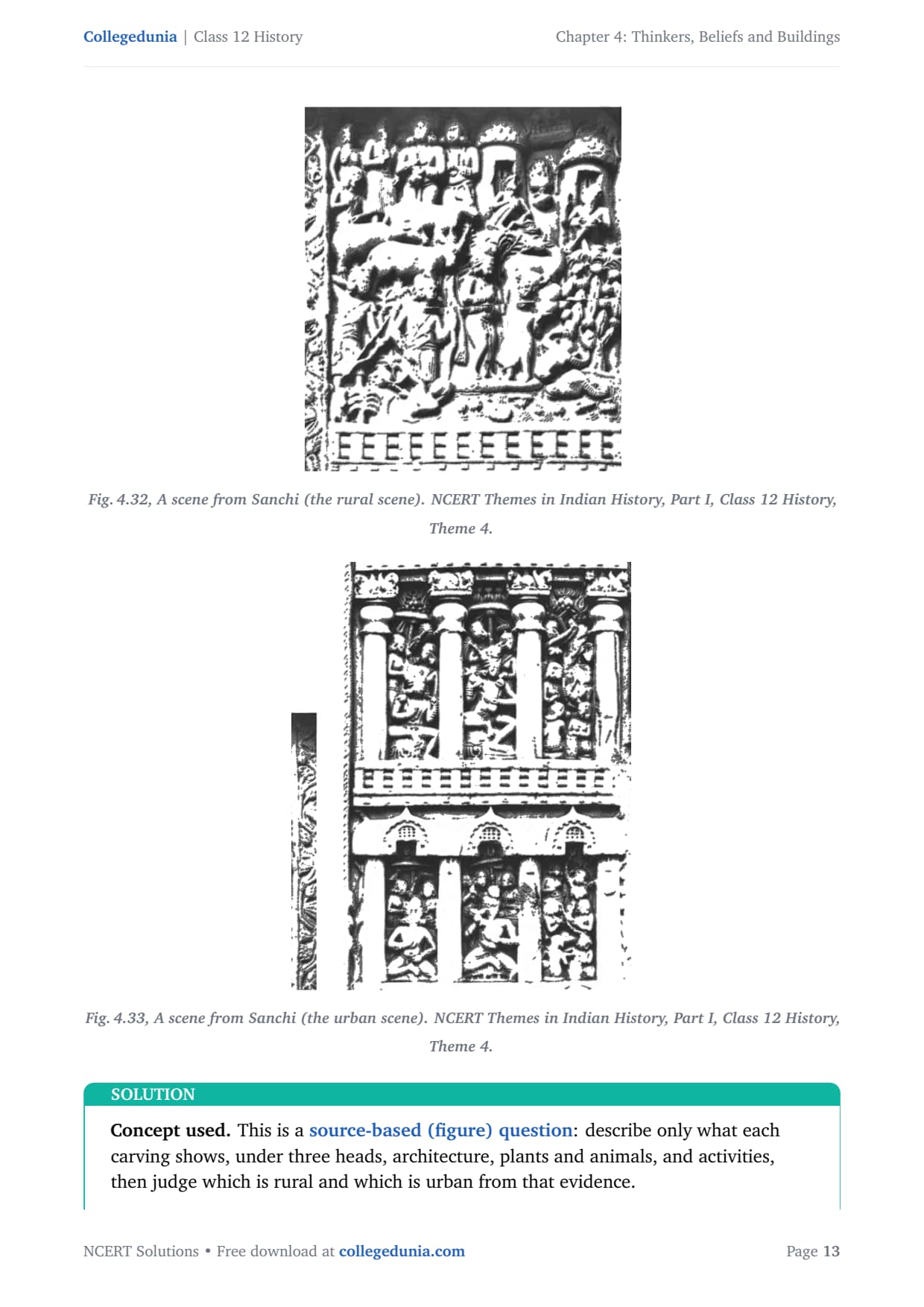
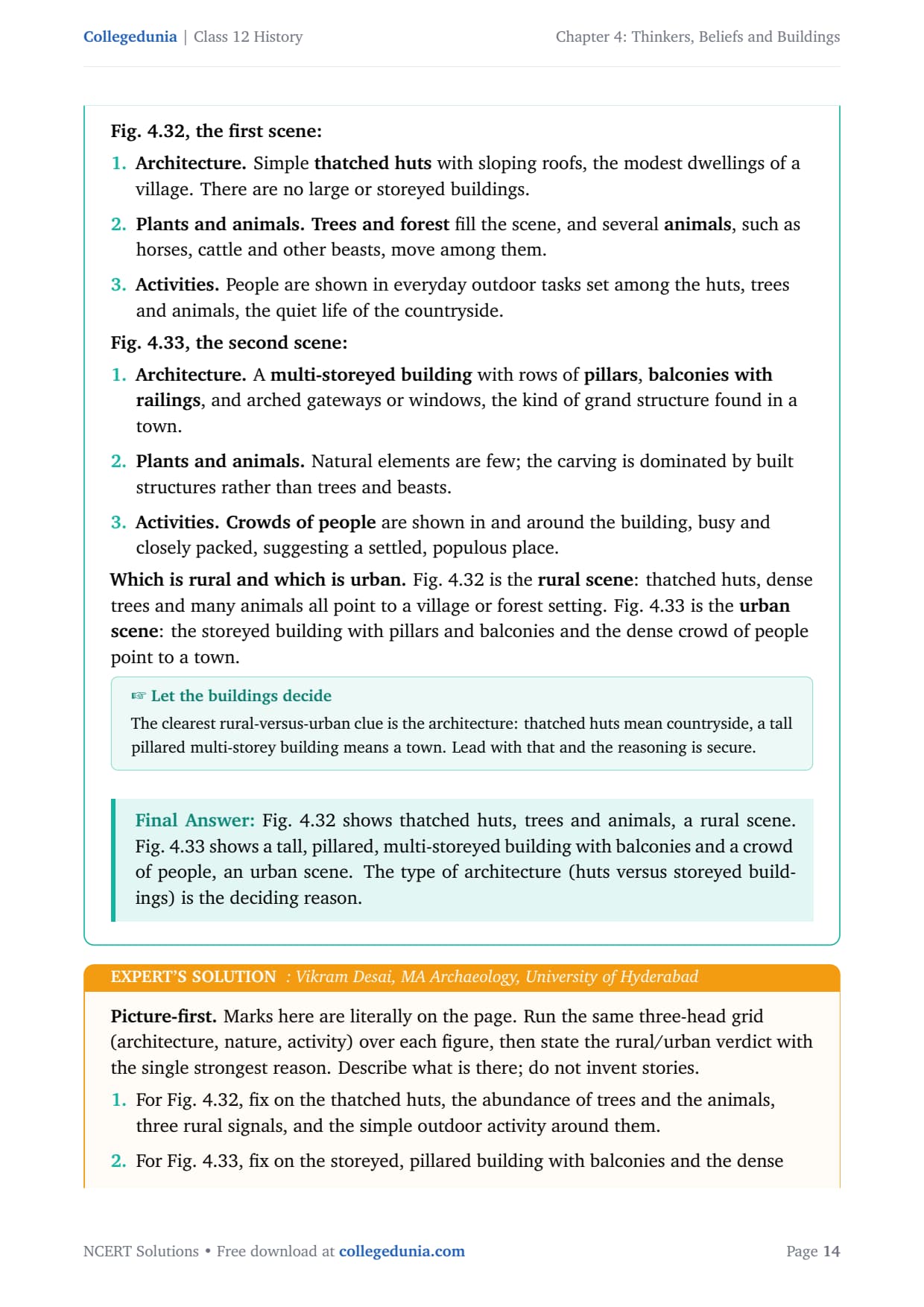
Fig. 4.32, A scene from Sanchi (the rural
scene). NCERT Themes in Indian History, Part I, Class 12 History, Theme 4.Fig. 4.33, A scene from Sanchi (the urban
scene). NCERT Themes in Indian History, Part I, Class 12 History, Theme 4.
Concept used. This is a source-based (figure) question:
describe only what each carving shows, under three heads, architecture,
plants and animals, and activities, then judge which is rural and which is
urban from that evidence.
Fig. 4.32, the first scene:
Architecture. Simple thatched huts with sloping
roofs, the modest dwellings of a village. There are no large or
storeyed buildings.
Plants and animals.Trees and forest fill the
scene, and several animals, such as horses, cattle and
other beasts, move among them.
Activities. People are shown in everyday outdoor tasks set
among the huts, trees and animals, the quiet life of the countryside.
Fig. 4.33, the second scene:
Architecture. A multi-storeyed building with rows of
pillars, balconies with railings, and arched
gateways or windows, the kind of grand structure found in a town.
Plants and animals. Natural elements are few; the carving is
dominated by built structures rather than trees and beasts.
Activities.Crowds of people are shown in and around
the building, busy and closely packed, suggesting a settled, populous
place.
Which is rural and which is urban. Fig. 4.32 is the rural
scene: thatched huts, dense trees and many animals all point to a village or
forest setting. Fig. 4.33 is the urban scene: the storeyed building
with pillars and balconies and the dense crowd of people point to a town.
Let the buildings decide
The clearest rural-versus-urban clue is the architecture: thatched huts mean
countryside, a tall pillared multi-storey building means a town. Lead with
that and the reasoning is secure.
Fig. 4.32 shows thatched huts, trees and animals, a rural scene.
Fig. 4.33 shows a tall, pillared, multi-storeyed building with balconies and
a crowd of people, an urban scene. The type of architecture (huts versus
storeyed buildings) is the deciding reason.
VD
Vikram Desai
MA Archaeology, University of Hyderabad
Verified Expert
Picture-first. Marks here are literally on the page. Run the same
three-head grid (architecture, nature, activity) over each figure, then state
the rural/urban verdict with the single strongest reason. Describe what is
there; do not invent stories.
For Fig. 4.32, fix on the thatched huts, the abundance of trees and
the animals, three rural signals, and the simple outdoor activity
around them.
For Fig. 4.33, fix on the storeyed, pillared building with balconies
and the dense crowd, the unmistakable marks of a town.
State the verdict with the deciding evidence: huts and forest versus a
multi-storey building, so 4.32 is rural and 4.33 is urban.
Why this matters. The skill being tested is reading an image as
evidence and arguing a conclusion from it. By tying "rural" to the huts,
trees and animals and "urban" to the architecture and the crowd, you show the
examiner a judgement built on observation, not a guess. Keeping description
and inference separate is exactly the discipline this source question rewards.
Fig. 4.32 (huts, trees, animals, simple outdoor life) is the rural
scene; Fig. 4.33 (multi-storeyed pillared building, balconies, crowds) is the
urban scene. The architecture is the clearest reason for each.
Q 4.8
Discuss the development in sculpture and architecture associated
with the rise of Vaishnavism and Shaivism.
Concept used.Vaishnavism (worship of Vishnu as the chief
deity) and Shaivism (worship of Shiva as the chief god) grew from
about the second century BCE within what we now call Hinduism, centred on
bhakti, love and devotion to a chosen god. This rise shaped both new
sculpture and new temple architecture.
1. New subjects in sculpture. As these cults grew, deities were
carved in stone. In Vaishnavism, cults formed around the ten avatars
(incarnations) of Vishnu, the forms he was believed to take to save the world
from evil, and different avatars were popular in different regions. Examples
in the chapter include the Varaha (boar) avatar of Vishnu rescuing
the earth goddess, and Vishnu reclining on the serpent Sheshnag.
2. Symbols and attributes. Shiva was symbolised by the
linga, though he was sometimes shown in human form too. Such
sculptures carried a complex set of ideas through symbols, head-dresses,
ornaments and ayudhas (weapons or auspicious objects held in the
deity's hands), and through the way the figure was seated. To read them,
historians use the Puranas, compiled by Brahmanas, which preserved
the stories of the gods and goddesses.
3. The first temples. Around the same time that stupas such as
Sanchi were taking their final form, the first temples to house
images of gods were being built (by about the third century CE). The early
temple was a small square room, the garbhagriha, with one doorway
for the worshipper to enter and offer worship to the image.
4. The temple grows more elaborate. Gradually a tall structure, the
shikhara, was raised over the central shrine, and temple walls were
covered with sculpture. Later temples became far grander, with assembly
halls, huge walls and gateways, and arrangements for water.
5. Rock-cut temples. A striking development was hollowing temples out
of rock as artificial caves. This old tradition (some earliest caves were cut
in the third century BCE for Ajivika renouncers on Asoka's orders) culminated
in the eighth century in the Kailashnatha temple at Ellora, an
entire temple carved from a single rock, prompting its chief sculptor to
exclaim, "Oh how did I make it!"
Devotion drives the image
The shift to bhakti, a personal bond of love with a chosen god, is what made
images and temples central. The devotee needed a deity to see and worship,
so sculpture and the temple grew together.
With Vaishnavism and Shaivism came new sculpture (Vishnu's ten
avatars such as Varaha, and Shiva shown as the linga or in human form, read
through the Puranas) and a new architecture: the early garbhagriha temple,
later crowned by a shikhara and richly carved, and even temples cut whole from
rock, like the Kailashnatha temple at Ellora.
IS
Imran Sheikh
MA History, Jamia Millia Islamia
Verified Expert
Strategic angle. The question has two threads, sculpture and
architecture, so braid them in time order: first the carved deities, then the
temple that housed them, then how the temple evolved. Anchor each stage to a
named example from the chapter.
Sculpture: tie it to bhakti. Cults grew around the ten avatars of
Vishnu, recognised as forms he took to save the world from evil, with
different avatars popular in different regions. Cite the Varaha (boar)
rescuing the earth and Vishnu reclining on Sheshnag, and Shiva shown as
the linga or in human form, all read through the Puranas.
Architecture, the seed: the garbhagriha, a single square shrine room
with one doorway for the image, appears around the third century CE,
just as the stupas at Sanchi were reaching their final form.
Architecture, the growth: the shikhara rises over the shrine, walls
fill with carving, and later assembly halls, walls, gateways and water
arrangements are added, until the tradition peaks in temples cut whole
from rock, the Kailashnatha at Ellora.
Why this matters. The strongest essays show why sculpture and
architecture rose together: bhakti, a personal bond of love with a chosen
god, needed a visible deity to worship and a house to keep it in, so the
carved image and the temple grew side by side. There is a unifying idea worth
stating too: recognising many local deities as forms of one Vishnu, and
preserving their stories in the widely-read Puranas, helped knit scattered
cults into a more unified tradition. Naming the Varaha panel, the Sheshnag
image and the Ellora temple proves you can support that argument with real
works, which is what lifts a "discuss" answer into the top band.
Bhakti within Vaishnavism and Shaivism produced new sculpture
(Vishnu's avatars like Varaha and the reclining Vishnu, Shiva as the linga,
decoded through the Puranas) and new architecture: the small garbhagriha
temple, later topped by a shikhara and elaborately carved, culminating in
rock-cut wonders such as the Kailashnatha temple at Ellora.
Q 4.9
Discuss how and why stupas were built.
Concept used. A stupa (Sanskrit for "heap") is a mound
built over relics of the Buddha. The question has two halves: why
stupas were built (their purpose) and how they were built (the
funding, structure and form).
Why stupas were built:
To enshrine relics. Certain places were sacred because
relics of the Buddha, his bodily remains or objects he had
used, were buried there. The mounds raised over them were stupas.
To venerate the Buddha himself. Because they held sacred
relics, the whole stupa came to be worshipped as an emblem of both the
Buddha and Buddhism.
On the Buddha's own instruction. The Mahaparinibbana Sutta
records that, as he lay dying, the Buddha said a thupa (stupa)
should be erected at crossroads for the Tathagata. Later, the
Ashokavadana says Asoka distributed the Buddha's relics to every
important town and ordered stupas built over them. By the second
century BCE stupas stood at Bharhut, Sanchi and Sarnath.
How stupas were built:
Through donations. Inscriptions on railings and pillars
record gifts for building and decorating stupas. Kings such as the
Satavahanas gave donations; so did guilds, the ivory workers financed
part of a gateway at Sanchi; and hundreds of ordinary women and men,
as well as bhikkhus and bhikkhunis, contributed, often recording
their names, homes and occupations.
The structure. The stupa began as a simple semi-circular
mound of earth, the anda. Above it sat the
harmika, a balcony-like structure representing the abode of
the gods. From the harmika rose a mast, the yashti, often
topped by a chhatri (umbrella). A railing surrounded the
mound, separating the sacred space from the secular world.
Gateways and circumambulation. The early stupas at Sanchi and
Bharhut had plain stone railings but richly carved gateways at the
four cardinal points. Worshippers entered by the eastern gateway and
walked clockwise around the mound, keeping it on the right, imitating
the sun's course. Later mounds, as at Amaravati, were elaborately
carved with niches and sculptures.
Split "how" from "why" with a clear line
Use a hinge sentence ("As for how they were built ...") between the two
halves. The examiner scans for both purpose and method, so signpost the
switch.
Stupas were built to enshrine the Buddha's relics and to venerate
him, following his own dying instruction and Asoka's distribution of relics.
They were built through donations from kings, guilds and ordinary devotees,
as a mound (anda) topped by a harmika, yashti and chhatri, ringed by a railing
with carved gateways at the four directions for clockwise worship.
LM
Lakshmi Menon
MA Ancient Indian History, University of Calcutta
Verified Expert
Strategic angle. Keep "why" and "how" in separate blocks, and make
"why" lead, since purpose explains form. For "how", braid two ideas: who paid
(donations) and what was built (the parts of the stupa). Name a part for every
claim.
Why: relics, the Buddha's bodily remains or objects he used, make the
spot sacred, so the whole mound becomes an emblem of the Buddha and of
Buddhism. Back this with the Buddha's own words in the Mahaparinibbana
Sutta and Asoka's relic-distribution in the Ashokavadana, which by the
second century BCE had raised stupas at Bharhut, Sanchi and Sarnath.
How, funding: donations recorded in inscriptions, from kings (the
Satavahanas), a guild (the ivory workers who paid for part of a Sanchi
gateway), and hundreds of ordinary devotees, bhikkhus and bhikkhunis,
who gave their names, homes and occupations. This shows the stupa was a
community effort, not a single ruler's project.
How, form: the anda (mound), the harmika above it, the yashti and its
chhatri, and the enclosing railing, plus the four carved gateways and
the clockwise circumambulation begun from the east.
Why this matters. A top answer shows that the stupa's form follows
its purpose: because it housed relics, it needed a sacred boundary (the
railing) to mark off the holy space, a way to honour the relic (clockwise
circumambulation, imitating the sun), and donor-funded gateways that
broadcast the merit of the givers. You can add the later development for
range: at Amaravati the mound itself was carved with niches and sculptures,
showing the form kept evolving. Linking why to how, rather than just listing
parts, is what earns full marks on a "discuss" essay.
Why: to enshrine the Buddha's relics and venerate him, on his own
instruction and through Asoka's relic distribution. How: funded by donations
from kings, guilds and ordinary devotees, built as a mound (anda) with
harmika, yashti and chhatri, enclosed by a railing with four carved gateways
for clockwise worship.
Q 4.10
On an outline world map, mark the areas to which Buddhism spread.
Trace the land and sea routes from the subcontinent to these areas.
Concept used. This is a map-work task. You mark the regions
that received Buddhism from the Indian subcontinent, and draw the
land and sea routes along which it travelled. Below is the guide;
on your own outline world map, shade each region and draw arrows for the
routes.
Areas to mark (shade or label).
Sri Lanka (where texts like the Dipavamsa and
Mahavamsa were written).
Central Asia and Afghanistan, on the overland route
west and north.
China, from where pilgrims such as Fa Xian
and Xuan Zang travelled to India in search of texts.
Korea and Japan in East Asia.
Myanmar, Thailand and the lands of Southeast Asia
(including the islands), reached by sea.
Land routes (draw arrows). From the subcontinent overland
through the northwest into Central Asia and Afghanistan, and onward
along the Silk Route to China, and from China to Korea and Japan.
Sea routes (draw arrows). From the eastern and southern
coasts of the subcontinent across the sea to Sri Lanka and to
Southeast Asia (Myanmar, Thailand and the island regions).
Distinguish land from sea routes
Use a solid arrow for land routes and a dashed (or differently coloured)
arrow for sea routes, and add a small key. Markers want the two clearly told
apart.
Mark Sri Lanka, Central Asia and Afghanistan, China, Korea, Japan,
and Southeast Asia (Myanmar, Thailand, the islands). Draw land routes
overland through the northwest into Central Asia and on to China, Korea and
Japan, and sea routes from the eastern and southern coasts to Sri Lanka and
Southeast Asia.
PB
Pooja Bhatt
MA Historical Geography, Aligarh Muslim University
Verified Expert
Structural observation. Map work is scored on accuracy and
legibility. Build a simple plan: shade the regions first, then add two kinds
of arrow (land and sea), then a key. Neat, correctly placed marks score full;
crowded scribbles do not.
Shade the regions in groups: south (Sri Lanka), east and southeast
(Myanmar, Thailand, the islands), and north or northwest leading on to
China, Korea and Japan.
Draw the land route as one connected line: subcontinent to the
northwest to Central Asia to China to Korea and Japan. The pilgrims Fa
Xian and Xuan Zang travelled this way.
Draw the sea routes from the coasts to Sri Lanka and across to
Southeast Asia, and finish with a clear key in a corner of the map.
Why this matters. The task tests whether you can turn the chapter's
account of travelling monks and pilgrims into geography, knowing not just
that Buddhism spread but where and how. A clean map with
a key, separating land from sea, is the whole answer.
Shade Sri Lanka, Central Asia and Afghanistan, China, Korea, Japan
and Southeast Asia; draw land routes overland through the northwest to Central
Asia and on to East Asia, and sea routes from the coasts to Sri Lanka and
Southeast Asia, with a key distinguishing the two.
Q 4.11
Of the religious traditions discussed in this chapter, is there any
that is practised in your neighbourhood? What are the religious texts used
today, and how are they preserved and transmitted? Are images used in
worship? If so, are these similar to or different from those described in this
chapter? Describe the buildings used for religious activities today, comparing
them with early stupas and temples.
Concept used. This is a project (field observation). There
is no single correct answer; you are marked on how well you observe a living
tradition and compare it with the past. The guide below shows what to look
for and how to organise the report.
Find a living tradition from the chapter. Look in your
neighbourhood for Buddhism, Jainism, Vaishnavism or Shaivism (forms of
Hinduism), any of which is discussed in the chapter. A temple, a Jaina
sthanak or a Buddhist vihara nearby will do.
The texts and how they survive. Note the religious texts used
today (for example the Puranas, the Tipitaka, Jaina Agamas, or the
Bhagavad Gita). Record how they are preserved and transmitted now:
printed books, recitation, audio, apps and the internet, then compare
with the chapter's oral teaching and hand-copied manuscripts.
Images in worship. Note whether images are used. Compare them
with the chapter: the Buddha shown through symbols (empty seat, stupa,
wheel) or in human form, Vishnu's avatars, Shiva's linga. Say whether
today's images are similar or different.
The buildings. Describe the building used for worship today,
its shape, shrine, hall and tower, and compare it with early stupas
(mound, harmika, railing, gateways) and early temples (garbhagriha and
shikhara).
Always compare, do not just describe
The marks are in the comparison. For every modern feature, add one line
on how it is like or unlike the early stupas and temples in the chapter.
Pick a tradition from the chapter that is practised near you, then
report on its present-day texts (and how they are preserved and transmitted),
its use of images, and its buildings, comparing each with the chapter's
oral and manuscript texts, its symbols and images, and its early stupas and
temples.
NV
Nikhil Verma
MA History, MS University of Baroda
Verified Expert
Strategic angle. Turn the four questions into a four-part report with
the same structure for the past and the present. A two-column table (then
versus now) for texts, images and buildings makes the comparison do the work.
Choose one nearby tradition and visit one place of worship, so your
observations are first-hand, not from memory.
Fill the "now" column from your visit (printed or digital texts, the
images you see, the building's plan) and the "then" column from the
chapter (manuscripts and oral transmission, symbols and avatars,
stupa and garbhagriha).
Write a short conclusion on what has changed and what has continued,
for example, images and shrines persist, while preservation has moved
from manuscripts to print and digital media.
Why this matters. The project teaches the chapter's real lesson, that
beliefs leave traces in texts, images and buildings, by making you read a
living tradition the way the chapter reads ancient ones.
Use a then-versus-now table across texts, images and buildings for
one nearby tradition, and conclude with what has continued (shrines, images)
and what has changed (oral and manuscript transmission giving way to print and
digital).
Q 4.12
Collect at least five pictures of sculpture or painting, belonging
to different periods and regions, on the religious traditions described in
this chapter. Remove their captions, and show each one to two people, and ask
them to describe what they see. Compare their descriptions and prepare a
report on your findings.
Concept used. This is a project (viewer experiment). You
test how different people "read" religious art when its captions are removed,
the same problem art historians face. There is no fixed answer; you are marked
on how carefully you gather and compare the responses.
Collect five captioned-then-uncaptioned images. Choose
sculpture or painting from different periods and regions on the
traditions in the chapter: a Buddhist symbol panel, a Jaina
tirthankara, a Vishnu avatar, a Shiva linga or image, and a temple or
stupa carving. Note the real caption for yourself, then cover it.
Show each image to two people and record their words. For
every picture, ask two people to describe what they see, and write
down their descriptions exactly.
Compare the descriptions. See where the two viewers agree and
differ, and where they miss the meaning that the hidden caption gives.
This shows how much an image "speaks" on its own.
Write the report. Add a short introduction, a table of the
five images with the two descriptions each, and a conclusion on how
far people could read the art without captions.
This is the historian's own problem
The chapter shows scholars puzzling over the shalabhanjika and the
Mahabalipuram panel without a sure text. Your experiment recreates exactly
that difficulty of reading images without a guide.
Collect five varied religious images from the chapter's traditions,
hide their captions, ask two people to describe each, and compare their
responses in a short report, concluding how far the art could be understood
without its caption.
AR
Aditi Rao
MA Art History, University of Hyderabad
Verified Expert
Picture-first. The whole project is a small experiment, so treat it
like one: same five images, same question to every viewer, answers recorded
word for word. A neat results table is the heart of the report.
Pick images that span the chapter's range (Buddhist, Jaina,
Vaishnava, Shaiva) and different periods, so the responses are varied
and interesting.
Ask every viewer the same open question, "describe what you see", so
the descriptions are comparable, and write them down verbatim.
In the conclusion, link your finding to the chapter: where viewers
guessed wrong without a caption, you have shown why historians need
texts to read images.
Why this matters. By stripping the captions you reproduce the real
challenge of interpreting ancient art, and your report shows, with evidence,
how much meaning depends on the texts and traditions behind an image.
Run it as an experiment: five varied uncaptioned religious images,
the same "what do you see" question to two viewers each, answers recorded
verbatim, then a comparison table and a conclusion on how far images can be
read without captions.
FAQs on Thinkers, Beliefs and Buildings Class 12 NCERT Solutions
Thinkers, Beliefs and Buildings Class 12 History Common Questions
Ques. Where can I get the class 12 history chapter 4 ncert solutions PDF?
Ans. You can download the Thinkers, Beliefs and Buildings Class 12 History NCERT Solutions PDF directly from this page. It is free, follows the 2026-27 NCERT, and answers all 12 exercise questions step by step.
Ques. How many questions are there in class 12 history chapter 4 questions and answers?
Ans. The chapter has 12 exercise questions. Nine are written answers, and the last three (4.10 to 4.12) are map work and project activities used in the history project file class 12 chapter 4.
Ques. Which are the most important questions in history class 12 chapter 4 question answer practice?
Ans. How and why stupas were built (Q 4.9), why people joined the sangha (Q 4.5), and how Buddhist literature helps read the Sanchi sculpture (Q 4.6) are the most-asked long answers. These three top every list of class 12 history chapter 4 important questions.
Ques. What is a stupa in Thinkers, Beliefs and Buildings?
Ans. A stupa is a mound built over relics of the Buddha. It has a hemispherical anda, a harmika on top, a central yashti, a railing for circumambulation, and carved gateways called toranas. Sanchi is the best-preserved stupa.
Ques. Why are the begums of Bhopal important in this chapter?
Ans. Shahjehan Begum and Sultan Jehan Begum of Bhopal funded the upkeep of the Sanchi stupa, built a museum and guesthouse, and kept it in its original place. Because of them, the best-preserved Buddhist stupa survived for students to study today.
Ques. Is class 12 history chapter 4 hard to score in the board exam?
Ans. No. It is a steady scoring chapter if you keep the thinkers apart and split the stupa question into "why" and "how". Practise the source-based extracts and a few class 12 history chapter 4 mcq sets, and learn the teachings of Jainism and Buddhism in your own words.








Comments