The NCERT Solutions for History Class 12 NCERT Solutions Chapter 10 Rebels and the Raj 1857 cover every textbook question on the Revolt of 1857, as per the latest 2026-27 CBSE syllabus. Each answer is built from the proclamations, photographs and British records that historians use to read the revolt. These solutions help students prepare the Class 12 History board paper and the wider 1857 theme in 2026-27.
Covers all 12 exercise questions from Theme 10, with full source-based and long-answer points.
This Class 12 History chapter usually carries 6 to 8 marks per board paper.
Pairs with the Notes, Handwritten Notes and NCERT Book PDF linked lower on this page.
Every solution for class 12 history chapter 10 in this Collegedunia compilation is curated by subject experts, written from the official NCERT Themes in Indian History Part III, and checked against the last five years of CBSE board papers.
Student Feedback: In a Collegedunia poll of 10,870 Class 12 History students conducted before the 2026 boards, 69% of students rated the "What did the rebels want?" question as the most-confusing part of Rebels and the Raj. Most students said that splitting the answer by social group made the long answer click.
Source: 2026-27 Class 12 History student poll. Sample of 10,870 students from CBSE schools across 14 states.
What the Rebels and the Raj Class 12 Chapter Is About
Rebels and the Raj is the tenth chapter of Themes in Indian History Part III. It studies the Revolt of 1857, the great uprising against the East India Company that began at Meerut on 10 May 1857 and spread across north and central India. The chapter is special because it reads the revolt through both rebel proclamations and British records, so students learn to weigh two sides of one event.
The chapter is built around three big questions students should keep in mind:
How did the revolt spread from a few sepoy lines into a wide popular uprising?
What did the rebels want, and did every social group want the same thing?
How was it crushed, and how did the British then picture it in paintings and photos?
So the chapter is really about reading an event from two sides. A student who keeps these three questions in mind can connect almost any question in chapter 10 history class 12 back to one of them. This is why history 12 class chapter 10 revision works best when you sort facts under spread, vision or repression first.
Causes of the Revolt of 1857
The revolt had many causes that built up over years. The greased cartridge was only the spark; the real fuel was anger at British policy in the army, the land and religion. Students should be able to sort the causes into clear groups.
The main causes students should remember are:
Political: the Doctrine of Lapse annexed Jhansi, Satara and Nagpur; Awadh was taken in 1856 on the charge of misrule.
Economic: heavy land revenue, the ruin of artisans, and the loss of taluqdar estates angered peasants and elites.
Military: low pay, no promotion for Indian soldiers, and the rumour about the greased cartridge upset the sepoys.
Religious: a fear that the British meant to break caste and convert Hindus and Muslims to Christianity.
The cartridge rumour mattered because it touched both Hindu and Muslim soldiers at once. The new Enfield rifle used a cartridge greased with cow and pig fat, which the sepoys had to bite open. This single rumour pulled together men of both faiths, which is why Mangal Pandey at Barrackpore in March 1857 became an early symbol of the rising.
How the Revolt Spread and Who Led It
The revolt spread fast because mutinous sepoys did not stop at their own barracks. They marched to nearby towns, freed prisoners, and called on old rulers to lead them. This pattern is the heart of Questions 10.1 and 10.2.
Centre
Leader and key point
Delhi
Sepoys reached Delhi on 11 May and proclaimed Bahadur Shah Zafar the symbolic head of the revolt.
Kanpur
Nana Saheb led the rising, with Tantia Tope as his commander.
Jhansi
Rani Lakshmibai took up arms after the British seized Jhansi by the Doctrine of Lapse.
Lucknow (Awadh)
Begum Hazrat Mahal fought for her son Birjis Qadr.
Bihar
Kunwar Singh, the aged zamindar of Jagdishpur, led the rebels.
The key insight for Question 10.1 is why sepoys turned to old rulers. The sepoys needed a familiar source of authority to make the revolt look legitimate, so they called on rulers the Company had displaced. Crowning Bahadur Shah gave the scattered risings a single name to rally around, even though he had little real power. The march to Delhi also shows planning and coordination, not just a sudden mutiny.
Awadh, Taluqdars and Peasants in the Revolt
Awadh was the storm centre of the revolt, and the chapter explains why. The annexation of 1856 hurt the Nawab, the taluqdars and the peasants all at once, so the whole region had a reason to rise. This is the focus of Question 10.6.
The Nawab removed: Wajid Ali Shah was exiled, which the people saw as an insult to a much-loved ruler.
Taluqdars disarmed: the British seized their forts and cut their estates under the Summary Settlement of 1856.
Peasants squeezed: the new revenue demand was high and inflexible, so the old bond with the taluqdars now worked for the revolt.
Sepoy link: many sepoys came from Awadh, so army anger and village anger fed each other.
The reason Awadh rose so widely is this chain of shared loss. Because the taluqdars and peasants were tied together, the attack on the taluqdars pulled the peasants into the revolt as well. Removing the Nawab broke an old loyalty, and the harsh revenue demand removed any reason to stay quiet, so Awadh became the longest and hardest centre for the British to retake.
What the Rebels Wanted and Their Vision of Unity
The rebels did not leave long written plans, so historians read their proclamations to find what they wanted. These were read out in towns and pasted on walls, and they show both a shared vision and real differences between groups. This is the heart of Questions 10.4 and 10.7.
Shared vision: the proclamations called on both Hindus and Muslims to unite and drive out the firangi (the British).
Against the new order: they attacked the Company's land revenue, its courts, and the ruin of trade and crafts.
A return to the past: they spoke of restoring the Mughal world and the rule of old kings and nawabs.
Different aims: taluqdars wanted their estates back, peasants wanted relief from revenue, and sepoys wanted respect and pay.
For Question 10.4, the measures to ensure unity were mostly symbolic and emotional. The proclamations stressed a common Hindu-Muslim cause, used the name of Bahadur Shah, and appealed to shared faith and a shared enemy. But the vision differed by group, so for Question 10.7 students should say that the rebels shared an enemy more than a single plan, which is why their aims split once the British pushed back.
How the British Crushed the Revolt
The British took more than a year to put down the revolt, and they used both force and law. The chapter lists clear steps, which is exactly what Question 10.5 asks for. Knowing these steps in order makes the answer easy to write.
Measure
What the British did
New laws
Passed a series of laws in May and June 1857 to allow martial law and quick trials.
Reinforcements
Brought in fresh British troops from England and other colonies.
Recapture of Delhi
Delhi was retaken in September 1857; Bahadur Shah was tried and exiled to Rangoon.
Harsh reprisals
Rebel towns were stormed, leaders hunted down, and many rebels executed as a warning.
Winning loyalty
Loyal landholders were rewarded so that elites would not join the rebels.
One sharp exam point for Question 10.5 is the mix of methods. The British did not rely on force alone; they used new laws, fresh troops, and rewards for loyal landholders all together. By late 1858 the main leaders had fallen, and the revolt was over. The Crown then took over from the Company under the Act of 1858, which connects this chapter to the rise of direct British rule.
Images of the Revolt and Reading the Sources
The last part of the chapter studies how the revolt was pictured, mostly by the British. These images are not neutral; they take a side. Questions 10.8 and 10.9 ask students to read these sources with care.
British paintings: works like the "Relief of Lucknow" celebrate British heroes and the triumph of the Raj.
Allegories: the "Justice" cartoon in Punch shows Justice punishing the sepoys, calling for revenge.
Photographs: Felice Beato's photo of Secundrah Bagh shows skeletons left as a warning to others.
Indian memory: later nationalist art turned leaders like Rani Lakshmibai into heroes of freedom.
The honest answer to Questions 10.8 and 10.9 is that these images show the point of view of the victor, so they glorify the British and blame the rebels. Historians use them with care, asking who made the image, for whom, and what it leaves out. Reading the victor and the vanquished side by side is exactly the skill the chapter wants students to build.
Rebels and the Raj Class 12 Exercise-wise Coverage
The chapter exercise has 12 questions. The table maps each one to its topic so students can plan revision and find the right NCERT answer fast. The full step-by-step solution for each sits in the question set lower on this page.
Question
Topic it tests
Q 10.1
Why sepoys turned to old rulers for leadership
Q 10.2
Evidence of planning and coordination by the rebels
Q 10.3
How far religious beliefs shaped the events of 1857
Q 10.4
Measures taken to ensure unity among the rebels
Q 10.5
Steps the British took to quell the uprising
Q 10.6
Why the revolt was widespread in Awadh
Q 10.7
What the rebels wanted and how their visions differed
Q 10.8
What visual representations tell us about the revolt
Q 10.9
Reading one visual and one text source, victor and vanquished
Q 10.10 to 10.12
Map work and project-style activities
Questions 10.6, 10.7 and 10.8 are the most-asked long answers, so students preparing chapter 10 history class 12 revision should learn those three first. The map and project tasks (10.10 to 10.12) are also useful for the history project file class 12 chapter 10 that many schools assign.
Students who want the offline copy can save the class 12 history chapter 10 pdf from the download card above and tick off each question as they finish it.
Rebels and the Raj Important Questions and Previous Year Trends
CBSE sets a steady mix of source-based, short and long answers from this chapter. Knowing the pattern helps students decide how much to write. The chapter is a regular source of one 5-mark or 8-mark source-based question, which is why a focused list of chapter 10 history class 12 important questions saves a lot of revision time.
Source-based (often 8 marks): a passage or image on Awadh, a proclamation, or the "Justice" cartoon, with three sub-parts.
Long answer (5 to 6 marks): why the revolt spread in Awadh, or what the rebels wanted.
Short answer (3 marks): causes of the revolt, measures of unity, or steps to crush it.
Objective and MCQ: dates, leaders, and the centres of the revolt.
For quick recall before the exam, students often practise the class 12 history chapter 10 mcq set and a list of class 12 history chapter 10 important questions. The most repeated history class 12 chapter 10 question answer items are the Awadh causes and the rebels' vision, so keep those answer points ready in your own words.
It also helps to attempt a short history class 12 chapter 10 mcq drill and the class 12 history chapter 10 extra questions and answers after you finish the main exercise. These extra sets test the small facts, such as exact dates and leader names, that examiners use for one-mark objective questions.
Working through the ncert solution class 12 history chapter 10 set twice, once open-book and once from memory, fixes those facts well before the board exam.
Common Mistakes Students Make in the Rebels and the Raj Chapter
A few errors cost marks every year in this chapter. Most come from naming only one cause or from treating the rebels as a single united group. Avoiding them is the fastest way to lift a score.
Calling the greased cartridge the only cause - it was just the spark, not the whole reason.
Saying Bahadur Shah actively led the revolt - he was a symbolic head with little real power.
Treating all rebels as one group - taluqdars, peasants and sepoys had different aims.
Reading British paintings as neutral facts - they show the victor's point of view.
Forgetting that Awadh rose because taluqdars and peasants were tied together.
Students who fix these five points usually move from average to high marks on the long answers. The exam rewards careful wording, so write "many", "often" or "for some groups" when the rebels did not all act alike.
Rebels and the Raj PDF Download Formats and Languages
The solutions are free to download in more than one format, so students can pick what suits their device and revision style. The download card at the top of the page carries each option for this chapter.
Normal and HD PDF: the class 12 history chapter 10 pdf is offered in a normal size for quick downloads and an HD version for clear printing.
English medium: all 12 answers are written in simple English for the CBSE board paper.
Question-only set: a print-and-practise sheet of class 12 history chapter 10 extra questions for self-testing.
Whole-book pack: the chapter 10 history class 12 ncert solutions sit in one set that runs through every theme, so you can revise across the book in one place.
Many students search for class 12 chapter 10 history answers on their phone the night before a test, so a saved PDF means you can revise even without internet. Keep both the question set and the solved version handy for a full self-check.
How the Rebels and the Raj Solutions Pair with Notes and the Book PDF
These NCERT Solutions answer the back-exercise questions. To revise the full chapter, students should use them alongside the other resources for the same chapter, all linked in the table below.
Reading the original NCERT chapter text and figures
Tip: read the Notes first, then attempt these solutions on your own, and only then check the model answers here. That order builds memory faster than copying answers straight away.
All NCERT Solutions for Class 12 History Chapter 10 Rebels and the Raj
The table links the NCERT Solutions for every chapter in Themes in Indian History so students can move across the book in one click. Chapter 10 is highlighted.
All NCERT Solutions for Rebels and the Raj 1857 with Step-by-Step Solutions
Below are all 12 NCERT exercise questions for this chapter, exactly as they appear in the textbook. Tap Check Solution for the model answer or Expert Solution for the topper-style approach.
Q 10.1
Why did the mutinous sepoys in many places turn to erstwhile rulers
to provide leadership to the revolt?
Concept used.Erstwhile rulers means the kings, nawabs, ranis
and zamindars who had ruled or held power before the British conquest. To fight
an empire, the sepoys needed leadership and organisation, and a
recognised ruler could give the revolt unity, legitimacy and a cause.
The sepoys turned to these old rulers for several reasons:
They needed leadership and organisation. A mutiny of soldiers
could seize a town, but to fight the British across regions the rebels
needed leaders who could command obedience and run a campaign. The old
ruling houses had the standing to do this.
The old rulers gave the revolt legitimacy. When the Meerut
sepoys rushed to Delhi and made the aged Bahadur Shah accept
the leadership, the revolt at once acquired a kind of legitimacy,
because it could now be carried on in the name of the Mughal
emperor. A rising under a king looked like a just war, not mere
disorder.
These rulers had their own grievances against the British. Many
had been dispossessed by annexation. In Kanpur Nana Sahib
(successor of Peshwa Baji Rao II), in Jhansi the rani, in
Arrah the zamindar Kunwar Singh, and in Lucknow Birjis
Qadr (young son of the exiled Nawab) were all hailed as leaders, often
under popular pressure.
They were familiar symbols of an older world. People wanted to
restore the pre-British order they had lost, so a known king or taluqdar
became the natural rallying point for that hope.
Name the leaders, not just the reason
The marks come from pairing the reason (legitimacy and leadership) with named
examples: Bahadur Shah at Delhi, Nana Sahib at Kanpur, the rani at Jhansi,
Birjis Qadr at Lucknow. Always anchor the point in cases.
The sepoys turned to old rulers because a rising needed leadership and
organisation, and a recognised king gave it legitimacy: making Bahadur Shah the
nominal head meant the revolt could be carried on in the Mughal emperor's name.
These rulers (Nana Sahib, the Rani of Jhansi, Kunwar Singh, Birjis Qadr) had
their own grievances against annexation and were familiar symbols of the older
world that people wished to restore.
AS
Ananya Sengupta
MA Medieval Indian History, JNU
Verified Expert
Strategic angle. Split the answer in two: why leaders were needed
(organisation and legitimacy) and who they were (named ruling houses). The
examiner wants the principle and the proof, so do not let the examples crowd out
the reasoning or the reasoning float without examples.
The functional reason: soldiers can mutiny, but a sustained war against
the British needed someone who could command, appoint officers and
collect revenue. Old rulers carried that authority ready-made.
The symbolic reason: a revolt led by the Mughal emperor or a popular rani
looked legitimate, a war of a people under their rightful king,
not a lawless riot. That made it easier to draw others in.
State the Delhi precedent: the very first act of the Meerut sepoys was to
ride to the Red Fort and press Bahadur Shah, reluctant at first, to bless
the rising, which gave it instant standing.
Show the pattern repeating on a smaller scale: Nana Sahib at Kanpur, the
rani at Jhansi, Kunwar Singh at Arrah, Birjis Qadr at Lucknow, each pushed
forward by popular pressure.
Tie it to motive: these houses had been displaced by annexation, so
leading the revolt let them try to recover the world the British had taken
from them.
Why this matters. The deeper point, worth a closing line, is that the
rebels were looking backwards to restore a familiar order, not forward to a
new state. Choosing kings and taluqdars as leaders shows the revolt drew its
imagination from the eighteenth-century past, which is also why it could not build
a wholly new vision of power. Seeing that the choice of leaders reveals the
revolt's character is what lifts the answer above mere listing.
Because a rising needed organisation and, above all, legitimacy: a
revolt led by Bahadur Shah or a popular rani looked like a just war, not a riot.
Named cases (Nana Sahib, the Rani of Jhansi, Kunwar Singh, Birjis Qadr) show old
ruling houses, themselves wronged by annexation, becoming rallying points for a
people who wished to restore the pre-British world.
Q 10.2
Discuss the evidence that indicates planning and coordination on the
part of the rebels.
Concept used.Planning and coordination means that the
mutinies were not random, isolated outbursts but were communicated, discussed and
in some measure organised between places. The question asks you to gather the
pieces of evidence in the chapter that point to this.
The evidence indicating planning and coordination:
A similar pattern everywhere. The sequence of events in every
cantonment followed a similar pattern: a signal (the evening gun or
the bugle), seizing the bell of arms, plundering the treasury, attacking
jail, telegraph office and records, then targeting everything connected
with the white man. Such uniformity suggests a shared plan.
Communication between sepoy lines. There was clear contact
between cantonments. After the 7th Awadh Irregular Cavalry refused the new
cartridges, they wrote to the 48th Native Infantry that "they
had acted for the faith and awaited the 48th's orders". Sepoys and their
emissaries moved from one station to another.
The Sisten incident. The conversation between the police
inspector Sisten and a Bijnor tahsildar ("How does the work
progress, brother? ... The direction of the business is in able hands")
shows that plans were being talked about and that a network of rebels
existed.
Collective decisions through panchayats. When the 41st Native
Infantry wanted Captain Hearsey killed, the dispute was settled by a
panchayat of native officers. Charles Ball noted that
panchayats were a nightly occurrence in the Kanpur sepoy lines, so the
sepoys took some decisions collectively.
Chapatti and proclamation networks. Chapattis were passed from
village to village and proclamations in Hindi, Urdu and Persian were put
up in the cities, signs of an organised circulation of news and signals.
The sepoys made their own rebellion
The chapter's conclusion is that, sharing lines, caste and lifestyle, the sepoys
could sit together and plan: "the sepoys were the makers of their own rebellion".
Use that line to argue the revolt had grassroots organisation, not just a single
mastermind.
The evidence includes the strikingly similar pattern of mutiny in every
cantonment, letters between sepoy lines (the 7th Awadh Cavalry writing to the 48th
Native Infantry), the Sisten-tahsildar conversation showing a rebel network,
nightly panchayats of native officers taking collective decisions in the Kanpur
lines, and the circulation of chapattis and trilingual proclamations. Together
these show planning and coordination, though direct documents naming the planners
are scarce.
RM
Rudra Mukherjee
MA History, University of Calcutta
Verified Expert
Structural observation. This is a "list and weigh the evidence"
question, so present each clue as a separate, named item and then add the
historian's caution that direct proof of who planned it is missing. A tight
evidence set scores best.
Pattern evidence: the near-identical sequence in cantonment after
cantonment is itself evidence of a shared template.
Communication evidence: the inter-regimental letter, the moving
emissaries, the Sisten conversation, the chapattis and proclamations.
Decision-making evidence: the panchayats of native officers settling
matters and meeting nightly in Kanpur.
Open with the pattern: identical signals and targets across many stations
argue for prior understanding, not coincidence.
Add the documentary clues: the 7th Cavalry's letter to the 48th, the
emissaries between stations, and the telling exchange Sisten overheard.
Close with the panchayat evidence and the chapter's verdict that the
sepoys, living together and often of one caste, decided their future
collectively.
Why this matters. The mature point, worth a closing line, is that
"planning" here does not mean a single hidden conspiracy with a chief planner. The
documents do not let us name the planners or reconstruct one master design. What
they show instead is a decentralised, shared organisation rising from the
sepoy lines and villages themselves. Stating that the coordination was real but
grassroots, rather than directed from one centre, shows the careful source-reading
the examiner rewards.
Planning and coordination are shown by the uniform pattern of revolt
across cantonments, letters and emissaries between sepoy lines (the 7th Awadh
Cavalry to the 48th Native Infantry), the Sisten-tahsildar exchange, the nightly
panchayats taking collective decisions at Kanpur, and the chapatti and
proclamation networks. The evidence points to real but decentralised, grassroots
organisation rather than one named conspiracy.
Q 10.3
Discuss the extent to which religious beliefs shaped the events of
1857.
Concept used. The question asks "to what extent", so you must show how
strongly religious beliefs, fears and symbols moved people in 1857, while not
reducing the revolt to religion alone, since material grievances over land,
revenue and power were also central.
Religious beliefs shaped the events in major ways:
The greased cartridges. The spark was the rumour that the new
Enfield cartridges were greased with the fat of cows and pigs.
Biting them, the sepoys feared, would corrupt the faith of both Hindus and
Muslims, the very reason the Meerut sepoys gave Bahadur Shah for their
rising.
Rumours of a plot against religion. People believed the British
had mixed the bone dust of cows and pigs into the flour (atta) and
meant to convert Indians to Christianity. Sepoys and common people refused
to touch the atta, and these fears "stirred men to action".
Prophecies and holy men. A prophecy said British rule would end
on the centenary of Plassey, 23 June 1857. Religious leaders and
self-styled prophets preached the destruction of British rule. A fakir at
Meerut and the Maulvi Ahmadullah Shah, believed invincible, drew
thousands and preached jehad.
Religious appeals for unity. The proclamations harked back to a
shared Hindu-Muslim past; the one in Bahadur Shah's name asked people to
fight under the standards of both Muhammad and Mahavir.
But not religion alone. The same proclamations and the taluqdars' words
show that grievances over annexation, land revenue and lost livelihoods
were just as important. Religion gave the revolt its language and emotional
charge, but it rode on top of deep material discontent.
Answer "to what extent" with a balance
Show religion was a powerful trigger and unifier (cartridges, rumours,
prophecies, jehad), then add the qualifier that economic and political grievances
mattered too. A balanced verdict scores higher than a one-sided one.
Religious belief shaped 1857 powerfully: the greased-cartridge fear, the
rumour of bone dust in the atta, the dread of forced conversion, the Plassey
prophecy and preachers like Ahmadullah Shah all drove people to act, and
proclamations appealed to a shared Hindu-Muslim faith. Yet religion was not the
whole story: grievances over annexation, land revenue and ruined livelihoods were
equally central. Religion gave the revolt its language and unity, riding on deep
material discontent.
AR
Aditi Rao
MA Modern Indian History, University of Delhi
Verified Expert
Strategic angle. The phrase "extent to which" demands a graded answer.
Build it as: religion as trigger, religion as unifier, then the limit, that
material causes mattered as much. End with a one-line verdict so the examiner sees
you weighed it.
Religion as trigger: the cartridge rumour and the bone-dust-in-flour
rumour turned a technical change and a food supply into a threat to caste
and faith.
Religion as unifier and inspiration: prophecies, jehad preachers like
Ahmadullah Shah, and proclamations invoking Muhammad and Mahavir gave the
rising a sacred cause that crossed the Hindu-Muslim divide.
Establish religion's force: the whole rising began with a fear about
defiled cartridges, and rumours about flour and conversion spread because
they touched people's deepest convictions.
Show religion binding people together: the proclamations deliberately
addressed both communities, and the British attempt at Bareilly to set
Hindus against Muslims (spending Rs 50,000) failed.
Add the qualifier: the same sources list land revenue, dispossession of
taluqdars and zamindars, and ruined artisans, so the revolt was as much
about livelihood and power as about faith.
Why this matters. The most mature reading is that the chapter itself
tells us why the rumours had such power: they "resonate with the deeper
fears and suspicions of people" created by decades of British policy. Religious
panic and material grievance were not separate; the fear for faith was the form
that a wider fear of an alien, intrusive order took. Showing that religion and
material cause were intertwined, not rivals, is the top-band insight.
Religious belief shaped 1857 to a large extent: it triggered the revolt
(greased cartridges), spread it (rumours of bone dust and conversion), inspired it
(Plassey prophecy, jehad, Ahmadullah Shah) and unified Hindus and Muslims
(proclamations under Muhammad and Mahavir). But it was not the sole cause;
grievances over annexation, revenue and livelihood were equally central, and the
religious panic was really the form a deeper fear of an alien order took.
Q 10.4
What were the measures taken to ensure unity among the rebels?
Concept used.Unity among the rebels means bringing together
people of different religions, castes and classes (Hindus and Muslims, sepoys,
peasants, zamindars, artisans) into a single fight against the British. The
question asks what was deliberately done to build that unity.
The measures taken to ensure unity:
Proclamations appealing to all, regardless of caste and creed.
The rebel proclamations of 1857 repeatedly appealed to all sections
of the population, irrespective of their caste and creed, so that the
rebellion was seen as a war in which both Hindus and Muslims had equally
to lose or gain.
Addressing Hindu sentiments even in Muslim-led appeals. Many
proclamations were issued by Muslim princes or in their names, but even
these took care to address the sentiments of Hindus, so as not to
divide the two communities.
Invoking a shared pre-British past. The ishtahars harked back to
the Hindu-Muslim past and glorified the coexistence of communities under
the Mughal Empire. The proclamation under Bahadur Shah's name called on
people to fight under the standards of both Muhammad and Mahavir.
Resisting British attempts to divide. Religious divisions between
Hindus and Muslims were hardly noticeable, despite British efforts to
create them. At Bareilly in December 1857 the British spent Rs
50,000 to incite Hindus against Muslims, and the attempt failed.
A common enemy and a common cause. The proclamations urged people
to unite to save their livelihood, faith, honour and identity, a fight for
the "greater public good", which gave all groups one cause.
Quote the "Muhammad and Mahavir" line
The single most quotable proof of conscious unity-building is the call to fight
under the standards of both Muhammad and Mahavir, plus the failed Rs 50,000 bribe
at Bareilly. Pair them to show unity was built and defended.
Unity was built through proclamations that appealed to all, regardless of
caste and creed, framing 1857 as a war in which Hindus and Muslims had equally to
lose or gain. Even Muslim-led appeals addressed Hindu sentiments and invoked a
shared pre-British past, the call to fight under both Muhammad and Mahavir being
the clearest example. The rebels held together against British efforts to divide
them, as when the Rs 50,000 spent at Bareilly to set Hindus against Muslims
failed.
VD
Vikram Desai
MA History, Banaras Hindu University
Verified Expert
Structural observation. The verb is "measures taken", so list concrete
actions, not vague sentiments. Group them as: inclusive proclamations, sensitive
Muslim-led appeals, invoking the shared past, and resisting British
divide-and-rule. Each with its textual proof.
Inclusive appeals: proclamations addressed every caste and creed and cast
the war as one in which both communities shared the stakes.
Symbolic unity: invoking the Mughal coexistence and the dual standards of
Muhammad and Mahavir made the cause belong to Hindus and Muslims alike.
State the deliberate inclusiveness of the proclamations, which appealed to
all sections irrespective of caste and creed.
Show the care taken across the divide: Muslim princes' proclamations still
addressed Hindu sentiments, and the ishtahars glorified the shared
Mughal-era coexistence.
Close with the defence of unity: the near-absence of Hindu-Muslim friction
during the rising and the failure of the British Rs 50,000 attempt at
Bareilly to break it.
Why this matters. The richer point is that this unity was a conscious
political achievement, not an accident. The rebel leaders understood that
British strength lay partly in dividing Indians, so they worked to keep Hindus and
Muslims together, and largely succeeded. Recognising that the unity was built and
guarded against deliberate British sabotage, rather than simply present, is what
marks a strong answer.
The rebels built unity by issuing proclamations that appealed to all
castes and creeds and framed the war as one in which Hindus and Muslims shared the
stakes; by having even Muslim-led appeals address Hindu sentiments and invoke the
shared Mughal past (fighting under both Muhammad and Mahavir); and by holding
together against British divide-and-rule, as the failed Rs 50,000 bribe at
Bareilly shows. The unity was a conscious political achievement.
Q 10.5
What steps did the British take to quell the uprising?
Concept used. To quell the uprising means to put down the
rebellion by force and by law. The British used a combination of special
legislation, military reconquest, the symbolic recapture of Delhi, and the
breaking of rebel unity by rewards and punishments.
The steps the British took:
Passed special repressive laws. Before sending out troops, they
passed a series of Acts in May and June 1857 that put the whole of North
India under martial law. Military officers and even ordinary
Britons were given the power to try and punish Indians suspected of
rebellion; the ordinary processes of law and trial were suspended.
Made rebellion punishable by death. It was put out that rebellion
would have only one punishment, death, and rebels were blown from
guns or hanged, often in public, as a "performance of terror" to spread
fear.
Brought in reinforcements and reconquered systematically. Armed
with the new laws and reinforcements from Britain, they mounted a
two-pronged attack, one force moving from Calcutta into North India
and the other from the largely peaceful Punjab.
Recaptured Delhi. Recognising the symbolic value of Delhi, they
attacked it from June 1857; the city was finally captured in late
September after heavy fighting, since rebels from all over North India had
come to defend it.
Reconquered the countryside village by village. In the Gangetic
plain and in Awadh, where the population was hostile and resistance long
(Forsyth estimated three-fourths of adult males in revolt), the British
had to fight village by village, controlling Awadh only by March 1858.
Broke rebel unity with rewards. Besides military force, they tried
to split big landholders from peasants by promising to return their
estates to loyal landholders, while dispossessing rebel ones.
Force plus law plus loyalty
A strong answer names all three instruments: special laws and martial law,
overwhelming military reconquest, and the political tactic of buying back
landholders' loyalty. The British did not rely on the army alone.
The British passed special Acts (May-June 1857) imposing martial law and
letting officers and even civilians try and execute suspected rebels, with death
as the sole punishment. Reinforced from Britain, they mounted a two-pronged
advance from Calcutta and Punjab, recaptured the symbolically vital Delhi by late
September 1857, and reconquered the Gangetic plain and Awadh village by village
until March 1858. They also broke rebel unity by promising loyal landholders their
estates while dispossessing rebels.
KM
Karan Mehta
MA Modern History, Jamia Millia Islamia
Verified Expert
Strategic angle. Sort the steps into two heads, legal-military and
political, so the answer reads as analysis. The legal-military head covers
the laws, the army and Delhi; the political head covers winning back landholders.
End by noting both were needed.
Legal-military: martial law and summary trials, death as the only
sentence, reinforcements, the two-pronged advance, the recapture of Delhi,
and the slow village-by-village reconquest of Awadh.
Political: dividing the rebel front by rewarding loyal big landholders with
their estates and dispossessing the rebels.
Begin with the legal armoury: the May-June 1857 Acts suspended normal law,
imposed martial law and authorised executions, signalling that rebellion
meant death.
Move to the military campaign: reinforcements from Britain, the Calcutta
and Punjab pincer, the hard-won recapture of Delhi by late September, and
the grinding reconquest of hostile Awadh into 1858.
Finish with the political tactic: promising estates back to loyal
landholders broke the united resistance of landholders and peasants.
Why this matters. The mature point is that the scale of repression,
public executions staged as terror, whole districts under martial law, reveals how
deep and popular the rising was. The British themselves realised, as they
reconquered Awadh, that this was "not a mere mutiny but an uprising that had huge
popular support". Noting that the severity of the crackdown is itself evidence of
the revolt's reach is the insight examiners reward.
The British combined law, force and politics: special Acts of May-June
1857 imposed martial law and summary execution (death the only sentence),
reinforcements enabled a two-pronged advance from Calcutta and Punjab, Delhi was
retaken by late September 1857, and the Gangetic plain and Awadh were reconquered
village by village until March 1858. Alongside, they broke rebel unity by
restoring estates to loyal landholders and dispossessing the rebels.
Q 10.6
Why was the revolt particularly widespread in Awadh? What prompted the
peasants, taluqdars and zamindars to join the revolt?
Concept used. The essay has two parts: whyAwadh became
the storm centre of 1857, and what drove its three rural groups, peasants,
taluqdars and zamindars, into the revolt. The answer lies in the resentment built
up by the annexation of 1856 and the land settlement that followed.
1. The annexation of Awadh and the Nawab's exile. In 1856 the British
annexed Awadh on the plea of misgovernment, and dethroned and exiled the popular
Nawab Wajid Ali Shah to Calcutta. He was widely loved; crowds followed
him singing songs of lament, and a deep sense of grief and loss spread, captured
in the line "the life was gone out of the body". The removal of the Nawab
dissolved the court and its culture, so musicians, dancers, poets, artisans,
cooks, retainers and officials lost their livelihood. This emotional and material
upheaval made Awadh exceptionally bitter.
2. Why the taluqdars joined. The annexation dispossessed the
taluqdars, who for generations had held estates, forts and armed
retainers. Immediately after annexation they were disarmed and their forts
destroyed. The Summary Settlement of 1856 treated them as interlopers
and removed them where possible: the share of villages they held fell from
67 per cent to 38 per cent, and southern Awadh's taluqdars were
the hardest hit. Stripped of land, power and status, they had every reason to
rebel, and many joined Begum Hazrat Mahal in Lucknow.
3. Why the peasants joined. The British claimed that removing taluqdars
would help the peasants, but it did not. Revenue demand was overassessed, rising
30 to 70 per cent in places, and collection was inflexible. Worse, the
peasant lost the taluqdar's old protection: there was no longer any guarantee of
reduced demand in a bad harvest or of loans in times of need. The "father figure"
was gone.
4. Why the zamindars joined. The Azamgarh Proclamation lists the
zamindars' grievances: exorbitant revenue, estates auctioned for arrears, the
humiliation of being summoned, arrested and disgraced in courts at the suit of "a
common ryot", and taxes for schools, hospitals and roads. They were promised
dignity and light revenue under a restored Badshahi government.
Conclusion. Awadh combined the grief of a deposed, beloved Nawab with the
ruin of taluqdars and the overtaxing of peasants, and the sepoys (the "nursery of
the Bengal Army" was Awadh) carried these grievances into the lines. That fusion
of prince, taluqdar, peasant and sepoy is why the revolt was deepest and longest
here.
The chain of grievances
The chapter's key phrase is that in Awadh "a chain of grievances linked prince,
taluqdar, peasant and sepoy". Use it as your thesis: every rural group had a
separate wound, and the annexation joined them into one.
Awadh was the storm centre because the 1856 annexation and exile of the
beloved Wajid Ali Shah caused widespread grief and threw court dependants out of
work. Taluqdars joined because they were disarmed, their forts razed and their
share of villages cut from 67 to 38 per cent by the Summary Settlement of 1856.
Peasants joined because revenue was overassessed (up 30 to 70 per cent) and they
lost the taluqdar's old protection. Zamindars joined over auctioned estates and
court humiliation. A chain of grievances linked prince, taluqdar, peasant and
sepoy.
TR
Tapti Roy
MA Modern Indian History, Jadavpur University
Verified Expert
Strategic angle. This is a two-part essay with a built-in structure: one
paragraph on why Awadh, then one each on taluqdars, peasants and zamindars.
Lead with the annexation as the common root, then give each group its specific
wound, and close with the sepoy link that fused them.
Common root: the 1856 annexation and the exile of Wajid Ali Shah, "a
cherry that will drop into our mouth", which hurt court, culture and
livelihood at once.
Group-specific wounds: taluqdars disarmed and dispossessed; peasants
overtaxed and unprotected; zamindars auctioned and disgraced.
Establish why Awadh: Dalhousie's annexation removed a popular ruler,
dissolved the Lucknow court and left a city that "wailed" his departure,
so disaffection ran unusually deep.
Take the taluqdars: the Summary Settlement of 1856 cut their villages from
67 to 38 per cent, razed their forts and stripped their authority, turning
the natural local leaders into rebels.
Take peasants and zamindars together: overassessment (30 to 70 per cent),
loss of the taluqdar's old support, auctioned estates and court humiliation
(Azamgarh Proclamation) drove both into revolt.
Why this matters. The deepest insight is that the British land policy
backfired on its own logic. It claimed to free peasants from taluqdari
oppression, but it raised the revenue burden and destroyed the reciprocal bonds
of patronage, so peasants fought alongside their old taluqdars rather than
against them. Showing that the annexation rebuilt, rather than broke, the
taluqdar-peasant alliance, and that the sepoys recruited from Awadh's villages
carried it into the army, is the top-band argument.
The revolt was widespread in Awadh because the 1856 annexation exiled
the beloved Wajid Ali Shah, dissolved the court and ruined its dependants.
Taluqdars rose because they were disarmed and their villages cut from 67 to 38 per
cent by the Summary Settlement; peasants rose because revenue was overassessed (30
to 70 per cent) and they lost the taluqdar's protection; zamindars rose over
auctioned estates and court humiliation. The annexation rebuilt the
taluqdar-peasant bond and the sepoys, drawn from Awadh's villages, carried these
grievances into the army.
Q 10.7
What did the rebels want? To what extent did the vision of different
social groups differ?
Concept used. The question has two halves: the shared aims of the
rebels (what they wanted) and the differences between social groups. The
difficulty, the chapter warns, is that the rebels left few records, so we read
their aims mainly from the surviving proclamations and ishtahars.
What the rebels wanted (the shared vision).
To drive out the firangi and restore the old world. The
proclamations completely rejected everything associated with British rule
and wanted to restore the pre-British world they had lost. The
rebel leadership in Delhi, Lucknow and Kanpur even set up short-lived
administrations, harking back to the eighteenth-century Mughal
world.
Unity across caste and creed. They appealed to all sections
irrespective of caste and creed, glorifying the Hindu-Muslim coexistence
of the Mughal past (fighting under both Muhammad and Mahavir).
To protect faith, livelihood and honour. They voiced the fear
that the British meant to destroy caste and religion and convert people to
Christianity, and called on all to fight for "the greater public good".
How the visions of different groups differed. The Azamgarh
Proclamation addressed each group's own interest:
Zamindars wanted light revenue, an end to estate auctions and the
restoration of their dignity and absolute rule in their zamindaries.
Merchants wanted freedom from the British monopoly of valuable
trade (indigo, cloth) and from tolls and taxes.
Public servants (sepoys, officials) wanted respect, higher pay
and the dignified posts that the British reserved for Englishmen.
Artisans wanted protection from cheap English imports that had
ruined the weavers, carpenters and smiths.
Pundits and fakirs were called to defend their religions in a
holy war.
The deeper difference. There was also a more radical vision among the
poor. In the villages, rebels burnt account books and ransacked moneylenders'
houses, an attempt to overturn traditional hierarchies, a glimpse of a more
egalitarian society. But this vision was not articulated in the
proclamations, which sought to unify all groups, including elites, against the
firangi. So the elite vision (restore the old order) and the popular vision
(overturn all oppressors) pulled in different directions.
Contrast restore versus overturn
The sharpest "extent of difference" point is the tension between the elites who
wanted to restore the old hierarchy and the poor who wanted to
overturn all oppressors. The proclamations hid this second vision to keep
unity.
The rebels wanted to drive out the firangi and restore the pre-British,
eighteenth-century Mughal world, uniting across caste and creed to protect faith,
livelihood and honour. But the visions differed by group: the Azamgarh
Proclamation promised zamindars light revenue and dignity, merchants free trade,
public servants respect and pay, and artisans protection from imports. A more
radical, egalitarian vision among the poor, who attacked moneylenders and
hierarchies, went unstated in the proclamations, which sought to unite even the
elites.
KI
Krishna Iyer
MA History, University of Hyderabad
Verified Expert
Strategic angle. Answer the two halves separately: first the common
programme (oust the British, restore the old order, unite the faiths), then the
group-by-group differences from the Azamgarh Proclamation, ending with the elite
-versus-poor tension that is the real measure of difference.
Shared want: expel the firangi, rebuild the pre-British Mughal order and
unite Hindus and Muslims against a common enemy.
Group wants: zamindars (revenue and dignity), merchants (free trade),
sepoys and officials (pay and respect), artisans (protection), holy men
(defend religion).
State the common aim and its backward-looking character: the rebels
restored court culture, made appointments and arranged revenue, recreating
the eighteenth-century Mughal world.
Lay out the differing group visions from the Azamgarh Proclamation's
sections, each addressing one social group's specific grievance and hope.
Surface the deeper divide: the proclamations' elite-friendly programme
against the poor's attacks on moneylenders and hierarchy, a glimpse of a
more egalitarian order the proclamations left unspoken.
Why this matters. The mature argument is that the revolt held two
visions in tension. The leaders' vision was restorative, putting kings,
taluqdars and zamindars back on top; the popular vision was, in places,
levelling, turning on all local oppressors. The proclamations papered over this
by uniting everyone against the British. Recognising that the "vision of
different social groups" differed most sharply between restoring and overturning
the old hierarchy, and that this tension was deliberately hidden to keep unity,
is the insight that earns the top band.
The rebels commonly wanted to expel the British and restore the
pre-British, eighteenth-century Mughal order, uniting the faiths to defend
religion, livelihood and honour. The Azamgarh Proclamation shows differing group
visions: zamindars sought revenue relief and dignity, merchants free trade,
public servants pay and respect, artisans protection. The deepest difference was
between the elites' restorative vision and the poor's more egalitarian one,
attacking moneylenders and hierarchies, which the unifying proclamations left
unstated.
Q 10.8
What do visual representations tell us about the revolt of 1857? How do
historians analyse these representations?
Fig. 10.10, "Relief of Lucknow", painted by
Thomas Jones Barker, 1859, a British painting celebrating Campbell's entry and
the triumph of British power. NCERT Themes in Indian History, Part III, Class 12
History, Theme 10.Fig. 10.13, "Justice", Punch, 12 September 1857,
an allegorical figure of Justice trampling sepoys while Indian women and children
cower. NCERT Themes in Indian History, Part III, Class 12 History, Theme 10.
Concept used.Visual representations are the paintings, pencil
drawings, etchings, posters, cartoons and bazaar prints produced about 1857.
Because the rebels left few records, these images, mostly British, are an
important source. The question asks what they tell us and how historians read
them.
What the visual representations tell us:
They celebrated British "saviours". Paintings like "Relief of
Lucknow" by Thomas Jones Barker (1859) commemorate the heroes
(Campbell, Outram, Havelock) at the centre of the canvas, with the dead in
the foreground and the rescued Residency behind, reassuring the British
public that British power had been re-established.
They portrayed English women as victims or heroines. "In
Memoriam" by Joseph Noel Paton shows helpless women and children awaiting
violence, stirring anger without showing gore; "Miss Wheeler" shows a
woman heroically defending her honour and Christianity (the Bible at her
feet), with the rebels demonised.
They demanded vengeance. The Punch print "Justice"
shows an allegorical female figure trampling sepoys, her face full of rage;
"The British Lion's Vengeance on the Bengal Tiger" and images of public
executions (blowing from guns, rows of hanged sepoys) sanctioned brutal
repression.
They mocked mercy and, later, inspired nationalism. "The Clemency
of Canning" ridiculed leniency; in the twentieth century, nationalist
prints and poems (Subhadra Kumari Chauhan's lines on the Rani of Jhansi)
recast 1857 as the First War of Independence.
How historians analyse these representations:
They read the artist's perspective. The images show how the
painters perceived the events, what they felt and what they wished
to convey, so historians treat them as evidence of viewpoint, not neutral
fact.
They distinguish reflecting from shaping. The images did not only
reflect emotions; they also shaped sensibilities, the British public
sanctioned brutal repression, and nationalist imagery shaped the
nationalist imagination.
They examine the visual elements. Historians study composition,
gesture, light, symbols (the lion and tiger, the Bible, the allegory of
Justice) and captions to identify the perspective and purpose of each
image.
Pair "what" with "how"
This is a two-part question. List the kinds of images and what they tell us, then
explain the historian's method: reading perspective, separating reflection from
shaping, and decoding visual elements. Do not answer only the first half.
Visual representations (British paintings, prints, cartoons and bazaar
prints) tell us how 1857 was seen: they celebrated British saviours ("Relief of
Lucknow"), cast English women as victims and heroines ("In Memoriam", "Miss
Wheeler"), demanded vengeance ("Justice" in Punch, execution scenes) and mocked
mercy ("Clemency of Canning"), while later nationalist images made the Rani of
Jhansi a heroine. Historians analyse them by reading the artist's perspective,
showing how images both reflected and shaped public feeling, and decoding their
visual elements (composition, symbols, captions).
SB
Sneha Banerjee
MA Art History, Visva-Bharati University
Verified Expert
Picture-first. The marks sit on the images, so group them by the emotion
they were built to produce, reassurance, pity, fury, ridicule, and then turn to
method. Naming specific pictures (Barker's painting, Paton's "In Memoriam", the
Punch prints) anchors the answer.
British images fall into types: celebration of saviours, the suffering or
heroism of English women, the call for vengeance, the mockery of
clemency.
Indian and nationalist images later reversed the lens, turning the
leaders, above all the Rani of Jhansi, into freedom-fighters.
Read the saviour and victim images: "Relief of Lucknow" reassures with
heroes at the centre; "In Memoriam" and "Miss Wheeler" stir anger by
showing women as innocent prey or armed defenders of Christianity.
Read the vengeance images: "Justice" and "The British Lion's Vengeance"
and the execution prints made brutal reprisal seem just, while "Clemency
of Canning" ridiculed mercy.
State the method: historians ask whose viewpoint each image carries, note
that pictures both mirrored and moulded public opinion, and analyse
composition, gesture and symbols to decode the artist's intent.
Why this matters. The deeper lesson is that images are active, not
passive. Fed by these pictures, the British public sanctioned the most
brutal repression, and nationalist imagery later built the memory of 1857
as a war of independence. So a representation is both a record of feeling and a
force that creates feeling. Showing that historians read images as
perspective-laden and as shapers of sensibility, rather than as windows onto fact,
is the source-critical move the examiner rewards.
Visual representations tell us how 1857 was imagined: British paintings
and prints celebrated saviours ("Relief of Lucknow"), pictured English women as
victims and heroines, demanded vengeance ("Justice" in Punch, execution scenes)
and mocked mercy ("Clemency of Canning"), while later nationalist images made the
Rani of Jhansi a heroine. Historians analyse them by identifying the artist's
perspective, recognising that images both reflected and shaped public feeling, and
decoding composition, symbols and captions.
Q 10.9
Examine any two sources presented in the chapter, choosing one visual
and one text, and discuss how these represent the point of view of the victor and
the vanquished.
Fig. 10.9, Secundrah Bagh, Lucknow, photograph by
Felice Beato, 1858, showing the desolate site where British forces under Campbell
killed over 2000 rebel sepoys; the strewn skeletons were meant as a warning. NCERT
Themes in Indian History, Part III, Class 12 History, Theme 10.
Concept used. The victor is the British, the vanquished
the rebels. The question asks you to pick one visual and one text
source from the chapter and read each for the point of view it carries. A good
pair is the visual Felice Beato photograph of Secundra Bagh (the
victor's view) and the text source "What the sepoys thought", the rebel
arzi (the vanquished's view).
The visual source: Felice Beato's photograph (victor's view).
What it shows. The photograph of Secundra Bagh, the
pleasure garden built by Wajid Ali Shah, shows a desolate, ruined building
with skeletons strewn on the ground, where British forces under Campbell
killed over 2000 rebel sepoys in 1857.
The viewpoint. This is the victor's image. The strewn skeletons
were "meant to be a cold warning of the futility of rebellion". After 1857,
British photographers recorded innumerable images of desolation and ruin,
proclaiming British power and the hopelessness of resistance.
The text source: the sepoys' arzi (vanquished's view).
What it says. In "What the sepoys thought", a surviving rebel
arzi (petition) explains that the sepoys had loyally served the
British and helped them conquer India, but rose only when ordered to bite
cartridges greased with cow and pig fat and to eat flour mixed with bone
dust, which would destroy their religion. It ends: "If the religion of a
Hindoo or Mussalman is lost, what remains in the world?"
The viewpoint. This is the vanquished's voice. It justifies the
revolt as a defence of faith and honour, presents the sepoys as wronged,
loyal men forced into war, and shows a Hindu-Muslim unity in a common
cause.
How they differ. The photograph, a victor's record, treats the rebels as
dead objects, a warning, with no voice; it shows power and finality. The arzi, a
vanquished's record, gives the rebels reasons, feelings and dignity, presenting
their cause as just. Read together, they reveal how each side framed 1857: the
British as the restoration of order, the rebels as a fight to save their world.
Why the imbalance matters
The British left vast records and photographs; the rebels left only a few arzis
and proclamations. So most of our evidence is the victor's, which is exactly why a
rare rebel text like this arzi is so valuable for recovering the vanquished's
point of view.
A strong pair is Felice Beato's photograph of Secundra Bagh (visual) and
the sepoys' arzi "What the sepoys thought" (text). The photograph is the victor's
view: ruined walls and strewn skeletons stage British power as "a cold warning of
the futility of rebellion", the rebels reduced to silent dead. The arzi is the
vanquished's view: it justifies the revolt as a defence of faith ("if the religion
of a Hindoo or Mussalman is lost, what remains in the world?"), giving the rebels
reasons and dignity. Each source frames 1857 from its own side.
IK
Ishaan Kapoor
MA History, Aligarh Muslim University
Verified Expert
Strategic angle. Choose a clear contrasting pair, one British image of
triumph and one rebel text of self-justification, and read each for viewpoint,
then set them side by side. Beato's Secundra Bagh photograph and the sepoys' arzi
make the contrast vivid.
Victor's source (visual): the photograph stages the aftermath of slaughter
as a deterrent, the rebels appearing only as bones, the message one of
invincible British power.
Vanquished's source (text): the arzi speaks in the rebels' own words,
casting them as loyal men driven to war to save religion and honour.
Read the photograph as victor's evidence: the desolation, the skeletons
and the caption's "warning of the futility of rebellion" turn the site into
a statement of British triumph and rebel hopelessness.
Read the arzi as vanquished's evidence: it recalls past loyalty, names the
cartridge and bone-dust grievances, and frames the war as a defence of
faith, ending with the cry about losing religion.
Contrast them: one denies the rebels a voice and shows only their corpses;
the other restores their voice and their reasons, so the two together
expose the gap between how victor and vanquished saw 1857.
Why this matters. The deeper point is about the politics of the
archive. Because the British were the victors, their photographs, paintings and
official reports dominate the record, while the rebels survive in a handful of
arzis and proclamations. Choosing one of each and reading them against each other
is itself the historian's method for recovering the silenced side. Showing that
the very imbalance of sources is part of what the comparison reveals is the
top-band insight.
Pairing Felice Beato's Secundra Bagh photograph (visual) with the sepoys'
arzi (text) shows victor against vanquished. The photograph is the victor's
record: ruins and skeletons stage British power as a warning of the "futility of
rebellion", denying the rebels a voice. The arzi is the vanquished's record: in
the sepoys' own words it justifies the revolt as a defence of faith and honour.
Read together they expose how each side framed 1857, and how the dominance of
victor's sources makes rare rebel texts precious.
Q 10.10
On an outline map of India, mark Calcutta (Kolkata), Bombay (Mumbai)
and Madras (Chennai), three major centres of British power in 1857. Refer to Maps
1 and 2 and plot the areas where the revolt was most widespread. How close or far
were these areas from the colonial cities?
Concept used. This is a map-work task. You mark the three
Presidency capitals (the seats of British power) and then plot the storm centres
of the revolt, finally judging the distance between the two. Below is the
guide; on your own outline map of India, mark each city and shade the revolt
zone.
Mark the three centres of British power.
Calcutta (Kolkata) in the east (Bengal), the capital of
British India.
Bombay (Mumbai) on the west coast.
Madras (Chennai) on the south-eastern coast.
Note that all three are coastal port cities.
Plot the most widespread areas of revolt. Using Maps 1 and 2,
shade the belt of the Ganga valley and central India: Delhi,
Meerut, Kanpur, Lucknow and the rest of Awadh, Jhansi, Bareilly,
Aligarh and Arrah. This is the heartland of North India.
Judge the distance. The revolt was concentrated in the
interior of North and central India and was far from the
three coastal colonial cities. Bengal around Calcutta, the Bombay region
and the Madras south remained largely quiet, while the rising raged in the
inland Gangetic plain.
Note the coast-versus-interior contrast
The key observation the question wants is that the three power centres were
coastal and calm, while the revolt was inland and intense. State that contrast
plainly and add a small key separating "centres of British power" from "areas of
revolt".
Mark Calcutta (east), Bombay (west) and Madras (south-east), the three
coastal Presidency capitals, then shade the revolt heartland of the Ganga valley
and central India (Delhi, Meerut, Kanpur, Lucknow and Awadh, Jhansi, Bareilly,
Arrah). The most widespread revolt was in the interior of North India, far from
the three coastal colonial cities, which stayed largely peaceful. Add a key
separating the power centres from the areas of revolt.
PB
Pooja Bhatt
MA Historical Geography, University of Delhi
Verified Expert
Structural observation. Map work is scored on accuracy and a clear key.
Plan it in three moves: mark the three coastal capitals, shade the inland revolt
belt, then state the distance. Neat, correctly placed marks score full; the
written distance line earns the analytical mark.
Place the three Presidency capitals correctly on the coasts: Calcutta in
the east, Bombay in the west, Madras in the south-east.
Shade the revolt heartland along the Ganga valley and central India,
centred on Delhi, the Doab and Awadh, using Maps 1 and 2 as your guide.
Write the distance conclusion: the rising was deep in the interior, well
away from the coastal seats of British power, which is why the British had
to march inland from Calcutta and the Punjab to reconquer it.
Why this matters. The task makes a real historical point geographically:
British power sat on the coasts, but the revolt erupted in the agrarian interior
of North India, the very region most disturbed by annexation and the new land
settlements. A clean map with the three capitals, the shaded inland belt and a key
is the whole answer.
Mark the three coastal capitals (Calcutta east, Bombay west, Madras
south-east) and shade the inland revolt belt of the Ganga valley and central India
(Delhi, Kanpur, Lucknow, Awadh, Jhansi). The most widespread revolt lay far in the
interior, away from the coastal centres of British power, which stayed calm,
explained with a clear key.
Q 10.11
Read a biography of any one of the leaders of the revolt of 1857. Check
the sources used by the biographer. Do these include government reports, newspaper
accounts, stories in regional languages, visual material, anything else? Do all
the sources say the same thing, or are there differences? Prepare a report on your
findings.
Concept used. This is a project (source criticism). You read a
biography of one 1857 leader (for example the Rani of Jhansi, Nana Sahib, Bahadur
Shah, Kunwar Singh, Begum Hazrat Mahal or Maulvi Ahmadullah Shah), then study the
sources the biographer used and ask whether they agree. There is no single
right answer; you are marked on how carefully you examine the evidence.
Choose a leader and a biography. Pick one leader of the revolt
and find a reliable biography (for example, Tapti Roy's Raj of the
Rani on the Rani of Jhansi, suggested in the chapter's reading list).
List the kinds of sources used. Look at the references and notes
and classify them: government reports (mutiny records, official
despatches), newspaper accounts (British and Indian),
stories and ballads in regional languages, visual
material (paintings, prints, photographs), and anything else (letters,
memoirs, oral traditions).
Compare what the sources say. Ask whether they agree. British
government reports may demonise the leader as a rebel, while regional
ballads and nationalist accounts may glorify the same person as a hero, as
with the Rani of Jhansi, "a masculine figure" in popular prints.
Explain the differences. Account for the disagreement by the
point of view of each source: the victor's records versus the
vanquished's memory, the colonial press versus folk tradition.
Write the report. Present your findings: the leader, the
biography, the range of sources, and where and why they differ.
The marks are in the comparison
The report is not a life story; it is a study of sources. For every claim
about the leader, note which kind of source it rests on and whether other sources
confirm or contradict it. That comparison is what is being assessed.
Pick one 1857 leader (such as the Rani of Jhansi via Tapti Roy's
Raj of the Rani), and classify the biographer's sources: government reports,
newspaper accounts, regional-language stories and ballads, visual material and
letters or memoirs. Compare them: British official sources often condemn the
leader while regional and nationalist sources glorify the same person. Explain the
differences by each source's point of view, and present a report on the leader, the
sources and where they disagree.
AS
Aarav Singh
MA Modern Indian History, JNU
Verified Expert
Strategic angle. Treat this as a source-criticism exercise, not a
biography. Build the report around the types of sources and the
disagreements between them, using one leader to make it concrete.
Source types to look for: official government records, the contemporary
press, regional-language ballads and tales, visual material, and personal
documents.
The likely fault line: the colonial archive versus the popular and
nationalist memory, which often portray the same leader in opposite ways.
Pick a well-documented leader and a serious biography, then read its notes
and bibliography to see what the author relied on.
Sort the sources by type and check each major claim against more than one
of them, noting agreements and contradictions.
Conclude by explaining the contradictions through point of view, the
victor's report against the vanquished's song, and write this up as your
report.
Why this matters. The project teaches the chapter's central method: that
1857 must be reconstructed from sources that pull in different directions, mostly
British, with only fragments from the rebels. Learning to ask who made a
source and why before trusting it is the historian's core skill, which is exactly
what this report is meant to build.
Choose one leader and a credible biography, then classify its sources
(government reports, newspapers, regional-language stories and ballads, visual
material, letters) and test the main claims across them. The colonial archive and
the popular or nationalist memory usually portray the leader very differently;
explain this by each source's point of view and present your findings as a report
on the leader and the sources used.
Q 10.12
See a film made on the revolt of 1857 and write about the way it
represents the revolt. How does it depict the British, the rebels, and those who
remained loyal to the British? What does it say about peasants, city dwellers,
tribals, zamindars and taluqdars? What kind of a response does the film seek to
evoke?
Concept used. This is a project (film analysis). You watch one
film on 1857 (for example Mangal Pandey: The Rising, The Tiger and the
Flame / Jhansi Ki Rani, or a documentary) and analyse how it represents
the revolt and its different groups. There is no fixed answer; you are marked on
careful, evidenced observation.
Describe how the film represents the revolt. Note whether it
treats 1857 as a heroic First War of Independence or as a mere
mutiny, and how it stages the key events (Meerut, Delhi, Lucknow, Kanpur,
Jhansi).
Depiction of the British. Say how the film portrays the British:
as oppressors, as victims, as a mix? Note whether they are individualised
or shown as a faceless ruling power.
Depiction of the rebels and the loyalists. Examine how the rebels
are shown (heroic, desperate, divided) and how those who remained
loyal to the British are treated (as traitors, as pragmatists,
sympathetically?).
Depiction of the social groups. Look for peasants, city dwellers,
tribals, zamindars and taluqdars: which groups are made central, which are
ignored, and how their roles and motives are shown.
The response it seeks to evoke. Decide what feeling the film aims
for: patriotic pride, anger at injustice, sympathy, or critical reflection;
and how its music, dialogue and imagery work to produce it.
A film is a representation, like a painting
Treat the film exactly as the chapter treats paintings and prints: as a
representation that carries a point of view and tries to shape feeling.
Asking what it includes, what it leaves out and what response it wants is the same
source-critical skill applied to a new medium.
Watch one film on 1857 (such as Mangal Pandey: The Rising or a
Jhansi Ki Rani film) and analyse its representation: how it frames the
revolt (heroic war or mutiny), how it depicts the British (oppressors or victims),
the rebels (heroic or divided) and the loyalists (traitors or pragmatists), and
which social groups (peasants, city dwellers, tribals, zamindars, taluqdars) it
centres or ignores. Finally judge the response it seeks, pride, anger, sympathy or
reflection, and how music and imagery produce it.
RC
Riya Chatterjee
MA Film and Media History, Jamia Millia Islamia
Verified Expert
Strategic angle. Watch the film as a historian reads a painting: note its
viewpoint, its inclusions and silences, and the emotion it engineers. Organise the
report around the question's own five prompts so nothing is missed.
Representation and viewpoint: does the film celebrate 1857 as a national
liberation struggle or present it more ambiguously?
Characters and groups: how it draws the British, the rebels, the loyalists,
and which social classes it foregrounds or erases.
Summarise the film's overall stance on the revolt and its handling of the
major events and leaders.
Take the three sides in turn, British, rebels, loyalists, and then the five
social groups, recording how each is portrayed and judged.
Analyse the techniques (music, framing, dialogue, climax) and state the
response the film is designed to evoke in its viewers.
Why this matters. The project extends the chapter's argument that
representations shape memory: just as nationalist prints made the Rani of
Jhansi a heroine, modern films keep re-making the public image of 1857. Asking
what a film chooses to show, whom it makes a hero or villain, and what it wants the
viewer to feel, trains you to watch popular history critically rather than accept
it, which is the real aim of the exercise.
Watch one 1857 film and report on how it represents the revolt (heroic
war or mutiny), depicts the British (oppressors or victims), the rebels (heroic or
divided) and the loyalists (traitors or pragmatists), and which social groups
(peasants, city dwellers, tribals, zamindars, taluqdars) it centres or leaves out.
Then judge the response it seeks, pride, anger, sympathy or reflection, treating
the film as a representation that carries a viewpoint and shapes memory.
FAQs on Rebels and the Raj Class 12 NCERT Solutions
Rebels and the Raj Class 12 History Common Questions
Ques. Where can I get the class 12 history chapter 10 ncert solutions PDF?
Ans. You can download the Rebels and the Raj Class 12 History NCERT Solutions PDF directly from this page. It is free, follows the 2026-27 NCERT, and answers all 12 exercise questions step by step.
Ques. How many questions are there in class 12 history chapter 10 questions and answers?
Ans. The chapter has 12 exercise questions. Nine are written answers, and the last three (10.10 to 10.12) are map work and project activities used in the history project file class 12 chapter 10.
Ques. Which are the most important questions in history class 12 chapter 10 question answer practice?
Ans. Why the revolt spread in Awadh (Q 10.6), what the rebels wanted (Q 10.7), and what visual sources tell us (Q 10.8) are the most-asked long answers. These three top every list of class 12 history chapter 10 important questions.
Ques. What was the Revolt of 1857?
Ans. The Revolt of 1857 was a major uprising against the East India Company that began at Meerut on 10 May 1857 and spread across north and central India. It is known for leaders like Bahadur Shah Zafar, Nana Saheb and Rani Lakshmibai.
Ques. Why was the revolt so widespread in Awadh?
Ans. Because the annexation of 1856 hurt the Nawab, the taluqdars and the peasants together. The taluqdars lost their forts and estates, the peasants faced a harsh revenue demand, and many sepoys came from Awadh, so army and village anger fed each other.
Ques. Is class 12 history chapter 10 hard to score in the board exam?
Ans. No. It is one of the easier scoring chapters if you sort causes into groups and treat the rebels as several groups, not one. Practise the source-based extracts and a few class 12 history chapter 10 mcq sets, and keep the Awadh causes ready in your own words.





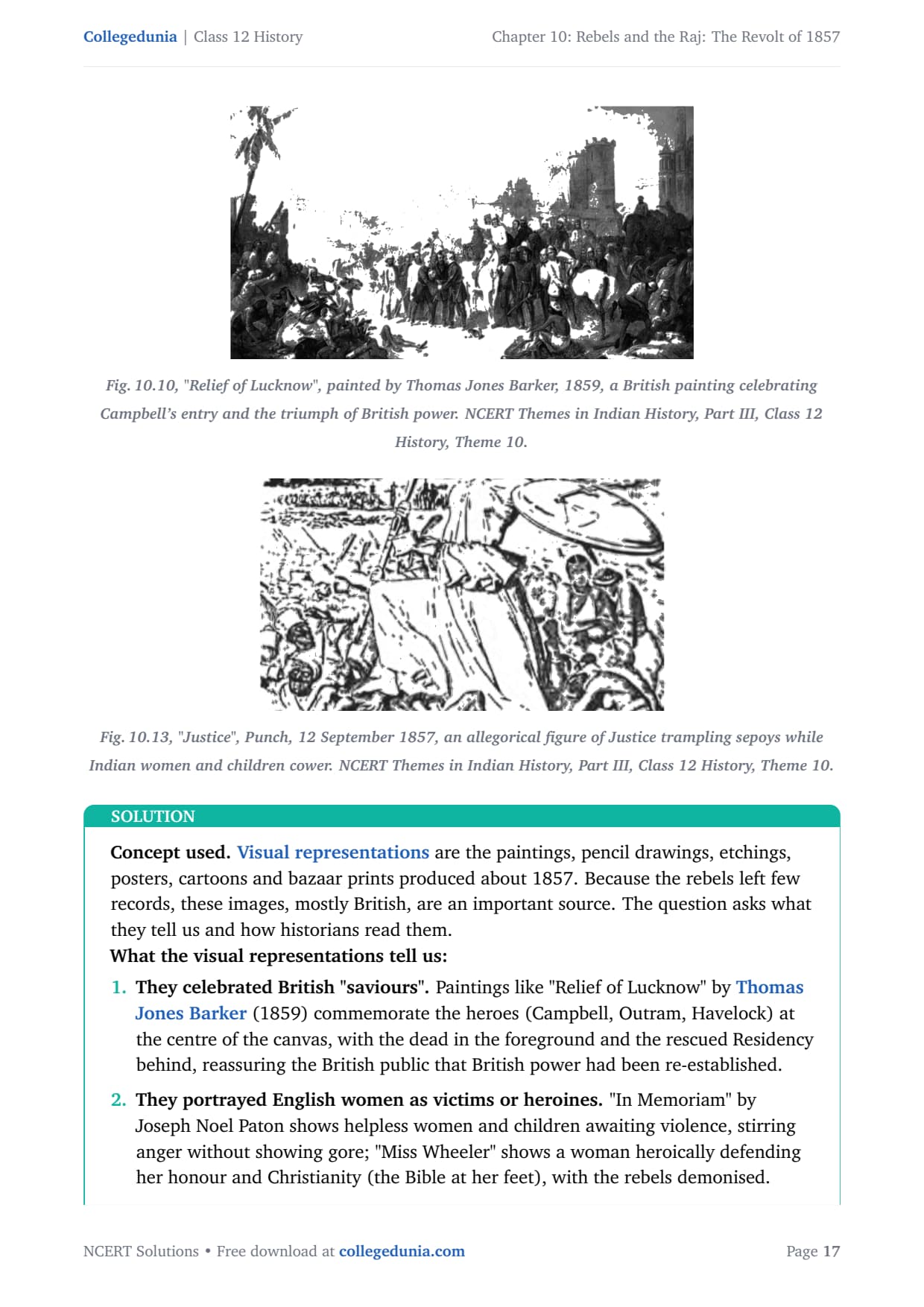
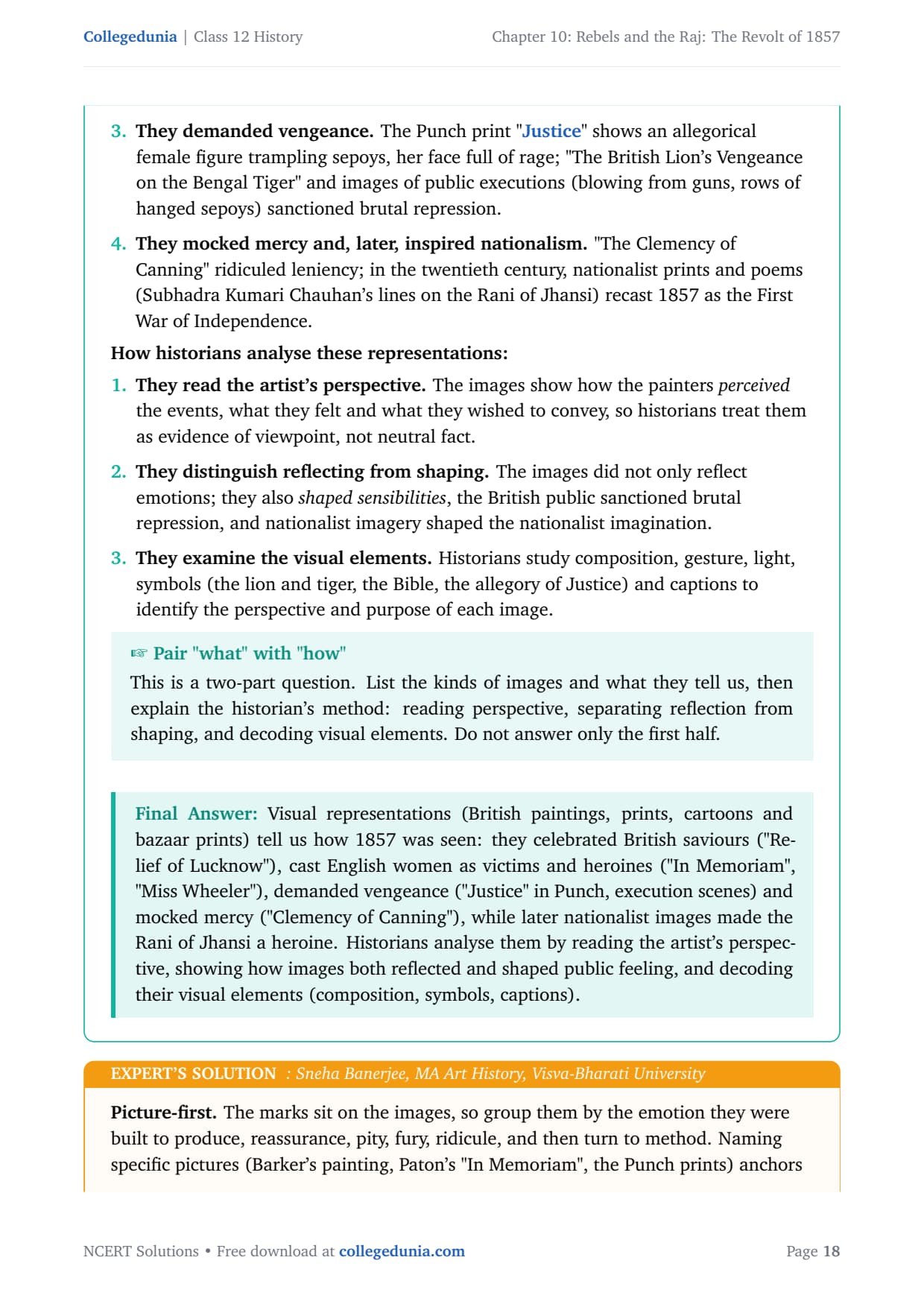
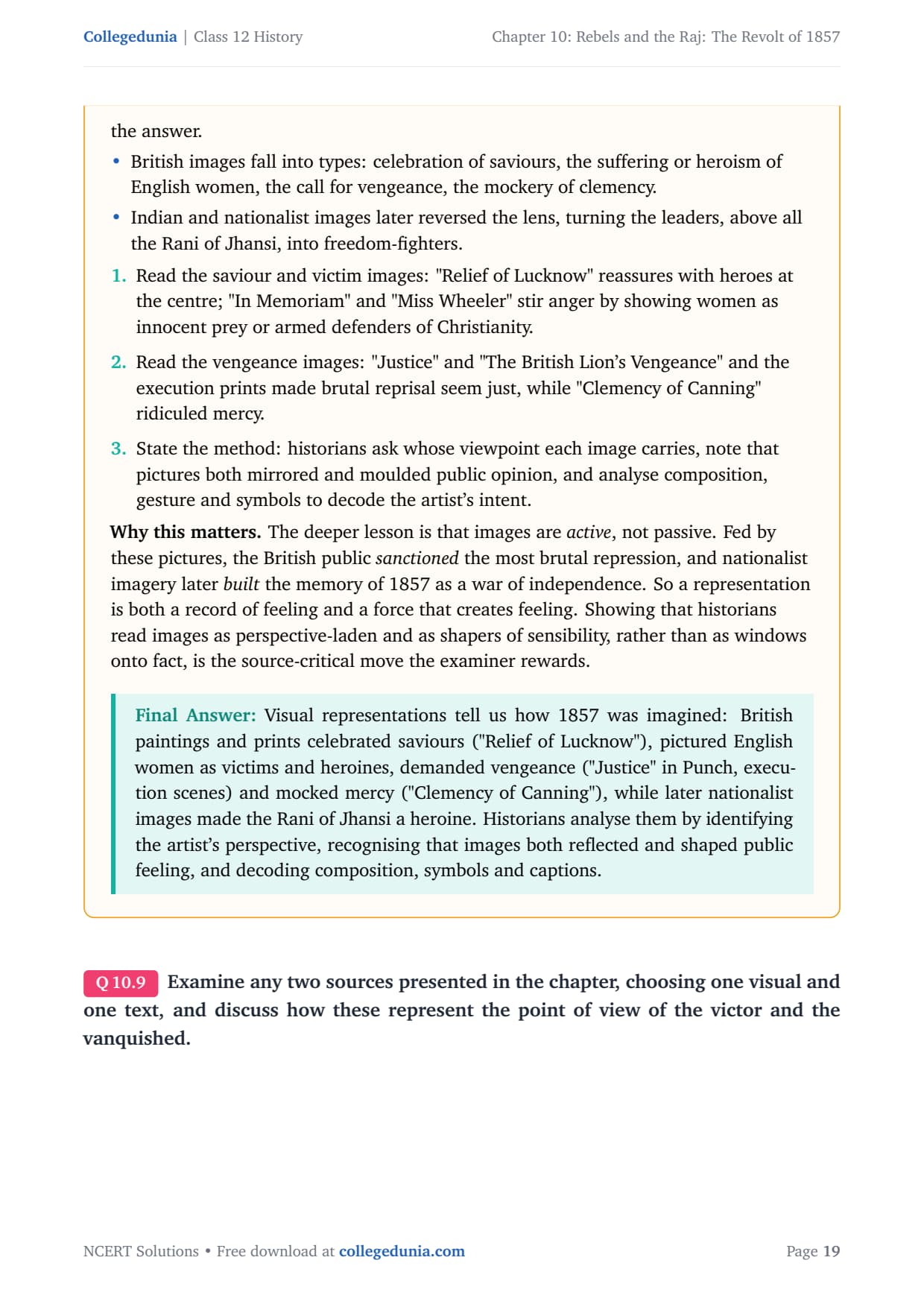



Comments