History Strategist, UPSC Mentor | Updated on - Jul 21, 2026
The NCERT Solutions for History Class 12 NCERT Solutions Chapter 12 Framing the Constitution answer every textbook question on the Constituent Assembly and the making of the Indian Constitution, following the latest 2026-27 CBSE syllabus. Each answer is built from the Constituent Assembly Debates that NCERT quotes, so students get the exact examples the board paper rewards. These solutions help with the Class 12 History exam and the UPSC foundation in 2026-27.
Covers all 11 exercise questions from Theme 15, with full source-based and long-answer points.
This Class 12 History chapter usually carries 6 to 8 marks per board paper.
Pairs with the Notes, Handwritten Notes and NCERT Book PDF linked lower on this page.
Every solution for class 12 history chapter 12 in this Collegedunia compilation is curated by subject experts, written from the official NCERT Themes in Indian History Part III, and checked against the last five years of CBSE board papers.
Student Feedback: In a Collegedunia poll of 10,210 Class 12 History students taken before the 2026 boards, 69% of students rated the "historical forces" and "strong Centre" questions as the toughest part of Framing the Constitution. Most students said sorting the debate speaker by speaker made the long answers click.
Source: 2026-27 Class 12 History student poll. Sample of 10,210 students from CBSE schools across 13 states.
What the Framing the Constitution Class 12 Chapter Is About
Framing the Constitution is the last chapter of Themes in Indian History Part III. It studies how the Constituent Assembly made the Indian Constitution between 1946 and 1950. The chapter is special because almost all its evidence comes from one source, the Constituent Assembly Debates, the printed record of what members said.
The chapter is built around a few big debates students must be able to retell:
The Objectives Resolution set out the ideals that later became the Preamble.
Powers were debated as a tug between a strong Centre and stronger provinces.
Rights covered the protection of minorities and other oppressed groups.
Language raised the Hindi question and how the Assembly settled it.
So the chapter is really about reading a debate. A student who keeps the speaker and the stand together can connect almost any question in chapter 12 history class 12 back to one of these debates. This is why history 12 class chapter 12 revision works best when you list the name, the view and the reason for each argument.
The Objectives Resolution and the Vision of the Constitution
The Objectives Resolution is where the chapter begins, and it is the first exercise question. Jawaharlal Nehru moved it on 13 December 1946, and it set the ideals the whole Constitution would follow. Knowing its promises in order earns easy marks.
The ideals the Objectives Resolution proclaimed were:
An Independent Sovereign Republic: India was bound to be sovereign, independent and a republic.
Justice, equality and freedom: guaranteed to all citizens as the core democratic promise.
Safeguards for the weak: for minorities, backward and tribal areas, and the Depressed and Other Backward Classes.
Democracy and economic justice: the content of democracy, fused with the idea of economic democracy.
An Indian path: Nehru said "We are not going just to copy" other constitutions.
The point that lifts the answer is that the Objectives Resolution later became the Preamble of the Constitution. So these were not loose words; they were the seed of the document's opening declaration. For Question 12.1, open with "Independent Sovereign Republic", list the rights and safeguards, then close with the Preamble link.
Powers of the Centre and the Provinces in the Debates
A large part of the chapter is the fight over how power should be split. The Draft Constitution leaned towards the Centre, and some members wanted the balance tilted back to the provinces. This federalism debate runs through Questions 12.3 and 12.7.
Side of the debate
Main argument
For the provinces (K. Santhanam)
An overburdened Centre could not work; giving states their own powers and finances would make the Centre stronger, not weaker.
Fiscal fairness
Most taxes went to the Centre, so provinces had no money for development; no state should have to come begging.
For a strong Centre (Ambedkar, Ayyangar)
After Partition, a strong Centre was needed to stop communal violence, plan the economy and defend the country.
Why the shift
Partition removed the earlier reason for giving provinces wide autonomy to reassure the Muslim League.
The sharp exam point is the link to Partition. Before Partition the Congress had agreed to wide provincial autonomy; once Partition was settled, many members swung to a strong Centre. Ambedkar wanted "a strong and united Centre", while Santhanam warned the provinces might "rise in revolt" if over-centralised. For Question 12.7, connect the violence and refugee crisis directly to the demand for a strong Centre.
Minorities, Oppressed Groups and the Question of Rights
The chapter spends many pages on who counted as a minority and how the weak should be protected. These pages feed Questions 12.2 and 12.6, both long-answer favourites. Different speakers gave very different definitions.
Religious minorities (B. Pocker Bahadur): minorities meant religious communities, above all Muslims, who needed a real voice.
The masses as the real minority (N. G. Ranga): the socialist Ranga said the poor were the true minority and needed economic "props and a ladder".
Tribals (Jaipal Singh): the Adivasi orator said tribals were neglected and needed reservation of seats, not separate electorates.
Depressed Castes (Nagappa, Dakshayani Velayudhan): they were 20 to 25 per cent of the people and asked for dignity and the end of untouchability.
Women (Hansa Mehta): they wanted equality and justice, not special privileges.
The key insight for both questions is that "minority" was never a fixed, numerical idea; it meant different things to different speakers. Strong answers cover all the groups, name the speaker for each, and end by noting that the Assembly chose reservation of seats over separate electorates.
The Language Question and How the Assembly Settled It
Language was one of the most heated debates in the Assembly, and it covers Questions 12.4 and 12.8. The fight was between those who wanted Hindi as the national language and those from the south and non-Hindi areas who feared Hindi domination.
Gandhi's view: he favoured Hindustani, a blend of Hindi and Urdu, because common people understood it and it could unite Hindus and Muslims, north and south.
A Language Committee: it produced a compromise formula to bridge the deadlock.
"Official", not "national": Hindi was called the official language, not the national language, to "placate ruffled emotions".
A gradual shift: Hindi in Devanagari would be the official language, with English continuing for fifteen years.
Room for regional languages: each province could choose its own language for its own work.
The point examiners look for is the word change. Calling Hindi "official" rather than "national" was the compromise that calmed the south. For Question 12.8, explain the Language Committee's formula, the gradual transition and the space left for regional languages, and you cover the answer fully.
Historical Forces That Shaped the Constitution
Question 12.5 asks what historical forces shaped the vision of the Constitution. This needs a layered answer that moves from long-term forces to the immediate trauma of 1947. The chapter gives five clear forces students can list.
Force
What it gave the Constitution
National movement
The struggle against an "oppressive and illegitimate" government became a struggle for democracy and the habit of public debate.
Social reform
Nineteenth-century reformers shaped the demand for social justice and equality.
Earlier reforms
The Acts of 1909, 1919 and 1935 gave Indians real experience of representation and self-government.
World revolutions
Nehru looked to the American and French Revolutions, while refusing to "just copy".
Trauma of Partition
The violence of 1947 pushed the framers towards a strong Centre and a secular order.
The conclusion that earns the top band is that the vision fused the liberal idea of democracy with the demand for social and economic justice. The Constitution was not borrowed wholesale; it grew out of India's own movement, reforms and the shock of Partition. Showing this fusion turns a list into an argument.
Framing the Constitution Class 12 Exercise-wise Coverage
The chapter exercise has 11 questions. The table maps each one to its topic so students can plan revision and find the right NCERT answer fast. The full step-by-step solution for each sits in the question set lower on this page.
Question
Topic it tests
Q 12.1
Ideals expressed in the Objectives Resolution
Q 12.2
How the term minority was defined by different groups
Q 12.3
Arguments for greater power to the provinces
Q 12.4
Why Gandhi thought Hindustani should be the national language
Q 12.5
Historical forces that shaped the vision of the Constitution
Q 12.6
Arguments for the protection of oppressed groups
Q 12.7
The political situation and the need for a strong Centre
Q 12.8
How the Assembly resolved the language controversy
Q 12.9 to 12.11
Map work and project-style activities
Questions 12.5, 12.6 and 12.7 are the most-asked long answers, so students preparing chapter 12 history class 12 revision should learn those three first. The map and project tasks (12.9 to 12.11) are also useful for the history project file class 12 chapter 12 that many schools assign.
Students who want the offline copy can save the class 12 history chapter 12 pdf from the download card above and tick off each question as they finish it.
Framing the Constitution Important Questions and Previous Year Trends
CBSE sets a steady mix of source-based, short and long answers from this chapter. Knowing the pattern helps students decide how much to write. The chapter is a regular source of one 5-mark or 8-mark source-based question drawn from the debates, which is why a focused list of chapter 12 history class 12 important questions saves a lot of revision time.
Source-based (often 8 marks): an extract from the debates on minorities, language or a strong Centre, with three sub-parts.
Long answer (5 to 6 marks): historical forces, protection of oppressed groups, or the need for a strong Centre.
Short answer (3 marks): the Objectives Resolution, Gandhi on Hindustani, or the language compromise.
Objective and MCQ: dates, who said what, and the role of key members.
For quick recall before the exam, students often practise the class 12 history chapter 12 mcq set and a list of class 12 history chapter 12 important questions. The most repeated items are the historical forces, the minorities debate and the strong-Centre arguments, so keep those answer points ready in your own words.
It also helps to attempt a short history class 12 chapter 12 mcq drill and the class 12 history chapter 12 extra questions and answers after you finish the main exercise. These extra sets test the small facts, such as exact dates and the names of speakers, that examiners use for one-mark objective questions.
Working through the ncert solution class 12 history chapter 12 set twice, once open-book and once from memory, fixes those facts well before the board exam.
Common Mistakes Students Make in the Framing the Constitution Chapter
A few errors cost marks every year in this chapter. Most come from naming only one speaker or from missing the link to Partition. Avoiding them is the fastest way to lift a score.
Giving only one definition of "minority" - it was contested, so name several speakers.
Forgetting that the Objectives Resolution became the Preamble.
Missing the Partition link in the strong-Centre answer.
Confusing "official language" with "national language" - the Assembly chose official.
Listing forces without the closing point that democracy was fused with social justice.
Students who fix these five points usually move from average to high marks on the long answers. The exam rewards a debate-style answer, so name the member, give the view and add the reason for each argument.
Framing the Constitution PDF Download Formats and Languages
The solutions are free to download in more than one format, so students can pick what suits their device and revision style. The download card at the top of the page carries each option for this chapter.
Normal and HD PDF: the history class 12 chapter 12 pdf is offered in a normal size for quick downloads and an HD version for clear printing.
English medium: all 11 answers are written in simple English for the CBSE board paper.
Question-only set: a print-and-practise sheet of class 12 history chapter 12 extra questions for self-testing.
Whole-book pack: the chapter 12 history class 12 ncert solutions sit in one set that runs through every theme, so you can revise from Chapter 1 to the final chapter in one place.
Many students search for class 12 chapter 12 history answers on their phone the night before a test, so a saved PDF means you can revise even without internet. Keep both the question set and the solved version handy for a full self-check.
How the Framing the Constitution Solutions Pair with Notes and the Book PDF
These NCERT Solutions answer the back-exercise questions. To revise the full chapter, students should use them alongside the other resources for the same chapter, all linked in the table below.
Reading the original NCERT chapter text and debate extracts
Tip: read the Notes first, then attempt these solutions on your own, and only then check the model answers here. That order builds memory faster than copying answers straight away.
All NCERT Solutions for Class 12 History Chapter 12 Framing the Constitution
The table links the NCERT Solutions for every chapter in Themes in Indian History so students can move across the book in one click. Chapter 12 is highlighted.
All NCERT Solutions for Framing the Constitution with Step-by-Step Solutions
Below are all 11 NCERT exercise questions for this chapter, exactly as they appear in the textbook. Tap Check Solution for the model answer or Expert Solution for the topper-style approach.
Q 12.1
What were the ideals expressed in the Objectives Resolution?
Concept used. The Objectives Resolution was moved by
Jawaharlal Nehru on 13 December 1946. It was a momentous
resolution that outlined the defining ideals of the Constitution and set the
ground rules within which constitution-making would proceed. "Ideals" here
means the guiding values and goals it proclaimed for the new nation.
The Objectives Resolution expressed these ideals:
An independent sovereign republic. It proclaimed India to be
an "Independent Sovereign Republic". Nehru insisted India was
bound to be sovereign, independent and a republic.
Justice, equality and freedom. It guaranteed to all
citizens justice, equality and freedom, the core promises of a
democratic order.
Safeguards for the weak. It assured that "adequate safeguards
shall be provided for minorities, backward and tribal areas,
and Depressed and Other Backward Classes", protecting those most
likely to be left behind.
Democracy and economic justice. Though the word "democratic"
was not used (Nehru said "republic" already contained it), he claimed
the resolution gave the content of democracy and even of
economic democracy, fusing liberal democracy with the
socialist idea of economic justice.
An Indian path, not a copy. Nehru placed the project in the
line of the American and French revolutions, but stressed "We
are not going just to copy": the system had to fit the temper of the
Indian people.
Lead with "sovereign republic"
The single phrase the examiner looks for is "Independent Sovereign Republic".
Open with it, then list justice, equality, freedom and safeguards for
minorities, and you have the marks.
The Objectives Resolution (Nehru, 13 December 1946) proclaimed India
an "Independent Sovereign Republic"; guaranteed its citizens justice, equality
and freedom; assured adequate safeguards for minorities, backward and tribal
areas, and the Depressed and Other Backward Classes; gave the content of
democracy and economic democracy; and insisted India would not just copy other
constitutions but build one fitting its own people.
AS
Ananya Sengupta
MA Modern Indian History, JNU
Verified Expert
Strategic angle. Treat the resolution as a list of promises and tick
them off: form of the state (sovereign republic), rights (justice, equality,
freedom), protection (safeguards for minorities and weaker sections), and the
spirit (democracy plus economic justice, an Indian path). Four clean heads read
as analysis, not memory.
Form of the state: an Independent Sovereign Republic, India bound to be
sovereign, independent and a republic, with democracy implied inside
the word "republic".
Rights and protection: justice, equality and freedom for all citizens,
plus adequate safeguards for minorities, backward and tribal areas and
the Depressed and Other Backward Classes.
Spirit and method: the content of democracy and economic democracy, and
Nehru's refusal to copy: the Constitution had to suit the temper of the
Indian people.
Why this matters. The deeper point, worth a closing line, is that the
Objectives Resolution became the Preamble of the Constitution. So
these were not loose words: they were the seed of the document's opening
declaration. Showing that the resolution set both the goals (justice,
liberty, equality) and the character (sovereign, republic, secular and
democratic in spirit) of the whole Constitution lifts the answer from a list
into an argument about why these ideals mattered.
The ideals were: an Independent Sovereign Republic; justice, equality
and freedom for all citizens; adequate safeguards for minorities, backward and
tribal areas and the Depressed and Other Backward Classes; the content of
democracy and economic democracy; and an India-specific Constitution that would
"not just copy" others. These ideals later shaped the Preamble.
Q 12.2
How was the term minority defined by different groups?
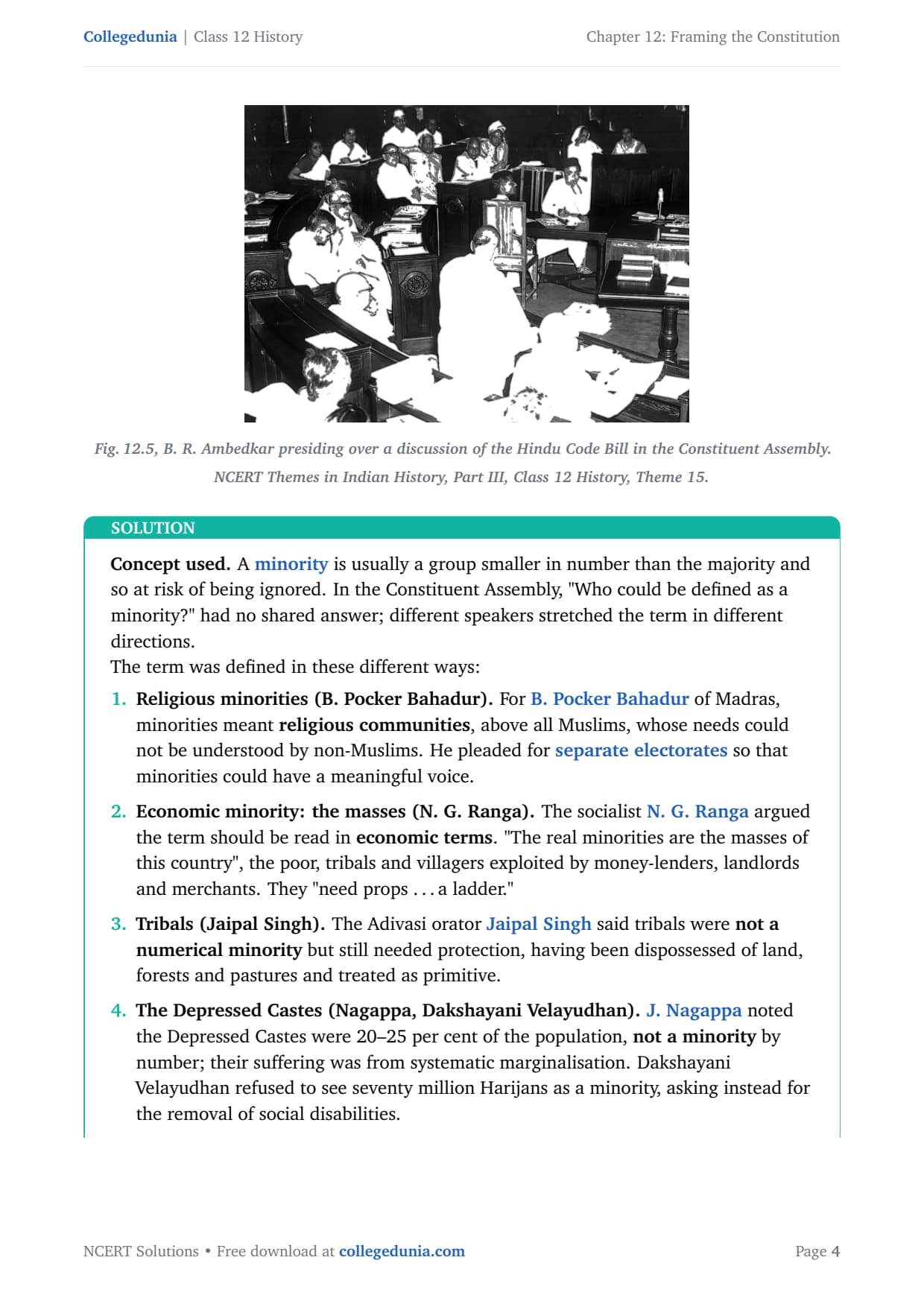
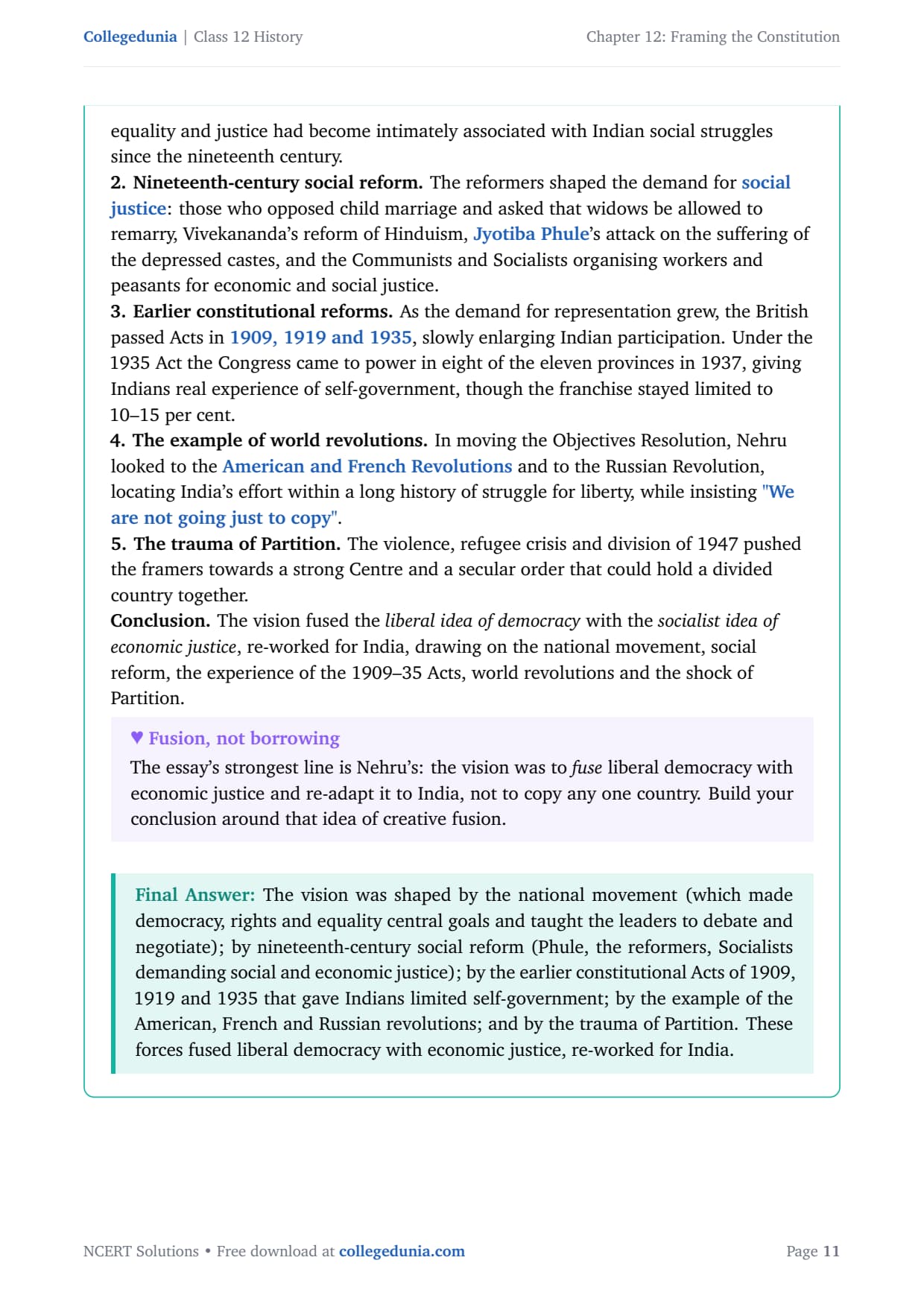
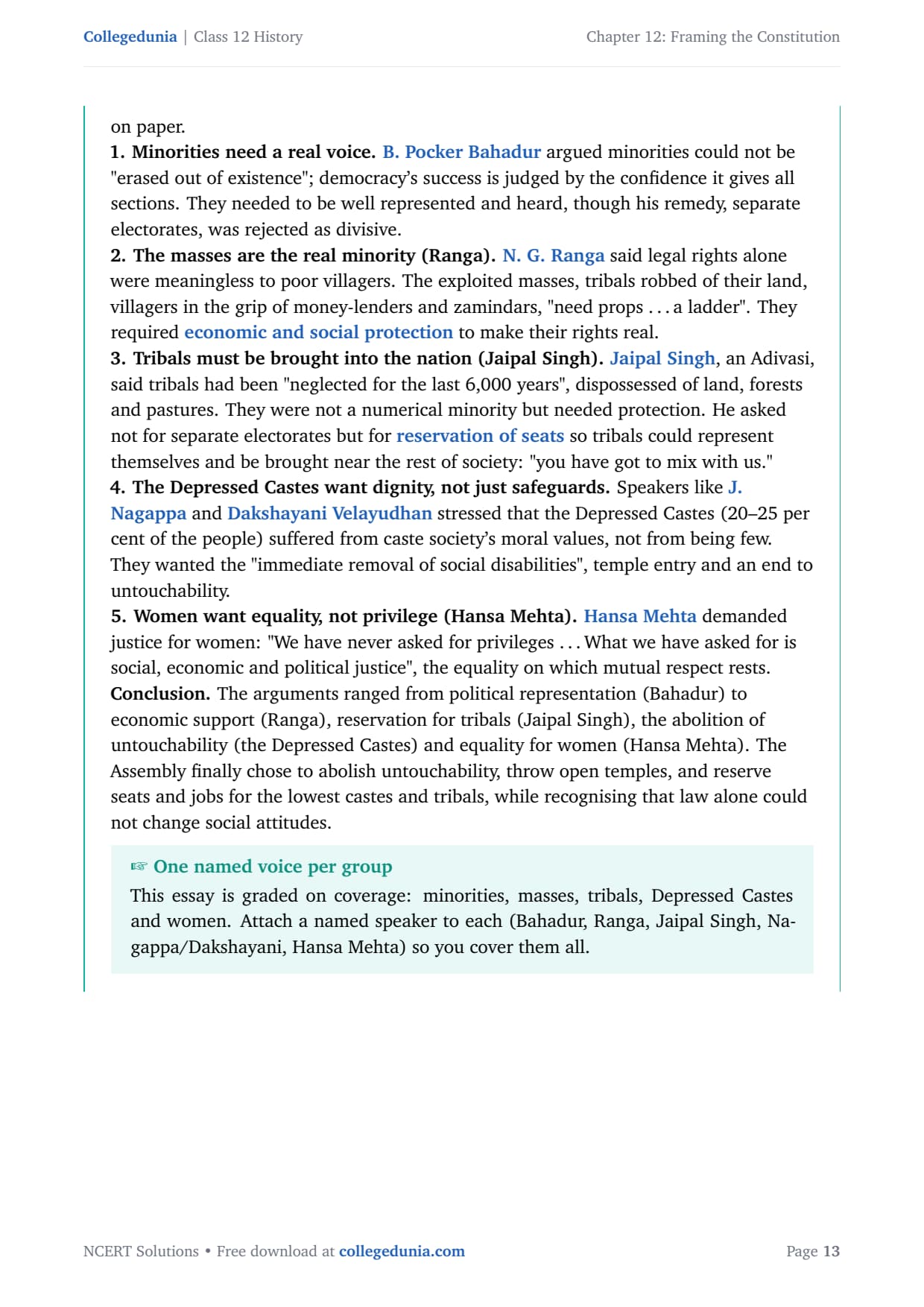
Fig. 12.5, B. R. Ambedkar presiding over a
discussion of the Hindu Code Bill in the Constituent Assembly. NCERT Themes in
Indian History, Part III, Class 12 History, Theme 15.
Concept used. A minority is usually a group smaller in
number than the majority and so at risk of being ignored. In the Constituent
Assembly, "Who could be defined as a minority?" had no shared answer; different
speakers stretched the term in different directions.
The term was defined in these different ways:
Religious minorities (B. Pocker Bahadur). For
B. Pocker Bahadur of Madras, minorities meant
religious communities, above all Muslims, whose needs could not
be understood by non-Muslims. He pleaded for separate
electorates so that minorities could have a meaningful voice.
Economic minority: the masses (N. G. Ranga). The socialist
N. G. Ranga argued the term should be read in
economic terms. "The real minorities are the masses of this
country", the poor, tribals and villagers exploited by money-lenders,
landlords and merchants. They "need props a ladder."
Tribals (Jaipal Singh). The Adivasi orator Jaipal
Singh said tribals were not a numerical minority but still
needed protection, having been dispossessed of land, forests and
pastures and treated as primitive.
The Depressed Castes (Nagappa, Dakshayani Velayudhan).J. Nagappa noted the Depressed Castes were 20–25 per cent of
the population, not a minority by number; their suffering was
from systematic marginalisation. Dakshayani Velayudhan refused to see
seventy million Harijans as a minority, asking instead for the removal
of social disabilities.
The word "minority" was contested
The real lesson is that "minority" was not a fixed, numerical idea. For some it
meant religion, for others poverty, for others caste oppression. Saying clearly
that the term was disputed is the heart of the answer.
Different groups defined "minority" differently. Bahadur meant
religious communities (especially Muslims) and wanted separate electorates.
Ranga read it in economic terms, the poor masses, tribals and villagers, as the
real minorities. Jaipal Singh said tribals, though not a numerical minority,
needed protection. Nagappa and Dakshayani Velayudhan argued the Depressed
Castes (20–25 per cent of the people) were not a minority by number but
suffered from caste marginalisation.
IS
Imran Sheikh
MA History, Jamia Millia Islamia
Verified Expert
Strategic angle. The question is a "compare the definitions" task, so
group the speakers by the kind of minority each meant: religious,
economic, tribal and caste. One named speaker per kind keeps it evidenced and
easy to mark.
Religious reading: Bahadur, minorities are faith communities (Muslims),
deserving separate electorates so their distinct needs are heard.
Economic reading: Ranga, the real minorities are the masses, the
downtrodden poor, tribals and villagers, whom mere legal rights cannot
protect without "props" and "a ladder".
Numerical-versus-social reading: Jaipal Singh (tribals) and Nagappa /
Dakshayani (Depressed Castes) both stress that these groups are large in
number yet oppressed, so "minority" should mean the marginalised, not
just the few.
Why this matters. The mature point is that this clash of definitions
decided policy. Because the Assembly finally rejected the religious
reading (and separate electorates) and accepted the social one, it chose
reservation of seats and jobs for the Depressed Castes and tribals
rather than separate electorates. Showing how the meaning of one word steered
the Constitution's approach to protection is the top-band insight.
Bahadur defined minority by religion (Muslims, needing separate
electorates); Ranga defined it economically as the exploited masses; Jaipal
Singh said tribals, though numerous, needed protection; Nagappa and Dakshayani
Velayudhan argued the Depressed Castes (20–25 per cent) were marginalised, not
a numerical minority. The term was thus contested between religious, economic
and caste meanings.
Q 12.3
What were the arguments in favour of greater power to the provinces?
Concept used.Federalism divides power between a central
government and the states. The Draft Constitution leaned heavily towards the
Centre, placing many subjects under exclusive Union control. Some
members argued the balance should tilt back towards the provinces
(states).
The arguments in favour of greater power to the provinces were:
A strong Centre needs strong states (K. Santhanam).K. Santhanam of Madras argued that piling all powers on the
Centre was a misconception: an overburdened Centre could not
function effectively. By transferring some functions to the states,
the Centre itself would actually become stronger.
The fiscal provisions would cripple the states. Most taxes,
except land revenue, had been made the preserve of the Centre.
Without finances the provinces could not undertake development. As
Santhanam put it, no state should have to come to the Centre begging "I
cannot educate my people give me a dole".
Fewer items on the Union and Concurrent lists. Many members
from the provinces fought hard for fewer subjects to be placed
on the Concurrent and Union lists, so that the states kept more
authority of their own.
Over-centralisation risks revolt. A member from Orissa warned
that "the Centre is likely to break" because powers had been
excessively centralised. Santhanam predicted that within a few years
the provinces would "rise in revolt against the Centre".
Anchor the answer to Santhanam
Most of the marks sit with K. Santhanam: a strong Centre needs strong states,
the fiscal squeeze will impoverish provinces, and over-centralisation invites
revolt. Lead with his name and these three points.
Those favouring provincial power, led by K. Santhanam, argued that an
overburdened Centre could not work well, so giving functions to the states would
make even the Centre stronger; that the fiscal provisions, with most taxes going
to the Centre, would impoverish the provinces and stop development; that fewer
items should be on the Union and Concurrent lists; and that excessive
centralisation risked the provinces rising in "revolt", since "the Centre is
likely to break".
PS
Pranav Sharma
MA History, University of Delhi
Verified Expert
Structural observation. This is really "summarise the provincialist
case", so present it as a short, ordered set of arguments, all traceable to
Santhanam and the provincial members, then add the warning that closes it. Named
points score; vague "states wanted more power" does not.
Efficiency argument: an overburdened Centre is a weak Centre, so
devolving functions strengthens, not weakens, the Union (Santhanam's
paradox).
Fiscal argument: with land revenue almost the only state tax, provinces
would be left too poor to fund schooling, sanitation and roads, forced
to beg the Centre for doles.
Stability argument: cramming the Union and Concurrent lists risks the
provinces revolting; "the Centre is likely to break" if power is
over-centralised.
Why this matters. The mature framing is that these were the
losing arguments. The Assembly, shaken by Partition violence and the need
to plan the economy, chose a Constitution with "a distinct bias towards the
rights of the Union" (Article 356, more items under Union control). Noting that
the provincialist case was strong in logic but defeated by the politics of the
moment shows you understand the debate as a contest, not just a list.
The provincialists argued: an overburdened Centre is ineffective, so
devolving powers to states makes the Centre stronger (Santhanam); the fiscal
scheme, leaving states only land revenue, would impoverish them and block
development; fewer items should sit on the Union and Concurrent lists; and
over-centralisation risked provinces revolting, since "the Centre is likely to
break".
Q 12.4
Why did Mahatma Gandhi think Hindustani should be the national language?
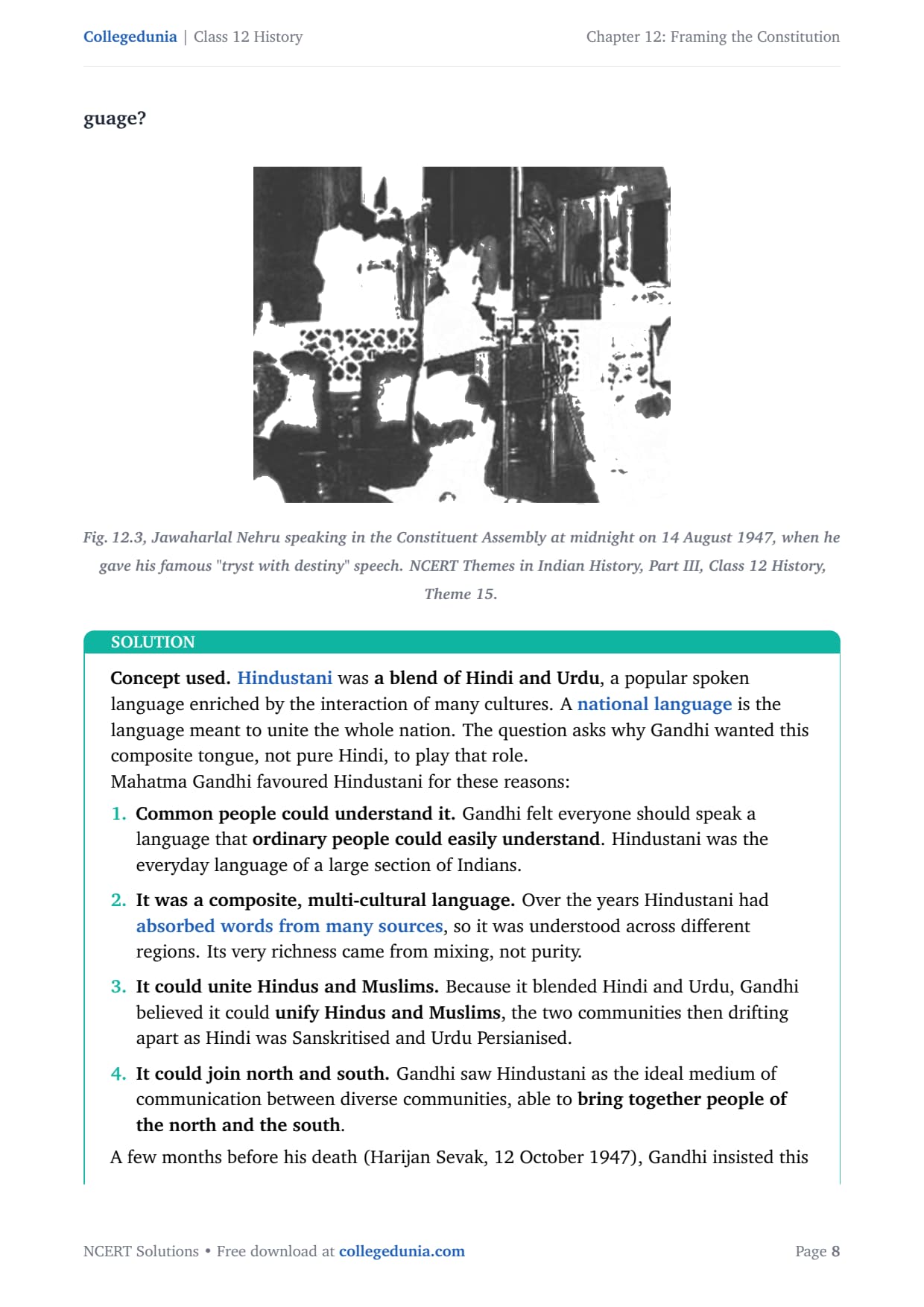
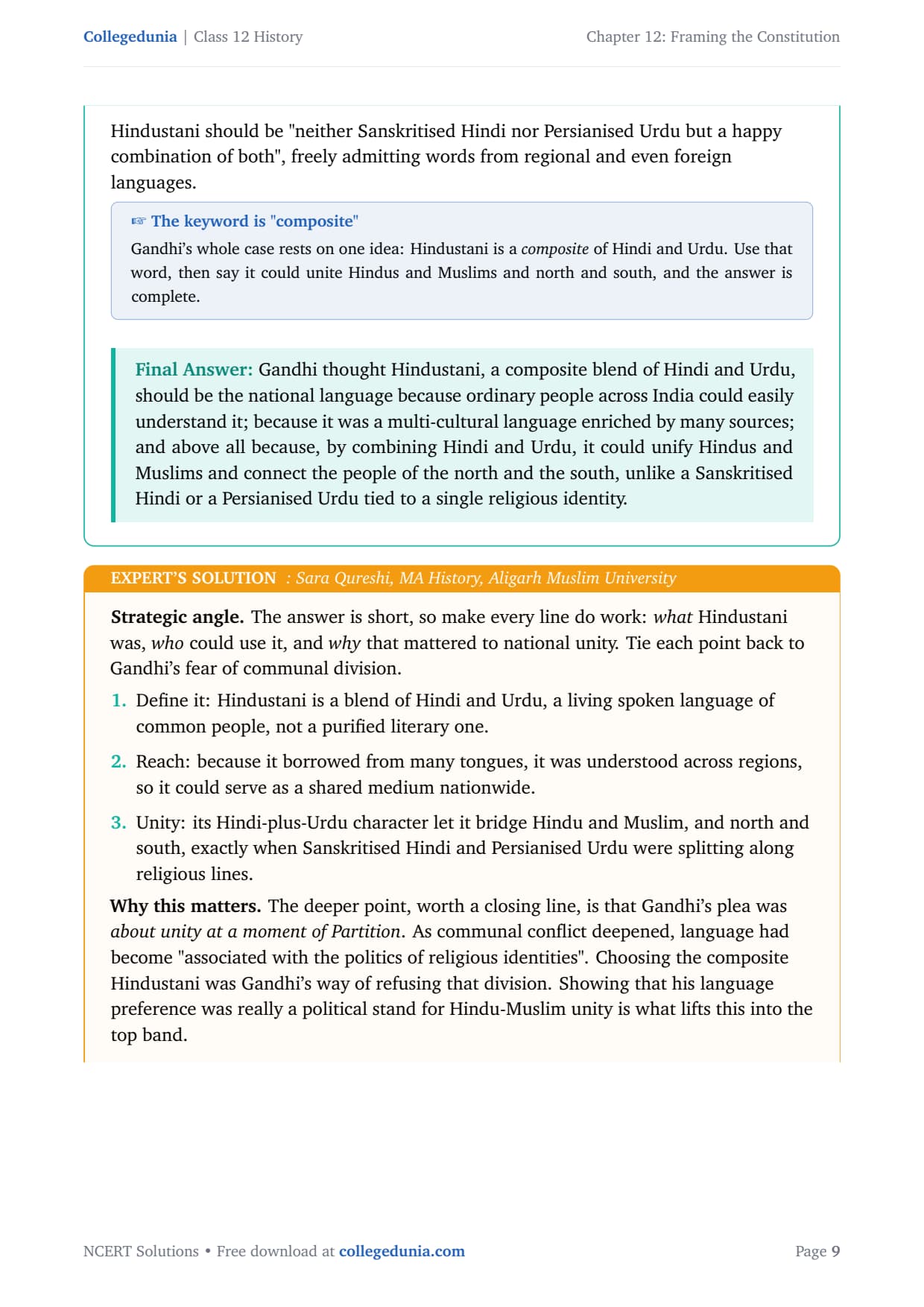
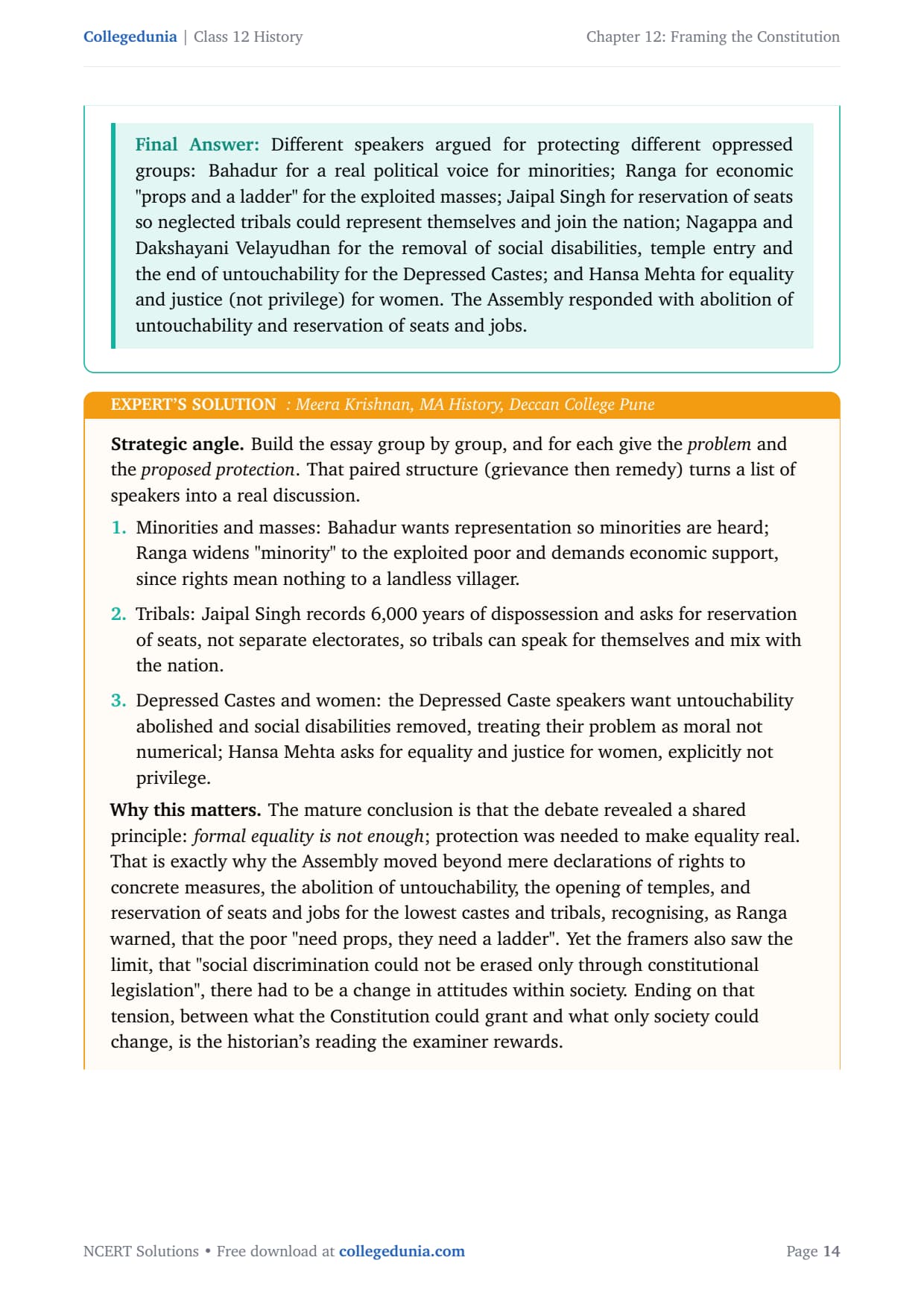
Fig. 12.3, Jawaharlal Nehru speaking in the
Constituent Assembly at midnight on 14 August 1947, when he gave his famous
"tryst with destiny" speech. NCERT Themes in Indian History, Part III, Class 12
History, Theme 15.
Concept used.Hindustani was a blend of Hindi and
Urdu, a popular spoken language enriched by the interaction of many cultures.
A national language is the language meant to unite the whole nation.
The question asks why Gandhi wanted this composite tongue, not pure Hindi, to
play that role.
Mahatma Gandhi favoured Hindustani for these reasons:
Common people could understand it. Gandhi felt everyone should
speak a language that ordinary people could easily understand.
Hindustani was the everyday language of a large section of Indians.
It was a composite, multi-cultural language. Over the years
Hindustani had absorbed words from many sources, so it was
understood across different regions. Its very richness came from mixing,
not purity.
It could unite Hindus and Muslims. Because it blended Hindi and
Urdu, Gandhi believed it could unify Hindus and Muslims, the
two communities then drifting apart as Hindi was Sanskritised and Urdu
Persianised.
It could join north and south. Gandhi saw Hindustani as the
ideal medium of communication between diverse communities, able to
bring together people of the north and the south.
A few months before his death (Harijan Sevak, 12 October 1947), Gandhi insisted
this Hindustani should be "neither Sanskritised Hindi nor Persianised Urdu but a
happy combination of both", freely admitting words from regional and even
foreign languages.
The keyword is "composite"
Gandhi's whole case rests on one idea: Hindustani is a composite of Hindi
and Urdu. Use that word, then say it could unite Hindus and Muslims and north
and south, and the answer is complete.
Gandhi thought Hindustani, a composite blend of Hindi and Urdu, should
be the national language because ordinary people across India could easily
understand it; because it was a multi-cultural language enriched by many
sources; and above all because, by combining Hindi and Urdu, it could unify
Hindus and Muslims and connect the people of the north and the south, unlike a
Sanskritised Hindi or a Persianised Urdu tied to a single religious identity.
SQ
Sara Qureshi
MA History, Aligarh Muslim University
Verified Expert
Strategic angle. The answer is short, so make every line do work:
what Hindustani was, who could use it, and why that
mattered to national unity. Tie each point back to Gandhi's fear of communal
division.
Define it: Hindustani is a blend of Hindi and Urdu, a living spoken
language of common people, not a purified literary one.
Reach: because it borrowed from many tongues, it was understood across
regions, so it could serve as a shared medium nationwide.
Unity: its Hindi-plus-Urdu character let it bridge Hindu and Muslim, and
north and south, exactly when Sanskritised Hindi and Persianised Urdu
were splitting along religious lines.
Why this matters. The deeper point, worth a closing line, is that
Gandhi's plea was about unity at a moment of Partition. As communal
conflict deepened, language had become "associated with the politics of
religious identities". Choosing the composite Hindustani was Gandhi's way of
refusing that division. Showing that his language preference was really a
political stand for Hindu-Muslim unity is what lifts this into the top band.
Because Hindustani was a composite of Hindi and Urdu that common
people everywhere could understand, and because its mixed, multi-cultural
character meant it could unite Hindus and Muslims and join north and south,
Gandhi held it should be the national language, in preference to a Sanskritised
Hindi or Persianised Urdu that tied language to a single religious identity.
Q 12.5
What historical forces shaped the vision of the Constitution?
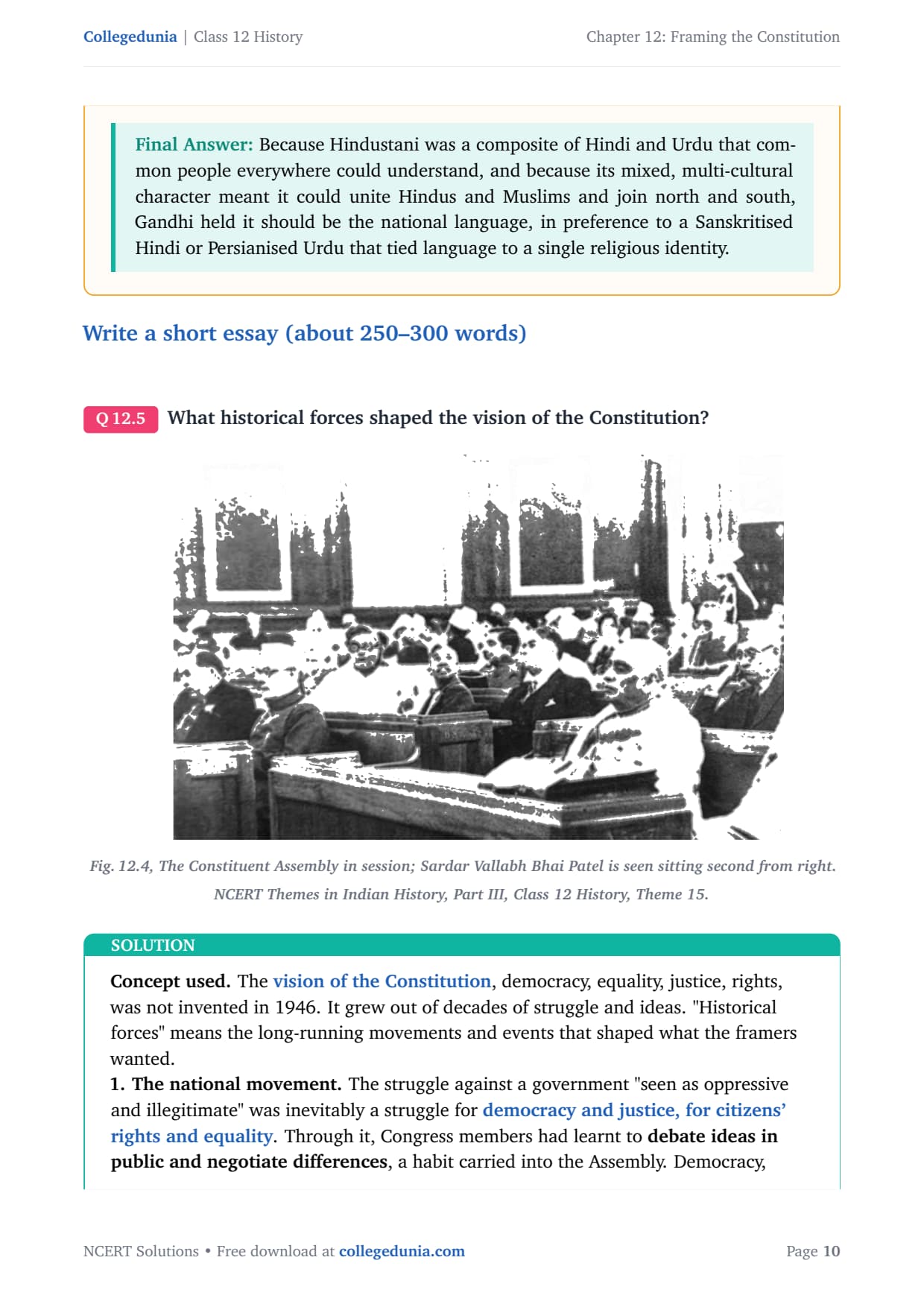
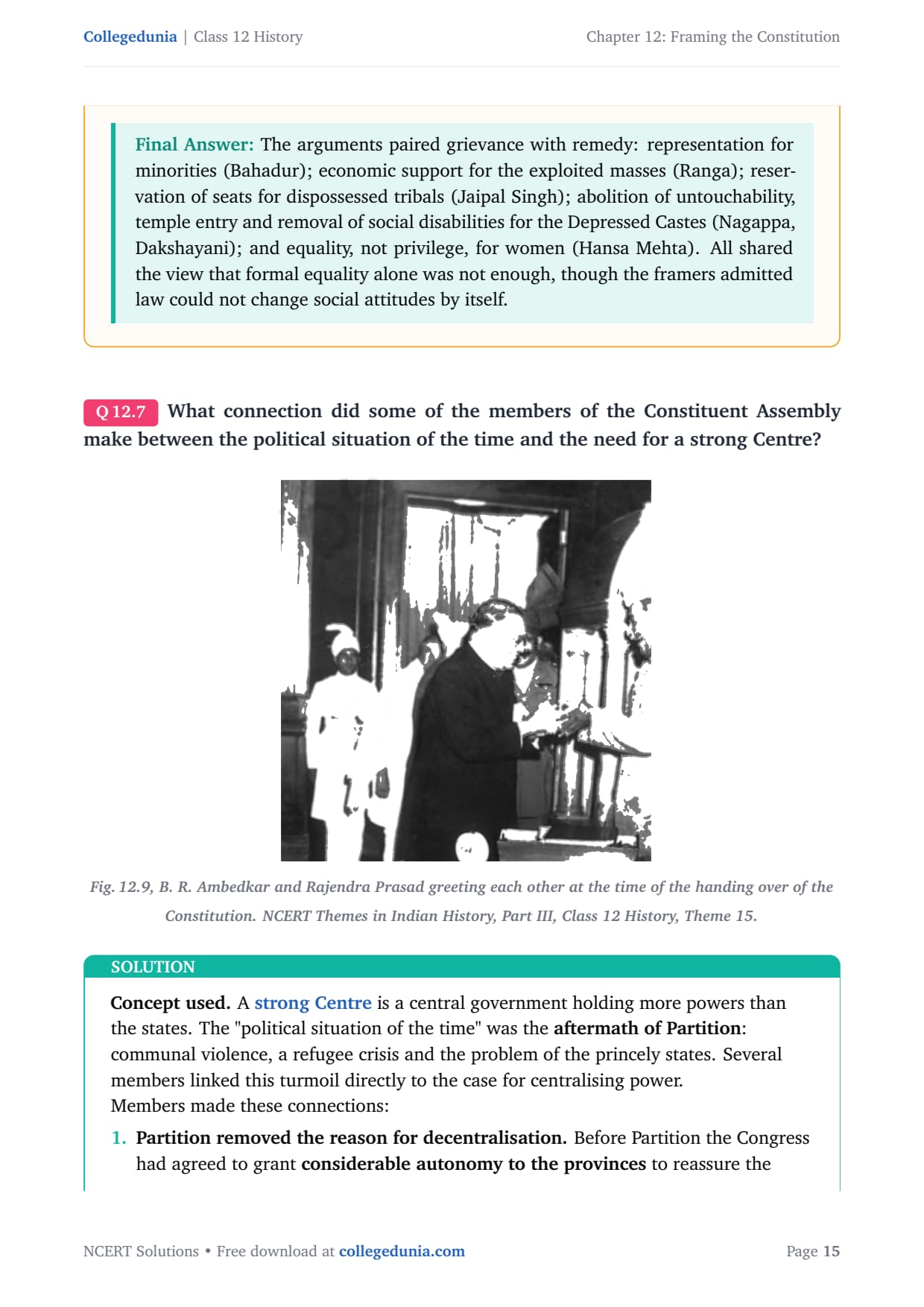
Fig. 12.4, The Constituent Assembly in session;
Sardar Vallabh Bhai Patel is seen sitting second from right. NCERT Themes in
Indian History, Part III, Class 12 History, Theme 15.
Concept used. The vision of the Constitution, democracy,
equality, justice, rights, was not invented in 1946. It grew out of decades of
struggle and ideas. "Historical forces" means the long-running movements and
events that shaped what the framers wanted.
1. The national movement. The struggle against a government "seen as
oppressive and illegitimate" was inevitably a struggle for democracy
and justice, for citizens' rights and equality. Through it, Congress members
had learnt to debate ideas in public and negotiate differences, a
habit carried into the Assembly. Democracy, equality and justice had become
intimately associated with Indian social struggles since the nineteenth
century.
2. Nineteenth-century social reform. The reformers shaped the demand
for social justice: those who opposed child marriage and asked that
widows be allowed to remarry, Vivekananda's reform of Hinduism, Jyotiba
Phule's attack on the suffering of the depressed castes, and the Communists and
Socialists organising workers and peasants for economic and social justice.
3. Earlier constitutional reforms. As the demand for representation
grew, the British passed Acts in 1909, 1919 and 1935, slowly enlarging
Indian participation. Under the 1935 Act the Congress came to power in eight of
the eleven provinces in 1937, giving Indians real experience of self-government,
though the franchise stayed limited to 10–15 per cent.
4. The example of world revolutions. In moving the Objectives
Resolution, Nehru looked to the American and French Revolutions and to
the Russian Revolution, locating India's effort within a long history of
struggle for liberty, while insisting "We are not going just to copy".
5. The trauma of Partition. The violence, refugee crisis and division
of 1947 pushed the framers towards a strong Centre and a secular order that
could hold a divided country together.
Conclusion. The vision fused the liberal idea of democracy with
the socialist idea of economic justice, re-worked for India, drawing on
the national movement, social reform, the experience of the 1909–35 Acts, world
revolutions and the shock of Partition.
Fusion, not borrowing
The essay's strongest line is Nehru's: the vision was to fuse liberal
democracy with economic justice and re-adapt it to India, not to copy any one
country. Build your conclusion around that idea of creative fusion.
The vision was shaped by the national movement (which made democracy,
rights and equality central goals and taught the leaders to debate and
negotiate); by nineteenth-century social reform (Phule, the reformers,
Socialists demanding social and economic justice); by the earlier
constitutional Acts of 1909, 1919 and 1935 that gave Indians limited
self-government; by the example of the American, French and Russian revolutions;
and by the trauma of Partition. These forces fused liberal democracy with
economic justice, re-worked for India.
VD
Vikram Desai
MA Modern History, University of Hyderabad
Verified Expert
Strategic angle. "Historical forces" wants a layered answer: long-term
(social reform, national movement), medium-term (the 1909–35 Acts and world
revolutions) and immediate (Partition). Order them by time-depth so the essay
reads as cause building on cause.
Long-term forces: the nineteenth-century social-reform movements and the
wider national movement made justice, equality and citizens' rights the
shared language of Indian politics.
Medium-term forces: the constitutional reforms of 1909, 1919 and 1935
gave Indians practice in legislatures and provincial government, and the
American, French and Russian revolutions offered models to learn from
but not copy.
Immediate force: Partition's violence and the princely-states problem
pushed the framers towards a strong Centre and an explicit commitment to
secularism and unity.
Why this matters. The mature thesis is that the Constitution was a
synthesis: Nehru's own words were that it would "fuse the liberal ideas of
democracy with the socialist idea of economic justice" and re-work them in the
Indian context. The historian's job is to show these forces did not simply add
up but were blended into something new. Notice too that the framers did not
treat these influences as a fixed inheritance: as the debate ran on over three
years, members "rethought their positions", so the vision itself kept evolving
in response to events such as Partition. A conclusion that names this creative,
evolving fusion, rather than just listing influences, earns the top band.
The vision was shaped by long-term forces (nineteenth-century social
reform and the national movement, which centred justice, equality and rights),
medium-term forces (the limited self-government of the 1909, 1919 and 1935 Acts,
and the example of the American, French and Russian revolutions), and the
immediate force of Partition. Nehru fused these into a synthesis of liberal
democracy and economic justice, re-adapted for India rather than copied.
Q 12.6
Discuss the different arguments made in favour of protection of the
oppressed groups.
Concept used.Oppressed groups in the debates meant the
minorities, the tribals, the Depressed Castes and women, those long
denied rights, dignity or a fair share. "Protection" meant special measures so
they could enjoy equality in practice, not just on paper.
1. Minorities need a real voice.B. Pocker Bahadur argued
minorities could not be "erased out of existence"; democracy's success is judged
by the confidence it gives all sections. They needed to be well represented and
heard, though his remedy, separate electorates, was rejected as divisive.
2. The masses are the real minority (Ranga).N. G. Ranga said
legal rights alone were meaningless to poor villagers. The exploited masses,
tribals robbed of their land, villagers in the grip of money-lenders and
zamindars, "need props a ladder". They required economic and
social protection to make their rights real.
3. Tribals must be brought into the nation (Jaipal Singh).Jaipal Singh, an Adivasi, said tribals had been "neglected for the last
6,000 years", dispossessed of land, forests and pastures. They were not a
numerical minority but needed protection. He asked not for separate electorates
but for reservation of seats so tribals could represent themselves and
be brought near the rest of society: "you have got to mix with us."
4. The Depressed Castes want dignity, not just safeguards. Speakers like
J. Nagappa and Dakshayani Velayudhan stressed that the
Depressed Castes (20–25 per cent of the people) suffered from caste society's
moral values, not from being few. They wanted the "immediate removal of social
disabilities", temple entry and an end to untouchability.
5. Women want equality, not privilege (Hansa Mehta).Hansa
Mehta demanded justice for women: "We have never asked for privileges
What we have asked for is social, economic and political justice", the equality
on which mutual respect rests.
Conclusion. The arguments ranged from political representation
(Bahadur) to economic support (Ranga), reservation for tribals (Jaipal Singh),
the abolition of untouchability (the Depressed Castes) and equality for women
(Hansa Mehta). The Assembly finally chose to abolish untouchability, throw open
temples, and reserve seats and jobs for the lowest castes and tribals, while
recognising that law alone could not change social attitudes.
One named voice per group
This essay is graded on coverage: minorities, masses, tribals, Depressed Castes
and women. Attach a named speaker to each (Bahadur, Ranga, Jaipal Singh,
Nagappa/Dakshayani, Hansa Mehta) so you cover them all.
Different speakers argued for protecting different oppressed groups:
Bahadur for a real political voice for minorities; Ranga for economic "props and
a ladder" for the exploited masses; Jaipal Singh for reservation of seats so
neglected tribals could represent themselves and join the nation; Nagappa and
Dakshayani Velayudhan for the removal of social disabilities, temple entry and
the end of untouchability for the Depressed Castes; and Hansa Mehta for equality
and justice (not privilege) for women. The Assembly responded with abolition of
untouchability and reservation of seats and jobs.
MK
Meera Krishnan
MA History, Deccan College Pune
Verified Expert
Strategic angle. Build the essay group by group, and for each give the
problem and the proposed protection. That paired structure
(grievance then remedy) turns a list of speakers into a real discussion.
Minorities and masses: Bahadur wants representation so minorities are
heard; Ranga widens "minority" to the exploited poor and demands
economic support, since rights mean nothing to a landless villager.
Tribals: Jaipal Singh records 6,000 years of dispossession and asks for
reservation of seats, not separate electorates, so tribals can speak for
themselves and mix with the nation.
Depressed Castes and women: the Depressed Caste speakers want
untouchability abolished and social disabilities removed, treating their
problem as moral not numerical; Hansa Mehta asks for equality and
justice for women, explicitly not privilege.
Why this matters. The mature conclusion is that the debate revealed a
shared principle: formal equality is not enough; protection was needed to
make equality real. That is exactly why the Assembly moved beyond mere
declarations of rights to concrete measures, the abolition of untouchability,
the opening of temples, and reservation of seats and jobs for the lowest castes
and tribals, recognising, as Ranga warned, that the poor "need props, they need
a ladder". Yet the framers also saw the limit, that "social discrimination could
not be erased only through constitutional legislation", there had to be a change
in attitudes within society. Ending on that tension, between what the
Constitution could grant and what only society could change, is the historian's
reading the examiner rewards.
The arguments paired grievance with remedy: representation for
minorities (Bahadur); economic support for the exploited masses (Ranga);
reservation of seats for dispossessed tribals (Jaipal Singh); abolition of
untouchability, temple entry and removal of social disabilities for the
Depressed Castes (Nagappa, Dakshayani); and equality, not privilege, for women
(Hansa Mehta). All shared the view that formal equality alone was not enough,
though the framers admitted law could not change social attitudes by itself.
Q 12.7
What connection did some of the members of the Constituent Assembly
make between the political situation of the time and the need for a strong
Centre?
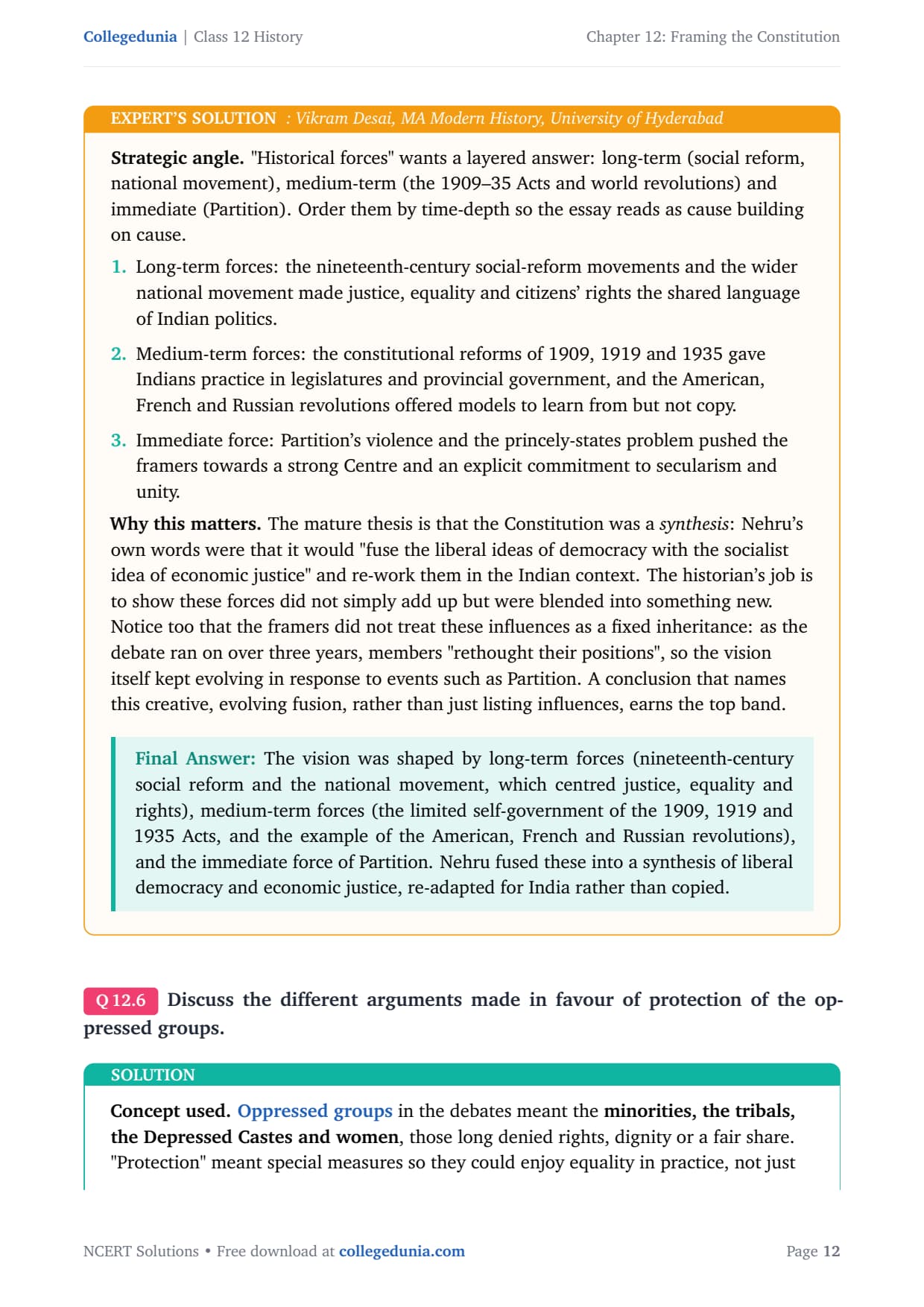
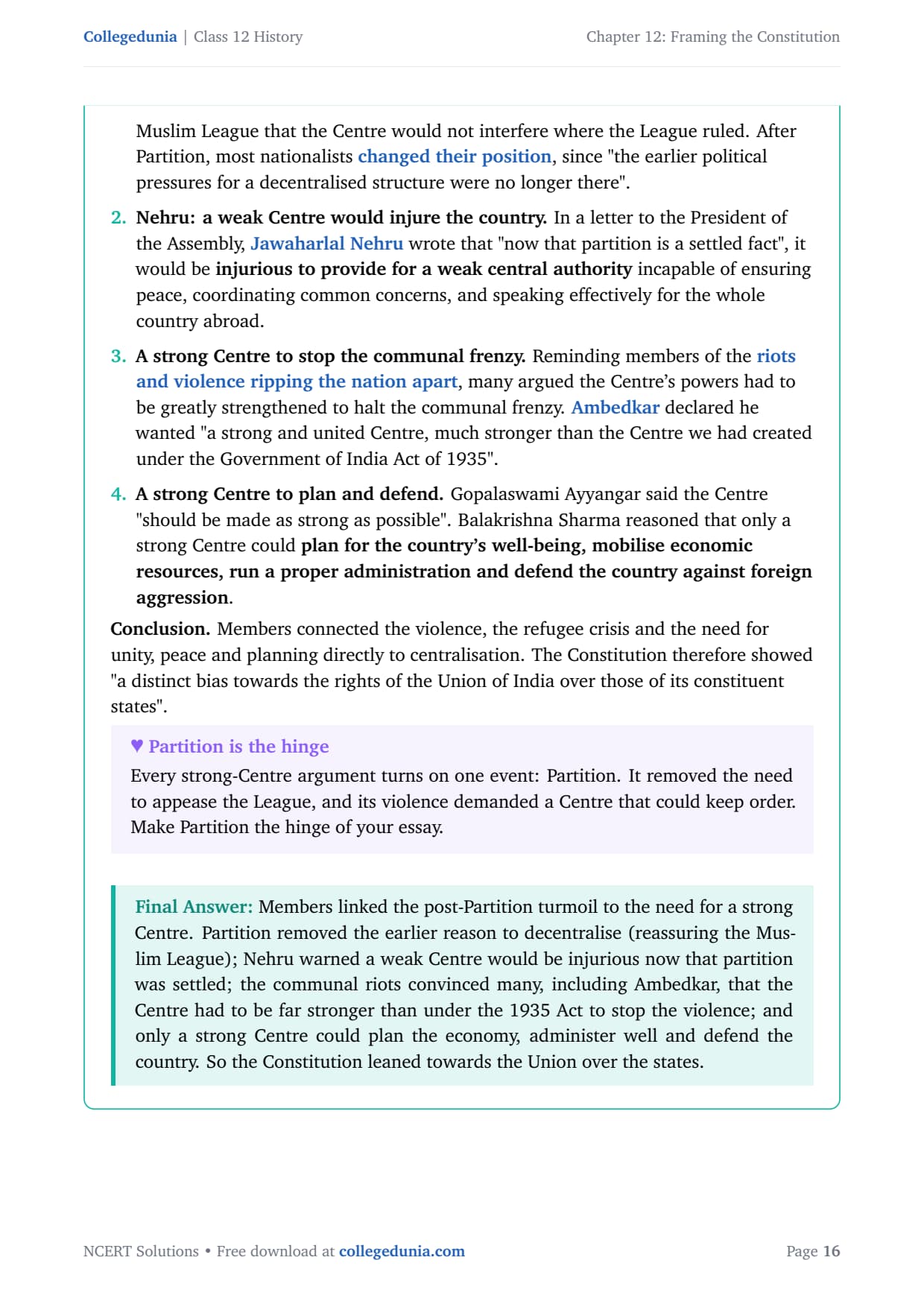
Fig. 12.9, B. R. Ambedkar and Rajendra Prasad
greeting each other at the time of the handing over of the Constitution. NCERT
Themes in Indian History, Part III, Class 12 History, Theme 15.
Concept used. A strong Centre is a central government holding
more powers than the states. The "political situation of the time" was the
aftermath of Partition: communal violence, a refugee crisis and the
problem of the princely states. Several members linked this turmoil directly to
the case for centralising power.
Members made these connections:
Partition removed the reason for decentralisation. Before
Partition the Congress had agreed to grant considerable autonomy
to the provinces to reassure the Muslim League that the Centre would
not interfere where the League ruled. After Partition, most nationalists
changed their position, since "the earlier political pressures
for a decentralised structure were no longer there".
Nehru: a weak Centre would injure the country. In a letter to
the President of the Assembly, Jawaharlal Nehru wrote that
"now that partition is a settled fact", it would be injurious to
provide for a weak central authority incapable of ensuring peace,
coordinating common concerns, and speaking effectively for the whole
country abroad.
A strong Centre to stop the communal frenzy. Reminding members
of the riots and violence ripping the nation apart, many
argued the Centre's powers had to be greatly strengthened to halt the
communal frenzy. Ambedkar declared he wanted "a strong and
united Centre, much stronger than the Centre we had created under the
Government of India Act of 1935".
A strong Centre to plan and defend. Gopalaswami Ayyangar said
the Centre "should be made as strong as possible". Balakrishna Sharma
reasoned that only a strong Centre could plan for the country's
well-being, mobilise economic resources, run a proper administration and
defend the country against foreign aggression.
Conclusion. Members connected the violence, the refugee crisis and the
need for unity, peace and planning directly to centralisation. The Constitution
therefore showed "a distinct bias towards the rights of the Union of India over
those of its constituent states".
Partition is the hinge
Every strong-Centre argument turns on one event: Partition. It removed the need
to appease the League, and its violence demanded a Centre that could keep order.
Make Partition the hinge of your essay.
Members linked the post-Partition turmoil to the need for a strong
Centre. Partition removed the earlier reason to decentralise (reassuring the
Muslim League); Nehru warned a weak Centre would be injurious now that partition
was settled; the communal riots convinced many, including Ambedkar, that the
Centre had to be far stronger than under the 1935 Act to stop the violence; and
only a strong Centre could plan the economy, administer well and defend the
country. So the Constitution leaned towards the Union over the states.
AR
Arjun Reddy
MA Modern History, Banaras Hindu University
Verified Expert
Strategic angle. The question links situation to need, so
write it as cause to effect: name each feature of the political moment, then the
centralising conclusion drawn from it. Quote Nehru and Ambedkar for authority.
The settled fact of Partition removed the political pressure for
autonomy that had been meant to reassure the Muslim League, so
nationalists freely turned towards a strong Centre.
The communal violence and refugee crisis made order the priority:
Ambedkar wanted a Centre "much stronger" than under the 1935 Act, and
many said only a strong Centre could halt the frenzy.
The tasks of nation-building, economic planning, administration and
defence (Ayyangar, Balakrishna Sharma) further demanded a powerful
Centre able to mobilise resources and speak for India abroad.
Why this matters. The mature point is that this was a shift of
mind driven by events, not a fixed doctrine. The same Congress that once
promised provincial autonomy reversed itself once Partition changed the stakes.
And the result was concrete: more items under Union control, Article 356, and a
fiscal system favouring the Centre. Showing that the political crisis literally
re-wrote the federal balance, against the provincialists like Santhanam, is the
top-band argument.
They connected the post-Partition situation, violence, refugees, the
princely states and the need for unity, directly to the case for a strong
Centre. Partition ended the need to appease the League; Nehru called a weak
Centre injurious; Ambedkar and others wanted a Centre much stronger than under
the 1935 Act to stop communal violence and to plan, administer and defend the
nation. The Constitution accordingly favoured the Union over the states.
Q 12.8
How did the Constituent Assembly seek to resolve the language
controversy?
Concept used. The language controversy pitted those who
wanted Hindi as the national language (like R. V. Dhulekar) against
those, especially from the south and the non-Hindi areas, who feared the
domination of Hindi over their own languages. The Assembly's task was to find a
compromise all could accept.
The Assembly sought to resolve the controversy in these ways:
Through a Language Committee and a compromise formula. The
Language Committee of the Constituent Assembly produced a
report with a compromise formula to bridge the deadlock between
the supporters and opponents of Hindi.
"Official" language, not "national" language. The Committee
carefully called Hindi the official language rather than the
national language. This change of word was meant to "placate
ruffled emotions" and reassure those who feared one language being
imposed as supreme.
Hindi in Devanagari, but a gradual transition. It decided that
Hindi in the Devanagari script would be the official language,
but the shift would be slow. For the first fifteen years,
English would continue for all official purposes.
Room for the regional languages. Each province was to be
allowed to choose one of its regional languages for official
work within the province, protecting linguistic diversity.
Yet the compromise did not silence the fears. Dhulekar still wanted Hindi
declared a national language; G. Durgabai and others from the south
warned that aggressive Hindi propaganda "cuts at the very root of the provincial
languages". Members like Ramalingam Chettiar pleaded that nothing be "forced on
people", so that "there should be mutual adjustment".
The crucial word swap
The heart of the resolution is one swap: "official" language instead of
"national" language, Hindi in Devanagari, English for fifteen years, regional
languages for the provinces. State that formula and you have the answer.
Through its Language Committee, the Assembly framed a compromise: Hindi
in the Devanagari script would be the official (not national) language; the word
"official" was chosen to calm fears of imposition; the transition would be
gradual, with English continuing for all official purposes for the first fifteen
years; and each province could pick one of its regional languages for its own
official work. This middle ground tried to satisfy both Hindi supporters and the
non-Hindi areas, though some fears remained.
TJ
Tara Joshi
MA History, Visva-Bharati University
Verified Expert
Strategic angle. The marks are in the terms of the compromise,
so list them precisely as a four-point deal, then add a line on why it still left
unease. Precision on "official versus national" is what separates a top answer.
Mechanism: a Language Committee produced a compromise formula instead of
forcing a vote between Hindi and its opponents.
The deal: Hindi in Devanagari as the official language (not
national), English retained for all official work for fifteen years, and
each province free to use a regional language internally.
The intent: calling it "official" rather than "national" was a
deliberate word choice to soothe the non-Hindi members' fear of
domination.
Why this matters. The mature reading is that this was give-and-take in
action, "forging a middle ground between two opposed positions", the same method
that produced much of the Constitution. But it was a managed compromise,
not a settled peace: Durgabai's fear that the inclusive Hindustani was being
narrowed into a Sanskritised Hindi showed the language question would outlast
1949. Showing that the resolution was a careful balance, yet an incomplete one,
is the historian's insight.
The Assembly resolved it through its Language Committee's compromise
formula: Hindi in the Devanagari script as the official (not national) language,
the word "official" chosen to ease fears of imposition; English continued for
all official purposes for fifteen years; and each province allowed one regional
language for its own use. This middle ground balanced the pro-Hindi and
non-Hindi camps, though anxieties about Hindi domination persisted.
Q 12.9
On a present-day political map of India, indicate the different
languages spoken in each state and mark out the one that is designated as the
language for official communication. Compare the present map with a map of the
early 1950s. What differences do you notice? Do the differences say something
about the relationship between language and the organisation of the states?
Concept used. This is a map-work and comparison task. On a
present-day political map you mark each state's main spoken language and its
official language, then compare with an early-1950s map (before the
linguistic reorganisation of states) and explain the link between
language and state boundaries. Below is the guide; do the marking on your own
outline maps.
Mark each state's language on the present map. For every state,
write the chief spoken language and underline the one chosen for
official communication, for example Tamil (Tamil Nadu), Telugu
(Andhra Pradesh, Telangana), Kannada (Karnataka), Malayalam (Kerala),
Marathi (Maharashtra), Gujarati (Gujarat), Bengali (West Bengal), Hindi
(across the northern states), and so on.
Draw an early-1950s map. Show the larger, multi-lingual
provinces of the early 1950s (such as the old Madras, Bombay and Central
Provinces), before states were redrawn on language lines.
Note the differences. The present map has many more,
smaller states, each centred on one main language; the 1950s map had
fewer, larger provinces mixing several languages. New states
(Andhra Pradesh in 1953, then the wider reorganisation of 1956, and
later Telangana) appear only on the present map.
Explain the link. The differences show that language
became the basis for organising the states: people demanded states
where their own language was dominant, so the map was redrawn so that
state boundaries largely matched language boundaries.
Make the comparison explicit
The marks lie in the comparison, not just the marking. For each change you show
(a province split into language-based states), add a line saying it reflects
the move to organise states by language.
On the present map, mark each state's main spoken language and underline
its official language (Tamil, Telugu, Kannada, Malayalam, Marathi, Gujarati,
Bengali, Hindi and so on). On the early-1950s map, show the larger multi-lingual
provinces (old Madras, Bombay, Central Provinces). The difference is that today
there are many more, smaller, mostly single-language states. This shows that
language became the basis for reorganising the states, so boundaries were redrawn
to match language regions.
PB
Pooja Bhatt
MA Historical Geography, Aligarh Muslim University
Verified Expert
Structural observation. Map work scores on neatness and on a clear
before-and-after contrast. Plan it in three moves: mark languages on the modern
map, sketch the larger 1950s provinces, then write the differences and their
meaning. A key separating "spoken language" from "official language" helps.
Modern map: place each state's main language and clearly mark the
official-communication language, using one symbol or colour for spoken
and another for official.
1950s map: show the few large provinces that combined many languages, so
the contrast with today's language-based states is obvious at a glance.
Differences and meaning: list the new, smaller, single-language states
and state plainly that they reflect the reorganisation of states on a
linguistic basis.
Why this matters. The task connects the chapter's language debates to
the map of modern India. The fear of Hindi domination and the pride in regional
languages, voiced by Durgabai and others, fed directly into the demand for
states drawn on language lines. So the difference between the two maps is the
visible result of the very anxieties the Constituent Assembly tried to manage.
Saying this links your map to the chapter's argument.
Mark each state's spoken and official language on the present map
(Tamil, Telugu, Kannada, Marathi, Bengali, Hindi, etc.); sketch the larger
multi-lingual provinces of the early 1950s. The present map has many more,
smaller, mostly single-language states, showing that language became the basis
for organising the states, with boundaries redrawn to match language regions, a
direct result of the language anxieties seen in the Assembly debates.
Q 12.10
Choose any one important constitutional change that has happened in
recent years. Find out why the change was made, what different arguments were put
forward for the change, and the historical background to the change. If you can,
try and look at the Constitutional Assembly Debates to see how the issue was
discussed at that time. Write about your findings.
Concept used. This is a project (constitutional change). You
pick one important amendment or change to the Constitution in recent
years, then study why it was made, the arguments for and
against it, its historical background, and how the issue was discussed
in the original Constituent Assembly Debates. There is no single right
answer; you are marked on research and balanced argument.
Choose a change and explain why it was made. Pick one
well-documented change, for example the 73rd and 74th
Amendments (panchayats and municipalities), the Right to
Education (86th Amendment), the GST (101st Amendment), or the
abrogation of Article 370. State the problem it was meant to
solve.
Set out the arguments for and against. Gather the
different arguments put forward, supporters' reasons and
critics' objections, so your account is balanced, just as the chapter
shows clashing views on every issue.
Give the historical background. Trace how the issue arose: the
social, political or economic conditions that led to the demand, and any
earlier attempts at reform.
Look at the Constituent Assembly Debates. Check whether the
original framers discussed the same theme (for instance, local
self-government, the right to education, or Centre-state powers) and
compare their views with the later change.
Write up your findings. Present a short report: the change, why
it was made, the arguments, the background, and the link (or contrast)
with the original debates.
Bridge to the founding debate
The mark-winning move is to connect your chosen change back to the Constituent
Assembly Debates. Even a brief "the framers had argued " shows you have used
the original source the project points you to.
Pick one important recent constitutional change (such as the 73rd/74th
Amendments, the Right to Education, GST, or Article 370). Report on why it was
made (the problem it addressed), the different arguments for and against it, its
historical background, and how the same theme was discussed in the Constituent
Assembly Debates. Write up a short, balanced account linking the recent change to
the founders' original thinking.
AR
Aditi Rao
MA Political History, University of Hyderabad
Verified Expert
Strategic angle. Treat the four prompts (why, arguments, background,
original debates) as four sections of a report, and choose a change with rich,
public documentation so each section can be filled. A well-debated amendment
works far better than an obscure one.
Pick a change you can research fully (for example the 73rd/74th
Amendments on local government), and open with the problem it solved,
weak grassroots democracy.
Lay out both sides: the case for the change and the objections raised,
so the report discusses rather than merely describes.
Add the historical background and then the founders' view: check the
Constituent Assembly Debates (for example Gandhi's idea of village
self-rule, or the debate on Centre-state powers) and compare it with the
modern change.
Why this matters. The project teaches the chapter's real method, that a
constitutional provision is the outcome of argument over time. By tracing
one change from its background through its debate to its link with the original
Assembly, you see that the Constitution is a living document, still being shaped
by give-and-take, exactly as it was in 1946–49.
Choose a well-documented recent change (73rd/74th Amendments, Right to
Education, GST or Article 370), and report under four heads: why it was made, the
arguments for and against, its historical background, and how the Constituent
Assembly Debates treated the same theme. Close by linking the modern change to
the founders' thinking, showing the Constitution as a living, debated document.
Q 12.11
Compare the Constitution of America, France or South Africa with the
Indian Constitution, focusing on any two of the following themes: secularism,
minority rights, relations between the Centre and the states. Find out how these
differences and similarities are linked to the histories of the regions.
Concept used. This is a comparative project. You choose one
foreign constitution (the USA, France or South Africa) and compare it
with the Indian Constitution on any two of three themes,
secularism, minority rights, and Centre-state
relations, then link the differences to each country's history. There is no
fixed answer; the marks are for careful comparison.
Choose a country and two themes. For example, compare India
with the USA on Centre-state relations and
secularism, or with France on secularism and
minority rights.
Compare secularism. India has a "judicious distance" between
state and religion, with no absolute separation but equal treatment of
all faiths; the USA has a "wall of separation"; France
has strict laicite. Note where India's model differs and why.
Compare minority rights. India gives cultural and educational
rights to minorities (Articles 29–30) and reservation for the Depressed
Castes and tribals; the USA relies on individual equality;
South Africa, after apartheid, built strong group protections
into its constitution. Compare the approaches.
Compare Centre-state relations. India is a strong-Centre
federation (more items on the Union list, Article 356); the USA
is a more classic federation with greater state autonomy. Set the
difference side by side.
Link to history. Explain the differences by history: India's
Partition and diversity pushed it towards a strong Centre and a
protective secularism; America's history of independent colonies gave it
stronger states; France's revolution shaped its strict secularism;
South Africa's apartheid past shaped its emphasis on minority and group
rights.
History explains the design
The real mark-winner is the last step: showing that each constitution's choices
flow from its history. India's strong Centre answers Partition; France's
laicite answers its revolution; South Africa's group rights answer apartheid.
Choose one country (USA, France or South Africa) and any two themes
(secularism, minority rights, Centre-state relations). Compare them with India:
for example, India's "judicious distance" secularism versus the US "wall of
separation" or French laicite; India's cultural rights and reservation versus US
individual equality or South Africa's group protections; India's strong-Centre
federalism versus US state autonomy. Then explain the differences by history,
India's Partition and diversity, America's colonial origins, France's revolution,
South Africa's apartheid past.
KA
Kabir Anand
MA Comparative Politics, Jadavpur University
Verified Expert
Strategic angle. Build the report as a two-column comparison, India
against your chosen country, theme by theme, then a final paragraph on history.
Pick the country whose contrast with India is sharpest on your two chosen themes,
so the comparison writes itself.
Choose, then tabulate: set India and (say) the USA side by side on your
two themes, stating each country's rule in one line per cell.
Draw out the contrast: name the key difference on each theme, for
instance India's strong Centre versus US state autonomy, or India's
equal-respect secularism versus the US wall of separation.
Explain by history: devote the closing paragraph to why, Partition and
diversity for India, the federation of former colonies for the USA,
revolution for France, apartheid for South Africa.
Why this matters. The project drives home the chapter's central lesson,
that a constitution is shaped by the history of its people. Nehru's own
plea was that India should not "just copy" other constitutions but craft one to
fit its own temper. By comparing India with another country and tracing each
choice to its past, you prove exactly why the framers insisted on an
India-specific Constitution.
Pick one country and two themes, and compare them with India in a
two-column report: secularism (India's judicious distance versus US separation or
French laicite), minority rights (India's cultural rights and reservation versus
US individual equality or South Africa's group rights), or Centre-state relations
(India's strong Centre versus US state autonomy). Then explain the differences by
history, India's Partition, America's colonial federation, France's revolution,
South Africa's apartheid, showing each constitution fits its own past.
FAQs on Framing the Constitution Class 12 NCERT Solutions
Framing the Constitution Class 12 History Common Questions
Ques. Where can I get the class 12 history chapter 12 ncert solutions PDF?
Ans. You can download the Framing the Constitution Class 12 History NCERT Solutions PDF directly from this page. It is free, follows the 2026-27 NCERT, and answers all 11 exercise questions step by step.
Ques. How many questions are there in class 12 history chapter 12 questions and answers?
Ans. The chapter has 11 exercise questions. Eight are written answers, and the last three (12.9 to 12.11) are map work and project activities used in the history project file class 12 chapter 12.
Ques. Which are the most important questions in history class 12 chapter 12 question answer practice?
Ans. The historical forces that shaped the Constitution (Q 12.5), the protection of oppressed groups (Q 12.6), and the need for a strong Centre (Q 12.7) are the most-asked long answers. These three top every list of class 12 history chapter 12 important questions.
Ques. What was the Objectives Resolution?
Ans. The Objectives Resolution was moved by Jawaharlal Nehru on 13 December 1946. It proclaimed India an Independent Sovereign Republic, guaranteed justice, equality and freedom, and promised safeguards for minorities and weaker sections. It later became the Preamble of the Constitution.
Ques. Why did the Assembly choose a strong Centre?
Ans. Members linked the violence and refugee crisis of Partition to the need for a strong Centre. Once Partition was settled, the earlier reason for wide provincial autonomy was gone, so leaders like Ambedkar argued for a strong, united Centre to stop the communal frenzy and plan the country.
Ques. Is class 12 history chapter 12 hard to score in the board exam?
Ans. No. It is one of the easier scoring chapters if you write debate-style answers. Name the member, give the view and add the reason. Practise the source-based extracts and a few class 12 history chapter 12 mcq sets before the exam.








Comments