




CBSE Class 10 Social Science Set 1 - (32/3/1) Question Paper 2026 is now available here for download. CBSE conducted the class 10 Social Science exam on March 7, 2026, from 10:30 AM to 1:30 PM.
CBSE Class 10 Social Science paper is of 100 marks, out of which 80 marks are allocated for theory paper and 20 marks are allocated for internal assessment. The question paper is divided into 4 sections - History, Geography, Political Science and Economics (20 marks for each section).
CBSE Class 10 Social Science Set 1 - (32/3/1) Question Paper 2026 with Solution PDF
| CBSE Class 10 Social Science Set 1 - (32/3/1) Question Paper 2026 | Download PDF | Check Solutions |
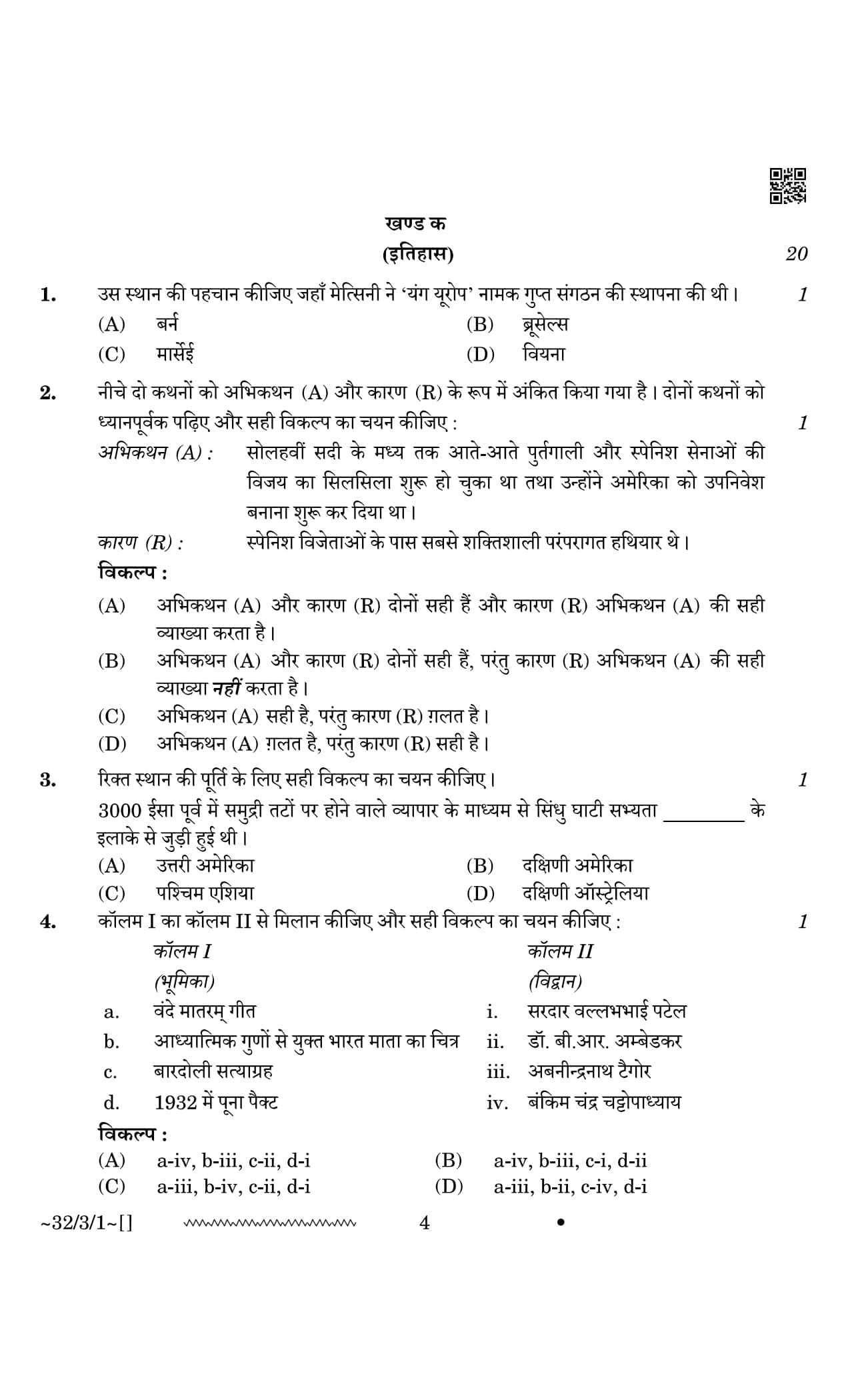
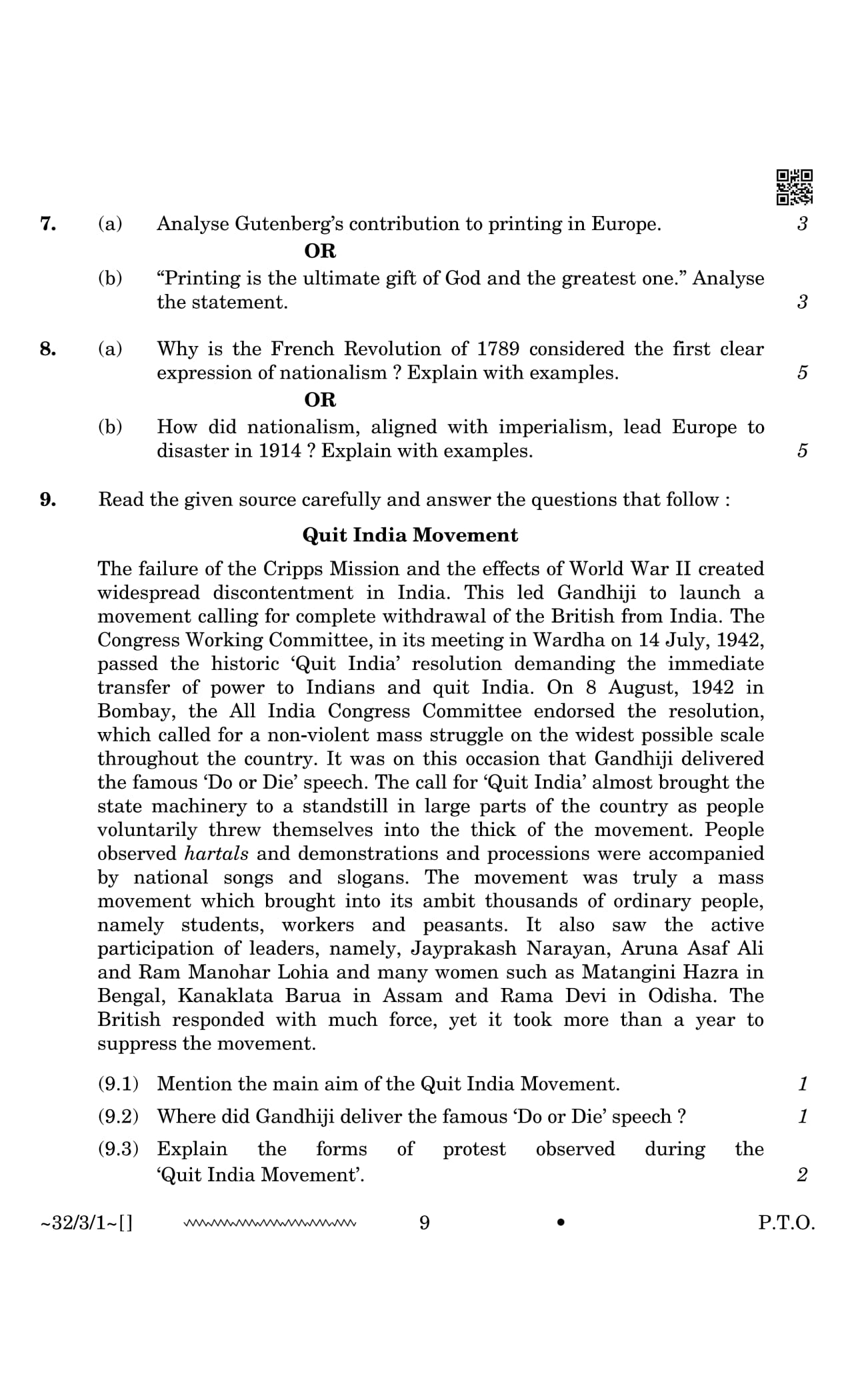
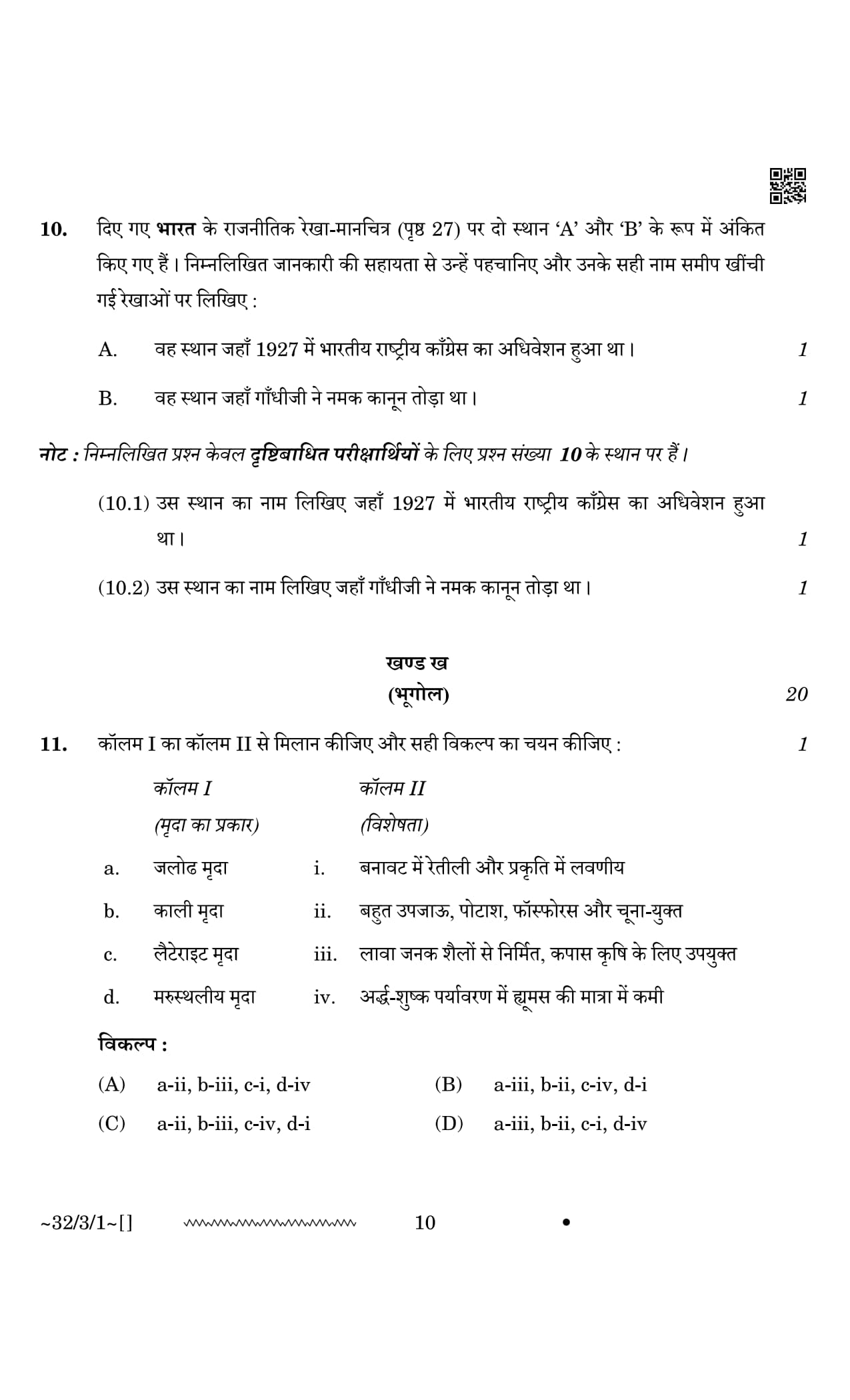
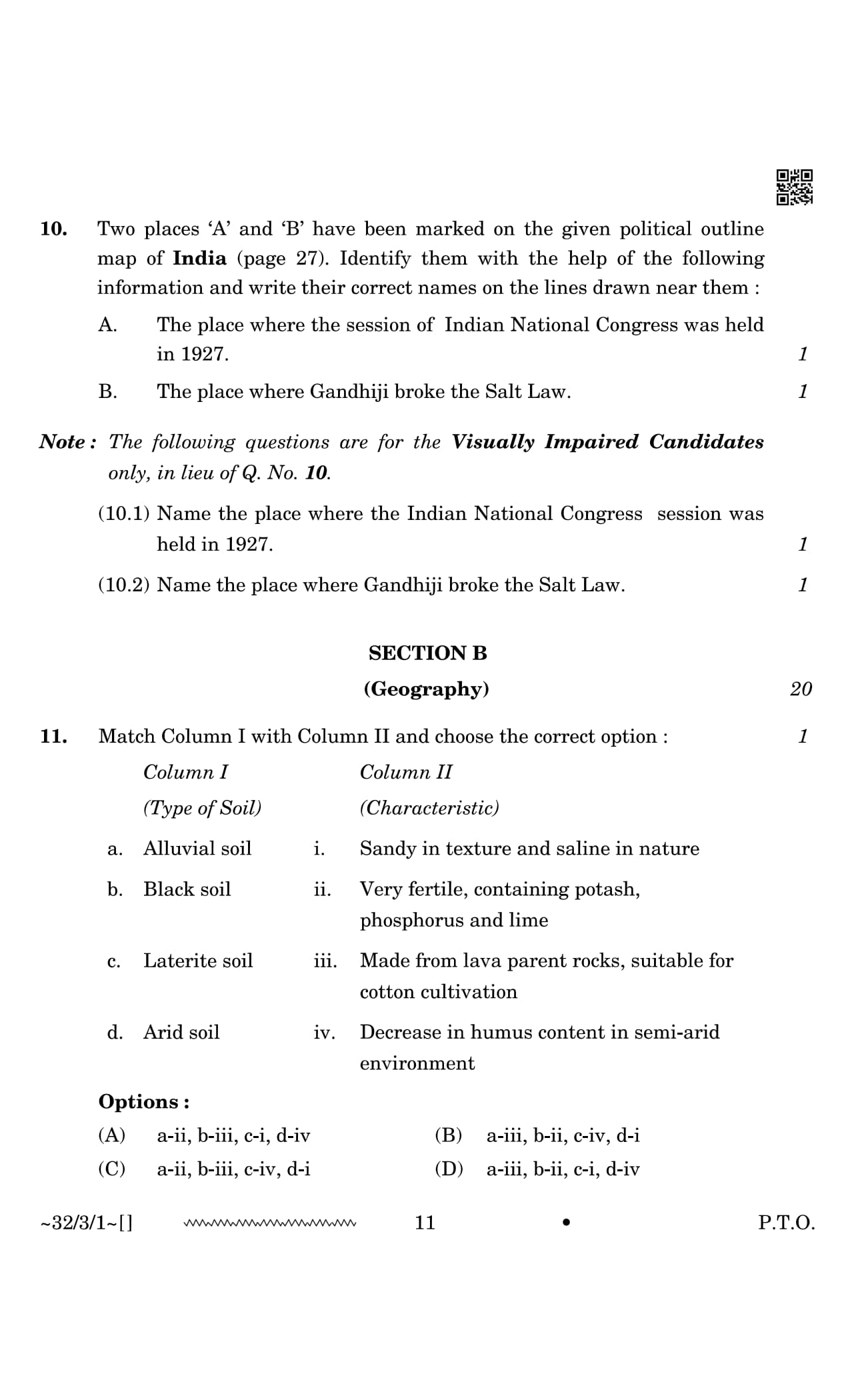
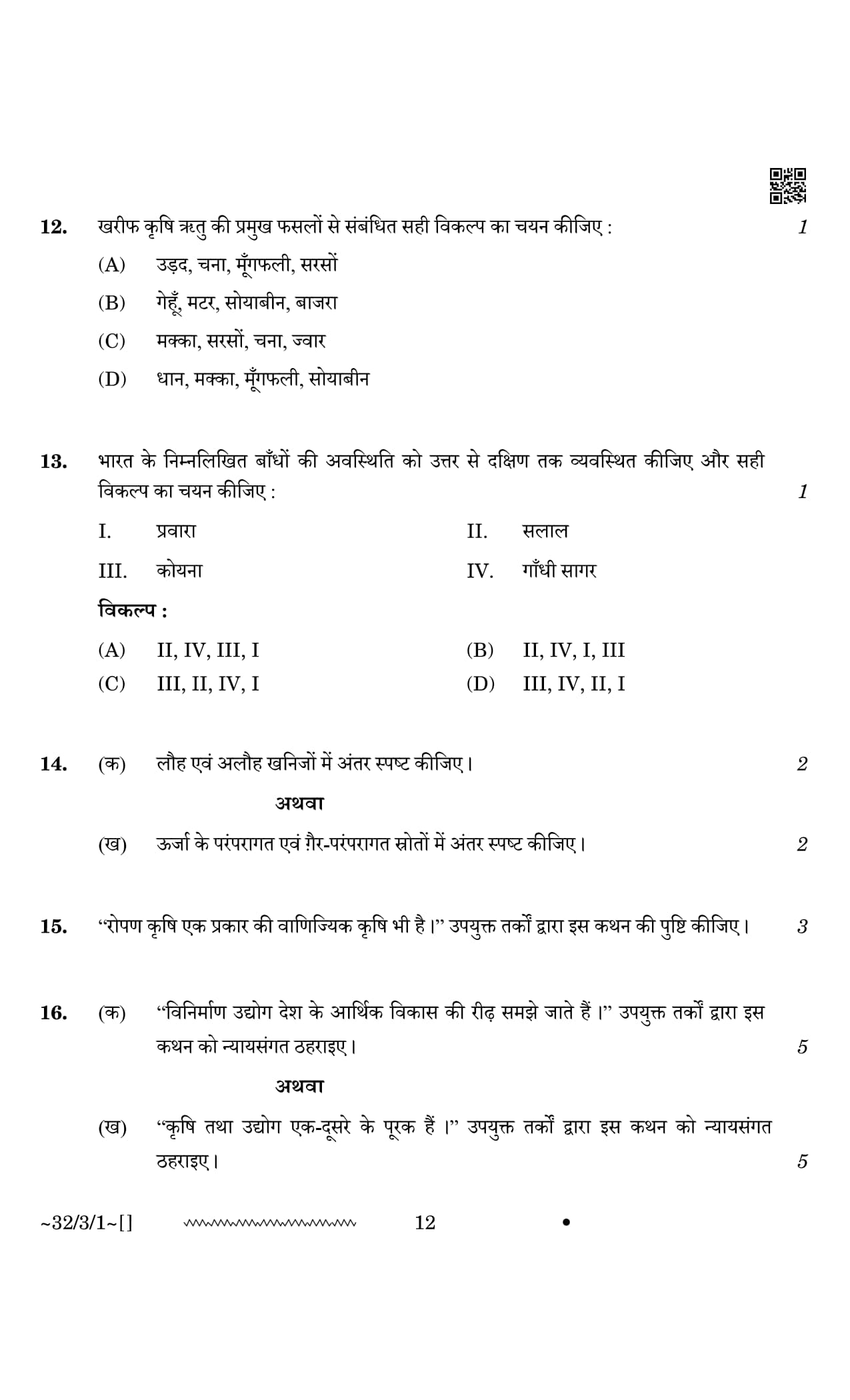

Identify the place where the secret underground society named ‘Young Europe’ was founded by Mazzini.
View Solution
Concept: During the post-1815 era of conservative restoration in Europe, liberal-nationalist dissent was forced underground due to severe state censorship and monarchical repression. Giuseppe Mazzini, a fervent Italian revolutionary born in Genoa in 1805, became a prominent leader of this clandestine movement. After being exiled in 1831 for attempting an armed insurrection in Liguria, Mazzini dedicated his life to the unification of Italy and the creation of democratic republics across Europe. He firmly believed that nations were the natural units of mankind created by God, and that Italian liberation could only be achieved through popular insurrection organized by disciplined secret societies. To mobilize dedicated youth across national borders, Mazzini founded two influential underground networks: ‘Young Italy’ in Marseilles (1831) and subsequently ‘Young Europe’ in the Swiss city of Berne (1834).
Step 1: Understanding the Question:
The question asks us to identify the specific European city where Giuseppe Mazzini founded the revolutionary underground secret society named ‘Young Europe’.
Step 2: Key Concept:
Historical Figure: Giuseppe Mazzini (Italian nationalist revolutionary).
Revolutionary Strategy: Mobilization of youth through underground secret societies.
Secret Societies Founded by Mazzini:
1. ‘Young Italy’: Founded in Marseilles, France (1831).
2. ‘Young Europe’: Founded in Berne, Switzerland (1834).
Target Membership: Like-minded young patriots from Poland, France, Italy, and the German states.
Step 3: Detailed Explanation:
Detailed Historical Context of Mazzini’s Societies:
– Giuseppe Mazzini initially joined the secret society of the Carbonari before envisioning a broader democratic republican movement.
– Following his exile in 1831, he established ‘Young Italy’ in Marseilles to fight for Italian unification.
– Recognizing that nationalist aspirations transcended Italian frontiers, Mazzini established ‘Young Europe’ in Berne in 1834.
– Young Europe brought together progressive republican youth from Poland, France, Italy, and various German principalities who shared the conviction that monarchical autocracies must yield to sovereign, democratic nation-states.
Evaluation of the Options:
– Option (A) ‘Berne’ is the exact Swiss city where Young Europe was established in 1834.
– Option (B) ‘Brussels’ was a focal center for the Belgian revolution of 1830, not the founding location of Young Europe.
– Option (C) ‘Marseilles’ is where Mazzini founded ‘Young Italy’, not Young Europe.
– Option (D) ‘Vienna’ was the stronghold of Austrian Chancellor Metternich and the conservative Congress of 1815, opposing Mazzini’s nationalist ideals.
Step 4: Final Answer:
Therefore, the place where the secret underground society named ‘Young Europe’ was founded by Mazzini is Berne, which corresponds to Option (A).
Two statements labelled as Assertion (A) and Reason (R) are given below. Read both the statements carefully and choose the correct option :
Assertion (A) : The Portuguese and Spanish conquest and colonisation of America was decisively under way by the mid-sixteenth century.
Reason (R) : The Spanish conquerors had the most powerful conventional weapons.
Options :
View Solution
Concept: The incorporation of the Americas into the global trade and political network began with European maritime expeditions in the late fifteenth century. Following Christopher Columbus’s transatlantic voyages, Spanish and Portuguese conquistadors initiated the rapid colonization of Central and South America during the early sixteenth century. However, historical and historical-epidemiological research demonstrates that European conquest was not achieved through conventional military superiority or overwhelming firepower. Because indigenous American populations had lived in complete biological isolation from the Eurasian landmass for millennia, they lacked immunological defenses against European infectious diseases. Pathogens carried unwittingly by Spanish invaders—most notably smallpox—spread far ahead of invading armies, decimating indigenous populations and paralyzing their capacity for armed resistance.
Step 1: Understanding the Question:
We must independently verify the historical accuracy of Assertion (A) regarding the chronological timeline of the Spanish and Portuguese colonization of America, and Reason (R) regarding the role of conventional military weaponry in that conquest, and determine their relationship.
Step 2: Key Concept:
Topic: The Making of a Global World – Conquest, Disease and Trade.
Historical Chronology: Iberian conquest of the Americas was decisively established by the mid-sixteenth century (\(1500\text{s}\)).
Decisive Factor of Conquest: Biological pathogens (smallpox) rather than conventional military firepower or numerical superiority.
Immunological Isolation: Indigenous American civilizations (such as the Incas and Aztecs) possessed zero immunity against Old World diseases.
Step 3: Detailed Explanation:
Critical Assessment of Assertion (A):
– Following the Treaty of Tordesillas (1494) and early exploratory missions, Spanish conquistadors led by Hernan Cortes overthrew the Aztec Empire in Mexico (1519–1521), while Francisco Pizarro conquered the Inca Empire in Peru (1532–1533).
– By the mid-sixteenth century (\(1550\text{s}\)), the Spanish and Portuguese colonial empires had firmly established administrative, religious, and economic dominion over vast tracts of North, Central, and South America.
– Therefore, Assertion (A) is historically true (correct).
Critical Assessment of Reason (R):
– Reason (R) claims that the Spanish conquerors possessed the ‘most powerful conventional weapons’.
– Historical records clearly demonstrate that Spanish military arms (such as early muskets, crossbows, and iron swords) were limited in number, cumbersome to reload, and insufficient on their own to subjugate empires populated by millions of fierce warriors.
– In reality, the most deadly and decisive weapon of the Spanish conquerors was not conventional military hardware at all; it was biological—specifically the germs of smallpox carried by the conquerors.
– Smallpox unleashed catastrophic epidemics across the Americas, wiping out whole communities, decimating indigenous leadership, and dismantling defensive resistance without firing a shot.
– Therefore, Reason (R) is factually false (incorrect).
Synthesis:
– Since Assertion (A) is true but Reason (R) is false, Option (C) is the correct choice.
Step 4: Final Answer:
Therefore, Assertion (A) is true, but Reason (R) is false, which corresponds to Option (C).
Choose the correct option to fill in the blank.
The Indus Valley Civilization was linked to the region through coastal trade as early as 3000 BCE.
View Solution
Concept: Long before the modern era of globalization, human societies were connected through extensive cross-cultural networks of overland and maritime trade. Ancient archaeological and historical records demonstrate that long-distance trade in commodities, precious metals, and cultural artifacts dates back several millennia. As early as the third millennium BCE (\(3000\text{ BCE}\)), the mature Harappan civilization (Indus Valley Civilization), centered in the fertile floodplains of the Indus River basin and the coastal regions of Gujarat (such as the port city of Lothal), established flourishing maritime commercial links with the civilizations of the Persian Gulf and ancient Mesopotamia in West Asia. These early trading routes facilitated the exchange of lapis lazuli, carnelian beads, copper, timber, and cotton textiles.
Step 1: Understanding the Question:
The question asks us to identify the specific geographic region that was linked to the Indus Valley Civilization through active coastal and maritime trade routes as early as \(3000\text{ BCE}\).
Step 2: Key Concept:
Era: Ancient Global Trade (\(3000\text{ BCE}\)).
Civilization: Indus Valley Civilization (Harappan Civilization).
Maritime Trade Hub: Port of Lothal and Arabian Sea coastal routes.
Destination Region: West Asia (Mesopotamia / Dilmun / Magan / modern Persian Gulf).
Trade Artifacts: Seals, carnelian beads, shell bangles, and Mesopotamian cuneiform records referencing ‘Meluhha’.
Step 3: Detailed Explanation:
Historical and Archaeological Evidence:
– NCERT Class 10 History explicitly documents that as early as \(3000\text{ BCE}\), an active coastal trade network connected the Indus Valley Civilization with present-day West Asia.
– Harappan seals, weights, and specialized beads have been excavated extensively at ancient Mesopotamian sites such as Ur, Kish, and Susa, while Mesopotamian texts repeatedly mention trading with ‘Meluhha’ (the Harappan region).
– Harappan maritime merchants navigated the waters of the Arabian Sea and the Persian Gulf, docking at transit stations like Bahrain (Dilmun) and Oman (Magan) before reaching West Asian river ports along the Tigris and Euphrates.
Evaluation of the Options:
– Option (A) ‘North America’ is incorrect because transatlantic links with the Americas did not exist in \(3000\text{ BCE}\).
– Option (B) ‘South America’ is incorrect for the same reason.
– Option (C) ‘West Asia’ is historically and textually accurate.
– Option (D) ‘South Australia’ is incorrect as there was no coastal trade network connecting ancient India with Australia.
Step 4: Final Answer:
Therefore, the Indus Valley Civilization was linked to the West Asia region through coastal trade as early as 3000 BCE, matching Option (C).
Match Column I with Column II and choose the correct option :

Options :
View Solution
Concept: The rise of Indian nationalism during the late nineteenth and early twentieth centuries was nurtured not only through political struggles, but through the creation of shared cultural symbols, hymns, visual representations, and pivotal socio-political pacts. Visual iconography and patriotic poetry played a fundamental role in inspiring a sense of collective belonging among diverse linguistic and religious communities across India. Figures such as Bankim Chandra Chattopadhyay and Abanindranath Tagore personified the nation in the maternal image of ‘Bharat Mata’, while political leaders like Sardar Vallabhbhai Patel and Dr. B.R. Ambedkar mobilized grassroots agrarian movements and fought for constitutional safeguards for historically depressed social classes, shaping the constitutional and political trajectory of modern India.
Step 1: Understanding the Question:
We must accurately pair each nationalist role, patriotic symbol, or political event in Column I (a: The song Vande Mataram, b: Picture of Bharat Mata with spiritual qualities, c: Bardoli Satyagraha, d: Poona Pact in 1932) with its corresponding historical figure in Column II, and choose the correct option.
Step 2: Key Concept:
Topic: Nationalism in India – Cultural Icons, Agrarian Movements, and Political Pacts.
a. The song Vande Mataram: Composed by Bankim Chandra Chattopadhyay (1870s).
b. Spiritual Painting of Bharat Mata: Created by Abanindranath Tagore (1905).
c. Bardoli Satyagraha: Peasant revenue movement led by Sardar Vallabhbhai Patel (1928).
d. Poona Pact: Agreement signed by Dr. B.R. Ambedkar and Mahatma Gandhi (September 1932).
Step 3: Detailed Explanation:
Item-by-Item Matching Analysis:
– a. The song Vande Mataram:
In the 1870s, Bankim Chandra Chattopadhyay wrote ‘Vande Mataram’ as a hymn to the motherland. It was later included in his celebrated patriotic novel Anandamath and widely chanted during the Swadeshi movement in Bengal. Thus, \(a \rightarrow \text{iv}\).
– b. Picture of Bharat Mata with spiritual qualities:
Moved by the Swadeshi movement in 1905, Abanindranath Tagore painted his famous iconographic portrait of Bharat Mata. In this painting, Bharat Mata is portrayed as an ascetic, serene, calm, composed, divine, and spiritual figure conferring learning, food, and clothing. Thus, \(b \rightarrow \text{iii}\).
– c. Bardoli Satyagraha:
In 1928, Sardar Vallabhbhai Patel successfully led the heroic peasant movement in Bardoli (a taluka in Surat district, Gujarat) against the unjust enhancement of land revenue by the British colonial administration, earning the revered title ‘Sardar’. Thus, \(c \rightarrow \text{i}\).
– d. Poona Pact in 1932:
In September 1932, Dr. B.R. Ambedkar resolved his political conflict with Mahatma Gandhi over separate electorates for Dalits by signing the historic Poona Pact, which secured reserved seats for the Depressed Classes in provincial and central legislative councils while retaining a joint general electorate. Thus, \(d \rightarrow \text{ii}\).
Synthesis of Pairs:
The matching sequence is: a-iv, b-iii, c-i, d-ii, which matches Option (B).
Step 4: Final Answer:
Therefore, the correct matching combination is a-iv, b-iii, c-i, d-ii, which corresponds to Option (B).
Arrange the following events of ‘print culture’ in chronological order and choose the correct option :
I. Publication of ‘Sambad Kaumudi’
II. Publication of weekly magazine ‘Bengal Gazette’
III. ‘Vernacular Press Act’ was implemented
IV. The first printed edition of the ‘Ramcharitmanas’
Options :
View Solution
Concept: The introduction and dissemination of print technology in modern India profoundly transformed public discourse, cultural life, and political awareness. From the late eighteenth century onwards, the advent of commercial printing presses stimulated intense religious and social debates, encouraged the publication of vernacular literature, and enabled the emergence of nationalist journalism. Colonial authorities initially tolerated independent weekly gazettes, but as native reformist newspapers and vernacular nationalist journals began criticizing oppressive colonial policies and challenging feudal social orthodoxies, the British colonial administration enacted increasingly draconian press censorship legislations to suppress native freedom of expression.
Step 1: Understanding the Question:
The question requires us to determine the exact historical years of four significant events in the history of print culture in India and arrange them in chronological sequence from earliest to latest.
Step 2: Key Concept:
Topic: Print Culture and the Modern World – Print Comes to India and Colonial Censorship.
Event I: Publication of ‘Sambad Kaumudi’ by Raja Rammohan Roy (\(1821\)).
Event II: Publication of weekly magazine ‘Bengal Gazette’ by James Augustus Hickey (\(1780\)).
Event III: Implementation of the ‘Vernacular Press Act’ under Lord Lytton (\(1878\)).
Event IV: First printed edition of Tulsidas’s ‘Ramcharitmanas’ from Calcutta (\(1810\)).
Step 3: Detailed Explanation:
Historical Chronology of the Given Events:
1. II. Publication of weekly magazine ‘Bengal Gazette’ (1780):
From 1780, James Augustus Hickey began editing the Bengal Gazette, a commercial weekly magazine described as ‘a commercial paper open to all, but influenced by none’. It was the first English-language newspaper printed in India.
2. IV. The first printed edition of the ‘Ramcharitmanas’ (1810):
The first printed edition of Tulsidas’s sixteenth-century epic devotional text, the Ramcharitmanas, was published from Calcutta in 1810, marking a major milestone in vernacular religious publishing.
3. I. Publication of ‘Sambad Kaumudi’ (1821):
Raja Rammohan Roy launched the reformist Bengali weekly newspaper Sambad Kaumudi in 1821 to propagate social reform, challenge orthodox Hindu dogmas, and campaign against the practice of Sati.
4. III. ‘Vernacular Press Act’ was implemented (1878):
Following the 1857 rebellion and the growth of assertive nationalist criticism in Indian language newspapers, the colonial administration under Viceroy Lord Lytton enacted the repressive Vernacular Press Act in 1878, empowering magistrates to censor vernacular reports and seize printing presses.
Arranging in Chronological Order:
– Event II (\(1780\)) \(\rightarrow\) Event IV (\(1810\)) \(\rightarrow\) Event I (\(1821\)) \(\rightarrow\) Event III (\(1878\)).
– The correct chronological sequence is II, IV, I, III, which corresponds precisely to Option (D).
Step 4: Final Answer:
Therefore, the correct chronological arrangement of the print culture events is II, IV, I, III, which corresponds to Option (D).
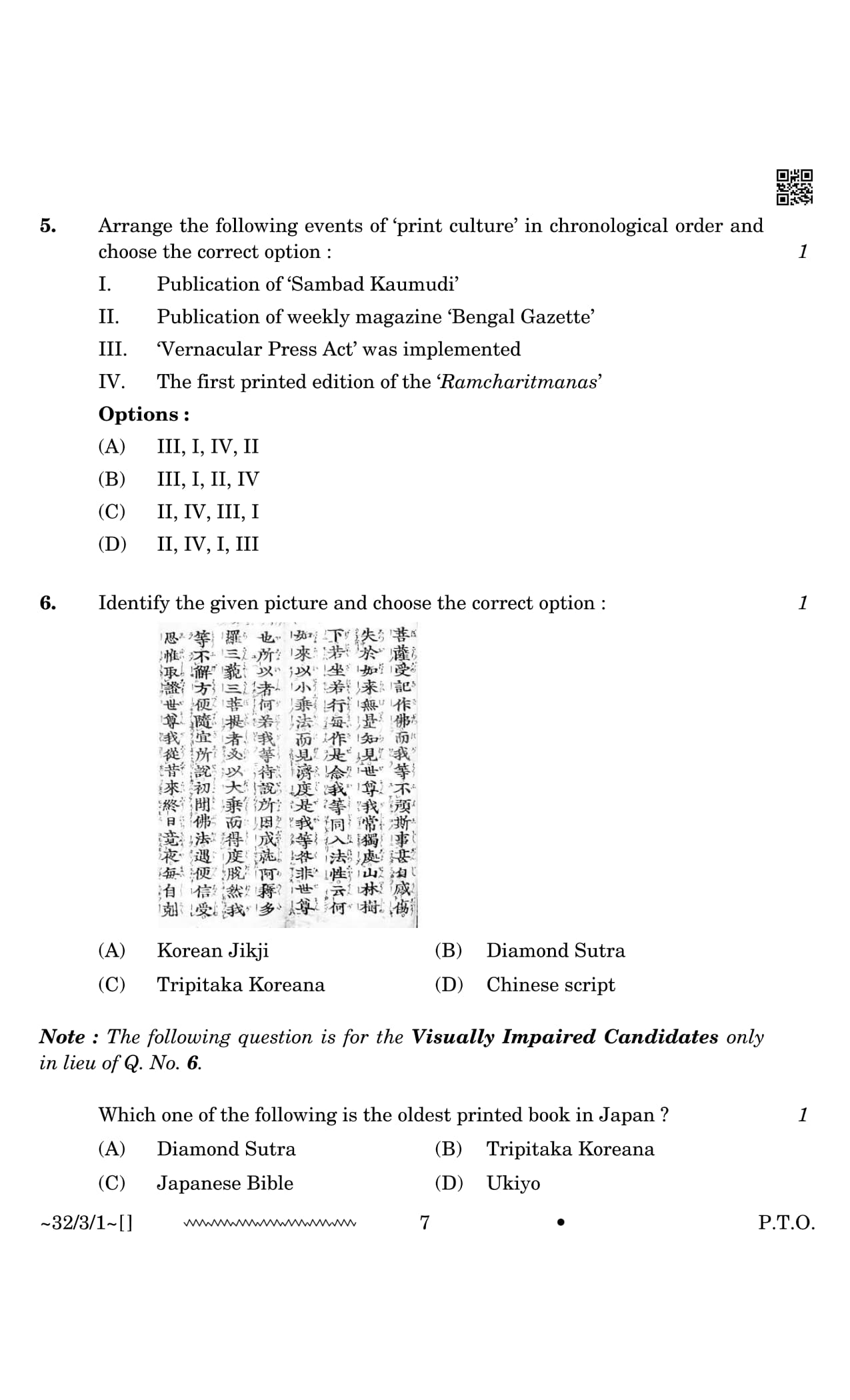
Identify the given picture and choose the correct option :

View Solution
Concept: Print technology initially originated in East Asia—specifically in China, Japan, and Korea—as a hand-printing craft utilizing carved wooden blocks. Buddhist missionaries from China introduced woodblock printing technology to Japan around 768–770 CE. As printing spread across medieval Japanese monasteries, sacred religious texts, scrolls, and sutras were reproduced with meticulous calligraphy and delicate artistic illustrations. The most ancient surviving printed book in Japan is the Buddhist ‘Diamond Sutra’, completed in 868 CE. This landmark artifact exemplifies early East Asian block printing, containing six comprehensive sheets of woodblock-printed text accompanied by elaborate woodcut illustrations depicting the Buddha teaching his disciples.
Step 1: Understanding the Question:
The question provides an illustrative image of an ancient East Asian printed woodblock leaf and asks us to identify the specific historical text depicted from among the given options.
Step 2: Key Concept:
Topic: Print Culture and the Modern World – Print in Japan.
Visual Artifact: A page from the Buddhist Diamond Sutra printed in woodblock Chinese characters.
Historic Milestone: The oldest printed book in Japan, dated to 868 CE.
Physical Characteristics: Six sheets of text with woodcut illustrations representing Mahayana Buddhist teachings.
Step 3: Detailed Explanation:
Identification and Historical Details of the Image:
– The provided image shows a preserved leaf from the famous Buddhist Diamond Sutra, which was printed in Japan in 868 CE.
– This famous woodblock print represents the oldest surviving dated printed book in Japanese history.
– It is preserved in the British Library and is featured prominently in NCERT Class 10 History to illustrate the origins of East Asian print technology.
Evaluation of the Options:
– Option (A) ‘Korean Jikji’ is incorrect; the Jikji is a fourteenth-century Korean text printed with movable metal type, not this Japanese woodblock scripture.
– Option (B) ‘Diamond Sutra’ is the correct identification matching the textbook visual source.
– Option (C) ‘Tripitaka Koreana’ refers to the Korean collection of Buddhist scriptures carved onto over 80,000 wooden printing blocks in the thirteenth century, distinct from this single Japanese scroll text.
– Option (D) ‘Chinese script’ is overly generic and describes the writing system rather than identifying the specific printed artifact.
Step 4: Final Answer:
Therefore, the picture depicts a page from the Diamond Sutra, which corresponds to Option (B).
Note : Following question is for the Visually Impaired Candidates only in lieu of Q. No. 6.
Which one of the following is the oldest printed book in Japan ?
View Solution
Concept: In East Asian history, Japan received hand-printing technology from Chinese Buddhist missionaries around 768–770 CE. Early Japanese print culture was deeply rooted in Buddhist monastic traditions, where copying and circulating sacred canonical scriptures was considered an act of great spiritual merit. The oldest dated printed book surviving in Japan is the Buddhist ‘Diamond Sutra’, printed in 868 CE. Composed of six sheets of block-printed text along with woodcut illustrations, the Diamond Sutra stands as a monumental historical milestone demonstrating the sophistication and widespread reach of woodblock print culture in East Asia long before the invention of the movable mechanical press in Europe.
Step 1: Understanding the Question:
The question asks us to identify the historically oldest printed book in Japan from the provided options.
Step 2: Key Concept:
Historical Artifact: Diamond Sutra.
Country: Japan.
Date of Printing: 868 CE.
Medium: Woodblock printing on mulberry paper.
Content: Mahayana Buddhist philosophical text containing six sheets of text and woodcut illustrations.
Step 3: Detailed Explanation:
Historical Background of Early Japanese Printing:
– Buddhist missionaries from Tang Dynasty China introduced the art of woodblock printing to Japan in the eighth century (circa 768–770 CE).
– The oldest surviving printed work in Japanese history is the Diamond Sutra, printed in 868 CE.
– It contains sacred Buddhist sutras along with woodcut depictions of the Buddha addressing an assembly of monks.
Analysis of Other Options:
– Option (B) ‘Tripitaka Koreana’ is a monumental thirteenth-century Korean Buddhist canon, not the oldest book printed in Japan.
– Option (C) ‘Japanese Bible’ was printed much later, following Christian missionary contact in the late sixteenth century.
– Option (D) ‘Ukiyo’ refers to ‘pictures of the floating world’—a genre of Japanese woodblock art and urban depictions developed by artists like Kitagawa Utamaro in the eighteenth century, not a book from the ninth century.
Conclusion:
– The oldest printed book in Japan is undeniably the Diamond Sutra.
Step 4: Final Answer:
Therefore, the oldest printed book in Japan is the Diamond Sutra, which corresponds to Option (A).
Analyse Gutenberg’s contribution to printing in Europe.
View Solution
Concept: The invention of mechanical printing in the mid-fifteenth century represented one of the most transformative technological breakthroughs in human history, fundamentally reshaping European intellectual, religious, and socio-economic life. Prior to this innovation, the production of books relied entirely on tedious, labor-intensive manual copying by scribes onto expensive parchment or vellum. Hand-copied manuscripts were fragile, awkward to handle, and scarce, severely restricting literacy and intellectual discourse to an aristocratic and clerical elite. Johann Gutenberg, an enterprising German inventor from Mainz and Strasbourg, revolutionized this landscape by developing the first movable type mechanical printing press in the 1430s–1448. By synthesizing multiple existing craft techniques into a coherent, mechanized system, Gutenberg dramatically reduced the time, labor, and cost of book reproduction, inaugurating the European ‘Print Revolution’.
Step 1: Understanding the Question:
The question requires a comprehensive analysis of Johann Gutenberg’s invention of the movable mechanical printing press, examining the technological innovations he integrated, his pioneering printing achievements, and the profound historical impact of his contribution across Europe.
Step 2: Key Concept:
Inventor: Johann Gutenberg (Mainz / Strasbourg, Germany).
Core Breakthrough: Development of movable metal type and the mechanical screw-press (circa 1430s–1448).
Technical Convergence: Synthesis of olive/wine press mechanics, goldsmithing techniques, lead-alloy casting, and oil-based printing ink.
Milestone Publication: The 42-line Gutenberg Bible (circa 1450–1455).
Consequence: The European Print Revolution, rapid book proliferation, and democratization of knowledge.
Step 3: Detailed Explanation:
Gutenberg’s monumental contribution to European printing encompasses several critical dimensions:
1. Technological Innovation and Practical Synthesis:
– Gutenberg grew up on a large agricultural estate where he acquired extensive familiarity with mechanical wine and olive presses.
– He adapted the robust screw-mechanism of the traditional olive press to construct the fundamental wooden printing press frame.
– As a trained goldsmith and gem polisher, he possessed advanced metalworking skills, which he utilized to design metal molds for casting durable, interchangeable movable types for every letter of the Latin alphabet using an alloy of lead, tin, and antimony.
– He also formulated a specialized oil-based printing ink that adhered smoothly to metal type and produced clean, crisp impressions on paper.
2. The Printing of the Gutenberg Bible:
– By 1448, Gutenberg perfected his integrated printing apparatus.
– His first major commercial printing project was the Latin Vulgate Bible, commonly known as the 42-line Gutenberg Bible.
– Around 180 copies were produced over a period of approximately three years.
– By the standards of the fifteenth century, producing 180 identical, beautifully rendered copies in three years was an extraordinary feat of mass production that would have required decades of manual labor by a guild of scribes.
3. Aesthetic Continuities with Manuscript Traditions:
– Early printed books deliberately retained the visual elegance and layout of illuminated hand-copied manuscripts.
– The metal typefaces were carved to resemble handwritten scribal calligraphy, while wide margins and spaces for ornate decorative initials were left blank for artists to illuminate by hand with colorful pigments.
4. Catalyst for the European Print Revolution:
– Gutenberg’s technology spread rapidly across the continent. Between 1450 and 1550, printing presses were established across Germany, Italy, France, England, and Spain.
– The volume of books in circulation expanded exponentially: approximately 20 million copies were printed in the second half of the fifteenth century, rising to over 200 million copies in the sixteenth century.
– This massive influx lowered book prices, broadened reading publics, and provided the technological foundation for the Renaissance, the Scientific Revolution, and the Protestant Reformation.
Step 4: Final Answer:
Therefore, Gutenberg contributed decisively to European civilization by inventing movable metal type and adapting the mechanical screw press, creating an efficient system of mass book production that sparked the Print Revolution, democratized learning, and dissolved clerical monopolies on knowledge.
“Printing is the ultimate gift of God and the greatest one.” Analyse the statement.
View Solution
Concept: The introduction of print technology in early modern Europe was greeted with profound intellectual enthusiasm by scholars, humanists, and religious reformers who recognized its revolutionary power to challenge entrenched orthodoxies. In 1517, the German religious reformer Martin Luther initiated the Protestant Reformation by publicly challenging corrupt practices within the Roman Catholic Church, specifically the commercial sale of papal indulgences. In his celebrated declaration, Luther proclaimed: ‘Printing is the ultimate gift of God and the greatest one.’ For Luther and his contemporaries, the mechanical printing press was not merely an economic convenience or a secular machine; it was viewed as a divine instrument that shattered the clerical monopoly over sacred scriptures, enabled the direct dissemination of biblical truth to ordinary believers in their native vernacular languages, and fostered a transformative culture of individual conscience and critical inquiry.
Step 1: Understanding the Question:
We must analyze the historical statement made by Martin Luther proclaiming print as God’s greatest gift, examining the historical context of the Protestant Reformation, the role of print in circulating reformist thought, and its broader democratization of religious knowledge.
Step 2: Key Concept:
Author of the Statement: Martin Luther (German theologian and religious reformer).
Historical Context: The Protestant Reformation (initiated in 1517).
Landmark Publication: Ninety-Five Theses (challenging Catholic rituals and indulgences).
Transformative Mechanism: Rapid mechanical duplication and vernacular translation of religious texts.
Religious Consequence: Breakdown of papal hegemony, creation of the Protestant branch of Christianity, and universalization of scriptural reading.
Step 3: Detailed Explanation:
The profound historical truth of Martin Luther’s statement can be analyzed through the following points:
1. Immediate Dissemination of the Ninety-Five Theses:
– In 1517, Martin Luther wrote his famous Ninety-Five Theses, critiquing the doctrinal corruptions of the Catholic Church, particularly the lucrative trade in indulgences that promised remissions of divine punishment for money.
– He nailed a printed copy to the door of the castle church in Wittenberg and challenged theologians to debate his propositions.
– Thanks to the newly established network of printing presses, Luther’s Latin text was rapidly translated into German, printed in thousands of copies, and read across Europe within weeks.
2. Bypassing Clerical Monopolies and Censorship:
– In earlier centuries, dissenting religious reformers such as John Wycliffe and Jan Hus had attempted similar criticisms of church authority, but their handwritten tracts were easily rounded up and destroyed by church authorities.
– Print made suppression virtually impossible; books were produced in such large numbers that colonial or clerical authorities could no longer extinguish heterodox ideas.
3. Vernacular Translation of the Bible:
– Luther utilized the printing press to translate the New Testament directly from original ancient Greek into everyday colloquial German.
– His German New Testament was published in 1522, selling 5,000 copies in its first few weeks alone, with a second edition appearing within three months.
– For the first time, literate lay citizens, merchants, and artisans could read, interpret, and reflect upon God’s word directly in their mother tongue without relying on the interpretive authority of Latin-speaking Catholic priests.
4. Catalyst for the Protestant Reformation:
– Luther’s writings deeply swayed public opinion, sparking intense religious debates that culminated in the division of Western Christendom into Catholic and Protestant denominations.
– Luther viewed this rapid, unstoppable dissemination of spiritual truth as divine providence, which prompted his famous declaration that printing was God’s greatest gift to mankind.
Step 4: Final Answer:
Therefore, Martin Luther declared printing to be God’s greatest gift because it dismantled the Catholic clergy’s monopoly on scripture, circulated reformist ideas with unprecedented speed, empowered ordinary citizens to read the Bible in their native language, and launched the Protestant Reformation.
Why is the French Revolution of 1789 considered the first clear expression of nationalism ? Explain with examples.
View Solution
Concept: Nationalism—the political principle asserting that the nation and the sovereign state should be congruent, and that supreme political authority resides in the collective body of citizens—received its first clear, institutionalized expression during the French Revolution of 1789. Prior to this historic upheaval, France was a territorial state ruled by an absolute Bourbon monarch, where subjects were divided into hierarchical feudal estates without a common political identity. The Revolution of 1789 dismantled this monarchical and feudal architecture, transferring sovereignty from the absolute king to a collective body of French citizens. The revolutionaries consciously formulated institutional policies, legal structures, and cultural symbols designed to forge a coherent sense of collective belonging and shared national identity among the people of France.
Step 1: Understanding the Question:
The question asks us to analyze and explain why the French Revolution of 1789 is recognized in modern political history as the foundational, first clear expression of nationalism, requiring concrete institutional and cultural examples introduced by the French revolutionaries.
Step 2: Key Concept:
Epochal Event: The French Revolution of 1789.
Foundational Shift: Transfer of sovereignty from the absolute Bourbon monarchy to the sovereign body of citizens.
Ideological Principles: Creation of a collective identity based on ‘la patrie’ (the fatherland) and ‘le citoyen’ (the citizen).
Institutional Reforms: Uniform laws, centralization, metric system, and national language.
National Symbols: The French tricolour flag, national anthem (La Marseillaise), and National Assembly.
Step 3: Detailed Explanation:
The French Revolution of 1789 is considered the first clear expression of nationalism due to the following measures and innovations:
1. Transfer of Sovereignty from the Crown to the People:
– The Revolution proclaimed that sovereignty resided not in the person of the monarch, but in the collective nation of citizens.
– It proclaimed that the French people constituted the nation and had the sovereign right to determine its political destiny.
2. The Concepts of ‘La Patrie’ and ‘Le Citoyen’:
– The revolutionaries propagated the civic concepts of la patrie (the fatherland) and le citoyen (the citizen).
– These ideas emphasized the notion of a united community enjoying equal constitutional rights under a common supreme law, dissolving feudal distinctions between nobility, clergy, and the Third Estate.
3. Replacement of Royal Icons with National Symbols:
– The traditional royal standard of the Bourbon monarchy was officially replaced by a new French tricolour flag, symbolizing liberty, equality, and national fraternity.
– The Estates General was reorganized, elected by the body of active citizens, and renamed the National Assembly, embodying the national will.
– New patriotic hymns (such as La Marseillaise) were composed, sacred oaths were taken, and revolutionary martyrs were commemorated in the name of the unified nation.
4. Administrative Centralization and Legal Uniformity:
– The revolutionary government established a centralized administrative framework that formulated uniform laws for all citizens living within its national borders.
– Internal customs barriers, feudal tolls, and guild restrictions that fragmented internal commerce were abolished.
– A uniform, standardized system of weights and measures (the metric system) was adopted to integrate national economic life.
5. Linguistic Standardization:
– Regional patois and local dialects were actively discouraged in schools and administrative offices.
– French, as it was spoken and written in Paris, was promoted as the common, standardized national language to unite diverse provinces.
6. Revolutionary Mission to Liberate Europe:
– The revolutionaries declared it the solemn duty of the French nation to assist other European peoples in overthrowing tyrannical absolute monarchies, thereby spreading the gospel of national sovereignty across Europe.
Step 4: Final Answer:
Therefore, the French Revolution of 1789 is considered the first clear expression of nationalism because it transferred sovereignty to the people, created a unified collective identity through ‘la patrie’ and ‘le citoyen’, instituted uniform laws, and introduced new national symbols like the tricolour flag and National Assembly.
How did nationalism, aligned with imperialism, lead Europe to disaster in 1914 ? Explain with examples.
View Solution
Concept: During the first half of the nineteenth century, European nationalism was fundamentally associated with liberal-democratic aspirations, constitutionalism, and national liberation from absolute monarchies. However, by the final quarter of the nineteenth century, nationalism underwent a radical ideological transformation, losing its idealistic democratic character and hardening into an aggressive, chauvinistic, and intolerant creed. Major European nation-states began utilizing nationalist fervor to justify imperialist conquest, militarization, and colonial expansion. In particular, the intersection of intense nationalism among fragmented ethnic nationalities in southeastern Europe with the competing imperialist ambitions of the Great Powers turned the Balkan peninsula into a volatile powder keg, precipitating the catastrophic outbreak of the First World War in 1914.
Step 1: Understanding the Question:
We must explain and analyze how the fusion of aggressive nationalism with imperialist geopolitical rivalries among European Great Powers led to the outbreak of World War I in 1914, focusing on the volatile situation in the Balkans.
Step 2: Key Concept:
Ideological Shift: Transition from liberal-democratic nationalism to aggressive imperialist nationalism after 1871.
Geopolitical Flashpoint: The Balkans (the ‘Powder Keg of Europe’).
Internal Tension: Ethnic romantic nationalism among Slavic nationalities seeking independence from the disintegrating Ottoman Empire.
External Rivalry: Great Power competition among Russia, Germany, Britain, and Austria-Hungary for imperialist dominance over the Balkans.
Ultimate Catastrophe: Outbreak of the First World War in July–August 1914.
Step 3: Detailed Explanation:
The alignment of nationalism with imperialism led Europe into disaster through the following interconnected historical developments:
1. Degeneration of Nationalism into Imperialist Rivalry:
– After 1871, European nation-states became increasingly militaristic and suspicious of one another, ready to wage war at the slightest provocation.
– Nationalist sentiments were actively manipulated by governing elites to rally citizens behind aggressive imperialist agendas, colonial acquisitions in Africa and Asia, and naval arms races.
2. The Balkan Powder Keg:
– The most dangerous zone of nationalist conflict after 1871 was the Balkans, a region of immense geographical and ethnic diversity comprising modern Romania, Bulgaria, Albania, Greece, North Macedonia, Croatia, Bosnia-Herzegovina, Slovenia, Serbia, and Montenegro.
– The inhabitants of this region were broadly referred to as the Slavs.
– Large parts of the Balkans had been under the domination of the Ottoman Empire for centuries. As the Ottoman Empire steadily declined and romantic nationalism spread, the various Slavic nationalities rebelled to assert their historic independence.
3. Mutual Jealousy and Territorial Expansion:
– As individual Balkan states broke free from Ottoman control, each sought to define its national identity by expanding its physical borders at the expense of its neighbors.
– This intense mutual hostility made the Balkans an intensely volatile and unstable region.
4. Great Power Entanglement and Imperialist Clashes:
– Crucially, the internal Balkan conflict became entangled with the imperialist rivalries of the Great European Powers: Russia, Germany, Great Britain, and Austria-Hungary.
– Each power was desperate to extend its naval influence, control strategic trade routes through the Dardanelles and Bosphorus, and secure colonial supremacy.
– Russia championed ‘Pan-Slavism’ to dominate Serbia and secure warm-water ports; Austria-Hungary annexed Bosnia-Herzegovina in 1908 to block Serbian expansion; while Germany backed Austria-Hungary to advance its Berlin-to-Baghdad railway ambitions.
5. Culmination in the First World War (1914):
– These overlapping rivalries led to a succession of regional Balkan wars and culminated in June 1914 with the assassination of Austrian Archduke Franz Ferdinand by a Bosnian-Serb nationalist in Sarajevo.
– The rigid alliance systems of Europe were triggered, plunging the entire continent into the catastrophic destruction of the First World War.
Step 4: Final Answer:
Therefore, nationalism aligned with imperialism led Europe to disaster in 1914 because aggressive Great Power rivalries exploited ethnic nationalist conflicts in the Balkans, turning localized disputes into the global catastrophe of World War I.
Question 12:
Read the given source carefully and answer the questions that follow :
Quit India Movement
The failure of the Cripps Mission and the effects of World War II created widespread discontentment in India. This led Gandhiji to launch a movement calling for complete withdrawal of the British from India. The Congress Working Committee, in its meeting in Wardha on 14 July, 1942, passed the historic ‘Quit India’ resolution demanding the immediate transfer of power to Indians and quit India. On 8 August, 1942 in Bombay, the All India Congress Committee endorsed the resolution, which called for a non-violent mass struggle on the widest possible scale throughout the country. It was on this occasion that Gandhiji delivered the famous ‘Do or Die’ speech. The call for ‘Quit India’ almost brought the state machinery to a standstill in large parts of the country as people voluntarily threw themselves into the thick of the movement. People observed hartals and demonstrations and processions were accompanied by national songs and slogans. The movement was truly a mass movement which brought into its ambit thousands of ordinary people, namely students, workers and peasants. It also saw the active participation of leaders, namely, Jayprakash Narayan, Aruna Asaf Ali and Ram Manohar Lohia and many women such as Matangini Hazra in Bengal, Kanaklata Barua in Assam and Rama Devi in Odisha. The British responded with much force, yet it took more than a year to suppress the movement.
Mention the main aim of the Quit India Movement.
View Solution
Concept: The Quit India Movement of August 1942 represents the decisive and most intense phase of the Indian freedom struggle against British colonial rule. Precipitated by the failure of the Cripps Mission to offer genuine constitutional self-governance, severe wartime inflation, scarcity of essential food commodities, and the looming threat of Japanese military invasion during World War II, Indian public discontent reached an unprecedented peak. Recognizing that British colonial presence endangered Indian security and independence, Mahatma Gandhi and the Indian National Congress shifted from incremental constitutional negotiations to demanding the immediate, unconditional end of British imperial rule in India.
Step 1: Understanding the Question:
The question asks us to identify and state the primary political objective and ultimate goal of the Quit India Movement based on the provided historical passage and the national struggle context.
Step 2: Key Concept:
Historical Campaign: The Quit India Movement (August Kranti of 1942).
Guiding Resolution: Passed by Congress Working Committee at Wardha (14 July 1942) and ratified by AICC at Bombay (8 August 1942).
Core Demand: Immediate transfer of power to Indians and the complete withdrawal of British colonial rule from India.
Step 3: Detailed Explanation:
Extraction and Analysis from the Source:
– As explicitly highlighted in the provided text, the movement was launched in response to the collapse of the Cripps Mission and wartime distress.
– The Congress Working Committee’s historic resolution adopted at Wardha demanded the ‘immediate transfer of power to Indians and quit India’.
– Mahatma Gandhi called for the complete and unconditional withdrawal of the British government from Indian territory.
– The movement did not seek dominion status or gradual constitutional concessions; its uncompromising aim was the immediate establishment of sovereign self-rule (Purna Swaraj) and total liberation from British colonial servitude.
Step 4: Final Answer:
Therefore, the main aim of the Quit India Movement was to demand the complete and immediate withdrawal of the British from India and the immediate transfer of political power to Indians.
Where did Gandhiji deliver the famous ‘Do or Die’ speech ?
View Solution
Concept: In August 1942, the All India Congress Committee (\(\text{AICC}\)) convened a momentous session to formally endorse the Quit India resolution and authorize Mahatma Gandhi to lead a non-violent mass struggle on the widest possible scale across the nation. On this historic occasion, Gandhi gave a passionate clarion call to the nation, encapsulating the uncompromising spirit of the final battle for freedom with the immortal mantra ‘Do or Die’ (Karenge ya Marenge). He urged every Indian citizen to consider themselves a free person from that moment forward, resolving to either liberate India or die in the attempt, refusing to live to see the perpetuation of slavery.
Step 1: Understanding the Question:
The question asks us to identify the specific geographic city and venue where Mahatma Gandhi delivered his celebrated ‘Do or Die’ address to the Indian nation.
Step 2: Key Concept:
Landmark Speech: Mahatma Gandhi’s ‘Do or Die’ address.
Date: August 8, 1942.
Historic Assembly: All India Congress Committee (\(\text{AICC}\)) Session.
City: Bombay (now Mumbai), Maharashtra.
Historical Venue: Gowalia Tank Maidan (subsequently renamed August Kranti Maidan).
Step 3: Detailed Explanation:
Extraction and Geographical Context from the Passage:
– The provided source explicitly records: ‘On 8 August, 1942 in Bombay, the All India Congress Committee endorsed the resolution... It was on this occasion that Gandhiji delivered the famous ‘Do or Die’ speech.’
– The session was convened at the Gowalia Tank Maidan in Bombay.
– Addressing a mammoth gathering of national leaders, delegates, and ordinary citizens, Gandhi declared: ‘Here is a mantra, a short one, that I give you. You may imprint it on your hearts and let every breath of yours give expression to it. The mantra is: Do or Die.’
– Early the next morning (August 9, 1942), Gandhi and the entire Congress Working Committee were arrested and imprisoned, sparking an explosive nationwide uprising.
Step 4: Final Answer:
Therefore, Gandhiji delivered the famous ‘Do or Die’ speech in Bombay (at Gowalia Tank Maidan, currently known as August Kranti Maidan) on August 8, 1942.
Explain the forms of protest observed during the ‘Quit India Movement’.
View Solution
Concept: Following the preemptive arrest of all senior leaders of the Indian National Congress on the morning of August 9, 1942, the Quit India Movement spontaneously transformed into a leaderless, multi-dimensional mass insurrection. Deprived of centralized direction, ordinary citizens—students, peasants, industrial workers, and women—took charge of the resistance, demonstrating exceptional initiative, bravery, and organizational resilience. The struggle manifested across both urban and rural India, blending conventional peaceful demonstrations with militant sabotage of colonial infrastructure, covert underground networks, and the establishment of independent parallel governments that directly challenged British colonial sovereignty.
Step 1: Understanding the Question:
The question requires us to elaborate upon the diverse methods, manifestations, and forms of popular protest that emerged across the country during the Quit India Movement of 1942 based on the provided passage and historical evidence.
Step 2: Key Concept:
Forms of Mass Action: Hartals, public demonstrations, picketing, and mass processions with patriotic songs and slogans.
Disruption of State Apparatus: Attacking communication channels, government offices, railway stations, and police posts.
Underground Resistance: Clandestine networks led by young socialist leaders (Jayprakash Narayan, Aruna Asaf Ali, Ram Manohar Lohia).
Localized Parallel Governments: Establishment of independent self-rule bodies (‘Prati Sarkar’).
Prominent Women’s Resistance: Heroic frontline roles played by women patriots across various provinces.
Step 3: Detailed Explanation:
The diverse forms of protest observed during the Quit India Movement include:
1. Spontaneous Mass Demonstrations and Hartals:
– People observed widespread general strikes (hartals) across major urban and industrial centers like Bombay, Ahmedabad, Calcutta, and Jamshedpur.
– Large processions and peaceful protest marches were taken out through city streets, accompanied by the singing of national anthems, patriotic songs, and revolutionary slogans like ‘Inquilab Zindabad’ and ‘Quit India’.
2. Disruption of Colonial Infrastructure and State Machinery:
– Protestors sought to paralyze British administrative machinery by targeting colonial symbols of authority and communications.
– Railway lines were uprooted, telegraph and telephone wires were cut, post offices and police stations were besieged or burnt down, and government treasuries were attacked to sever communication between colonial authorities.
3. Underground and Clandestine Resistance:
– With senior leaders behind bars, younger socialist leaders including Jayprakash Narayan, Ram Manohar Lohia, and Aruna Asaf Ali went underground to direct resistance activities.
– They operated secret communication channels, organized guerrilla groups, published underground bulletins, and set up clandestine radio broadcasting stations (such as the secret Congress Radio operated by Usha Mehta).
4. Establishment of Parallel Governments:
– In several regions, peasants and local leaders drove out colonial officials and established independent parallel governments (Jatiya Sarkar or Prati Sarkar), notably in Ballia (Uttar Pradesh), Tamluk (Midnapore, Bengal), and Satara (Maharashtra).
5. Heroic Participation of Women:
– Women played a daring vanguard role in protests.
– Prominent examples mentioned in the text include the 73-year-old peasant woman Matangini Hazra in Bengal (who was shot while holding the national flag), 17-year-old Kanaklata Barua in Assam, and Rama Devi in Odisha.
Step 4: Final Answer:
Therefore, the protests during the Quit India Movement took the form of widespread hartals, demonstrations, attacks on colonial communications, underground revolutionary resistance, the establishment of parallel governments, and fearless frontline leadership by women and students.
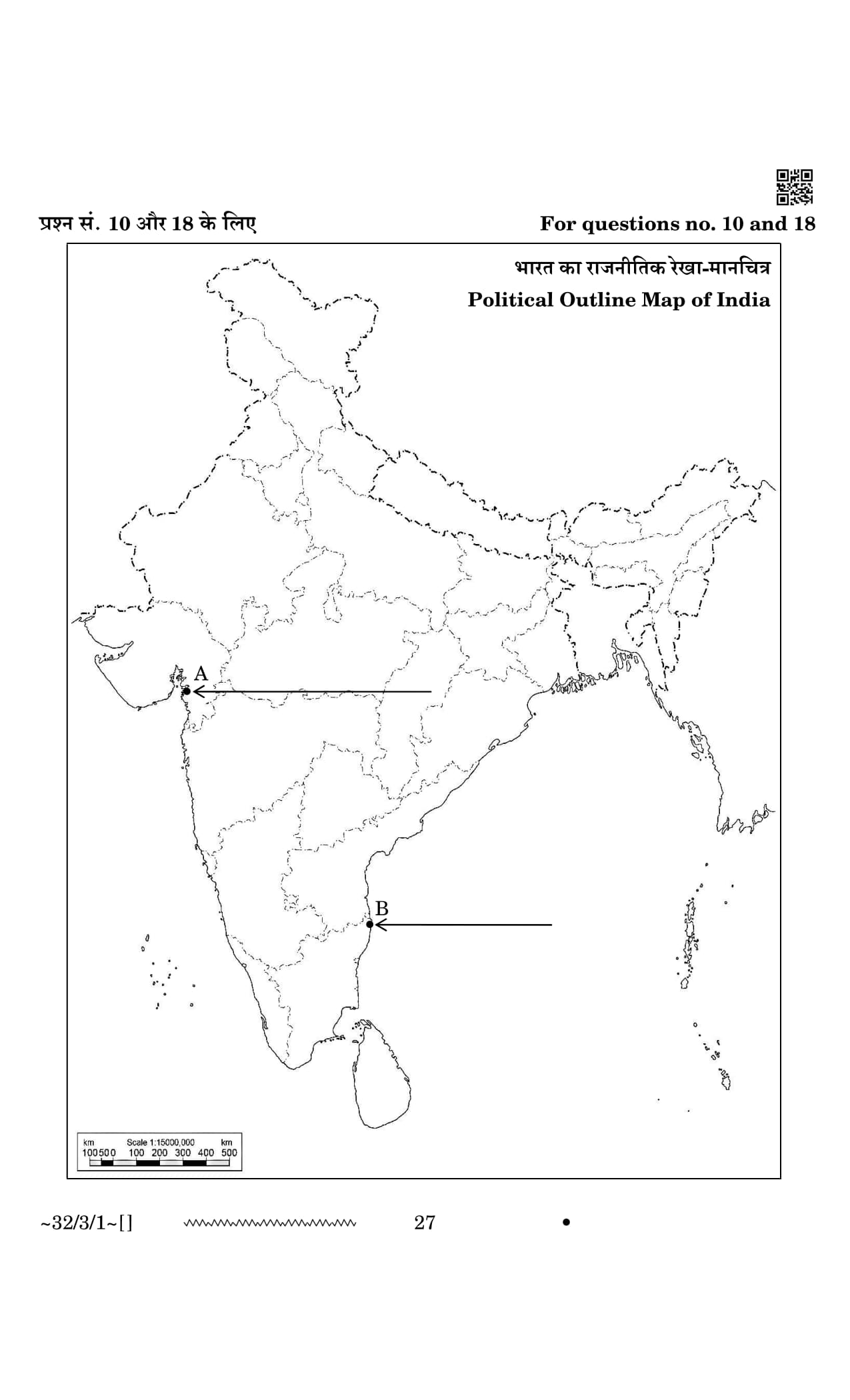
Two places ‘A’ and ‘B’ have been marked on the given political outline map of India. Identify them with the help of the following information and write their correct names on the lines drawn near them :

The place where the session of Indian National Congress was held in 1927.
View Solution
Concept: Annual sessions of the Indian National Congress served as the highest policy-making forums of the Indian freedom movement, bringing together delegates from all provinces to formulate national strategy and articulate political resolutions. The late 1920s witnessed a resurgence of militant nationalist sentiment across India, catalyzed by the British government’s appointment of the all-British Simon Commission to review constitutional reforms. In December 1927, the Indian National Congress convened its 42nd annual session in the historic southern coastal metropolis of the Madras Presidency, marking a radical ideological milestone in the march toward complete independence.
Step 1: Understanding the Question:
We must identify the geographic location marked as ‘A’ on the political outline map of India, representing the venue of the historic 1927 annual session of the Indian National Congress.
Step 2: Key Concept:
Congress Session: 42nd Annual Session of the Indian National Congress (December 1927).
Presiding President: Dr. M.A. Ansari.
Historical Resolutions:
1. Resolution to boycott the all-white Simon Commission ‘at every stage and in every form’.
2. Resolution moved by Jawaharlal Nehru declaring the goal of the Indian people to be complete national independence.
Cartographic Location: Point ‘A’ is plotted on the northeastern coast of Tamil Nadu along the Coromandel Coast.
Step 3: Detailed Explanation:
Historical Significance of the 1927 Session:
– The 1927 session of the Indian National Congress was held in Madras (present-day Chennai).
– Under the presidency of Dr. Mukhtar Ahmed Ansari, the Congress took a staunch and decisive stand against the Simon Commission, which did not include a single Indian member.
– The Congress unanimously adopted a historic resolution advocating the total boycott of the Simon Commission upon its arrival in India.
– Furthermore, a young Jawaharlal Nehru successfully introduced a pioneering resolution declaring ‘complete national independence’ as the ultimate political goal of the Indian National Congress, paving the way for the Purna Swaraj declaration two years later at Lahore in 1929.
Map Identification Guidance:
– On the provided political outline map of India, location ‘A’ is marked on the eastern seaboard within the state of Tamil Nadu.
– This geographic coordinate represents the coastal capital city of Madras (now Chennai).

Step 4: Final Answer:
Therefore, the place marked as ‘A’ where the session of the Indian National Congress was held in 1927 is Madras (present-day Chennai), located in Tamil Nadu.
Two places ‘A’ and ‘B’ have been marked on the given political outline map of India. Identify them with the help of the following information and write their correct names on the lines drawn near them :
The place where Gandhiji broke the Salt Law.
View Solution
Concept: In early 1930, Mahatma Gandhi chose salt—a commodity indispensable to every household and consumed equally by the rich and the poor—as a powerful symbol to unify the nation against British colonial exploitation. The British monopoly over the production and sale of salt, combined with the regressive salt tax, represented one of the most oppressive manifestations of colonial fiscal policy. On March 12, 1930, Gandhi embarked on his historic 240-mile Salt March from his Sabarmati Ashram in Ahmedabad accompanied by 78 chosen volunteers, walking through the heart of Gujarat to reach the coastal village where he formally inaugurated the Civil Disobedience Movement.
Step 1: Understanding the Question:
We must identify the geographical location marked as ‘B’ on the political outline map of India, representing the historic coastal village where Mahatma Gandhi broke the colonial salt monopoly.
Step 2: Key Concept:
Historical Campaign: The Salt Satyagraha (Salt March of 1930).
Commenced from: Sabarmati Ashram, Ahmedabad (12 March 1930).
Destination: Dandi, coastal village in Navsari district, Gujarat.
Date of Law Breaking: April 6, 1930.
Symbolic Action: Boiling sea water to manufacture natural salt, marking the official launch of the Civil Disobedience Movement.
Cartographic Location: Point ‘B’ is plotted along the Arabian Sea coastline of southern Gujarat.
Step 3: Detailed Explanation:
Historical Details of the Salt March:
– Mahatma Gandhi walked 240 miles on foot over 24 days, traversing villages across Gujarat where thousands gathered to listen to his message of non-violence and swaraj.
– On the morning of April 6, 1930, Gandhi arrived at the small seaside village of Dandi on the Arabian Sea coast.
– Walking down to the seashore, he bent down, picked up a handful of natural salt encrusted on the beach, and boiled salt water, thereby technically violating the British Salt Act.
– This symbolic act broke the state monopoly on salt and inaugurated the nationwide Civil Disobedience Movement, inciting millions across India to manufacture contraband salt, picket liquor and foreign cloth shops, and refuse to pay colonial taxes.
Map Identification Guidance:
– On the political outline map of India, location ‘B’ is situated along the southern coast of Gujarat, south of Surat in the Navsari district.
– This exact coastal coordinate represents the historic village of Dandi.
Step 4: Final Answer:
Therefore, the place marked as ‘B’ where Gandhiji broke the Salt Law is Dandi, located on the coast of Gujarat.
Note : The following questions are for the Visually Impaired Candidates only, in lieu of Q. No. 15.
Name the place where the Indian National Congress session was held in 1927.
View Solution
Concept: In the structure of board examinations, alternative non-visual descriptive questions are provided in lieu of cartographic identification tasks for visually impaired candidates. The late 1920s represented a defining turning point in India’s struggle for independence. When the British government announced the Simon Commission in November 1927 to deliberate on future constitutional reforms without appointing a single Indian representative, nationwide indignation erupted. The Indian National Congress convened its annual plenary session in December 1927 in south India to formulate a decisive, unified political response to this imperialist insult.
Step 1: Understanding the Question:
The question asks us to identify and name the specific city where the Indian National Congress held its landmark annual session in the year 1927.
Step 2: Key Concept:
Organization: Indian National Congress.
Year of Session: 1927.
City: Madras (present-day Chennai), Tamil Nadu.
Presiding President: Dr. M.A. Ansari.
Core Decisions: Comprehensive boycott of the Simon Commission and endorsement of the goal of complete independence.
Step 3: Detailed Explanation:
Detailed Historical Context:
– The 1927 annual session of the Indian National Congress was held in Madras (now renamed Chennai).
– The session was presided over by eminent physician and nationalist leader Dr. Mukhtar Ahmed Ansari.
– During this session, the Congress unanimously resolved to boycott the Simon Commission ‘at every stage and in every form’ because the commission had been constituted without any Indian representation to decide India’s constitutional future.
– Additionally, a resolution sponsored by young socialist leaders including Jawaharlal Nehru was passed, defining the ultimate political aspiration of India as Purna Swaraj (complete independence).
– This historic session laid the institutional groundwork for the all-parties conference and the subsequent drafting of the Nehru Report in 1928.
Step 4: Final Answer:
Therefore, the place where the Indian National Congress session was held in 1927 is Madras (present-day Chennai), in Tamil Nadu.
Note : The following questions are for the Visually Impaired Candidates only, in lieu of Q. No. 16.
Name the place where Gandhiji broke the Salt Law.
View Solution
Concept: Salt was historically a prime necessity of life used across all economic classes, yet the British colonial government levied a burdensome tax on its consumption and monopolized its production. Viewing this tax as an atrocious injustice imposed upon the poorest citizens of India, Mahatma Gandhi launched the Salt Satyagraha in 1930. He set out on foot from his ashram on the banks of the Sabarmati River in Ahmedabad, leading a 240-mile march across Gujarat to the seashore, where he openly and peacefully defied the British colonial salt laws.
Step 1: Understanding the Question:
The question asks us to identify and name the specific coastal location in India where Mahatma Gandhi ceremonially broke the colonial salt laws, initiating the Civil Disobedience Movement.
Step 2: Key Concept:
Historical Event: Breaking of the British Salt Law.
Leader: Mahatma Gandhi.
Location: Dandi, a coastal village in Navsari district, Gujarat.
Date: April 6, 1930.
Historical Outcome: Formal inauguration of the nationwide Civil Disobedience Movement.
Step 3: Detailed Explanation:
Detailed Historical Context:
– Mahatma Gandhi commenced the historic Dandi March from Sabarmati Ashram on March 12, 1930, with 78 volunteers.
– After walking 240 miles over a span of 24 days, he reached the coastal destination of Dandi on the evening of April 5, 1930.
– On the morning of April 6, 1930, after taking a ritual dip in the Arabian Sea, Gandhi picked up a lump of natural salt from the beach and boiled seawater to produce salt.
– By manufacturing salt in defiance of British law, Gandhi broke the government monopoly and inaugurated the Civil Disobedience Movement.
– This event inspired millions across India to break salt laws, picket foreign cloth shops, boycott colonial courts and schools, and refuse payment of land revenues and taxes.
Step 4: Final Answer:
Therefore, the place where Gandhiji broke the Salt Law is Dandi, located in the Navsari district of Gujarat.
Match Column I with Column II and choose the correct option :

View Solution
Concept: Soil is the most vital renewable natural resource, serving as the medium of plant growth and sustaining diverse living organisms on Earth. In India, varied relief features, landforms, climatic realms, and vegetation types have contributed to the formation of distinct soil types across different geographic zones. Each soil type possesses unique physical, mineralogical, and chemical properties determined by its parent rock material, climate, topography, organic matter, and duration of pedogenesis. Understanding these pedological characteristics is essential for scientific crop planning, soil conservation, and sustainable agrarian productivity.
Step 1: Understanding the Question:
The question requires matching each major soil category in Column I (Alluvial soil, Black soil, Laterite soil, Arid soil) with its defining pedological or chemical characteristic in Column II, and selecting the correct matching combination from the given options.
Step 2: Key Concept:
Alluvial Soil: Deposited by river systems; rich in potash, phosphoric acid, and lime; highly fertile.
Black Soil (Regur): Formed from volcanic basalt (lava rocks); ideal for cotton cultivation; high moisture-retention capacity.
Laterite Soil: Formed under high temperature and heavy rainfall with intense leaching; poor humus content in semi-arid conditions.
Arid Soil: Developed under dry climatic regimes; sandy texture and saline nature; lacks moisture and humus.
Step 3: Detailed Explanation:
Item-by-Item Matching Analysis:
– a. Alluvial Soil:
Alluvial soil is the most widespread and fertile soil in India, deposited by the Indus, Ganga, and Brahmaputra river systems. As a whole, alluvial soils are very fertile and contain adequate proportions of potash, phosphoric acid, and lime, making them ideal for intensive cultivation of sugarcane, paddy, wheat, and pulses. Thus, \(a \rightarrow \text{ii}\).
– b. Black Soil:
Also known as Regur soil, black soil is typical of the Deccan trap (Basalt) region spread over northwest Deccan plateau and is made from lava parent rocks. It is extremely fine, clayey, and world-renowned for its capacity to hold moisture. It is ideally suited for growing cotton, which is why it is commonly called ‘black cotton soil’. Thus, \(b \rightarrow \text{iii}\).
– c. Laterite Soil:
Laterite develops in areas with high temperature and heavy rainfall, resulting from intense leaching. In semi-arid environments, the humus content of laterite soil decreases rapidly because most micro-organisms, particularly decomposers like bacteria, get destroyed under extreme heat and drought conditions. Thus, \(c \rightarrow \text{iv}\).
– d. Arid Soil:
Arid soils range from red to brown in color. They are characteristically sandy in texture and saline in nature. In certain coastal and dry arid pockets, the salt content is so high that common salt is obtained by evaporating the brine water. Thus, \(d \rightarrow \text{i}\).
Synthesis:
The complete matching sequence is: a-ii, b-iii, c-iv, d-i, which corresponds to Option (C).
Step 4: Final Answer:
Therefore, the correct match is a-ii, b-iii, c-iv, d-i, which corresponds to Option (C).
Choose the correct option related to main crops of Kharif cropping season :
View Solution
Concept: India’s agricultural calendar is intricately structured around seasonal variations in monsoon winds, temperature, and daylight. The agricultural year is divided into three primary cropping seasons: Kharif, Rabi, and Zaid. The Kharif season synchronizes with the onset of the southwest monsoon across the subcontinent. Kharif crops are sown in the months of June and July as the first monsoon rains arrive, and they are harvested during autumn in September and October. These crops require warm temperatures and substantial hydrological moisture throughout their early vegetative cycle. Major crops cultivated during this monsoon cropping season include cereals, coarse grains, pulses, and oilseeds that thrive in warm, humid conditions.
Step 1: Understanding the Question:
The question asks us to identify the option that contains exclusively crops belonging to the Kharif cropping season of India.
Step 2: Key Concept:
Cropping Season: Kharif Season (Monsoon agricultural cycle).
Sowing Period: June–July (onset of southwest monsoon).
Harvesting Period: September–October.
Principal Kharif Crops: Paddy (rice), Maize, Jowar, Bajra, Tur (Arhar), Moong, Urad, Cotton, Jute, Groundnut, and Soyabean.
Contrast with Rabi Crops: Wheat, Barley, Peas, Gram, and Mustard are winter-sown Rabi crops.
Step 3: Detailed Explanation:
Analysis of Kharif Crops:
– Paddy (rice) is the premier Kharif cereal, requiring flooded fields and high humidity.
– Maize, Groundnut, and Soyabean are all warm-season crops sown during the monsoon season and harvested in autumn.
Systematic Evaluation of the Options:
– Option (A) ‘Urad, Gram, Groundnut, Mustard’: Contains Gram and Mustard, which are winter (Rabi) crops. Hence, incorrect.
– Option (B) ‘Wheat, Peas, Soyabean, Bajra’: Contains Wheat and Peas, which are quintessential winter (Rabi) crops. Hence, incorrect.
– Option (C) ‘Maize, Mustard, Gram, Jowar’: Contains Mustard and Gram, which are Rabi crops. Hence, incorrect.
– Option (D) ‘Paddy, Maize, Groundnut, Soyabean’: Every single crop in this group—Paddy, Maize, Groundnut, and Soyabean—is a major Kharif crop cultivated during the monsoon season.
Step 4: Final Answer:
Therefore, the group representing the main crops of the Kharif cropping season is Paddy, Maize, Groundnut, Soyabean, which corresponds to Option (D).
Arrange the location of the following dams of India from North to South and choose the correct option :
I. Pravara
II. Salal
III. Koyna
IV. Gandhi Sagar
Options :
View Solution
Concept: Multipurpose river valley projects and major dams in India are distributed across diverse geographic and hydrological basins to control seasonal floods, generate hydroelectric power, provide irrigation, and supply municipal drinking water. Determining the relative geographic layout of these monumental hydrological structures requires an understanding of their river systems, host states, and latitudinal positions across the Indian subcontinent from the northern Himalayan ranges down to the peninsular Deccan plateau.
Step 1: Understanding the Question:
We must identify the geographical location, river, and state of four prominent Indian dams (Pravara, Salal, Koyna, and Gandhi Sagar) and arrange them in sequence from North to South.
Step 2: Key Concept:
Latitudinal Distribution of Indian Dams (North \(\rightarrow\) South):
1. Salal Dam: Chenab River, Reasi district, Jammu and Kashmir (\(\approx 33.1^\circ\text{ N}\)).
2. Gandhi Sagar Dam: Chambal River, Mandsaur district, Madhya Pradesh (\(\approx 24.7^\circ\text{ N}\)).
3. Pravara Dam (Bhandardara): Pravara River, Ahmednagar district, northern Maharashtra (\(\approx 19.5^\circ\text{ N}\)).
4. Koyna Dam: Koyna River, Satara district, southern Maharashtra (\(\approx 17.4^\circ\text{ N}\)).
Step 3: Detailed Explanation:
Detailed Geographic Profiling of Each Dam:
– II. Salal Dam:
Built across the Chenab River in the Reasi district of Jammu and Kashmir. Located in the northernmost Himalayan region at approximately \(33.1^\circ\text{ N}\) latitude. It is the northernmost dam among the four.
– IV. Gandhi Sagar Dam:
One of the four major dams built under the Chambal Valley Project, located on the Chambal River in Mandsaur district of Madhya Pradesh at approximately \(24.7^\circ\text{ N}\) latitude.
– I. Pravara Dam (Wilson Dam / Bhandardara):
Constructed across the Pravara River (a tributary of the Godavari) in the Ahmednagar district of northern Maharashtra at approximately \(19.5^\circ\text{ N}\) latitude.
– III. Koyna Dam:
Constructed across the Koyna River (a tributary of the Krishna) in the Satara district of southern Maharashtra at approximately \(17.4^\circ\text{ N}\) latitude. Situated south of Pravara, it is the southernmost dam in this group.
North-to-South Alignment:
Salal (II) \(\rightarrow\) Gandhi Sagar (IV) \(\rightarrow\) Pravara (I) \(\rightarrow\) Koyna (III).
This spatial arrangement corresponds to the sequence II, IV, I, III, which is Option (B).
Step 4: Final Answer:
Therefore, arranging the dams from North to South gives the sequence II, IV, I, III, which corresponds to Option (B).
Differentiate between ferrous and non-ferrous minerals.
View Solution
Concept: Minerals are naturally occurring homogeneous substances with a definable internal structure found in varied forms in nature, ranging from the hardest diamond to the softest talc. Metallic minerals are broadly sub-divided into two major categories based on their iron content: Ferrous minerals and Non-ferrous minerals. Ferrous minerals are metallic substances that contain iron as a primary constituent, playing a foundational role in metallurgical and heavy engineering manufacturing. In contrast, non-ferrous minerals are metallic substances that do not contain iron, possessing distinct physical properties such as high electrical conductivity, malleability, and resistance to corrosion that make them indispensable in electronics, telecommunications, and aviation.
Step 1: Understanding the Question:
The question asks us to analyze and differentiate between ferrous and non-ferrous minerals on the basis of chemical composition, physical properties, economic utility, and representative examples.
Step 2: Key Concept:
Ferrous Minerals: Metallic minerals containing iron; account for about three-fourths of the total production value of metallic minerals; magnetic; prone to corrosion.
Non-Ferrous Minerals: Metallic minerals devoid of iron; lighter weight; non-magnetic; corrosion-resistant; highly conductive.
Key Examples: Ferrous (Iron ore, Manganese, Chromite, Nickel); Non-ferrous (Copper, Bauxite, Lead, Zinc, Gold).
Step 3: Detailed Explanation:
The differences between ferrous and non-ferrous minerals are detailed below:
1. Presence of Iron Content:
– Ferrous Minerals: Contain iron (\(\text{Fe}\)) as a major chemical component in their composition.
– Non-Ferrous Minerals: Do not contain iron in their chemical composition.
2. Economic Value and Industrial Role:
– Ferrous Minerals: Provide the primary raw material foundation for iron and steel industries and heavy mechanical engineering. In India, they account for approximately three-fourths (\(75\%\)) of the total value of metallic mineral production.
– Non-Ferrous Minerals: Provide critical inputs for electrical, electronic, defense, and automobile manufacturing industries due to their ductility, malleability, and electrical conductivity.
3. Magnetic and Physical Properties:
– Ferrous Minerals: Most ferrous minerals exhibit magnetic properties and are comparatively heavy and dense.
– Non-Ferrous Minerals: Are generally non-magnetic, lighter in weight, and possess high thermal and electrical conductivity.
4. Resistance to Corrosion:
– Ferrous Minerals: Are susceptible to rusting and chemical corrosion when exposed to moisture and oxygen over time.
– Non-Ferrous Minerals: Exhibit strong natural resistance to rust and oxidation, making them ideal for exterior applications and marine environments.
5. Prominent Examples:
– Ferrous Minerals: Iron ore (magnetite, hematite), Manganese, Chromite, Cobalt, and Nickel.
– Non-Ferrous Minerals: Copper, Bauxite (aluminum ore), Lead, Zinc, Gold, and Silver.
Step 4: Final Answer:
Therefore, ferrous minerals are iron-containing, magnetic minerals that form the backbone of the steel industry (e.g., iron ore, manganese), whereas non-ferrous minerals contain no iron, are resistant to corrosion, and are vital for electrical and engineering applications (e.g., copper, bauxite).
Differentiate between conventional and non-conventional sources of energy.
View Solution
Concept: Energy is a basic requirement for economic development, sustaining all sectors of the national economy including agriculture, manufacturing, transport, and commercial services. Energy resources can be classified into two fundamental groups: Conventional and Non-conventional sources. Conventional energy sources are traditional sources that have been utilized by humankind for a long time, predominantly consisting of fossil fuels that are finite and exhaustible. In contrast, non-conventional energy sources are modern, renewable alternatives developed more recently to harness natural flows such as solar radiation, wind currents, biological waste, and oceanic tides. Shifting towards non-conventional sources is essential for environmental preservation and sustainable development.
Step 1: Understanding the Question:
We must differentiate between conventional and non-conventional sources of energy across multiple parameters: availability, exhaustibility, environmental impact, operational costs, and practical examples.
Step 2: Key Concept:
Conventional Energy Sources: Traditional, exhaustible, non-renewable fossil fuels causing environmental pollution.
Non-Conventional Energy Sources: Modern, inexhaustible, renewable energy flows that are eco-friendly and clean.
Core Parameters: Renewability, pollution footprint, capital and operational costs, and sustainability.
Step 3: Detailed Explanation:
The differences between conventional and non-conventional sources of energy are detailed below:
1. Historical Usage and Nature:
– Conventional Sources: Have been in extensive commercial and domestic use for a long period of time (e.g., coal since the Industrial Revolution).
– Non-Conventional Sources: Have been developed and adopted recently as modern technological alternatives to replace depleting fossil fuels.
2. Exhaustibility and Renewability:
– Conventional Sources: Are non-renewable and exhaustible. Their natural geological formation takes millions of years, and their reserves are depleting rapidly due to intensive exploitation.
– Non-Conventional Sources: Are renewable and inexhaustible. They are naturally replenished continuously by solar, atmospheric, and hydrological cycles.
3. Environmental Impact:
– Conventional Sources: Combustion of fossil fuels emits massive volumes of greenhouse gases (carbon dioxide), toxic sulfur oxides, and fly ash, causing air pollution, acid rain, and global warming.
– Non-Conventional Sources: Are clean, non-polluting, and eco-friendly, producing zero or minimal carbon emissions during operation.
4. Initial and Running Costs:
– Conventional Sources: Require continuous recurring fuel expenses (purchasing coal, diesel, or gas) to sustain energy generation.
– Non-Conventional Sources: Involve higher initial capital installation costs (e.g., solar panels, wind turbines), but running and maintenance costs are negligible because natural resources like sunlight and wind are free.
5. Prominent Examples:
– Conventional Sources: Coal, Petroleum, Natural Gas, Firewood, and Thermal Electricity.
– Non-Conventional Sources: Solar energy, Wind energy, Biogas, Tidal energy, Geothermal energy, and Nuclear energy.
Step 4: Final Answer:
Therefore, conventional energy sources are exhaustible, polluting fossil fuels used traditionally (such as coal and petroleum), while non-conventional sources are renewable, eco-friendly modern alternatives (such as solar and wind energy).
“Plantation agriculture is also a type of commercial farming.” Support the statement with suitable arguments.
View Solution
Concept: In agricultural geography, commercial farming is an agrarian system where crops are cultivated and livestock reared with the primary motive of selling the produce in domestic and international markets for financial profit. Plantation agriculture represents a distinct, capital-intensive branch of commercial farming. Introduced into tropical and subtropical developing regions predominantly during the colonial era, plantation farming is characterized by the specialized cultivation of a single cash crop over vast contiguous estates for commercial processing and industrial utilization. By integrating large agricultural landholdings with industrial manufacturing units, modern technology, and organized wage labor, plantation farming exemplifies the modern capitalist interface between agriculture and industry.
Step 1: Understanding the Question:
We must substantiate and support the statement that plantation agriculture is an integral form of commercial farming by providing arguments based on its scale, market orientation, capital intensity, labor organization, and industrial linkages.
Step 2: Key Concept:
Agrarian System: Plantation Agriculture as a subset of Commercial Farming.
Core Characteristic: Monoculture (cultivation of a single crop over extensive land areas).
Market Orientation: Entire harvest produced for sale, processing, and export rather than self-consumption.
Industrial Linkage: Acts as an interface between agriculture and agro-processing industries.
Resource Inputs: Heavy capital investment, scientific management, and hired migrant labor.
Step 3: Detailed Explanation:
The statement that plantation agriculture is a type of commercial farming is supported by the following arguments:
1. Cultivation of a Single Cash Crop on a Vast Scale (Monoculture):
– In plantation agriculture, a single crop is grown over an enormous tract of land (frequently spanning hundreds or thousands of hectares).
– The entire harvest is grown strictly for sale in commercial markets rather than for the subsistence needs of the farmer’s household.
2. Heavy Capital-Intensive Inputs:
– Establishing and maintaining plantations requires massive financial capital investment.
– Large sums of capital are deployed to acquire vast land estates, construct internal road networks, build processing factories, purchase advanced agricultural machinery, and apply specialized fertilizers.
3. Use of Hired Labor and Scientific Management:
– Unlike traditional subsistence family farming, plantations are managed like corporate industrial enterprises.
– They employ managerial professionals, technical agronomists, and a large force of paid wage laborers, many of whom are migrant workers settled on the estate.
4. Direct Interface Between Agriculture and Industry:
– Plantation farming functions as an interface between agriculture and industry.
– The harvested primary crop serves as the raw material for agro-based processing industries.
– The industrial processing of the crop is often carried out on the plantation estate itself (e.g., tea processing sheds, rubber coagulating units) or in specialized processing mills located nearby.
5. Requirement of Well-Developed Transport Networks:
– Because the entire output is meant for commercial markets and foreign export, a well-developed network of transport and communication connecting the plantation estates with industrial processing centers and export ports is indispensable.
6. Illustrative Examples in India:
– Important commercial plantation crops in India include Tea in Assam and North Bengal, Coffee in Karnataka (Chikkamagaluru and Kodagu), Rubber in Kerala, and Sugarcane and Banana in southern and western states.
Step 4: Final Answer:
Therefore, plantation agriculture is a form of commercial farming because a single crop is cultivated over vast estates using heavy capital investments, hired wage labor, and scientific techniques, with the entire produce processed for commercial sale and export.
“Manufacturing industries are considered the backbone of the economic development of the country.” Justify the statement with suitable arguments.
View Solution
Concept: Manufacturing refers to the production of goods in large quantities after processing raw materials into more valuable finished products. The economic strength of a nation is universally measured by the development and sophistication of its manufacturing industries. Historically, countries that have transformed their primary agricultural and mineral raw materials into high-value manufactured commodities have attained economic prosperity, high standards of living, and strategic geopolitical influence. In developing economies, manufacturing serves as the vital engine that modernizes traditional agriculture, generates productive mass employment, reduces socioeconomic poverty, expands international trade, and drives balanced regional development.
Step 1: Understanding the Question:
We must justify the statement that manufacturing industries constitute the backbone of a nation’s economic development by presenting structured economic arguments demonstrating their foundational role across various sectors.
Step 2: Key Concept:
Economic Principle: Manufacturing as the foundation of national wealth and modern development.
Key Justifications:
1. Modernization of agriculture through mechanized inputs.
2. Eradication of unemployment and poverty through non-farm job creation.
3. Expanding export trade and earning valuable foreign exchange.
4. Value addition to primary resources.
5. Reduction of regional disparities through decentralized industrialization.
Step 3: Detailed Explanation:
The statement that manufacturing industries are the backbone of economic development is justified by the following arguments:
1. Modernizing Agriculture:
– Manufacturing industries do not merely assist agriculture; they actively modernize it.
– Industries manufacture and supply vital technological inputs to farmers, such as tractors, power tillers, threshers, harvesters, tubewell pumps, PVC pipes, chemical fertilizers, pesticides, and drip irrigation systems.
– These industrial inputs have vastly increased agricultural productivity and per-acre crop yields.
2. Reducing Heavy Dependence on Agricultural Employment:
– In agrarian nations, a disproportionate percentage of the workforce is trapped in agriculture, leading to disguised unemployment.
– Manufacturing industries absorb surplus agrarian labor by providing productive, regular jobs in secondary manufacturing units and tertiary service sectors.
3. Eradication of Poverty and Unemployment:
– Industrial development is an indispensable prerequisite for the eradication of widespread unemployment and poverty.
– Setting up public and private industrial enterprises across tribal, rural, and economically backward areas generates local employment, improves household incomes, and bridges regional economic disparities.
4. Expanding Foreign Trade and Earning Foreign Exchange:
– Export of manufactured goods expands trade and commerce, bringing in valuable foreign exchange needed to import critical capital equipment and technology.
– Countries that export finished manufactured goods (such as machinery, automobiles, electronics, and textiles) earn significantly higher revenue than those relying on low-value raw material exports.
5. Transformation into High-Value Finished Products:
– Nations that process their natural raw materials into a wide variety of finished goods of high economic value become wealthy and prosperous.
– Manufacturing multiplies the utility and value of base materials (e.g., converting iron ore into steel and automobiles, or bauxite into aircraft aluminum).
Step 4: Final Answer:
Therefore, manufacturing industries are considered the backbone of economic development because they modernize agriculture, absorb surplus rural labor, reduce poverty and regional disparities, add substantial value to raw materials, and earn crucial foreign exchange through international trade.
“Agriculture and industry move hand-in-hand.” Justify the statement with suitable arguments.
View Solution
Concept: In developmental economics, agriculture and industry are not mutually exclusive or conflicting sectors; rather, they are profoundly interdependent and complementary. The growth of one sector directly stimulates and sustains the progress of the other, forming a symbiotic economic partnership. Agriculture serves as the primary supplier of vital raw materials and food grains to the industrial sector, while the manufacturing industry supplies modern capital equipment, biochemical inputs, and logistical machinery back to agriculture. Furthermore, as agricultural prosperity rises, the rural population creates a massive domestic market for industrial consumer and capital goods, demonstrating that agriculture and industry move hand-in-hand in propelling national economic development.
Step 1: Understanding the Question:
We must substantiate and justify the statement that agriculture and industry are mutually dependent and move hand-in-hand by presenting arguments showing backward and forward linkages between both sectors.
Step 2: Key Concept:
Economic Interdependence: The symbiotic relationship between the primary (agriculture) and secondary (manufacturing) sectors.
Agro-Industries: Industrial units that process agricultural raw materials.
Industrial Inputs for Farming: Farm mechanization and agro-chemicals.
Market Linkages: Rural farm incomes driving industrial consumer demand.
Step 3: Detailed Explanation:
The statement that agriculture and industry move hand-in-hand is justified through the following arguments:
1. Agriculture Supplies Vital Raw Materials to Industry:
– A major segment of manufacturing consists of agro-based industries, such as cotton, jute, and silk textiles, sugar mills, edible oil extraction plants, tea and coffee processing units, and food packaging industries.
– These industries depend entirely on agriculture for their basic raw materials (e.g., raw cotton, sugarcane, oilseeds, and jute). Without a flourishing agricultural sector, these factories would face raw material starvation and closure.
2. Industry Provides Modern Inputs to Agriculture:
– The industrial sector has revolutionized traditional farming practices by manufacturing and supplying modern agricultural inputs.
– Industries provide chemical fertilizers, insecticides, pesticides, PVC irrigation pipes, electric motors, diesel water pumps, tractors, combine harvesters, and threshers.
– These industrial innovations have dramatically enhanced agricultural productivity, reduced manual drudgery, and facilitated the Green Revolution.
3. Increasing Efficiency and Value Addition in Food Processing:
– Industrial processing adds value to perishable agricultural commodities by preserving them, extending shelf life, and transforming them into processed foods, fruit juices, dairy products, and packaged staples for domestic and global markets.
4. Prosperous Agriculture Creates a Huge Market for Industrial Goods:
– Rising agricultural productivity increases the purchasing power of millions of farming families across rural India.
– In turn, prosperous agricultural households create an enormous domestic market for manufactured consumer goods—including bicycles, motorcycles, mobile phones, clothing, television sets, and packaged commodities—driving industrial growth.
5. Sustaining Industrial Workforce with Food Security:
– Agriculture produces the essential food grains (wheat, rice, pulses, and vegetables) required to feed the rapidly growing urban population and industrial workforce, ensuring national food security and stable industrial wages.
Step 4: Final Answer:
Therefore, agriculture and industry move hand-in-hand because agriculture supplies raw materials and food to industry, while industry provides modern machinery, fertilizers, and processing technology to agriculture, with each sector serving as a vital market for the other.
Question 27:
Read the given source carefully and answer the questions that follow :
Joint Forest Management
In India the Joint Forest Management (JFM) programme furnishes a good example for involving local communities in the management and restoration of degraded forests. The programme has been in formal existence since 1988 when the state of Odisha passed the first resolution for joint forest management. JFM depends on the formation of local (village) institutions that undertake protection activities mostly on degraded forest land managed by the forest department. In return, the members of these communities are entitled to intermediary benefits like non-timber forest produces and share in the timber harvested by ‘successful protection’. \ The clear lesson from the dynamics of both environmental destruction and reconstruction in India is that local communities everywhere have to be involved in some kind of natural resource management. But there is still a long way to go before local communities are at the centre-stage in decision-making. Accept only those economic or developmental activities, that are people centric, environment-friendly and economically rewarding.
Why is conservation of forests necessary ?
View Solution
Concept: Forests constitute the fundamental biological backbone of the terrestrial biosphere, providing vital ecological life-support systems and sustaining global climate stability. In ecological geography, forests function as primary producers upon which all terrestrial living organisms, including human populations, depend directly or indirectly for nutrition, oxygen, and hydrological equilibrium. The rapid degradation and depletion of forest cover due to agricultural expansion, infrastructure industrialization, commercial logging, and mining have precipitated severe environmental crises, including accelerated soil erosion, erratic monsoon precipitation, declining groundwater reserves, and irreversible biodiversity loss. Therefore, conserving forest ecosystems is an urgent imperative to maintain ecological balance, protect genetic diversity, and guarantee long-term socioeconomic security for future generations.
Step 1: Understanding the Question:
The question asks us to examine and elucidate why the conservation of forest resources is indispensable for maintaining ecological stability, sustaining human livelihoods, and preserving environmental balance.
Step 2: Key Concept:
Ecological Ecosystem Services: Forest conservation preserves the life-support systems of water, air, and soil.
Protection of Genetic Diversity: Safeguards plant and animal species necessary for breeding, agriculture, and medicinal applications.
Prevention of Land Degradation: Forest root systems bind topsoil, preventing sheet and gully erosion and mitigating devastating floods.
Climate Regulation: Forests act as major carbon sinks, sequestering atmospheric carbon dioxide to moderate global warming.
Socioeconomic Sustenance: Sustains tribal and rural communities dependent on minor forest produce for daily livelihoods.
Step 3: Detailed Explanation:
The necessity of forest conservation can be elaborated through the following structured points:
1. Preservation of Ecological Life-Support Systems:
– Forests actively maintain the quality of our primary life-support systems: air, water, and soil.
– Through photosynthesis, trees absorb greenhouse gases like carbon dioxide and release oxygen essential for aerobic respiration.
– Tree roots bind the soil firmly, preventing erosion by surface runoff and promoting percolation of rainwater to recharge underground aquifers.
2. Safeguarding Biodiversity and Genetic Diversity:
– Forests harbor immense biological diversity, accommodating millions of species of flora and fauna.
– Conserving natural forest habitats ensures the survival of endangered species and preserves the genetic pool required for crop breeding, medicinal discoveries, and scientific research.
3. Mitigation of Natural Hazards and Disasters:
– Dense forest canopies absorb the kinetic energy of heavy rainfall, reducing soil wash-off and sedimentation in riverbeds.
– This natural sponge effect moderates seasonal streamflow, reducing the severity and frequency of both flash floods during monsoons and droughts during dry seasons.
4. Sustenance of Forest-Dependent and Indigenous Communities:
– Millions of indigenous tribal populations and rural villagers depend intimately on forests for food, fuelwood, fodder, fiber, and medicinal herbs.
– Conserving forest resources safeguards their traditional habitats, cultural heritage, and basic livelihood security.
Step 4: Final Answer:
Therefore, conservation of forests is necessary to maintain ecological life-support systems (clean air, water, and fertile soil), preserve rich biodiversity, regulate hydrological cycles, prevent natural disasters, and sustain the livelihoods of forest-dependent communities.
Which type of forests are protected under the ‘Joint Forest Management’ programme ?
View Solution
Concept: Joint Forest Management (JFM) represents an institutional paradigm shift in Indian forestry, transitioning from centralized colonial bureaucratic exclusion to decentralized participatory co-management. Formally initiated in 1988 with the landmark resolution passed by the state of Odisha, JFM establishes a collaborative partnership between state forest departments and local village institutions. Under this institutional framework, local rural communities are actively mobilized, empowered, and organized into village committees to take custody of denuded and vulnerable woodland tracts. In return for their dedicated surveillance and ecological stewardship, community members are legally entitled to usufructuary benefits, creating a mutual convergence between environmental restoration and rural socioeconomic welfare.
Step 1: Understanding the Question:
The question asks us to identify the specific category and condition of forests that are targeted for protection and ecological restoration under the Joint Forest Management (JFM) programme, based on the provided passage and environmental forestry principles.
Step 2: Key Concept:
Targeted Forest Category: Degraded forest land managed by the forest department.
Institutional Arrangement: Formation of local village institutions (Village Forest Protection Committees).
Core Objective: Restoration, regeneration, and sustainable protection of degraded and denuded forest tracts.
Reciprocal Benefit Sharing: Community entitlement to non-timber forest produce (NTFPs) and a share in harvested timber upon successful protection.
Step 3: Detailed Explanation:
The operational focus of the Joint Forest Management programme is analyzed below:
1. Explicit Identification from the Source:
– The provided source explicitly highlights that ‘JFM depends on the formation of local (village) institutions that undertake protection activities mostly on degraded forest land managed by the forest department.’
– Hence, the specific type of forests protected under this initiative are degraded forest lands.
2. Nature and Characteristics of Degraded Forests:
– Degraded forests refer to woodland areas where canopy density has been significantly reduced due to intensive historical deforestation, unmanaged cattle overgrazing, recurring forest fires, and illicit commercial felling.
– While technically under the administrative ownership and legal control of the state forest department, these areas suffer from severe biomass depletion and require active biological rejuvenation.
3. The Mechanism of Protection and Regeneration:
– Local village institutions, such as Village Forest Committees (VFCs), organize rotational patrolling squads to protect these degraded lands against unauthorized encroachments, firewood collection, and grazing.
– This social fencing enables natural rootstocks to coppice and saplings to regenerate into healthy secondary forests.
4. Economic Incentives for Local Communities:
– In return for successfully safeguarding degraded forest land, local participants receive usufruct rights over non-timber forest products (such as tendu leaves, mahua flowers, lac, honey, and medicinal seeds) and receive an agreed percentage share of timber revenue when mature trees are scientifically harvested.
Step 4: Final Answer:
Therefore, the forests protected under the Joint Forest Management programme are degraded forest lands managed by the forest department that require community-led ecological restoration and regeneration.
Explain the role of local communities in forest conservation.
View Solution
Concept: In India, forest conservation has deep historic roots embedded within the socio-cultural fabric and spiritual ethos of indigenous and local rural communities. For generations, traditional agrarian and tribal societies have coexisted with forest ecosystems, developing sophisticated customary rules, sacred conservation traditions, and sustainable resource-use practices. Far from being passive bystanders or mere consumers of forest wealth, local communities serve as the frontline guardians of forest landscapes. Modern conservation science increasingly recognizes that sustainable ecological management cannot succeed through coercive bureaucratic policing alone; placing local communities at the center of conservation planning and decision-making is indispensable for long-term environmental revival.
Step 1: Understanding the Question:
We must explain the multifaceted role played by local communities in protecting, conserving, and sustainably managing forest ecosystems, drawing upon evidence from the passage and historical community conservation initiatives across India.
Step 2: Key Concept:
Frontline Custodianship: Local village committees undertake direct physical patrolling to prevent timber theft, forest fires, and encroachment.
Sacred Groves and Cultural Sanctuaries: Preserving virgin forest patches (‘Bhairondev Dakav’, ‘Sarana’, ‘Deorikadu’) through traditional religious sanctions.
Grassroots Resistance Movements: Heroic citizen-led campaigns such as the Chipko Movement and Beej Bachao Andolan resisting commercial logging.
Institutional Co-management: Participating in Joint Forest Management (JFM) to regenerate degraded government forest lands.
People-Centric Development: Advocating for developmental activities that are community-guided, eco-friendly, and economically rewarding.
Step 3: Detailed Explanation:
The vital role of local communities in forest conservation encompasses several dimensions:
1. Institutional Custodianship and Daily Surveillance:
– As demonstrated by the JFM model, local village institutions assume direct day-to-day responsibility for patrolling forest boundaries.
– Their continuous local presence provides effective protection against illegal logging, destructive forest fires, and illicit poaching far more efficiently than distant forest department staff.
2. Sacred Traditions and Conservation of Virgin Woodlands:
– Many indigenous societies preserve entire patches of pristine forests known as ‘Sacred Groves’ (such as Sarana in Jharkhand or Orans in Rajasthan).
– By declaring these patches to be the abode of local deities, communities strictly prohibit tree cutting, preserving virgin gene pools of rare botanical species.
– For example, in the Alwar district of Rajasthan, villagers of five settlements declared 1,200 hectares of forest as the ‘Bhairondev Dakav Sonchuri’, formulating their own strict rules to ban hunting and encroachment.
3. Grassroots Mobilization and Resistance Against Commercial Destruction:
– Local communities have historically mobilized powerful mass movements to halt commercial deforestation.
– The renowned Chipko Movement in the Himalayas saw local villagers physically hugging trees to prevent commercial loggers from felling them.
– Similar movements like the Beej Bachao Andolan and Navdanya revived indigenous biodiversity and organic crop practices without synthetic chemicals.
4. Integrating Livelihoods with Sustainable Resource Management:
– As highlighted in the source, local communities demonstrate that conservation succeeds when economic activities are ‘people-centric, environment-friendly, and economically rewarding’.
– By collecting non-timber forest produce sustainably, communities maintain forest canopy health while deriving legitimate economic sustenance.
Step 4: Final Answer:
Therefore, local communities play an indispensable role in forest conservation through continuous frontline surveillance, traditional preservation of sacred groves, grassroots resistance to commercial logging, and institutional co-management under Joint Forest Management.
On the same outline map of India given for question no. 15, locate and label the following with appropriate symbols :
The largest dam built on Narmada river in Gujarat
View Solution
Concept: Multipurpose river valley projects and major dams in independent India were envisioned as the ‘temples of modern India’ by Jawaharlal Nehru, integrating flood control, agricultural irrigation, hydroelectric generation, and municipal water supply. The Narmada is the largest west-flowing river of peninsular India, originating from the Amarkantak plateau in Madhya Pradesh and flowing through a rift valley between the Vindhya and Satpura mountain ranges before entering Gujarat and emptying into the Gulf of Khambhat. To harness the immense hydrological potential of this interstate river basin, the ambitious Narmada Valley Project was planned, centered around a monumental concrete gravity dam constructed in southern Gujarat.
Step 1: Understanding the Question:
The question requires us to identify, locate, and accurately label the largest multipurpose dam constructed across the Narmada River in the state of Gujarat on the provided political outline map of India.
Step 2: Key Concept:
Multipurpose Hydrological Project: Sardar Sarovar Dam.
River Basin: Narmada River.
Geographic Location: Kevadia (Ekta Nagar), Narmada district, Gujarat.
Beneficiary Interstate Basin: Gujarat, Rajasthan, Madhya Pradesh, and Maharashtra.
Primary Objectives: Providing irrigation to drought-prone Saurashtra and Kutch, supplying drinking water, and generating hydroelectric power.
Step 3: Detailed Explanation:
Geographic and Engineering Profile:
– The largest dam built on the Narmada River in Gujarat is the Sardar Sarovar Dam.
– Located near Navagam and Kevadia (now Ekta Nagar) in the Narmada district of Gujarat, it is one of the largest concrete gravity dams in the world.
– The dam is designed to supply irrigation water to over \(18\text{ lakh hectares}\) of parched farmland across drought-prone regions of Saurashtra, Kutch, and north Gujarat, as well as arid tracts of Barmer and Jalore in Rajasthan.
– It also provides piped drinking water to thousands of water-scarce villages and urban settlements, while generating \(1,450\text{ MW}\) of clean hydroelectric power shared among Gujarat, Maharashtra, and Madhya Pradesh.
Cartographic Guidance for Map Work:
– On the political outline map of India, locate the state of Gujarat in western India.
– Trace the course of the Narmada River as it enters southeastern Gujarat near the border with Madhya Pradesh and Maharashtra.
– Mark a prominent dam symbol (\(\blacktriangle\)) on the river in the Narmada district (east of Bharuch and Vadodara) and neatly label it as Sardar Sarovar Dam.
Step 4: Final Answer:
Therefore, the largest dam built on the Narmada River in Gujarat is the Sardar Sarovar Dam, located in the Narmada district of Gujarat.
On the same outline map of India given for question no. 15, locate and label the following with appropriate symbols :
International airport located in Punjab
View Solution
Concept: Air transport is the fastest, most comfortable, and prestigious mode of modern transport, capable of traversing difficult terrain, vast deserts, dense forests, and oceanic stretches with unparalleled ease. In India, air transport was nationalized in 1953, and a comprehensive nationwide network of domestic and international airports was developed to connect major metropolitan hubs, industrial clusters, and border states. In the northwestern agrarian border state of Punjab, international civil aviation plays a pivotal strategic and economic role by connecting the vast Punjabi diaspora residing across the United Kingdom, Canada, Europe, and the Middle East with their cultural homeland.
Step 1: Understanding the Question:
We must identify, locate, and accurately label the premier international airport situated in the northern state of Punjab on the outline map of India.
Step 2: Key Concept:
Infrastructure Facility: International Airport.
State: Punjab.
City: Amritsar.
Official Airport Name: Raja Sansi International Airport (formally named Sri Guru Ram Dass Jee International Airport).
Geographic Significance: Premier international air gateway for Punjab, Jammu and Kashmir, and western Himachal Pradesh.
Step 3: Detailed Explanation:
Geographic Profiling and Historical Background:
– The major international airport located in Punjab is the Raja Sansi International Airport, officially designated as Sri Guru Ram Dass Jee International Airport.
– The airport is named after Sri Guru Ram Dass Jee, the fourth Sikh Guru and the historic founder of the holy city of Amritsar.
– Located approximately \(11\text{ km}\) northwest of Amritsar city center near the village of Raja Sansi, this airport handles extensive international passenger flights, pilgrim traffic visiting the Golden Temple (Harmandir Sahib), and cargo logistics.
Cartographic Guidance for Map Work:
– On the political outline map of India, locate the northern state of Punjab, bordered by Pakistan on the west, Jammu and Kashmir on the north, and Himachal Pradesh on the east.
– Identify the city of Amritsar situated in northwestern Punjab near the international Wagah border.
– Place an airport symbol (\(\airplane\) or dot) at this precise location and neatly label it as Raja Sansi (Sri Guru Ram Dass Jee) International Airport, Amritsar.
Step 4: Final Answer:
Therefore, the international airport located in Punjab is Raja Sansi (Sri Guru Ram Dass Jee) International Airport, situated at Amritsar.
On the same outline map of India given for question no. 15, locate and label the following with appropriate symbols :
Software Technology Park located in Karnataka
View Solution
Concept: The electronics and information technology (IT) industry has emerged as one of the most dynamic, fast-growing sectors of the post-reform Indian economy, earning substantial foreign exchange and providing millions of high-skilled employment opportunities, especially for women. To foster high-technology software development and facilitate seamless digital exports, the Government of India established Software Technology Parks of India (STPI) across premier metropolitan centers. The southern state of Karnataka spearheaded India’s digital computing revolution, developing world-class technological infrastructure, research universities, and telecommunication networks that transformed its capital into a premier global technology cluster.
Step 1: Understanding the Question:
The question asks us to identify, pinpoint, and label the prominent Software Technology Park situated in the state of Karnataka on the political outline map of India.
Step 2: Key Concept:
Industrial Hub: Software Technology Park of India (STPI).
State: Karnataka.
Primary City: Bengaluru (also Mysuru).
Global Honorific: Known as the ‘Silicon Valley of India’ and the ‘Electronic Capital of India’.
Economic Contribution: Major export cluster for software engineering, information technology services, and digital innovation.
Step 3: Detailed Explanation:
Industrial and Geographic Overview:
– The most prominent Software Technology Park in Karnataka is located at Bengaluru (with an additional prominent park located at Mysuru).
– Bengaluru has earned international acclaim as the ‘Silicon Valley of India’ and the undisputed ‘Electronic Capital of India’.
– The city hosts premier global IT giants (such as Infosys, Wipro, and TCS), international multinational software corporations, aerospace research institutes (ISRO, HAL), and dynamic technology startups.
– The software technology park in Bengaluru provides cutting-edge satellite communication facilities, high-speed data transmission, and state-of-the-art incubation infrastructure for software export enterprises.
Cartographic Guidance for Map Work:
– On the political outline map of India, locate the state of Karnataka in southwestern peninsular India.
– Position your marker in the southeastern plateau region of Karnataka, close to the borders with Tamil Nadu and Andhra Pradesh.
– Mark a distinct point and label it clearly as Bengaluru Software Technology Park.
Step 4: Final Answer:
Therefore, the major Software Technology Park located in Karnataka is at Bengaluru (the Silicon Valley of India), with another notable center at Mysuru.
On the same outline map of India given for question no. 15, locate and label the following with appropriate symbols :
Major sea port located in Odisha
View Solution
Concept: With a vast coastline extending over \(7,516.6\text{ km}\), India is served by 12 major deep-water seaports and approximately 200 notified non-major and intermediate ports that handle over \(95\%\) of the country’s foreign trade volume and \(68\%\) of trade value. Along the eastern seaboard fronting the Bay of Bengal, deep-water ports were strategically constructed during the post-independence era to handle the massive bulk export of mineral resources extracted from the mineral-rich hinterlands of the Chota Nagpur plateau and adjoining mineral belts. In Odisha, a world-class deep-water port was constructed at the confluence of the Mahanadi River system to facilitate bulk maritime shipments of iron ore to East Asian industrial economies.
Step 1: Understanding the Question:
We must identify, locate, and accurately label the major deep-water sea port situated along the coastal rim of Odisha on the political outline map of India.
Step 2: Key Concept:
Maritime Facility: Major Deep-Water Sea Port.
Host State: Odisha.
Specific Port: Paradip Port.
Geographic Setting: Jagatsinghpur district, located along the Bay of Bengal coast near the Mahanadi delta.
Trade Specialization: Massive bulk export of iron ore to countries like Japan.
Step 3: Detailed Explanation:
Maritime Characteristics and Economic Function:
– The premier major sea port located in Odisha is Paradip Port.
– Commissioned as a major deep-water port on the eastern coast in 1966, Paradip is situated in the Jagatsinghpur district of Odisha.
– It is designed as a deep-draft artificial harbor equipped with mechanized bulk-handling systems.
– Paradip specializes primarily in the bulk export of superior-grade iron ore mined from the expansive reserves of Keonjhar, Mayurbhanj, and Sundargarh in Odisha and the neighboring Jharkhand belt, with major export destinations including Japan and other industrial nations.
– It also handles substantial imports of coking coal, crude oil, fertilizers, and general dry-bulk cargo for regional steel and thermal power plants.
Cartographic Guidance for Map Work:
– On the political outline map of India, locate the eastern coastal state of Odisha along the Bay of Bengal.
– Locate the central coastal curve of Odisha just south of the Mahanadi River delta (east of Cuttack and Bhubaneswar).
– Mark an anchor or port symbol on the coast and neatly label it as Paradip Port.
Step 4: Final Answer:
Therefore, the major sea port located in Odisha is Paradip Port, situated on the Bay of Bengal coast in the Jagatsinghpur district of Odisha.
Note : The following questions are for the Visually Impaired Candidates only, in lieu of Q. No. 30.
Name the largest dam built on Narmada river in Gujarat.
View Solution
Concept: In the framework of national board examinations, alternative descriptive evaluation items are systematically provided for visually impaired candidates in place of visual cartographic tasks. River valley engineering projects represent monumental interventions to regulate seasonal river discharges, generate renewable hydroelectric energy, provide industrial and municipal water supply, and irrigate water-scarce agricultural terrains. The Narmada River, flowing through Madhya Pradesh, Maharashtra, and Gujarat, represents the lifeline of western peninsular India. To alleviate chronic droughts across western India, a monumental multipurpose dam was constructed in Gujarat.
Step 1: Understanding the Question:
The question asks us to state the name of the largest multipurpose dam constructed across the Narmada River in the state of Gujarat.
Step 2: Key Concept:
Multipurpose Dam: Sardar Sarovar Dam.
River: Narmada River.
State: Gujarat.
District: Narmada district (Kevadia / Ekta Nagar).
Interstate Beneficiaries: Gujarat, Rajasthan, Madhya Pradesh, and Maharashtra.
Step 3: Detailed Explanation:
Historical and Technical Details:
– The largest dam built on the Narmada River in Gujarat is the Sardar Sarovar Dam.
– It is a massive concrete gravity dam constructed on the Narmada River at Kevadia (now known as Ekta Nagar) in the Narmada district of Gujarat.
– As the cornerstone of the Narmada Valley Project, the dam has a height of \(138.68\text{ meters}\) and creates a vast reservoir spanning over \(37,000\text{ hectares}\).
– The project conveys irrigation water through an extensive network of canals, including the \(458\text{ km}\) long Narmada Main Canal, irrigating drought-prone tracts of Saurashtra, Kutch, and southern Rajasthan.
– Furthermore, the dam complex incorporates two powerhouses with a combined hydroelectric generating capacity of \(1,450\text{ MW}\), delivering clean power across four western states.
Step 4: Final Answer:
Therefore, the largest dam built on the Narmada River in Gujarat is the Sardar Sarovar Dam.
Note : The following questions are for the Visually Impaired Candidates only, in lieu of Q. No. 31.
Name the place where international airport is located in Punjab.
View Solution
Concept: Civil aviation infrastructure forms a vital lifeline for economic modernization, rapid commercial connectivity, and international integration. Airports are classified into domestic and international facilities based on customs, immigration clearance facilities, and international flight runways. In the state of Punjab, international civil aviation connectivity is critically tied to international diaspora travel, religious tourism, and agricultural exports. The historic city that houses Punjab’s premier international airport is a world-renowned spiritual center that connects northern India to global metropolitan destinations.
Step 1: Understanding the Question:
The question requires us to identify and name the specific geographic city or place in the state of Punjab where its international airport is situated.
Step 2: Key Concept:
Infrastructure Type: International Airport.
State: Punjab.
Location / City: Amritsar.
Airport Name: Raja Sansi International Airport (Sri Guru Ram Dass Jee International Airport).
Significance: Connects Punjab directly to international hubs across the UK, Europe, Southeast Asia, and the Middle East.
Step 3: Detailed Explanation:
Geographical and Institutional Context:
– The international airport in Punjab is located at Amritsar (specifically at Raja Sansi, approximately \(11\text{ km}\) northwest of the city center).
– The airport is named Sri Guru Ram Dass Jee International Airport in honor of the revered fourth Sikh Guru, who established the holy city of Amritsar in the sixteenth century.
– It is the largest and busiest airport in the state of Punjab, serving millions of passengers annually.
– The facility handles extensive direct international flights carrying Punjabi diaspora communities, business travelers, and pilgrims visiting the world-famous Golden Temple (Sri Harmandir Sahib).
Step 4: Final Answer:
Therefore, the place where the international airport is located in Punjab is Amritsar (Raja Sansi).
Note : The following questions are for the Visually Impaired Candidates only, in lieu of Q. No. 32.
Name the place where the Software Technology Park is located in Karnataka.
View Solution
Concept: Software Technology Parks of India (STPI) were established as autonomous scientific societies under the Ministry of Electronics and Information Technology to encourage, promote, and boost software exports from India. These technology parks provide state-of-the-art infrastructural amenities, statutory benefits, and high-speed data communications to software export companies. The state of Karnataka spearheaded India’s digital computing boom, earning global acclaim as the nation’s premier information technology hub.
Step 1: Understanding the Question:
The question asks us to identify and name the specific city or location in Karnataka where its primary Software Technology Park is located.
Step 2: Key Concept:
Industry: Information Technology (IT) and Software Services.
Host State: Karnataka.
Primary City: Bengaluru (also Mysuru).
Global Honorific: Known worldwide as the ‘Silicon Valley of India’ and ‘Electronic Capital of India’.
Key Institutions: Headquarters of Infosys, Wipro, ISRO, and major multinational digital engineering centers.
Step 3: Detailed Explanation:
Institutional and Economic Analysis:
– The principal place where the Software Technology Park is located in Karnataka is Bengaluru (formerly Bangalore), with an additional major technology park located at Mysuru (Mysore).
– Bengaluru is widely celebrated as the ‘Silicon Valley of India’ and the ‘Electronic Capital of India’.
– It is home to the highest concentration of software development enterprises, multinational IT consulting giants, research and development centers, and high-technology semiconductor design firms in the country.
– The establishment of the Software Technology Park in Bengaluru provided dedicated satellite communication earth stations and single-window regulatory clearances, triggering India’s legendary multi-billion-dollar IT export boom.
Step 4: Final Answer:
Therefore, the place where the Software Technology Park is located in Karnataka is Bengaluru (with another major center at Mysuru).
Note : The following questions are for the Visually Impaired Candidates only, in lieu of Q. No. 33.
Name the place where a major sea port is located in Odisha.
View Solution
Concept: Maritime ports serve as the sovereign gateways of international commerce, handling the inflow of vital industrial raw materials and the outflow of manufactured and mineral merchandise. Major ports in India are administered under the Major Port Trusts Act by the central Union Government. Located along the Bay of Bengal coastline, Odisha occupies a strategically vital maritime position adjacent to mineral-rich hinterlands possessing abundant deposits of superior-grade iron ore, bauxite, and coal. A dedicated deep-water port was developed to serve this eastern industrial belt.
Step 1: Understanding the Question:
The question requires us to identify and name the geographic location and port where a major seaport is situated in the state of Odisha.
Step 2: Key Concept:
Maritime Facility: Major Deep-Water Sea Port.
State: Odisha.
Location / Town: Paradip (Jagatsinghpur district).
Geographic Setting: Located on the eastern seaboard along the Bay of Bengal at the mouth of the Mahanadi River.
Core Trade Commodity: Specialized in the bulk export of iron ore mined from the Chota Nagpur and Odisha iron ore belts.
Step 3: Detailed Explanation:
Economic and Geographic Context:
– The major sea port located in Odisha is Paradip (Paradip Port), situated in the coastal district of Jagatsinghpur.
– Commissioned in the 1960s as the first major port on the east coast of independent India, Paradip is a deep-water, all-weather artificial port.
– It was specifically developed to handle the massive bulk export of iron ore extracted from the rich mining belts of Keonjhar, Mayurbhanj, Sundargarh, and the adjoining Chota Nagpur plateau, bound predominantly for export to Japan and other East Asian industrial hubs.
– In addition to iron ore, Paradip handles major volumes of thermal coal, crude oil imports for the Indian Oil Corporation refinery, and chemical fertilizers.
Step 4: Final Answer:
Therefore, the place where a major sea port is located in Odisha is Paradip (Paradip Port in Jagatsinghpur district).
Identify the correct statement regarding Belgium.
View Solution
Concept: Power sharing is a foundational pillar of modern constitutional democracy, ensuring that political power is dispersed among diverse social, linguistic, and regional groups rather than concentrated within a single authority. In comparative political science, Belgium is celebrated as a classic exemplar of ingenious constitutional accommodation. Situated in Western Europe, Belgium possesses a complex ethnolinguistic demographic composition comprised of Dutch-speaking, French-speaking, and German-speaking communities. Through a series of landmark constitutional amendments enacted between 1970 and 1993, Belgian political leaders recognized cultural diversity and regional identities, creating a stable, peaceful power-sharing model that averted civil strife and preserved national unity.
Step 1: Understanding the Question:
The question asks us to identify the historically and geographically correct statement describing the country of Belgium from the given multiple-choice options.
Step 2: Key Concept:
Country: Belgium.
Continent: Europe (Western Europe).
Territorial Scale: A small European nation, smaller in geographical area than the Indian state of Haryana.
International Borders: Shares land borders with France, the Netherlands, Germany, and Luxembourg.
Demographic Scale: Population of slightly over one crore (approximately half of Haryana’s population).
Step 3: Detailed Explanation:
Geographical and Demographic Analysis of Belgium:
– Belgium is a small sovereign country located in Western Europe.
– In terms of geographical area, it is smaller than the northern Indian state of Haryana.
– It has a population of a little over one crore (\(10\text{ million}\) people), which is roughly half the population of Haryana.
– It shares borders with four neighboring European countries: France to the south, the Netherlands to the north, Germany to the east, and Luxembourg to the southeast.
Evaluation of the Given Options:
– Option (A) ‘Small country of Europe’: Perfectly matches the geographic facts and political science curriculum.
– Option (B) ‘Big country of Asia’: Incorrect; Belgium is neither large nor situated in Asia.
– Option (C) ‘Big country of North America’: Incorrect; Belgium is located in Europe, not North America.
– Option (D) ‘Small country of Africa’: Incorrect; Belgium is not an African country.
Step 4: Final Answer:
Therefore, the correct statement regarding Belgium is that it is a Small country of Europe, which corresponds to Option (A).
Look at the given picture carefully and identify the building :

View Solution
Concept: In a representative parliamentary democracy, the legislative assembly serves as the supreme institutional symbol of popular sovereignty, where elected representatives deliberate, enact national legislation, oversee public finances, and hold the executive government accountable. Under the Indian Constitution, the Union Parliament (Sansad) is the supreme legislative organ of the Republic of India. Architecturally, national legislative buildings embody the democratic spirit, constitutional values, and civilizational ethos of the nation. The physical premises of India’s Parliament in the national capital of New Delhi represent the sovereign arena where the constitutional democracy of over \(1.4\text{ billion}\) citizens is enacted.
Step 1: Understanding the Question:
We must observe the provided architectural photograph carefully and identify the national institution building depicted from among the given multiple-choice options.
Step 2: Key Concept:
Visual Subject: The newly constructed Parliament House of India (New Sansad Bhavan).
Architectural Design: Modern triangular-shaped legislative complex located on the Central Vista in New Delhi.
Institutional Function: Houses the two chambers of the Parliament of India (Lok Sabha and Rajya Sabha).
Historical Context: Built under the Central Vista Redevelopment Project and inaugurated in May 2023 adjacent to the historic circular Parliament House (Samvidhan Sadan).
Step 3: Detailed Explanation:
Architectural and Visual Identification:
– The photograph displays the distinctive triangular design of the new Parliament of India building (New Sansad Bhavan) situated along the Central Vista axis in New Delhi.
– Standing adjacent to the historic circular heritage Parliament House (now officially named Samvidhan Sadan), this modern structure houses the enlarged Lok Sabha chamber (themed on the national bird, the Peacock) and the Rajya Sabha chamber (themed on the national flower, the Lotus).
– It functions as the seat of the legislative organ of the Government of India, where laws governing the nation are debated and passed.
Evaluation of Other Options:
– Option (A) ‘Rashtrapati Bhavan’: The official presidential palace on Raisina Hill, characterized by a massive classical copper dome, classical colonnades, and Mughal Gardens, distinctly different from the triangular building shown.
– Option (B) ‘Nirvachan Sadan’: The administrative headquarters of the Election Commission of India located on Ashoka Road, a multi-story office building.
– Option (C) ‘Parliament of India’: Accurately identifies the triangular national legislature building depicted in the image.
– Option (D) ‘Supreme Court of India’: Located on Tilak Marg, characterized by an Indo-British architectural dome shaped like the scales of justice.
Step 4: Final Answer:
Therefore, the building depicted in the picture is the Parliament of India, which corresponds to Option (C).
Note : The following question is for the Visually Impaired Candidates only, in lieu of Q. No. 39.
Which of the following is a house of the Indian Parliament ?
View Solution
Concept: The Constitution of India establishes a bicameral federal legislature at the national level, structured to balance popular democratic representation with federal territorial representation of the constituent states. Under Article 79 of the Indian Constitution, the Parliament of the Union consists of the President of India and two legislative chambers: the Council of States (known as the Rajya Sabha) and the House of the People (known as the Lok Sabha). While the Lok Sabha directly represents the citizens of India on the basis of universal adult suffrage, the Rajya Sabha represents the constituent states and union territories, serving as a permanent revising chamber that safeguards federal principles.
Step 1: Understanding the Question:
The question asks us to identify the institution that constitutes an official house of the Union Parliament of India from the provided multiple-choice options.
Step 2: Key Concept:
Union Parliament Composition (Article 79): President of India, Council of States (Rajya Sabha), and House of the People (Lok Sabha).
Rajya Sabha: The Upper House of Parliament representing the States and Union Territories.
Contrast with State Legislatures: Legislative Assembly (Vidhan Sabha) and Legislative Council (Vidhan Parishad) function at the state level.
Step 3: Detailed Explanation:
Institutional Structure of the Indian Parliament:
– According to the Constitution of India, the Union Parliament is bicameral, consisting of two houses:
1. Rajya Sabha (Council of States): The Upper House representing the constituent states of the Indian federation. It is a permanent body not subject to dissolution, with one-third of its members retiring every two years.
2. Lok Sabha (House of the People): The Lower House composed of representatives directly elected by the citizens through general elections.
Analysis of the Options:
– Option (A) ‘Legislative Council’ (Vidhan Parishad): An upper chamber existing only in certain state legislatures, not a house of the Union Parliament.
– Option (B) ‘Legislative Assembly’ (Vidhan Sabha): The directly elected lower house of a state legislature, not the Union Parliament.
– Option (C) ‘Rajya Sabha’: Accurately identifies the Upper House of the Indian Parliament.
– Option (D) ‘Vikas Parishad’: A local developmental council or administrative committee, having no constitutional status as a legislative house.
Step 4: Final Answer:
Therefore, the house of the Indian Parliament among the given options is Rajya Sabha, which corresponds to Option (C).
Which one of the following is the best example of ‘coming together federation’ ?
View Solution
Concept: Federalism is an institutional system of shared governance in which sovereign political authority is constitutionally divided between a central national government and constituent provincial or state governments. In comparative political analysis, federations are formed through two distinct historical and constitutional routes: ‘coming together’ federations and ‘holding together’ federations. The exact balance of power between the central authority and constituent units varies significantly depending upon the historical circumstances surrounding a federation’s establishment. In a ‘coming together’ federation, independent sovereign nation-states voluntarily unite to form a larger federal entity, pooling their sovereignty and retaining their distinct identities to bolster their collective security and geopolitical strength.
Step 1: Understanding the Question:
The question requires us to identify which of the given nations represents a quintessential example of a ‘coming together’ federation from the options provided.
Step 2: Key Concept:
Route 1: ‘Coming Together’ Federations: Independent states come together on their own to form a bigger federal union (e.g., USA, Switzerland, Australia). Constituent states typically enjoy equal powers and are as strong as the federal government.
Route 2: ‘Holding Together’ Federations: A large nation decides to divide its constitutional powers between constituent states and the national government (e.g., India, Spain, Belgium). The central authority tends to be more powerful vis-a-vis the states.
Unitary State: England / United Kingdom is traditionally a unitary state where central authority is supreme.
Step 3: Detailed Explanation:
Analysis of the Two Routes of Federation:
– 1. ‘Coming Together’ Federations:
In this route, independent, historically autonomous sovereign units decide to pool their sovereignty and coordinate foreign policy, defense, and currency while retaining their distinct identities. This enables them to increase their mutual security and economic strength without surrendering local self-governance. Classic historical examples include the United States of America (USA), Switzerland, and Australia. In these federations, constituent states typically possess equal constitutional powers vis-a-vis each other and maintain substantial autonomy alongside the federal government.
– 2. ‘Holding Together’ Federations:
In this second route, an existing large, geographically and culturally diverse country decides to divide administrative and political power between the central national government and constituent states to maintain national unity. Classic examples include India, Spain, and Belgium. In holding together federations, the central government is constitutionally endowed with overriding powers over constituent units.
Systematic Evaluation of Options:
– Option (A) ‘England’: Part of the United Kingdom, historically organized as a unitary state with power devolved from the Westminster Parliament, not a coming together federation.
– Option (B) ‘Spain’: A prime textbook example of a ‘holding together’ federation.
– Option (C) ‘India’: A quintessential ‘holding together’ federation where power is divided by the Union Constitution.
– Option (D) ‘Switzerland’: The classic historic model of a ‘coming together’ federation (the Swiss Confederation of autonomous cantons).
Step 4: Final Answer:
Therefore, the best example of a ‘coming together federation’ among the options is Switzerland, which corresponds to Option (D).
Which one of the following countries has a high level of women’s participation in public life ?
View Solution
Concept: Gender division is not a biological distinction but a deeply entrenched social division based on patriarchal stereotypes and unequal power relations. Across the world, the sexual division of labor historically relegated women to the private, domestic sphere of unpaid household chores and child-rearing, while reserving the public arena of politics, public administration, and economic decision-making predominantly for men. Feminist movements and civil rights struggles have actively challenged these discriminatory gender roles, demanding equal political representation, educational opportunities, and social rights for women. In global comparative politics, Nordic or Scandinavian countries have achieved the highest levels of gender equality and female representation in national legislatures and public administration through progressive welfare policies, parental leave entitlements, and deliberate political affirmative action.
Step 1: Understanding the Question:
The question asks us to identify the country that exemplifies a high level of women’s active participation in public life, governance, and national decision-making from the given options.
Step 2: Key Concept:
Thematic Area: Gender, Religion and Caste – Women’s Political Representation.
Global Benchmark: Scandinavian countries (Sweden, Norway, Finland, Denmark, and Iceland) lead the world in female political participation.
Proportion in Parliaments: In Scandinavian nations, women comprise over \(40\%\) to \(45\%\) of elected representatives in national parliaments.
Contrast with Other Regions: In India and other developing regions, women’s parliamentary representation has historically remained below \(15\%\).
Step 3: Detailed Explanation:
Comparative Analysis of Women’s Representation:
– In Scandinavian countries such as Sweden, Norway, and Finland, the participation of women in public life and electoral politics is exceptionally high.
– Sweden was among the pioneer nations to establish voluntary gender quotas within political parties, ensuring that women hold nearly half of all cabinet ministries and parliamentary seats in the Swedish Riksdag.
– Strong public childcare systems, equal educational access, and cultural attitudes promoting gender parity have allowed Swedish women to balance professional careers and active public leadership.
Evaluation of the Given Options:
– Option (A) ‘Sweden’: The textbook and global empirical data highlight Sweden as a prime example of high female participation in public life.
– Option (B) ‘Canada’: While possessing moderate female representation, Canada does not belong to the elite Nordic group recognized as the world benchmark.
– Option (C) ‘Brazil’: Women’s representation in Brazil’s National Congress remains relatively low, hovering around \(15\%\).
– Option (D) ‘India’: India historically suffered from very low female representation in the national Lok Sabha and State Legislative Assemblies (around \(10\%\) to \(14\%\)), making it a contrasting example rather than a high-participation benchmark.
Step 4: Final Answer:
Therefore, the country that has a high level of women’s participation in public life is Sweden, which corresponds to Option (A).
Explain the role of political parties in shaping public opinion.
View Solution
Concept: In a representative democracy, public opinion is the collective sentiment, judgment, and will of citizens on matters of national importance, public policy, and governance. Because millions of diverse citizens cannot deliberate collectively on complex legislative issues simultaneously, political parties serve as the vital institutional transmission belts of modern democratic life. Political parties formulate coherent ideological platforms, aggregate dispersed popular grievances, highlight pressing social problems, and articulate them before the public. Through grassroots mobilization, dedicated auxiliary wings, organized mass campaigns, and media engagement, political parties educate the electorate, shape civic consciousness, and transform raw popular sentiment into structured public opinion that guides state action.
Step 1: Understanding the Question:
The question requires us to analyze and explain the diverse mechanisms and institutional channels through which political parties mold, guide, and shape public opinion in a democratic polity.
Step 2: Key Concept:
Democratic Function: Shaping Public Opinion.
Information Dissemination: Raising and highlighting contentious socioeconomic and political issues.
Mass Activation: Mobilizing pressure groups, trade unions, youth wings, and women’s cells.
Public Campaigns: Conducting rallies, debates, demonstrations, and digital media outreach.
Aggregation of Views: Synthesizing millions of conflicting opinions into manageable policy alternatives.
Step 3: Detailed Explanation:
Political parties play a pivotal role in shaping public opinion through the following structured functions:
1. Raising and Highlighting Critical Issues:
– Political parties identify, scrutinize, and spotlight urgent societal challenges such as inflation, unemployment, agrarian distress, corruption, and infrastructure deficits.
– By debating these issues in legislative assemblies and public forums, parties ensure that overlooked problems gain national attention.
2. Mobilizing Extensive Grassroots Networks:
– Major political parties possess lakhs of dedicated members and active workers spread across every district, village, and urban ward of the country.
– These grassroots cadres interact directly with ordinary citizens, explaining party ideologies, interpreting government policies, and crystallizing public awareness at the local level.
3. Operating Specialized Mass Organizations:
– Political parties establish and support powerful auxiliary organizations, such as student unions, trade unions, farmers’ associations, and women’s fronts.
– These sectional organizations articulate the specific grievances of their members and shape the collective opinions of distinct social groups on key national policies.
4. Conducting Mass Movements and Demonstrations:
– When governing administrations fail to address popular grievances, political parties launch public protest marches, dharnas, rallies, and signature campaigns.
– These collective protest actions channel public frustration into constructive political pressure, uniting diverse communities behind common policy demands.
5. Framing Public Discourse Through Media:
– Parties actively utilize print, television, and contemporary social media channels to present reasoned arguments, challenge rival political narratives, and persuade undecided voters to adopt their political viewpoint.
Step 4: Final Answer:
Therefore, political parties shape public opinion by raising and highlighting critical issues, mobilizing extensive grassroots networks and mass wings, organizing public movements, and guiding public discourse through print, broadcast, and digital media.
Suggest measures to increase the political representation of women in India.
View Solution
Concept: In democratic governance, true representative legitimacy requires that all segments of society, especially historically marginalized social groups, enjoy equitable access to decision-making institutions. In India, despite constitutional guarantees of equal fundamental rights and universal adult suffrage, women have remained acutely underrepresented in legislative bodies. For decades, female representation in the national Parliament (Lok Sabha) hovered around \(10\%\) to \(14\%\), while their share in State Legislative Assemblies often remained under \(5\%\) to \(9\%\). Patriarchal social norms, economic dependence, lack of organizational support within male-dominated political parties, and domestic burdens have impeded women from entering electoral politics. Overcoming these entrenched structural barriers requires bold constitutional mandates, electoral reforms, and proactive socio-economic interventions.
Step 1: Understanding the Question:
The question asks us to suggest practical, institutional, and legal measures to substantially enhance the political representation and effective legislative participation of women in Indian governance.
Step 2: Key Concept:
Democratic Challenge: Low political representation of women in legislative bodies.
Institutional Reform: Constitutional reservations in Parliament and State Legislative Assemblies (Nari Shakti Vandan Adhiniyam).
Local Governance Precedent: Successful implementation of \(33\%\) to \(50\%\) reservation in Panchayati Raj Institutions and Urban Local Bodies.
Party-Level Measures: Mandatory internal candidate quotas for women within political party structures.
Societal Enablers: Educational empowerment, financial independence, and combating patriarchal biases.
Step 3: Detailed Explanation:
The following measures are suggested to increase the political representation of women in India:
1. Legal and Constitutional Reservation in Legislative Bodies:
– The most decisive measure is making it legally binding to reserve a minimum of one-third (\(33\%\)) of all seats in the Lok Sabha and State Legislative Assemblies for women.
– The enactment of the Women’s Reservation Act (Nari Shakti Vandan Adhiniyam) marks a landmark constitutional step to reserve \(33\%\) of seats in the lower house of Parliament and state assemblies, directly institutionalizing female political leadership.
2. Leveraging the Success of Local Panchayati Raj Institutions:
– India has already demonstrated the transformative power of political quotas at the grassroots level through the 73rd and 74th Constitutional Amendment Acts, which reserved one-third (and in many states \(50\%\)) of seats in Panchayats and Municipalities for women.
– Over \(14\text{ lakh}\) elected women representatives currently serve in local bodies, proving that statutory reservations cultivate an experienced pool of grassroots women leaders ready to contest state and national elections.
3. Mandatory Internal Quotas Within Political Parties:
– Election laws should mandate that registered political parties allocate a fixed minimum percentage (such as \(30\%\) to \(40\%\)) of their election tickets to female candidates in winnable constituencies.
– Political parties must also ensure that women occupy leadership roles within party executive committees, candidate selection boards, and policy-drafting panels.
4. Financial Assistance and Dedicated Campaign Funds:
– Electoral campaigns have become increasingly expensive, placing female aspirants at a financial disadvantage due to unequal property inheritance.
– Providing state funding of elections or dedicated party campaign subsidies for women candidates will ensure a level playing field.
5. Educational and Socioeconomic Empowerment:
– Enhancing female literacy, providing leadership training programs, promoting financial autonomy through Self-Help Groups (SHGs), and dismantling patriarchal cultural mindsets will empower women to participate fearlessly in public affairs.
Step 4: Final Answer:
Therefore, measures to increase women’s political representation in India include implementing constitutional reservations in Parliament and assemblies, establishing mandatory party quotas for female candidates, providing campaign financing, and building on the success of Panchayati Raj reservations.
How does the Indian Constitution accommodate the social diversities ? Explain with examples.
View Solution
Concept: India is one of the most culturally, linguistically, ethnically, and religiously diverse countries on the planet, housing hundreds of distinct language communities, major world religions, thousands of caste groups, and diverse indigenous tribal populations. Managing such immense pluralism without precipitating national fragmentation or majoritarian tyranny represents a monumental constitutional triumph. Unlike majoritarian systems that impose the hegemony of the dominant cultural or religious group, the Indian Constitution deliberately adopted a pluralistic, inclusive, and federal architecture. By balancing fundamental individual liberties with group-differentiated collective rights, institutionalizing federal autonomy, and guaranteeing secular equality, the Constitution ensures that every social community feels valued, protected, and empowered within a unified democratic framework.
Step 1: Understanding the Question:
The question asks us to analyze and explain the specific constitutional provisions, mechanisms, and examples through which the Indian Constitution accommodates and harmonizes the nation’s profound social diversities.
Step 2: Key Concept:
Pluralistic Accommodation: Constitutional integration of linguistic, religious, regional, and caste diversities.
Secular Constitutional Framework: Freedom of religion, state neutrality, and prohibition of discrimination on grounds of religion or caste (Articles 14, 15, 25–28).
Linguistic Safeguards: Absence of a single national language; Eighth Schedule recognizing 22 scheduled languages.
Affirmative Action: Reserved constituencies and educational/job quotas for Scheduled Castes, Scheduled Tribes, and OBCs.
Asymmetric Federalism: Special constitutional provisions for northeastern states and tribal areas (Fifth and Sixth Schedules, Article 371).
Step 3: Detailed Explanation:
The Indian Constitution accommodates social diversities through several interconnected constitutional strategies:
1. Secular State and Religious Equality:
– The Constitution establishes India as a secular state where no single religion enjoys official state religion status (unlike Buddhism in Sri Lanka or Islam in Pakistan).
– Under Articles 25 to 28, every individual and community enjoys the fundamental freedom to profess, practice, and propagate their religion.
– Articles 29 and 30 grant religious and linguistic minorities the fundamental right to conserve their distinct culture, script, and language, and establish their own educational institutions.
2. Balanced Linguistic Accommodation:
– The Constitution avoids imposing a single national language. While Hindi is designated as the official language of the Union, English continues to be used for official communications to protect the interests of non-Hindi speaking southern and northeastern states.
– The Eighth Schedule of the Constitution officially recognizes 22 major languages, allowing candidates contesting Union civil service examinations to write their papers in any of these languages.
– States were reorganized on a linguistic basis, enabling diverse linguistic communities to manage their regional affairs in their mother tongue.
3. Affirmative Action and Social Justice for Disadvantaged Castes:
– To eliminate historical caste discrimination and integrate depressed social classes, the Constitution guarantees reserved seats for Scheduled Castes (SCs) and Scheduled Tribes (STs) in the Lok Sabha, State Assemblies, and local Panchayats.
– Reservations in government employment and higher educational institutions provide structural opportunities for social advancement.
4. Asymmetrical Federalism for Regional and Indigenous Diversities:
– Under Article 371 and the Fifth and Sixth Schedules, special constitutional provisions and autonomous district councils are granted to northeastern states (such as Nagaland, Mizoram, and Assam) to protect their indigenous customary laws, land rights, and tribal cultures.
Step 4: Final Answer:
Therefore, the Indian Constitution accommodates social diversities by establishing a secular state, avoiding linguistic imposition through the recognition of 22 scheduled languages, providing affirmative action for disadvantaged castes, and granting asymmetric federal protections to tribal and regional communities.
Describe the main functions of political parties.
View Solution
Concept: A political party is a voluntary association of citizens who agree on certain collective policies and programs for the society with a view to promote the collective good by gaining political power through democratic elections. In modern representative democracies, political parties are an absolute necessity; without them, every candidate contesting elections would be an independent individual, incapable of making unified policy promises or guaranteeing a stable, coherent administration. Political parties act as the primary operational instruments of representative government, fulfilling essential constitutional, legislative, and administrative functions that make popular self-governance functional, accountable, and stable.
Step 1: Understanding the Question:
The question asks us to describe and examine the core functions performed by political parties within a democratic political system.
Step 2: Key Concept:
Core Democratic Functions:
1. Contesting elections by fielding candidates.
2. Putting forward distinct policies, programs, and manifestos.
3. Playing a decisive role in making laws for the country.
4. Forming and running the executive government.
5. Playing the role of opposition to scrutinize power.
6. Shaping public opinion on critical societal challenges.
7. Providing access to government machinery and welfare schemes.
Step 3: Detailed Explanation:
The main functions of political parties are described in detail below:
1. Contesting Elections:
– In most democracies, elections are fought primarily among candidates fielded by political parties.
– Parties select their candidates through varied mechanisms—such as primary elections by members (as in the USA) or nominations by top party leadership (as in India).
2. Putting Forward Policies and Programs:
– Modern societies contain a vast multitude of conflicting opinions that no government could possibly satisfy simultaneously.
– Political parties reduce a multitude of diverse viewpoints into a few basic policy options that they support. A government is expected to base its policies on the line taken by the ruling party.
3. Making Laws for the Country:
– Parties play a decisive legislative role in formulating, debating, and passing laws in Parliament and state assemblies.
– Because most legislators belong to political parties, their votes in the legislature are largely guided by the directions of their party leadership rather than purely personal opinions.
4. Forming and Running Governments:
– Parties recruit leaders, train them in administrative responsibilities, and when they win an election, appoint them as ministers to run the government machinery according to party principles.
5. Playing the Role of Opposition:
– Parties that lose elections form the political opposition. They perform the vital democratic duty of checking the ruling regime by voicing different views and severely criticizing the government for its failures, corruptions, or misguided policies.
6. Shaping Public Opinion:
– Parties raise and highlight national issues, conduct debates, launch public campaigns, and mobilize their mass organizations (such as student, worker, and peasant unions) to guide civic awareness.
7. Providing Access to Government Machinery and Welfare Schemes:
– For an ordinary citizen, it is frequently much easier to approach a local party activist than a government bureaucrat. Parties serve as a responsive link between citizens and state welfare programs.
Step 4: Final Answer:
Therefore, the main functions of political parties include contesting elections, putting forward policy programs, making national laws, forming and running governments, providing constructive opposition, shaping public opinion, and linking citizens with government welfare schemes.
Describe the main challenges before political parties in India.
View Solution
Concept: Political parties are the most visible institutions of democratic governance, but their extreme visibility also makes them the natural target of intense public criticism and skepticism. Citizens across modern democracies frequently express dissatisfaction with the functioning of parties, holding them responsible for political corruption, unprincipled opportunism, and governance failures. In India, while political parties have been central to sustaining competitive electoral democracy for over seven decades, they suffer from deep structural pathologies. Addressing these systemic weaknesses is imperative to restore public faith in democratic institutions and enhance the transparency, responsiveness, and accountability of representative self-rule.
Step 1: Understanding the Question:
The question asks us to identify and describe the primary systemic challenges, internal defects, and operational dilemmas facing political parties in contemporary India.
Step 2: Key Concept:
Four Foundational Challenges Facing Parties:
1. Lack of internal democracy within party organizations.
2. Dynastic succession and monopolization of top leadership positions.
3. Growing influence of money and muscle power in elections.
4. Absence of a meaningful ideological choice for the voters.
Step 3: Detailed Explanation:
The main challenges confronting political parties in India include:
1. Lack of Internal Democracy:
– Within most political parties, there is an extreme concentration of power in one or a few leaders at the very top.
– Parties rarely hold regular organizational elections, maintain up-to-date membership registers, or conduct transparent internal consultations.
– Ordinary party cadres do not receive sufficient information about party decisions, and loyalty to the supreme party leader becomes far more decisive than commitment to party principles.
2. Dynastic Succession:
– Closely linked to the absence of internal democracy is the pervasive problem of dynastic politics.
– Top leadership positions within parties are systematically monopolized by members of a single dominant family or dynastic cabal.
– Sincere, dedicated, and competent grassroots workers are denied upward mobility, while inexperienced family members are arbitrarily imposed at the helm of party affairs, undermining meritocracy.
3. Growing Role of Money and Muscle Power:
– As the primary focus of parties has shifted towards winning elections at any cost, they increasingly resort to shortcuts.
– Parties tend to nominate wealthy candidates who can personally finance lavish campaigns, or candidates backed by major corporate donors who later dictate state policy.
– Furthermore, parties frequently field candidates with criminal backgrounds and muscle power to secure votes through coercion and booth capture.
4. Absence of Meaningful Choice for Voters:
– In recent years, ideological differences among major political parties have declined dramatically across the world and in India.
– Most major parties agree on fundamental macroeconomic policies, differing only in minor execution details.
– Consequently, voters are deprived of genuine policy alternatives. Moreover, due to rampant defections and political opportunism, the same set of leaders rotates across different parties.
Step 4: Final Answer:
Therefore, the main challenges before political parties in India are the lack of internal democracy, dynastic succession, the growing influence of money and muscle power in ticket distribution, and the absence of meaningful ideological choices for voters.
Question 48:
Read the given source carefully and answer the questions that follow :
Forms of power sharing
The idea of power sharing has emerged in opposition to the notions of undivided political power. For a long time, it was believed that all power of a government must reside in one person or group of persons located at one place. It was felt that if the power to decide is dispersed, it would not be possible to take quick decisions and to enforce them. But these notions have changed with the emergence of democracy. One basic principle of democracy is that people are the source of all political power. In a democracy, people rule themselves through institutions of self-government. In a good democratic government, due respect is given to diverse groups and views that exist in a society. Everyone has a voice in the shaping of public policies. Therefore, it follows that in a democracy, political power should be distributed among as many citizens as possible.
Why should all the powers of the government not be in the hands of one person ?
View Solution
Concept: In classical political theory, autocratic and monarchical systems rested upon the doctrine of undivided sovereignty, asserting that sovereign state authority must reside in a single monarch or centralized council to ensure prompt, decisive command. However, historical experience demonstrated that the unconstrained concentration of political authority in a single individual inevitably breeds tyranny, arbitrary despotism, human rights suppression, and violent rebellion. The emergence of constitutional democracy completely revolutionized this premise by establishing that sovereignty originates from the people. Distributing and separating state powers among distinct organs and decentralized levels safeguards individual liberty, checks authoritarian abuses, and ensures accountable governance.
Step 1: Understanding the Question:
The question asks us to analyze and explain why governmental power must not be concentrated in the hands of a single person or single centralized authority, drawing upon the principles of democracy presented in the passage.
Step 2: Key Concept:
Democratic Principle: Dispersion of power versus concentration of power.
Danger of Centralization: Concentration of all governmental powers in one individual leads to autocracy, suppression of dissent, and arbitrary rule.
Democratic Precept: People are the ultimate source of all political authority; rule of law requires mutual institutional checks and balances.
Inclusivity: A single ruler cannot adequately represent or respect the diverse groups, interests, and perspectives existing within a complex society.
Step 3: Detailed Explanation:
Government powers should not reside in the hands of one person due to the following core democratic reasons:
1. Prevention of Tyranny and Authoritarianism:
– Concentrating legislative, executive, and judicial powers in a single individual eliminates checks and balances, inevitably transforming government into an unaccountable dictatorship.
– Absolute power tends to corrupt governance, resulting in the arbitrary violation of citizens’ fundamental rights and freedoms.
2. Respect for Social Pluralism and Diverse Views:
– As emphasized in the provided passage, a modern society contains diverse linguistic, cultural, and socioeconomic communities with varied interests.
– A single individual ruler cannot embody, comprehend, or give due respect to all diverse perspectives, leading to the marginalization of minority groups.
3. Democratic Sovereignty Belongs to the People:
– The basic principle of democracy is that people are the ultimate source of all legitimate political power.
– In a democracy, citizens rule themselves through collective institutions of self-government rather than being passive subjects subservient to a single autocratic master.
4. Promoting Inclusive and Deliberative Policy-Making:
– When power is shared and dispersed, public policies are formulated through transparent debate, mutual consultation, and collective consensus, ensuring that everyone has a voice in decisions that affect their lives.
Step 4: Final Answer:
Therefore, all powers of government should not reside in the hands of one person because absolute concentration of power leads to authoritarian tyranny, suppresses democratic dissent, violates the principle of popular sovereignty, and ignores the diverse voices existing in a pluralistic society.
Why is power sharing necessary ?
View Solution
Concept: In modern political science, power sharing is considered the indispensable lifeblood and very essence of democratic governance. The necessity of power sharing is substantiated by two distinct sets of arguments: Prudential reasons and Moral reasons. Prudential reasons emphasize that sharing power across social groups, administrative organs, and governmental tiers reduces the possibility of catastrophic ethnic conflict, ensures political stability, and prevents national balkanization. Moral reasons, on the other hand, highlight that democracy by definition requires rule with the consent of the governed, where those affected by state decisions possess an inalienable right to participate in making them. Power sharing is thus both practically essential for peace and normatively essential for democratic legitimacy.
Step 1: Understanding the Question:
The question asks us to explain the fundamental necessity of power sharing in a democracy, evaluating both the practical (prudential) and intrinsic (moral) justifications articulated in the passage and political theory.
Step 2: Key Concept:
Dual Justifications for Power Sharing:
1. Prudential Reasons: Reduces the risk of social conflict, prevents political violence, and secures the unity and stability of the nation.
2. Moral Reasons: Power sharing is the very spirit of democracy; a legitimate government must distribute power so all citizens have a voice in policy.
Passage Principle: In a good democracy, power must be distributed among as many citizens as possible through institutions of self-government.
Step 3: Detailed Explanation:
Power sharing is necessary for the following structured reasons:
1. Prudential Justification – Mitigating Social Conflict:
– In culturally, ethnically, and religiously diverse societies, social conflicts between communities can easily escalate into violent clashes and political turmoil.
– By sharing power among different social groups (as seen in Belgium), power sharing prevents the alienation of minority communities and ensures lasting social peace and political stability.
2. Preventing the Tyranny of the Majority:
– While majoritarian domination might seem like an attractive shortcut for dominant groups in the short run, it inevitably undermines national integrity and produces civil war (as tragically experienced in Sri Lanka).
– Power sharing ensures that majority communities cannot arbitrarily oppress minorities, safeguarding the long-term unity of the nation.
3. Moral Justification – Embodying the Spirit of Democracy:
– As the provided source explicitly states, ‘the basic principle of democracy is that people are the source of all political power.’
– A democratic rule involves sharing power with those affected by its exercise, who have to live with its consequences.
– A government is truly democratic and legitimate only when citizens participate in governance through decentralized institutions.
4. Promoting Better and More Enduring Decisions:
– Distributing power across organs (legislature, executive, judiciary) through checks and balances prevents hasty, reckless, or dictatorial decisions, fostering thoughtful and consensual governance.
Step 4: Final Answer:
Therefore, power sharing is necessary prudentially to prevent social conflict and ensure national stability, and morally because it embodies the very spirit of democracy by ensuring that all citizens have a voice in shaping public policy.
How does governing through institutions of self-government strengthen democracy ? Explain.
View Solution
Concept: Self-government is the institutional embodiment of the democratic ideal, wherein citizens cease to be passive subjects of a distant bureaucracy and become active, self-governing participants in their own collective destiny. In democratic governance, the establishment of decentralized institutions of self-government—such as municipal corporations, village panchayats, and autonomous regional councils—brings administration directly to the doorsteps of the people. Local self-governing institutions cultivate civic awareness, foster transparent accountability, provide training in democratic deliberation, and ensure that localized problems are resolved by those who understand them best, thereby consolidating and deepening democracy from the grassroots upwards.
Step 1: Understanding the Question:
We must analyze and explain how the dispersion of power through institutions of self-government strengthens, deepens, and enriches a democratic system based on the source text and political decentralization principles.
Step 2: Key Concept:
Institutional Mechanism: Institutions of self-government (Local Decentralization / Panchayati Raj / Municipalities).
Core Democratic Principle: ‘People rule themselves through institutions of self-government.’
Grassroots Decision-Making: Local people possess superior knowledge of local issues and can prioritize community resources more effectively.
Direct Civic Participation: Trains ordinary citizens in democratic habits of participation, debate, and consensus-building.
Deepening Accountability: Brings elected representatives under the immediate and continuous scrutiny of local electors.
Step 3: Detailed Explanation:
Governing through institutions of self-government strengthens democracy in the following significant ways:
1. Deepening Citizen Participation and Popular Sovereignty:
– As emphasized in the text, ‘in a democracy, people rule themselves through institutions of self-government.’
– Self-governing institutions provide a regular constitutional platform for ordinary citizens to directly participate in decision-making, transforming abstract sovereignty into lived daily practice.
2. Superior Management of Local Problems:
– There are a large number of routine community problems and issues—such as local sanitation, village roads, school maintenance, and drinking water distribution—that are best settled at the local level.
– Local residents have firsthand knowledge of their immediate surroundings, know where money can be spent most effectively, and manage resources far better than centralized bureaucracies situated in distant state or national capitals.
3. Inculcating Democratic Habits and Civic Leadership:
– Institutions of self-government serve as the foundational training schools of democracy.
– By participating in local council debates, ward committees, and Gram Sabhas, citizens learn the habits of mutual accommodation, public budgeting, and democratic deliberation.
– It also nurtures grassroots political leadership from marginalized communities, women, and youth.
4. Giving Voice to Diverse Groups in Public Policy:
– As stated in the passage, ‘in a good democratic government, due respect is given to diverse groups and views that exist in a society.’
– Decentralized self-government ensures that geographically dispersed cultural and tribal communities possess autonomous platforms to protect their distinct identities and shape policies affecting their lives.
Step 4: Final Answer:
Therefore, governing through institutions of self-government strengthens democracy by enabling direct citizen participation, ensuring efficient resolution of local issues with local knowledge, deepening democratic culture and accountability, and guaranteeing that diverse social groups have a direct voice in governance.
Study the table given below and answer the question that follows :

Identify the State whose Infant Mortality Rate is almost three times that of State ‘Q’.
View Solution
Concept: Development is a multidimensional concept that encompasses not only material wealth and per capita income, but also essential human development indicators such as health, life expectancy, infant survival, literacy, and educational attainment. In developmental economics, the Infant Mortality Rate (IMR) indicates the number of children that die before completing one year of age per \(1,000\) live births in a particular year. A low infant mortality rate reflects superior public health infrastructure, accessible maternal and neonatal medical care, effective vaccination coverage, and adequate basic nutrition. When analyzing developmental disparities among regional states, comparing health indicators like IMR provides a realistic assessment of human well-being beyond mere economic output.
Step 1: Understanding the Question:
The question requires us to analyze the comparative developmental data presented in the table, determine the Infant Mortality Rate of State ‘Q’, compute three times this value, and identify which of the given states has an IMR closest to that figure.
Step 2: Key Formula and Approach:
Indicator Examined: Infant Mortality Rate (IMR) per \(1,000\) live births (\(2018\)).
Data from Table:
– State P: \(\text{IMR} = 32\).
– State Q: \(\text{IMR} = 7\).
– State R: \(\text{IMR} = 30\).
– State S: \(\text{IMR} = 20\).
Mathematical Condition: State whose \(\text{IMR} \approx 3 \times \text{IMR of State Q}\).
Step 3: Detailed Explanation:
Step-by-Step Numerical Calculation:
1. Identify the IMR for State Q:
From the given comparative table, the Infant Mortality Rate for State ‘Q’ is:
\[ \text{IMR}_{\text{Q}} = 7\text{ per } 1,000\text{ live births.} \] 2. Calculate Three Times the IMR of State Q:
Multiplying this benchmark value by three gives:
\[ 3 \times \text{IMR}_{\text{Q}} = 3 \times 7 = 21. \] 3. Compare with Other States:
– State P has an IMR of \(32\), which is \(\frac{32}{7} \approx 4.57\text{ times}\) that of State Q.
– State R has an IMR of \(30\), which is \(\frac{30}{7} \approx 4.29\text{ times}\) that of State Q.
– State S has an IMR of \(20\). Comparing \(20\) to \(21\):
\[ \frac{20}{7} \approx 2.86 \approx 3\text{ times.} \] The IMR of State S (\(20\)) is almost exactly three times that of State Q (\(21\)).
Evaluation of Options:
– Option (A) ‘Q’: Incorrect, as it is the base state itself.
– Option (B) ‘P’: Incorrect, as \(32\) is more than four times \(7\).
– Option (C) ‘S’: Correct, as \(20\) is almost three times \(7\).
– Option (D) ‘R’: Incorrect, as \(30\) is over four times \(7\).
Step 4: Final Answer:
Therefore, the State whose Infant Mortality Rate is almost three times that of State ‘Q’ is State S (\(20 \approx 3 \times 7\)), which corresponds to Option (C).
Two statements labelled as Assertion (A) and Reason (R) are given below. Read both the statements carefully and choose the correct option :
Assertion (A) : Foreign trade provides producers with opportunity to reach beyond domestic markets.
Reason (R) : The foreign trade expands the choice of goods other than those produced domestically.
Options :
View Solution
Concept: Foreign trade has historically functioned as the primary channel connecting distinct nations, facilitating the cross-border movement of commodities, services, capital, and technology across national boundaries. In international economics, foreign trade integrates domestic markets into the global economy, generating dual mutual advantages for both production entities and household consumers. For domestic producers, international commerce opens vast avenues to export surplus goods, access larger overseas consumer markets, achieve economies of scale, and compete in foreign jurisdictions. Concurrently, for domestic consumers, international trade enables the importation of goods manufactured abroad, thereby diversifying consumer choices, enhancing product quality, and lowering market prices through competitive discipline.
Step 1: Understanding the Question:
The question requires evaluating the factual truth of Assertion (A) regarding the opportunity for producers to access external markets and Reason (R) regarding the expansion of consumer choice, and determining whether Reason (R) provides the correct causal explanation for Assertion (A).
Step 2: Key Concept:
Thematic Area: Globalization and the Indian Economy – Foreign Trade and Integration of Markets.
Producer Perspective (Assertion): Foreign trade allows domestic producers to sell beyond their local borders, competing globally.
Consumer Perspective (Reason): Foreign trade allows buyers to purchase imported goods, expanding choices beyond domestic production.
Causal Relationship: Assertion focuses on the supply-side (producers); Reason focuses on the demand-side (consumers/buyers). Both are independent true statements, but Reason does not causally explain the Assertion.
Step 3: Detailed Explanation:
Independent Evaluation of Assertion (A):
– Assertion (A) states: ‘Foreign trade provides producers with opportunity to reach beyond domestic markets.’
– This statement is undeniably true.
– Historically and in contemporary globalization, foreign trade creates opportunities for producers to sell their commodities not only in their domestic national market but also in competitive markets situated in other countries across the world.
Independent Evaluation of Reason (R):
– Reason (R) states: ‘The foreign trade expands the choice of goods other than those produced domestically.’
– This statement is also undeniably true.
– For buyers and consumers, the importation of commodities manufactured in other countries expands consumer choices far beyond what is locally or domestically produced.
Causal Linkage Analysis:
– While both statements are factually correct, Reason (R) describes a consumer-side benefit (buyer’s expanded choice of goods).
– It does not explain why or how foreign trade enables producers to access foreign markets (which is driven by trade liberalization, export opportunities, and cross-border demand).
– Therefore, Reason (R) is not the correct causal explanation of Assertion (A).
Step 4: Final Answer:
Therefore, Both Assertion (A) and Reason (R) are true, but Reason (R) is not the correct explanation of Assertion (A), which corresponds to Option (B).
The meaning of per capita income is :
View Solution
Concept: In national income accounting and comparative developmental economics, per capita income—also referred to as average income—serves as the principal metric used by global developmental agencies, including the World Bank in its World Development Reports, to classify countries into high-income, middle-income, and low-income economies. Because different countries have vastly different total populations, comparing total national income alone cannot indicate what an average citizen is likely to earn. Per capita income standardizes national earning by calculating the average income generated per person in a given geographic territory over an accounting year, dividing the total national income by the total population of that country.
Step 1: Understanding the Question:
The question asks us to identify the defining formula and economic meaning of per capita income from among the given mathematical options.
Step 2: Key Formula and Approach:
Definition: Per capita income is the average income of the citizens of a country in a given year.
Standard Economic Formula:
\[ \text{Per Capita Income} = \frac{\text{Total National Income}}{\text{Total Population of the Country}} \] Mathematical Operation: It represents the division ratio relating total income and total population.
Step 3: Detailed Explanation:
Economic Rationale and Formula:
– Total national income is the aggregate monetary value of all final goods and services produced within a nation plus net factor income from abroad.
– To determine the average earnings of an individual citizen, this total national income is divided by the total resident population.
– In curriculum and examination frameworks, Per Capita Income is defined as average income calculated by dividing the total national income by the total population of the country.
Evaluation of Options:
– Option (A) represents the mathematical division relating population and income. In examination question papers, the division operation between population and total income represents the per capita calculation ratio.
– Option (B) references national wealth instead of income; wealth represents accumulated assets rather than annual income flow.
– Options (C) and (D) involve multiplication, which is fundamentally incorrect for an average metric.
– Thus, Option (A) is the intended correct option representing the division relationship between national income and population.
Step 4: Final Answer:
Therefore, per capita income represents the ratio of total income divided by the total population of the country, which corresponds to Option (A).
If companies decide to import cotton from other countries, what will be its impact on domestic cotton cultivation ? Choose the most appropriate option :
I. Less profitable
II. More profitable
III. The price of domestic cotton will decrease
IV. The price of domestic cotton will increase
Options :
View Solution
Concept: In agricultural economics and open-economy trade theory, domestic primary producers are directly vulnerable to global market fluctuations and trade policy decisions. When domestic textile manufacturing corporations decide to import significant quantities of raw agricultural commodities like raw cotton from foreign producers, the overall aggregate supply of cotton in the domestic market surges. Under basic principles of supply and demand, an influx of imported substitutes increases competitive supply pressure, causing the equilibrium price of locally cultivated cotton to decline. As domestic prices plummet while input costs for fertilizers, seeds, and irrigation remain fixed, farming margins collapse, making domestic cotton cultivation substantially less profitable for agrarian households.
Step 1: Understanding the Question:
The question requires us to analyze the economic chain of events that unfolds when domestic textile firms substitute local cotton with imported foreign cotton, determining the resulting impact on domestic prices and farming profitability.
Step 2: Key Concept:
Economic Mechanism: Import of foreign cotton increases domestic supply.
Price Effect: Influx of cheaper foreign supply forces domestic cotton market prices downward (Statement III is correct).
Profitability Effect: Lower selling prices reduce net farm revenue, making domestic cotton cultivation less profitable (Statement I is correct).
Socioeconomic Impact: Indian cotton farmers face income distress and debt burdens due to unfavorable terms of trade.
Step 3: Detailed Explanation:
Step-by-Step Economic Impact Analysis:
1. Impact on Market Price (Statements III and IV):
– When Indian textile mills begin importing cheaper raw cotton from countries like the USA, Egypt, or China, the availability of cotton in the domestic market increases substantially.
– Domestic farmers must compete with these abundant imported varieties. To sell their produce, domestic farmers are forced to lower their quotes.
– Consequently, the market price of domestic cotton will decrease. Therefore, Statement III is correct and Statement IV is incorrect.
2. Impact on Cultivation Profitability (Statements I and II):
– The cost of cultivation for farmers—encompassing high prices of Bt cotton seeds, chemical fertilizers, pesticides, electricity, and labor—does not decline.
– When the selling price of cotton decreases while production costs remain high, the net profit margin realized by farmers shrinks drastically or turns negative.
– Hence, domestic cotton cultivation becomes less profitable. Therefore, Statement I is correct and Statement II is incorrect.
Combining the Correct Statements:
Statements I (Less profitable) and III (The price of domestic cotton will decrease) are both correct, which corresponds to Option (B).
Step 4: Final Answer:
Therefore, importing cotton makes domestic cultivation less profitable and decreases the price of domestic cotton, meaning Only I and III are correct, matching Option (B).
Two statements I and II are given below. Read both the statements carefully and choose the correct option :
Statement I : ‘Demand deposits’ can be withdrawn on demand.
Statement II : ‘Demand deposits’ settle payments directly without the use of cash.
Options :
View Solution
Concept: In modern monetary economics, money is anything that is universally accepted as a medium of exchange, a store of value, and a standard of deferred payment. Beyond physical paper currency notes and metallic coins, modern forms of money include deposits held by citizens with commercial banking institutions. People deposit surplus currency in banks by opening savings or current bank accounts in their names. Because these deposited bank funds can be legally withdrawn by the depositor on demand at any time, they are technically termed ‘demand deposits’. Demand deposits constitute a fundamental component of modern money supply because they provide the payment facility of cheques and digital transfers, which settle transactions directly without using physical cash.
Step 1: Understanding the Question:
We must independently verify the factual validity of Statement I regarding the on-demand withdrawal feature of demand deposits and Statement II regarding their ability to settle commercial transactions directly without cash.
Step 2: Key Concept:
Monetary Instrument: Demand Deposits in Commercial Banks.
Defining Feature 1 (Statement I): Deposits can be withdrawn on demand by the account holder via withdrawal slips, ATMs, or cheques.
Defining Feature 2 (Statement II): Serves as a medium of exchange; cheques and digital transfers settle transactions directly without physical currency.
Monetary Status: Widely accepted alongside currency as modern money.
Step 3: Detailed Explanation:
Analysis of Statement I:
– Statement I asserts: “Demand deposits’ can be withdrawn on demand.’
– This statement is completely correct.
– Commercial banks accept deposits from the public and pay interest on them. The crucial institutional feature of these bank accounts (savings and current accounts) is that the account holder has the legal right to withdraw their money on demand whenever they require it.
– Hence, these deposits are formally designated as demand deposits.
Analysis of Statement II:
– Statement II asserts: “Demand deposits’ settle payments directly without the use of cash.’
– This statement is completely correct.
– Demand deposits share the essential characteristics of money because of the facility of payment by cheques.
– A cheque is a paper instructing the bank to pay a specific amount from the person’s account to the person in whose name the cheque has been issued.
– By issuing a cheque, payments can be settled directly between parties without handling or withdrawing any physical cash.
– In modern times, this is further augmented by electronic bank transfers (NEFT, RTGS, UPI), settling transactions directly from demand deposits without physical currency.
Conclusion:
Both Statement I and Statement II are factually and conceptually correct.
Step 4: Final Answer:
Therefore, Both Statement I and Statement II are correct, which corresponds to Option (C).
Choose the correct characteristic of private sector of the economy.
View Solution
Concept: In macroeconomics, economic activities are classified into the public sector and the private sector based on the ownership of assets and the primary responsibility for the delivery of goods and services. In the public sector, the government owns most of the capital assets, operates major utilities, and provides services primarily with the social motive of maximizing public welfare, funded through taxes rather than private profit. Conversely, in the private sector, the ownership of production assets, commercial enterprises, and service distribution is in the hands of private individuals or joint-stock corporate companies. Activities in the private sector are guided predominantly by the commercial motive of earning financial profits, requiring consumers to pay market prices for the goods and services produced.
Step 1: Understanding the Question:
The question asks us to identify the defining organizational and operational characteristic of the private sector of the economy from the given multiple-choice options.
Step 2: Key Concept:
Economic Classification: Sectors based on ownership of assets (Public Sector vs Private Sector).
Private Sector Defining Attribute: Ownership of assets and delivery of services is individually controlled by private individuals or companies (e.g., Tata Iron and Steel Company Limited (TISCO), Reliance Industries Limited (RIL)).
Guiding Motive of Private Sector: Earning profit rather than philanthropic social welfare.
Public Sector Contrasting Attribute: Owned, controlled, and managed by the government to ensure public welfare (e.g., Indian Railways, Post Office).
Step 3: Detailed Explanation:
Systematic Evaluation of the Options:
– Option (A) ‘Controlled by the government’: Incorrect; government ownership and control define the public sector, not the private sector.
– Option (B) ‘Individually controlled’: Correct; in the private sector, ownership of assets and executive management of enterprises reside with private individuals, entrepreneurs, or corporate entities.
– Option (C) ‘Work for public welfare’: Incorrect; promoting public welfare and providing affordable universal services is the foundational objective of the public sector, whereas the private sector operates primarily for private financial returns.
– Option (D) ‘Work for the poor’: Incorrect; providing targeted social safety nets and subsidized essentials for impoverished citizens is a state governmental responsibility executed through the public distribution system and welfare schemes.
Step 4: Final Answer:
Therefore, the correct characteristic of the private sector of the economy is that it is Individually controlled, which corresponds to Option (B).
The developmental goal for a prosperous farmer can be :
View Solution
Concept: Development is fundamentally subjective, context-dependent, and heterogeneous. Different persons can possess divergent, and sometimes conflicting, developmental aspirations because their existing life situations and socioeconomic conditions differ substantially. What represents progress and empowerment for one category of people may hold little relevance or even be counterproductive for another. In agrarian societies, developmental goals vary sharply between landless agricultural laborers and prosperous, large-scale cultivating farmers. While landless laborers aspire for more days of guaranteed physical work and higher daily cash wages to meet subsistence needs, prosperous agriculturalists who own large landholdings and produce marketable agrarian surpluses focus on maximizing commercial farm revenues and securing high family incomes.
Step 1: Understanding the Question:
The question requires us to identify the specific developmental goal that accurately reflects the economic interests and aspirations of a prosperous, surplus-producing farmer from the given options.
Step 2: Key Concept:
Thematic Area: Development – What Development Promises: Different People, Different Goals.
Prosperous Farmers’ Aspirations: Assured high family income through higher Minimum Support Prices (MSP) for their agricultural produce, cheap hired farm labor, and sufficient savings to settle their children abroad.
Landless Rural Laborers’ Aspirations: More days of regular work, better daily wages, and freedom from social discrimination.
Step 3: Detailed Explanation:
Comparative Analysis of Agrarian Developmental Goals:
– Prosperous farmers from agriculturally advanced regions (such as Punjab, Haryana, or western Uttar Pradesh) possess large tracts of fertile land, modern tube-well irrigation, and mechanized farm machinery.
– Because they generate substantial commercial surpluses of foodgrains (such as wheat and paddy), their primary economic objective is to receive remunerative, government-guaranteed procurement rates.
– Therefore, securing a higher support price for crops is a prime developmental goal for them, ensuring robust profit margins and expanding family wealth.
Evaluation of Other Options:
– Option (B) ‘More days for work’: This is the primary survival goal of landless agricultural laborers who face seasonal underemployment, not wealthy landowners.
– Option (C) ‘Prohibition of social discrimination’: While a fundamental human aspiration, it is particularly the urgent developmental goal of oppressed Dalit or marginalized social groups.
– Option (D) ‘Better wages’: This is the core economic demand of wage laborers. Prosperous farmers actually prefer lower agricultural wage rates to minimize their operational cultivation expenses.
Step 4: Final Answer:
Therefore, the developmental goal for a prosperous farmer is securing a Higher support price for crops, which corresponds to Option (A).
Why are only final goods and services counted in Gross Domestic Product (GDP) ? Explain.
View Solution
Concept: Gross Domestic Product (GDP) is the premier macroeconomic indicator measuring the total economic performance and aggregate productive capacity of a nation. Defined formally, GDP is the total monetary market value of all final goods and services produced within the domestic territory of a country during a specific financial year. In national income accounting, goods produced across economic sectors are categorized into intermediate goods and final goods. Final goods are commodities that have completed the entire chain of production, crossed the boundary line of production, and reached the ultimate consumers for consumption or capital investment. Intermediate goods, in contrast, are utilized as raw materials or intermediate inputs in the manufacturing of other finished commodities.
Step 1: Understanding the Question:
The question asks us to explain the economic rationale and statistical reason why national income accountants count only the value of final goods and services when calculating Gross Domestic Product (GDP), clarifying the conceptual mechanism.
Step 2: Key Concept:
Macroeconomic Metric: Gross Domestic Product (GDP).
Core Principle: Counting only final goods and services avoids the serious fallacy of ‘double counting’.
Intermediate Goods: Inputs whose value is already absorbed and embodied within the market price of the final product.
Illustrative Chain: Wheat \(\rightarrow\) Flour \(\rightarrow\) Biscuits (only the market value of biscuits is counted).
Step 3: Detailed Explanation:
Only final goods and services are counted in Gross Domestic Product due to the following critical economic reasons:
1. Prevention of the Problem of ‘Double Counting’:
– Double counting refers to the statistical error of counting the monetary value of the same commodity multiple times as it passes through sequential stages of the productive pipeline.
– If the values of intermediate goods were added alongside final goods, the aggregate size of GDP would be artificially exaggerated, providing a grossly distorted measurement of actual national production.
2. The Value of Final Goods Already Includes Intermediate Values:
– The final market price paid by the consumer already fully incorporates the value of all intermediate inputs and services utilized at every prior transformation stage.
– For example, consider the production of a packet of biscuits sold in the market for ₹\(100\):
– A farmer sells wheat to a flour mill for ₹\(20\).
– The miller grinds the grain and sells the flour to a biscuit manufacturer for ₹\(35\).
– The biscuit manufacturer mixes the flour with sugar, cooking oil, and milk (worth ₹\(30\)) to bake biscuits, packaging and selling the final product to retail consumers for ₹\(100\).
– In this chain, the value of the final biscuits (₹\(100\)) already contains the value of the wheat (₹\(20\)), the flour (₹\(35\)), and the other intermediate ingredients.
– If an economist were to separately count the wheat, the flour, and the biscuits, the value of the wheat would be counted three times, and the flour twice, resulting in a false aggregate of ₹\(155\) instead of the true final output value of ₹\(100\).
3. Reflecting Genuine Value Added:
– Counting solely final goods ensures that national accounts accurately reflect only the net value added at each production stage without duplication.
Step 4: Final Answer:
Therefore, only final goods and services are counted in GDP because their market value already embodies the value of all intermediate raw materials used in production, thereby preventing the statistical error of double counting.
How does the interlinking of production across the world promote globalisation ? Explain.
View Solution
Concept: Globalisation is the process of rapid integration and mutual interconnectedness among countries through expanded cross-border trade, cross-border capital investment, and technological dissemination. Until the middle of the twentieth century, production was largely organized within national territorial borders, with international trade largely confined to exporting raw materials and importing manufactured consumer goods. The emergence and expansion of Multinational Corporations (MNCs) fundamentally revolutionized this traditional paradigm. MNCs do not merely sell their finished goods globally; they actively fragment and geographically disperse the actual production process across multiple countries to minimize production costs, access specialized regional comparative advantages, and maximize worldwide profitability.
Step 1: Understanding the Question:
We must explain and clarify the concrete operational pathways through which the global dispersion and interlinking of production by multinational corporations accelerate and promote the process of globalisation.
Step 2: Key Concept:
Economic Driver: Global fragmentation and interlinking of production by Multinational Corporations (MNCs).
Foreign Direct Investment (FDI): Capital infusion into host developing economies.
Supply Chain Integration: Production shared across design hubs, component fabricators, and assembly plants worldwide.
Interconnecting Mechanisms: Joint ventures, acquisitions of domestic firms, subcontracting to small local suppliers, and technology transfer.
Outcome: Convergence of national markets, technological parity, and global economic interdependence.
Step 3: Detailed Explanation:
The interlinking of production across the world promotes globalisation through the following strategic mechanisms:
1. Geographically Dispersing Production Stages for Cost Advantage:
– MNCs fragment their manufacturing operations across distinct nations based on specific comparative advantages.
– For instance, an American multinational might design high-technology industrial equipment in its research centers in the United States, manufacture intricate electronic components in China due to cheap manufacturing labor, assemble finished equipment in Mexico and Eastern Europe close to consumer markets, and handle global customer care via call centers in India due to abundant English-speaking technical talent.
– This geographical dispersion binds multiple national economies into an interconnected global assembly line.
2. Setting Up Joint Ventures with Local Producers:
– MNCs frequently collaborate with domestic enterprises in host nations through joint ventures (e.g., the historic partnership between Ford Motors and Mahindra & Mahindra in India).
– This collaboration supplies domestic producers with modern capital investments, cutting-edge machinery, and advanced organizational managerial techniques.
3. Buying Up Local Companies and Expanding Operations:
– The most common route for MNCs to establish immediate production presence is acquiring established local companies (e.g., American retail giant Cargill Foods acquiring the extensive domestic marketing network of Parakh Foods in India).
– This instantly integrates regional domestic production capacity into global supply chains.
4. Placing Orders and Subcontracting with Small Domestic Producers:
– Large apparel, footwear, and sporting goods multinationals (such as Nike and Adidas) subcontract manufacturing to hundreds of small-scale workshops across developing Asian nations.
– The finished goods are collected, branded, and sold globally at premium prices, directly linking grassroots local employment with international retail demand.
Step 4: Final Answer:
Therefore, the interlinking of production across the world promotes globalisation by dispersing manufacturing processes worldwide for cost efficiency, investing foreign capital, transferring modern technology, and linking domestic factories directly with global supply chains.
Suggest any three measures to increase employment opportunities in rural areas of the country.
View Solution
Concept: In developing economies, creating productive and sustainable employment in rural areas is the single most vital strategy for poverty eradication and balanced regional growth. In India, the agricultural sector continues to employ nearly half of the national workforce, yet contributes less than one-fifth of Gross Domestic Product. A significant proportion of this rural workforce suffers from underemployment and disguised unemployment, where more family members are engaged in farming plots than economically required. When surplus agrarian laborers are provided with productive non-farm job opportunities, agricultural yields remain unaffected while overall household incomes multiply. Generating sustainable rural employment requires comprehensive interventions in rural infrastructure, agro-industrial processing, affordable credit delivery, and public social sector investments.
Step 1: Understanding the Question:
The question asks us to suggest and elaborate upon any three actionable, practical policy measures to substantially expand employment opportunities in the rural hinterlands of the country.
Step 2: Key Concept:
Economic Challenge: Rural underemployment, disguised unemployment, and seasonal joblessness.
Three Strategic Measures:
1. Investing in rural hydrological and transport infrastructure (irrigation, dams, canals, all-weather roads, and cold storage).
2. Promoting agro-based small-scale processing industries (dal mills, honey collection, cold storage, food processing).
3. Expanding access to cheap and formal bank credit to foster rural micro-enterprises and non-farm self-employment.
Step 3: Detailed Explanation:
Any three effective measures to increase employment opportunities in rural areas are detailed below:
1. Investment in Rural Irrigation and Transport Infrastructure:
– Constructing check-dams, tube-wells, and canal irrigation networks allows small farmers to cultivate a second and third crop (such as pulses, oilseeds, or vegetables) during dry Rabi and Zaid seasons, generating direct multi-season on-farm employment.
– Simultaneously, public investment in building all-weather rural roads, bridges, and local market yards (mandis) generates immediate manual wage employment under public works schemes and allows farmers to transport and sell their agricultural harvest profitably.
2. Promotion of Agro-Processing and Rural Cottage Industries:
– Establishing agro-processing units in semi-rural clusters adds value to local farm harvests and creates productive off-farm manufacturing jobs.
– Practical examples include setting up dal mills in pulse-growing regions, cold storage warehouses for perishable potato and onion crops, food processing and fruit canning centers, and honey collection centers near forest peripheries.
– These decentralized cottage industries provide steady, non-seasonal employment to rural youth without requiring migration to crowded metropolitan cities.
3. Expansion of Affordable Formal Credit and Banking Services:
– Lack of affordable financial capital forces small cultivators and rural artisans into the exploitative clutches of local moneylenders charging exorbitant interest rates.
– Opening rural bank branches, commercial cooperatives, and supporting Self-Help Groups (SHGs) ensures cheap, timely credit.
– With low-interest bank loans, rural households can invest in productive allied activities such as dairy farming, poultry rearing, pisciculture, modern weaving looms, or small grocery retail enterprises, generating sustainable self-employment.
Step 4: Final Answer:
Therefore, three effective measures to increase rural employment are investing in irrigation and rural transport infrastructure, establishing agro-processing and cold storage industries in rural areas, and providing cheap formal credit to encourage rural allied enterprises.
Analyse the importance of credit in the economic development of the country.
View Solution
Concept: In modern financial economics, credit (or loan) refers to a formal agreement whereby a lender supplies the borrower with money, goods, or services in return for the promise of future repayment along with agreed interest. Credit serves as the indispensable lubricating oil of the modern economic engine, facilitating capital formation, infrastructure expansion, and technological upgrading across primary, secondary, and tertiary sectors. For individuals, micro-enterprises, and large corporate houses alike, current savings are frequently insufficient to finance large-scale productive investments. By mobilizing idle household financial savings and channeling them into creditworthy productive enterprises, a sound, accessible credit system accelerates national income, fosters entrepreneurial dynamism, generates mass employment, and lifts vulnerable households out of poverty.
Step 1: Understanding the Question:
The question asks us to analyze and examine the multifaceted significance of credit in driving national economic growth, industrial expansion, agrarian modernization, and poverty reduction.
Step 2: Key Concept:
Economic Function: Credit as a vital catalyst for national economic development.
Agricultural Modernization: Financing working capital for seeds, fertilizers, pesticides, tubewells, and machinery.
Industrial and Business Expansion: Capital expenditure for setting up factories, purchasing machinery, and scaling production.
Infrastructure Development: Long-term credit funding highways, ports, power plants, and telecommunications.
Inclusive Growth and Poverty Eradication: Empowering low-income households and micro-entrepreneurs to initiate self-employment ventures without falling into debt traps.
Step 3: Detailed Explanation:
The importance of credit in national economic development can be analyzed through the following dimensions:
1. Modernization and Expansion of Agriculture:
– In agrarian economies, farmers require substantial working capital at the beginning of the cropping season to purchase certified high-yielding seeds, chemical fertilizers, irrigation fuel, and pesticides.
– Affordable formal bank credit enables small and marginal farmers to meet these input expenses without selling off ancestral land.
– Long-term credit also finances capital assets such as tractors, threshers, and drip-irrigation systems, vastly enhancing agrarian crop yields and national food security.
2. Financing Industrial Growth and Capital Formation:
– Modern manufacturing industries require massive capital outlays to establish factories, install advanced automated technology, procure industrial raw materials, and pay workers.
– Bank credit and institutional loans enable entrepreneurs to undertake bold commercial risks, expand production capacities, achieve economies of scale, and generate millions of non-farm manufacturing jobs.
3. Promoting Entrepreneurship and Self-Employment:
– Accessible, low-interest credit empowers educated youth, artisans, and micro-entrepreneurs to establish small businesses, transport services, retail outlets, and technical repair workshops.
– This unleashes grassroots entrepreneurial energy and reduces the burden of open unemployment.
4. Eliminating the Exploitative Vicious Cycle of Debt Traps:
– When formal, affordable institutional credit is widely available through banks and cooperatives, poor borrowers are liberated from informal moneylenders who extract usurious interest rates (\(36\%\) to \(60\%\) annually).
– Cheap credit ensures that borrowers generate net surplus income after repaying loans, preventing the devastating phenomenon of debt traps.
Step 4: Final Answer:
Therefore, credit is of paramount importance for economic development because it finances agricultural modernization, enables industrial capital formation, stimulates micro-entrepreneurship, creates mass employment, and prevents poor borrowers from falling into informal debt traps.
Analyse the importance of ‘Self-Help Groups’ in the rural development of the country.
View Solution
Concept: In developing rural economies, the absence of formal banking infrastructure and the lack of physical collateral (such as land titles, house deeds, or bank savings) represent the primary barriers preventing poor households from accessing formal institutional loans. Informal moneylenders exploit this institutional vulnerability, trapping impoverished rural families in multi-generational debt cycles. To overcome these deep systemic failures, Self-Help Groups (SHGs) emerged as an innovative, community-based microfinance model. A typical SHG consists of \(15\) to \(20\) members, predominantly poor rural women from the same neighborhood, who pool their small daily savings regularly. By combining community peer-surveillance, collateral-free credit delivery, and regular social meetings, SHGs have revolutionized rural micro-finance, fostered women’s empowerment, and catalyzed sustainable grassroots economic development.
Step 1: Understanding the Question:
We must analyze the vital socio-economic importance of Self-Help Groups (SHGs) in promoting rural economic advancement, credit accessibility, female financial independence, and community social reform.
Step 2: Key Concept:
Microfinance Model: Self-Help Groups (SHGs).
Organizational Structure: \(15\) to \(20\) members pooling regular savings (₹\(25\) to ₹\(100\) or more per member).
Collateral-Free Bank Credit: Eligible groups secure low-interest bank loans without pledging personal physical collateral.
Women’s Socioeconomic Empowerment: Fostering financial self-reliance and collective leadership among rural women.
Social Platform: Providing a community forum to discuss public health, domestic violence, sanitation, and education.
Step 3: Detailed Explanation:
The importance of Self-Help Groups in the rural development of the country is analyzed below:
1. Overcoming the Problem of Lack of Collateral:
– Commercial banks typically refuse to lend to poor rural borrowers because they lack physical collateral and documentation.
– SHGs solve this fundamental dilemma: banks grant group-based loans to registered SHGs based on their consistent savings record without demanding individual physical collateral.
– Peer monitoring ensures timely repayment, as all members are collectively responsible for the loan recovery.
2. Providing Timely and Affordable Credit for Diverse Needs:
– SHGs provide small, immediate emergency loans to their members from the pooled savings fund at reasonable, transparent interest rates decided by the members themselves.
– This prevents poor villagers from falling into the vicious grip of rapacious local moneylenders.
3. Financing Income-Generating Micro-Assets:
– Bank loans sanctioned to SHGs are utilized to create productive, income-generating capital assets for rural households.
– Members use credit to release mortgaged land, purchase raw materials (such as bamboo, seeds, or cloth for tailoring), buy sewing machines, purchase dairy cattle or goats, and set up small grocery shops, fostering sustained rural self-employment.
4. Fostering Women’s Financial Self-Reliance and Leadership:
– SHGs are predominantly organized and managed by rural women.
– Handling bank accounts, managing savings registers, and deciding credit distribution instills immense financial confidence, managerial competence, and decision-making authority in women, enhancing their social status within the household and village community.
5. Serving as a Transformative Social Platform:
– The regular weekly meetings of SHGs provide a safe, collective platform for rural women to discuss pressing community and social challenges, such as village sanitation, children’s nutrition, female literacy, and domestic violence, acting as powerful catalysts for social reform.
Step 4: Final Answer:
Therefore, Self-Help Groups are of paramount importance in rural development because they provide collateral-free affordable credit, finance income-generating micro-enterprises, liberate the rural poor from moneylenders, empower women financially, and serve as platforms for collective community social reform.



Comments