




For CBSE Class 10 preparation, allocate 4–6 hours for focused self-study on school days and additional revision time on weekends. Complete NCERT examples, exercises, diagrams, activities and in-text questions before moving to reference books.
Since 50% of the question paper carries competency-focused questions, regularly practise case-based, assertion-reason, and application-based questions to strengthen conceptual understanding and problem-solving skills.
- Follow a Three-Month Preparation Roadmap. Use November for completing pending chapters, December for revision, January for mock tests, and February for final revision.
- Focus on Science Diagrams and Numericals. Practise labelled Biology diagrams, Chemistry equations, and Physics numericals with correct formulas and units.
- Revise All Four Social Science Subjects. Allocate separate study slots to History, Geography, Political Science, and Economics. Prepare timelines, definitions, and map locations.
- Improve English and Hindi Writing Skills. Practise unseen passages, grammar exercises, literature questions, and prescribed writing formats. Pay attention to word limits and spelling.
- Solve CBSE Sample Papers. Start with one sample paper per week in December and increase the frequency to two or three papers per week by late January.
- Practise Under Actual Exam Conditions. Attempt full-length papers between 10:30 AM and 1:30 PM to improve concentration and time management.
Related Links:
- CBSE Class 10 Exam Pattern 2027: Subject-wise Marks, Question Types & Marking Scheme
- CBSE Class 10 Syllabus 2027: Subject-wise Topics, Deleted Chapters and PDF Download
- CBSE Class 10 Question Paper 2026(Available): Download PDF & Check CBSE PYQs with Solution
Key Summary
- Follow the Latest Syllabus: Download the CBSE 2026-27 syllabus, identify unfinished chapters, and prepare a fixed daily study schedule with 4–6 hours of focused study.
- Prioritise NCERT and Competency-Based Questions: Cover NCERT textbooks thoroughly and practise case-based, assertion-reason, MCQ, and application-based questions, which account for 50% of the paper.
- Follow a 3-Month Study Roadmap: Complete pending chapters in November, revise all subjects in December, practise full-length mock tests in January, and focus on short notes and weak areas in February.
- Practise Sample Papers and Improve Answer Writing: Solve official CBSE sample papers under timed conditions, analyse marking schemes, maintain a mistake notebook and practise presenting answers with relevant keywords and steps.
- Revise Consistently and Maintain a Healthy Routine: Follow a subject-wise timetable, revise formulas and important concepts daily, complete internal assessments on time, and maintain 7–8 hours of sleep to avoid burnout.
How to Start Your Class 10 Board Preparation 2027?
Download the latest 2026-27 syllabus and highlight every chapter and list the chapters you have not finished or understood well. Then, fix a daily study slot that does not change.
A fixed slot of 4 to 6 hours of focused study on school days, and a little more on weekends, works better than irregular long sessions.
CBSE Class 10: 3-Month Preparation Roadmap
Follow the tips below for CBSE Class 10 preparation:
- Since 50% of the CBSE Class 10 question paper comprises competency-based questions, practise case-study, assertion-reason, and application-based questions alongside NCERT exercises.
- While solving sample papers, note down errors in calculations, formulas, concepts and keywords. Revise this notebook regularly to avoid repeating mistakes in the board exam.
- Practise Mock Tests During Exam Hours: Solve full-length sample papers between 10:30 AM and 1:30 PM to build concentration and improve time management.
| Period | Main goal | What you do |
|---|---|---|
| November | Close all gaps | Finish pending chapters, clear doubts with teachers, solve NCERT exercises topic by topic |
| December | First full revision | Revise every subject once, make short notes and formula sheets, start one sample paper per week |
| January | Test yourself | Solve timed full papers, complete projects and practical files for internal assessment, fix weak chapters |
| February (before your first paper) | Final polish | Revise only short notes, redo mistakes from sample papers, protect sleep |
If your date sheet gives you a gap between papers, use it for the next subject only. Do not reopen subjects that are already over.
Check Out:
Subject-Wise Preparation Tips for CBSE Class 10
Mathematics (Standard and Basic)
- Practice, do not just read. Solve every NCERT example and exercise question at least twice, then move to sample paper questions.
- Learn formulas through use. Write each formula on a single page and test yourself on it every morning.
- Calculators are not allowed in the Maths paper, so practise squares, cubes, and basic calculations by hand.
- Show every step. In the marking scheme, marks are given for steps, not only for the final answer.
- If you are taking Basic Maths, secure the chapters where questions are direct and formula-based first, then work on application problems.
Science
- NCERT is the base for Science. Read every chapter line by line, including diagrams, activities, and in-text questions.
- For Chemistry, practise balancing equations and writing reactions daily.
- For Physics, practise numericals with correct units and write the formula before substituting values.
- For Biology, practise labelled diagrams. Neat, correctly labelled diagrams are easy marks.
- Prepare for practical-based questions as well. A part of the theory paper tests what you do in the lab.
Social Science
- Treat History, Geography, Political Science and Economics as four separate mini subjects and give each a fixed weekly slot.
- Make a timeline of events for History and a list of terms and definitions for Economics and Political Science.
- Practise map work regularly. Map questions are scored if you know the locations well.
- Write answers in short points with keywords. A well-structured answer is easier for the examiner to mark than a long paragraph.
English
- Practise unseen passages weekly and learn to find answers from the text instead of guessing.
- Revise the formats for letters, notices, and other writing tasks, along with word limits.
- Read the prose and poetry chapters for theme, character, and message, because questions often test understanding rather than recall.
- Revise grammar topics through exercises, not just rules.
Hindi
- Revise grammar topics such as vakya, muhavare, and ras through short daily practice.
- Practise unseen passages and writing tasks in the prescribed format.
- For literature, learn the central idea of each chapter and poem and write it in your own words.
- Check spelling and matras, because small errors add up across a full paper.
This YouTube video by the channel “Sidharth Slide” shares a structured approach to managing the final three months of board exam preparation. The strategy centers on using a personalized syllabus tracker and monthly planners to organize study schedules and efficiently handle exam-related pressure.
Official CBSE Class 10 Subject-wise Syllabus PDF Download
| Subject | Official PDF Download |
|---|---|
| Mathematics: Standard (Code 041) / Basic (Code 241) | Download CBSE Class 10 Maths Syllabus PDF |
| Social Science (Code 087) | Download CBSE Class 10 Social Science Syllabus PDF |
| Science (Code 086) | Download CBSE Class 10 Science Syllabus PDF |
| English Language and Literature (Code 184) | Download CBSE Class 10 English Syllabus PDF |
| Hindi A (Code 002) / Hindi B (Code 085) | Download CBSE Class 10 Hindi Syllabus PDF |
CBSE Class 10 Exam Pattern 2027
CBSE Class 10 follows the exam pattern below:
- Mathematics: The paper contains 38 compulsory questions across five sections.
- Science: Questions are divided across Physics, Chemistry and Biology-related units.
- Social Science: Includes 5 marks of compulsory map work from History and Geography.
- English: Tests reading comprehension, writing, grammar and textbook-based understanding.
| Particulars | Details |
|---|---|
| Total Marks | 100 marks per subject |
| Theory Examination | 80 marks |
| Internal Assessment | 20 marks |
| Exam Mode | Offline (Pen-and-Paper) |
| Exam Duration | 3 hours |
| Negative Marking | No negative marking |
| Passing Criteria | Minimum 33% aggregate marks (Theory + Internal Assessment) |
Subject-Wise Exam Pattern
| Subject | Section / Topic | Marks |
|---|---|---|
| Mathematics (Basic & Standard) | Algebra | 20 |
| Geometry | 15 | |
| Trigonometry | 12 | |
| Statistics & Probability | 11 | |
| Other Topics | 22 | |
| Science | Chemical Substances | 25 |
| World of Living | 25 | |
| Effects of Current | 13 | |
| Natural Phenomena | 12 | |
| Natural Resources | 5 | |
| Social Science | History | 20 |
| Geography | 20 | |
| Political Science | 20 | |
| Economics | 20 | |
| English (Language & Literature) | Section A: Reading Skills | 20 |
| Section B: Writing Skills & Grammar | 20 | |
| Section C: Language & Literature | 40 |
CBSE Class 10 Sample Papers 2026-27
| CBSE Class 10 Subject | Sample Question Paper |
|---|---|
| Science | Check Here |
| English (Language & Literature) | Check Here |
| Hindi A | Check Here |
| Hindi B | Check Here |
| Mathematics Basic | Check Here |
| Mathematics Standard | Check Here |
What Type of Questions are Asked in the CBSE Class 10 Exam?
The CBSE Class 10 question paper includes a mix of objective, competency-based and descriptive questions to assess students' conceptual understanding, analytical skills and application of knowledge.
- Under the NEP 2020 framework, the question paper follows a combination of different question types.
- 50% weightage for competency-focused questions, 20% for objective-type questions, and 30% for constructed-response questions.
| Type of Questions | Weightage | Question Format | What It Tests |
|---|---|---|---|
| Competency-Focused Questions | 50% |
| Application of concepts, critical thinking and problem-solving skills |
| Objective-Type Questions | 20% |
| Conceptual clarity, factual knowledge and quick analysis |
| Constructed-Response Questions | 30% |
| Descriptive knowledge, logical explanations and answer-writing skills |
| Skill and Practical-Based Questions | Included across question formats |
| Visual interpretation, subject-specific skills and practical understanding |
Also Check:
How to Use CBSE Sample Papers and Competency-Based Questions?
CBSE has released the Sample Question Papers and marking schemes for the 2026-27 session, and you should treat them as your main practice material.
Recent papers have placed a large share of marks on competency-based questions, such as case studies, assertion and reason, and application questions, so practising only direct textbook questions is not enough.
Follow this method for every sample paper:
- Solve it in one sitting, with a timer set to 3 hours and no books open.
- Check your answers against the official marking scheme, not against a guide.
- Note every lost mark in a mistake log, and write the reason: concept gap, careless error, or time shortage.
- Revise the topics in your log within two days, then attempt similar questions again.
Start with one paper a week in December, and move to two or three a week by the end of January. The mistake log matters more than the number of papers you solve.
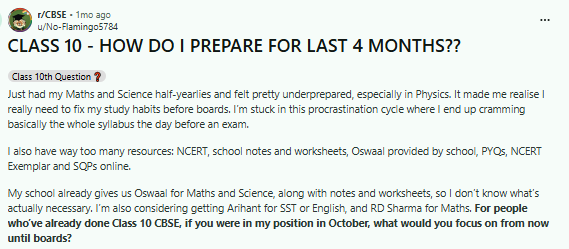
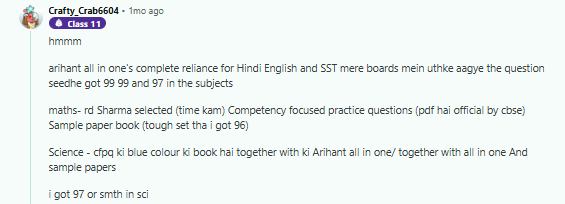
Students on Reddit share the following tips for effective CBSE Class 10 board exams preparation:
- Rely on Arihant 'All in One' for Languages & SST: Use Arihant's All in One for Hindi, English, and Social Science, as direct questions often appear from it in the board exams.
- Solve Official Competency Questions for Maths & Science: Focus on CBSE’s official Competency-Focused Practice Questions (CFPQ) PDFs/books alongside standard reference material.
- Be Selective with Heavy Reference Books: Due to limited time, solve selected questions from RD Sharma for Maths rather than trying to complete the entire book, and practice sample paper sets for final test prep.
Source: Reddit
CBSE Class 10 Sample Papers 2027: Download PDF
| Subject | Sample Question Paper |
|---|---|
| Science | Download PDF |
| English (Language & Literature) | Download PDF |
| English (Communicative) | Download PDF |
| Hindi A | Download PDF |
| Hindi B | Download PDF |
| Mathematics (Basic) | Download PDF |
| Mathematics (Standard) | Download PDF |
| Social Science | Download PDF |
Daily Study Timetable for CBSE Class 10 2027
The following timetable balances 3.5–4 hours of daily self-study on weekdays with longer revision sessions and mock tests on weekends. It covers all major subjects, practical assignments and exam-oriented practice.
| Time | Activity | Study Focus |
|---|---|---|
| 03:00 PM – 04:00 PM | Break & Refreshment | — |
| 04:00 PM – 05:30 PM | Study Block 1: Maths & Science | Practise numerical problems, formulas, NCERT exercises and scientific concepts. |
| 05:30 PM – 06:00 PM | Short Break | Outdoor activity, walking or snacks. |
| 06:00 PM – 07:30 PM | Study Block 2: SST & Biology | Revise NCERT chapters, practise descriptive answers, important keywords and diagrams. |
| 07:30 PM – 07:45 PM | Short Break | Stretch, relax or have refreshments. |
| 07:45 PM – 08:30 PM | Study Block 3: English & Hindi | Practise grammar, unseen passages, writing formats and literature questions. |
| 08:30 PM – 09:30 PM | Dinner & Family Time | Relax and spend time with family. |
| 09:30 PM – 10:00 PM | Daily Revision & Planning | Review mistakes, revise key concepts and plan the next day's topics. |
| 10:00 PM onwards | Sleep | Maintain a consistent sleep schedule of 7–8 hours. |
CBSE Class 10 Mathematics: NCERT Solutions
| Check out the Detailed NCERT solutions for CBSE Class 10 Mathematics |
|---|
Answer Writing Tips to Score More in CBSE Class 10 Boards
- Read the whole paper in the reading time and mark the questions you are sure about. Start with them to build confidence.
- Match the length of your answer to the marks. A 2-mark question needs two clear points, not half a page.
- Underline keywords, definitions, and formulas so the examiner can find them quickly.
- Write the question number correctly and attempt every question. There is no negative marking, so a blank answer can never earn marks.
- Keep the last 15 minutes for revision, and use them to check calculations, units, and missed sub-parts.
- Keep your handwriting legible and your presentation neat.
CBSE Class 10 Preparation 2027: Revision Strategy for the Last 30 Days
- Revise from your own short notes, formula sheets, and mistake log, not from full textbooks.
- Use active recall. Close the book and write what you remember, then check what you missed.
- Spend 60 percent of your time on weak chapters and 40 percent on strong ones, so that strong chapters do not fade.
- Revise one subject each day in the final week before that subject's paper, with a quick look at the others.
- Do not start a new topic in the last few days. Strengthen what you already know.
Daily Routine and Health Tips During Board Preparation
- Sleep for 7 to 8 hours. Your memory and focus depend on it, and late-night study before a paper usually backfires.
- Take a 5- to 10-minute break after every 45 to 50 minutes of study.
- Keep one hour a day for exercise, a walk, or a hobby.
- Limit your phone use and social media during study hours.
- Eat regular meals and drink enough water, especially in February and March.
- Talk to your parents, teachers, or friends when you feel stressed, instead of carrying it alone.
Also Check:
CBSE Class 10 Science: NCERT Solutions
Common Mistakes Class 10 Students Should Avoid
| Mistake | Why it hurts | What to do instead |
|---|---|---|
| Studying only the subjects you like | Weak subjects drag down your total | Give weak subjects the best part of your day |
| Memorising without understanding | Competency-based questions test application | Understand the concept, then practise varied questions |
| Skipping the marking scheme | You miss how marks are actually awarded | Compare every answer with the official marking scheme |
| Not solving timed papers | You run out of time in the exam hall | Practise full papers under exam conditions |
| Leaving revision for the last week | Content gets forgotten and stress rises | Revise in cycles from December onwards |
| Ignoring internal assessment | You lose easy marks | Complete projects and files on time |
CBSE Class 10 Previous Year Question Papers
How to complete the CBSE Class 10 syllabus on time
Count the chapters left in each subject and divide them by the weeks you have until the end of November.
- Set a weekly chapter target and tick it off every Sunday. Finish all pending chapters by the end of November, so that December and January are fully free for revision and practice.
- If a chapter is difficult, ask your teacher for help in the same week instead of postponing it.
How to reduce stress before CBSE Class 10 boards
Break your syllabus into small weekly targets so that the workload feels manageable. Keep time for sleep, a short walk, and meals at fixed times. If you feel overwhelmed, talk to a parent, teacher, or friend early instead of waiting until exam week.
CBSE Class 10 Preparation 2027: Frequently Asked Questions
Ques. How can I start preparing for the CBSE Class 10 board exam 2027?
Ans. Begin with the 2026-27 syllabus and list the chapters you have not finished. Fix a daily study schedule, clear pending doubts, and solve NCERT exercises first. After that, move to the official sample papers and marking schemes. This order builds concepts before you test them.
Ques. How many hours should a Class 10 student study per day?
Ans. Most students do well with 4 to 6 focused hours on school days and a little more on weekends. The quality of study matters more than the number of hours. Short breaks, regular sleep, and a fixed schedule will help you stay consistent.
Ques. Are NCERT books enough for the CBSE Class 10 board exam?
Ans. NCERT is the main base for all subjects, and you should finish it completely, including examples and in-text questions. For extra practice, you can add the official CBSE sample papers and competency-based question practice. Additional books are useful only after you are confident with NCERT.
Ques. Is Phase 2 compulsory for CBSE Class 10 students in 2027?
Ans. No. Phase 1 is compulsory, and Phase 2 in May is optional for students who want to improve their performance. Check the official CBSE circular for the exact rules about the subjects you can choose and how the final marks are shown.
Ques. When will the CBSE Class 10 date sheet 2027 be released?
Ans. As of 4 November 2026, CBSE has not released the Class 10 date sheet. Reports expect it in the coming weeks, with Phase 1 papers starting in February 2027. Keep checking the official CBSE website for the confirmed schedule.



Comments