



Education Content Expert
Abdominal Muscles are a set of strong bands of muscles that make up the walls of the abdomen. These muscles are located in the front of the human body, between the ribs and the pelvis.
- Abdomen is a region between the thorax and pelvis in all vertebrates.
- It is the front part of the abdominal segment of the trunk.
- Abdominal space is the space that contains the abdomen and is the region that the liver occupies.
- Abdomen is commonly referred to as the stomach, tummy, or midriff.
Abdominal Muscles hold the organs in place, allow movement, and are extensible. Together with the intrinsic back muscles, the deep abdominal muscles make up the core muscles, which support and stabilize the body and protect the spine.
Key Terms: Abdominal Muscles, Ribs, Trunk, Pelvis, Thorax, Rectus Abdominis, External Obliques, Abdomen
What are Abdominal Muscles?
[Click Here for Sample Questions]
Abdomen is the area between the pelvis and the thorax in all vertebrates, including humans. The abdominal cavity is the area in which the abdomen is located. The liver is located within the abdominal cavity.
- Abdominal muscles are the muscles that form the abdominal walls.
- They are located between the ribs and the pelvis in the front of the trunk of the body.
- They support the trunk and hold organs in place by regulating internal abdominal pressure.
- Abdominal wall is made up of skin, fascia, and muscle and encases the abdominal cavity and viscera.
There are five main abdominal muscles in the human body:
- External Obliques
- Internal Obliques
- Pyramidalis
- Rectus Abdominis
- Transversus Abdominis
![What are Abdominal Muscles]()
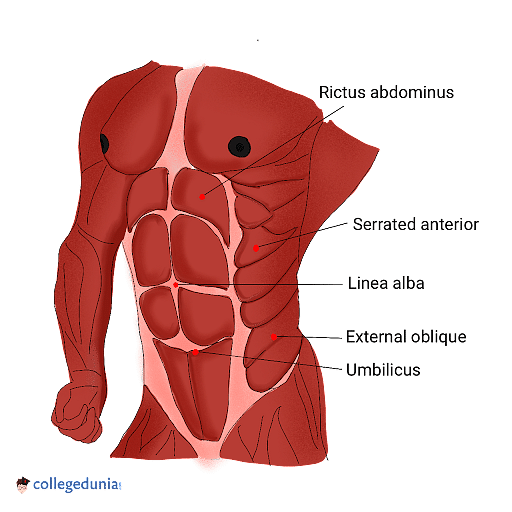
Abdominal Muscles Anatomy
Read More:
| Relevant Concepts | ||
|---|---|---|
| Pelvic Bones | Thoracic Cavity | Pelvic Girdle Bones |
| Muscular Tissue | Pectoralis Muscle | Deltoid Muscle |
Types of Abdominal Muscles
[Click Here for Sample Questions]
The four basic types of abdominal muscles that work together to cover all the internal organs in the abdomen are as follows:
Rectus Abdominis
- Rectus Abdominis is made up of three tendinous junctions that span over the muscle.
- It is a long, flat muscle located between the pubis and the fifth, sixth, and seventh ribs.
- In a healthy state, the rectus abdominis is enclosed by a lateral abdominal wall made up of three muscles.
- Beginning at the pubis bone, the rectus abdominis muscles run the sides of the linea alba before joining the lower ribs.
- It helps in the flexion of the spinal column by constricting the gap between the pelvis and the ribs.
- These muscles are engaged when the body bends to the side.
- They also support the stabilization of the trunk during movements involving the head and the extremities.
Transverse Abdominis
- Transversus abdominis is the name of the lowest layer of the abdominal muscles.
- The internal oblique and transverse fascia are typically located between the flat, triangular-shaped transverse abdominal muscles and their horizontal fibers.
- Transverse abdominal muscle wraps around the torso from front to back, then from the ribs to the pelvis.
- They help in respiration and breathing but don’t help with the movement of the spine or pelvis.
- These muscles are known to help with internal organ compression, a strong exhalation of air from the lungs, and spin stability.
- Additionally, it supports the abdominal wall and aids in compressing the abdomen.
![Types of Abdominal Muscles]()
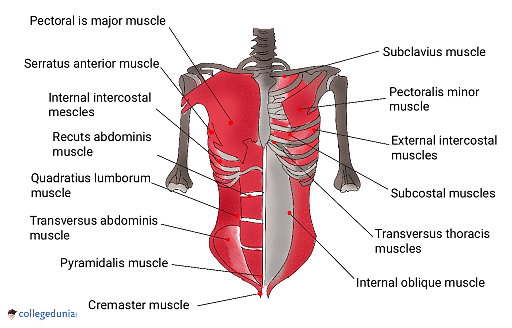
Types of Abdominal Muscles
External Oblique
- External oblique muscles are the muscles on either side of the rectus abdominis.
- The letter V is formed by the external obliques' muscle fibers running diagonally downward and inward from the lower ribs to the pelvic region.
- The rectus abdominis has external oblique muscles on both sides.
- External obliques typically begin between the fifth and twelfth ribs, inserting into the iliac crest after that.
- The primary role of the external oblique muscle is to enable spinal flexion, torso rotation, sideways bending, and abdominal compression.
Internal Oblique
- There is a pair of deep muscles just under the external oblique muscles.
- The muscles of the internal and external obliques are at a right angle to one another.
- The inguinal ligament to the iliac crest, the lower back, and the lowest three ribs are connected through the internal obliques to the linea alba.
- Lower muscle fibers in the internal obliques extend nearly horizontally.
- Due to their position at a right angle, the internal and external obliques are referred to as opposite-side rotators.
- In contrast to the internal oblique on the left, the external oblique on the left causes the trunk and spine to rotate to the left.
Functions of Abdominal Muscles
[Click Here for Sample Questions]
Some of the primary functions of the abdominal muscle are mentioned below:
- Abdominal Muscles help with basic body processes like peeing, feces, coughing, sneezing, and vomiting.
- They also help in the birth of a child by raising intraabdominal pressure.
- These muscles keep the internal organs such as the stomach, intestines, pancreas, liver, and gallbladder in position and protect them.
- They consistently maintain internal pressure in the abdomen.
- Abdominal muscles keep the posture upright and support our core.
- They support our spine and body when sitting, standing, leaning over, twisting, exercising, or singing.
Effective Abdominal Workouts
[Click Here for Sample Questions]
Knowing the basic and essential exercises for the abdominal muscles is crucial after gaining a basic understanding of them to keep them healthy and functioning properly. Here are a few effective workouts for the proper functioning of abdominal muscles:
- Instead of only doing regular crunches, include workouts that will aid in strengthening the core ab muscles.
- Pilates is one of the best exercises for the abdominal muscles.
- Dancers typically use pilates to treat serious physical issues and recover from injuries.
- Exercise balls can be utilized in a variety of ways, including strengthening the torso and boosting stability and balance.
- Once can also perform isometric exercises like the plank and the bird dog as they concentrate on limiting trunk movement.
- The abdominal crunch can aid in enhancing the stability of the abdominal muscles.
Check More:
Muscle Action
[Click Here for Sample Questions]
Abdominal muscles have different muscle fiber orientations that typically work in three planes when moving. These are connected either by a common connecting point or by laying fascia. The other muscle will also contract when the first one does.
- Our bodies are primarily made to move, and the muscles play a major role in assisting us in accomplishing this.
- To manage the movement of the spine, pelvis, and rib cage, the muscles in our bodies typically cooperate.
- During the gait cycle, there is a counterrotation between the upper and lower parts, and the arm and the leg are moving in the opposite direction from one another.
- When walking normally, one side's external obliques and rectus abdominis work eccentrically to slow the anterior pelvic tilting brought on by that side's hip extension.
- The opposite side's rectus abdominis and external obliques work eccentrically to control the thoracic extension and rotation brought on by that side's shoulder extension.
Things to Remember
- Abdominal muscles are fibrous around the rectus abdominis, which rises from the pubis to the ribs.
- In addition to supporting the viscera in a tonic, elastic manner, abdominal muscles also pull the rib cage downward during expiration due to their ability to recoil.
- Abdominal muscles tighten in response to blows to create a solid wall of defense for the viscera.
- Abdominal muscles participate in the expulsive actions of urine, defecation, birthing, vomiting, singing, and coughing while the glottis is closed and the thorax and pelvis are fixed.
- The abdominal muscles can lift the pelvis and lower limbs when the thorax is fixed.
Sample Questions
Ques. What are the Functions of the Abdomen? (3 Marks)
Ans. The abdomen's primary tasks include movement, breathing, digestion, posture, and equilibrium. All of the major abdominal organs make up the digestive system. The abdomen is strongly reliant on the accessory muscles of respiration for breathing. These muscles support a variety of bodily functions, including breathing, coordinating, coughing, urinating, sobbing, humming, defecating, and reproduction. In addition to supporting movement and posture, the abdomen also aids in breathing.
Ques. How are the Oblique Crunches Helpful? (3 Marks)
Ans. Oblique crunches will be very beneficial in enhancing general core strength and in toning the body's abdominal muscles. The oblique crunches also help to keep the right form. You can make the oblique crunch workout harder by synchronizing your abdominal breathing with the exercise, increasing the number of repetitions, or lifting the legs off the floor. Oblique crunches have a reputation for enhancing lateral stability and boosting core strength, both of which can help prevent back injuries.
Ques. How do abdominal muscles affect the body? (2 Marks)
Ans. By controlling internal abdominal pressure, the abdominal muscles support the trunk, provide movement, and retain organs in place. Your "core" muscles, which include the deep abdominal muscles and the back muscles, support and stabilize your spine and assist maintain your body steady and balanced.
Ques. Which abdominal muscle is the most important? (2 Marks)
Ans. Rectus abdominis, From your ribs to the front of your pelvis, this pair of muscles runs through the middle of your abdomen. The muscles stabilize your body while you move and hold your internal organs in place.
Ques. How many layers of abdominal muscle are there? (2 Marks)
Ans. Skin, subcutaneous tissue, superficial fascia, external oblique muscle, internal oblique muscle, transversus abdominis muscle, transversalis fascia, preperitoneal adipose and areolar tissue, and peritoneum make up the nine layers of the abdominal wall. There are nerves, blood arteries, and lymphatics everywhere.
Ques. What muscles compress the abdomen? (2 Marks)
Ans. The rectus abdominis muscles are a pair of long muscles that extend from the pubis to the xiphoid process, running vertically up the front of the abdomen. They tighten the abdominal wall and compress the viscera. The muscles stabilize your body while you move and hold your internal organs in place.
Ques. What nerves control abdominal muscles? (2 Marks)
Ans. The iliohypogastric, lateral cutaneous, subcostal, thoracoabdominal, and ilioinguinal nerves are important nerves to the anterolateral abdominal wall. The inferior intercostal nerves are formed from the thoracoabdominal nerves, which originate from T7 to T11. These nerves follow the transversalis and internal obliques muscles.
Ques. Which abdominal muscle plays a major role in forced exhalation? (2 Marks)
Ans. The rectus abdominis plays a crucial role in posture. The contraction causes the lumbar spine to flex when the pelvis is stationary. A posterior pelvic tilt occurs during a contraction when the ribcage is fixed. Additionally, it is crucial for causing forced expiration and raising intra-abdominal pressure.
Ques. How do the abdominal muscles aid in respiration? (2 Marks)
Ans. The diaphragm relaxes and the abdominal muscles tighten during expiration, flattening the abdomen. As a result, the pressure inside the abdomen rises, pushing firmly against the diaphragm to help with expiration. As a result, the thorax's pressure rises and the breath is exhaled.
Ques. What are the types of Abdominal Muscles? (2 Marks)
Ans. The main types of abdominal muscles are as follows:
- External Obliques
- Internal Obliques
- Pyramidalis
- Rectus Abdominis
- Transversus Abdominis
Check-Out:



Comments