


An electric dipole of dipole moment p is lying along uniform electric field E. Calculate the work done in rotating the dipole by 90 degrees.

Jasmine Grover logo

Jasmine Grover

Education Journalist | Study Abroad Lead

Ques: An electric dipole of dipole moment p is lying along uniform electric field E. Calculate the work done in rotating the dipole by 90 degrees.

Ans: The work done in rotating the dipole by 90 degrees when dipole moment is lying along uniform electric field is “pE”. 

Explanation: The potential energy of an electric dipole in a uniform electric field is given by an expression: U = -pEcosθ.

Initially, the dipole moment is aligned with the electric field, so θ = 0, and the potential energy is:

U1 = -pEcos0 = -pE

When the dipole is rotated by 90 degrees, the angle between the dipole moment and the electric field becomes θ = 90 degrees, and the potential energy becomes:

U2 = -pEcos90 = 0

The change in potential energy is then equal to the work done

Work Done = ΔU = U2 - U1 = 0 - (-pE) = pE
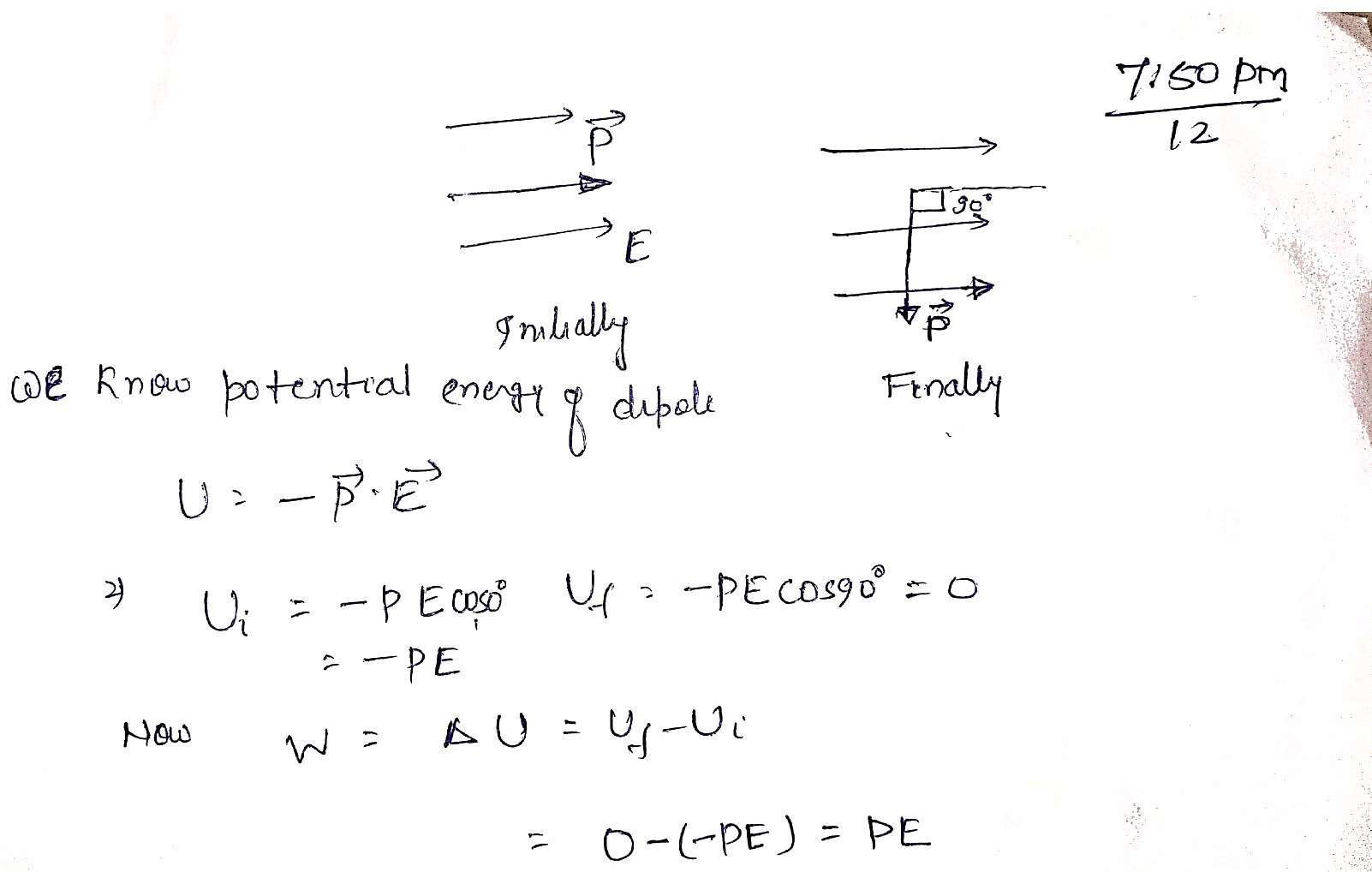
electric dipole of dipole moment p is lying along uniform electric field E

Therefore, the potential energy of the dipole in rotating it by 90 degrees is pE.

CBSE CLASS XII Related Questions

  • 1.
    Two small identical metallic balls having charges \( q \) and \( -2q \) are kept far at a separation \( r \). They are brought in contact and then separated at distance \( \frac{r}{2} \). Compared to the initial force \( F \), they will now:

      • attract with a force \( \frac{F}{2} \)
      • repel with a force \( \frac{F}{2} \)
      • repel with a force \( F \)
      • attract with a force \( F \)

    • 2.
      If both the number of protons and the neutrons are conserved in each nuclear reaction, in what way is mass converted into energy (or vice versa) in a nuclear reaction? Explain.


        • 3.
          A long solenoid of length \( L \) and radius \( r_1 \) having \( N_1 \) turns is surrounded symmetrically by a coil of radius \( r_2 \, (r_2>r_1) \) having \( N_2 \) turns (\( N_2 \ll N_1 \)) around its mid-point. Derive an expression for the mutual inductance of solenoid and coil. Is \( M_{12} = M_{21} \) valid in this case?


            • 4.
              Draw the number of scattered particles versus the scattering angle graph for scattering of alpha particles by a thin foil. Write two important conclusions that can be drawn from this plot.


                • 5.
                  Assertion (A) : All atoms have a net magnetic moment. Reason (R) : A current loop does not always behave as a magnetic dipole.

                    • Both Assertion (A) and Reason (R) are true and Reason (R) is the correct explanation of the Assertion (A).
                    • Both Assertion (A) and Reason (R) are true, but Reason (R) is not the correct explanation of the Assertion (A).
                    • Assertion (A) is true, but Reason (R) is false.
                    • Both Assertion (A) and Reason (R) are false.

                  • 6.
                    What is displacement current (\( i_d \))? Considering the case of charging of a capacitor, show that \( i_d = \varepsilon_0 \frac{d\Phi_E}{dt} \). What is the value of \( i_d \) for a conductor across which a constant voltage is applied?

                      CBSE CLASS XII Previous Year Papers

                      Comments


                      No Comments To Show
