


When an electric dipole is placed in a non uniform electric field what does the dipole experience?

Collegedunia Team logo

Collegedunia Team

Content Curator

When an electric dipole is placed in a non-uniform electric field, it experiences a net force and a net torque.

  • The electric field exerts a force on the charges of the dipole, with the positive charge experiencing a force in the direction of the electric field. 
  • The negative charge experiencing a force in the opposite direction. As a result, the dipole experiences a net force that tends to align it with the direction of the electric field.
  • At the same time, the non-uniform electric field produces a torque on the dipole, causing it to rotate.
  • The torque is given by the cross product of the dipole moment vector and the electric field vector.
  • The magnitude of the torque is maximum when the dipole is oriented perpendicular to the electric field, and zero when the dipole is aligned parallel to the electric field.

The net effect of the force and torque is to cause the dipole to rotate and align with the direction of the electric field. This process is known as dielectric polarization, and is important in many applications, such as in the functioning of capacitors, where it helps to store electrical energy.
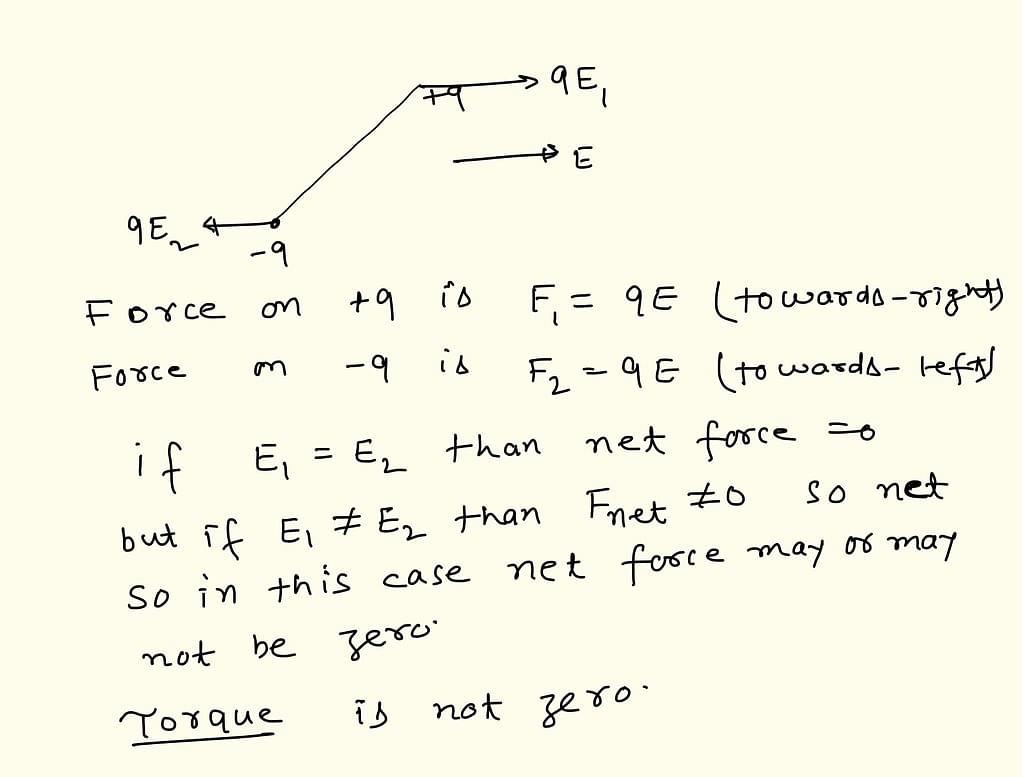
Electric Dipole in Non-uniform Electric Field

Electric Dipole in Non-uniform Electric Field

Check out:

CBSE CLASS XII Related Questions

  • 1.
    The figure shows three point charges kept at the vertices of triangle ABC. The net electric field, due to this system of charges, at the midpoint M of base BC will be:

      • \( \frac{q}{4 \pi \epsilon_0 l^2} \) pointing along MA
      • \( \frac{q}{\pi \epsilon_0 l^2} \) pointing along AM
      • \( \frac{q}{2 \pi \epsilon_0 l^2} \) pointing along AM
      • Zero

    • 2.
      What is displacement current (\( i_d \))? Considering the case of charging of a capacitor, show that \( i_d = \varepsilon_0 \frac{d\Phi_E}{dt} \). What is the value of \( i_d \) for a conductor across which a constant voltage is applied?


        • 3.
          Write any two features of nuclear forces.


            • 4.
              Draw a circuit diagram of a full-wave rectifier using p-n junction diodes. Explain its working and show the input-output waveforms.


                • 5.
                  If Bohr’s quantization postulate (angular momentum \( = \frac{nh}{2\pi} \)) is a basic law of nature, it should be equally valid for the case of planetary motion also. Why, then, do we never speak of quantization of orbits of planets around the Sun? Explain.


                    • 6.
                      A tank is filled with a liquid to a height of \( 12.5 \, \text{m} \). The apparent depth of a needle lying at the bottom of the tank is measured to be \( 9.0 \, \text{m} \). Calculate the speed of light in the liquid.

                        CBSE CLASS XII Previous Year Papers

                        Comments


                        No Comments To Show
