


An electric dipole of dipole moment vec p is placed in a uniform electric field vec E. Find the maximum torque experienced by the dipole.

Collegedunia Team logo

Collegedunia Team

Content Curator

When an electric dipole of dipole moment vector p is placed in a uniform electric field vector E, it experiences a torque given by the formula:

τ = p × E

where τ is the torque vector, p is the dipole moment vector, and E is the electric field vector.

The magnitude of the torque is given by:

|τ| = p E sin θ

where θ is the angle between the dipole moment vector and the electric field vector.

The maximum torque occurs when the dipole moment vector is perpendicular to the electric field vector, i.e., when θ = 90 degrees. In this case, sin θ = 1, and the magnitude of the torque is:

|τ|max = p E

Therefore, the maximum torque experienced by the dipole is equal to the product of the dipole moment and the electric field strength.
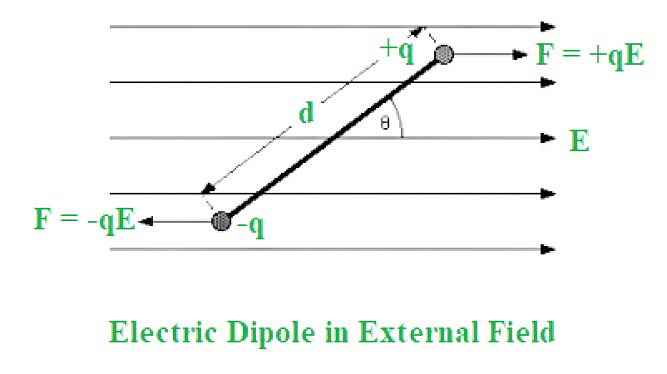
Electric Dipole in External Field

Electric Dipole in External Field

Also check:

CBSE CLASS XII Related Questions

  • 1.
    Draw the number of scattered particles versus the scattering angle graph for scattering of alpha particles by a thin foil. Write two important conclusions that can be drawn from this plot.


      • 2.
        Assertion (A) : All atoms have a net magnetic moment. Reason (R) : A current loop does not always behave as a magnetic dipole.

          • Both Assertion (A) and Reason (R) are true and Reason (R) is the correct explanation of the Assertion (A).
          • Both Assertion (A) and Reason (R) are true, but Reason (R) is not the correct explanation of the Assertion (A).
          • Assertion (A) is true, but Reason (R) is false.
          • Both Assertion (A) and Reason (R) are false.

        • 3.
          The figure shows three point charges kept at the vertices of triangle ABC. The net electric field, due to this system of charges, at the midpoint M of base BC will be:

            • \( \frac{q}{4 \pi \epsilon_0 l^2} \) pointing along MA
            • \( \frac{q}{\pi \epsilon_0 l^2} \) pointing along AM
            • \( \frac{q}{2 \pi \epsilon_0 l^2} \) pointing along AM
            • Zero

          • 4.
            Write the expression for the magnetic field due to a current element in vector form. Consider a 1 cm segment of a wire, centered at the origin, carrying a current of 10 A in positive x-direction. Calculate the magnetic field \( \mathbf{B} \) at a point \( (1 \, \text{m}, 1 \, \text{m}, 0) \).


              • 5.
                Four independent waves are expressed as \[ (i)\; y_1=A_1\sin\omega t, \] \[ (ii)\; y_2=A_2\sin 2\omega t, \] \[ (iii)\; y_3=A_3\cos\omega t, \] \[ (iv)\; y_4=A_4\sin\left(\omega t+\frac{\pi}{3}\right) \] The interference between two of these waves is possible in

                  • (i) and (iii) only
                  • (iii) and (iv) only
                  • (i), (iii) and (iv) only
                  • All of them

                • 6.
                  Write any two features of nuclear forces.

                    CBSE CLASS XII Previous Year Papers

                    Comments


                    No Comments To Show
