


An electric dipole of dipole moment vec p is placed in a uniform electric field vec E. Find the maximum torque experienced by the dipole.

Collegedunia Team logo

Collegedunia Team

Content Curator

When an electric dipole of dipole moment vector p is placed in a uniform electric field vector E, it experiences a torque given by the formula:

τ = p × E

where τ is the torque vector, p is the dipole moment vector, and E is the electric field vector.

The magnitude of the torque is given by:

|τ| = p E sin θ

where θ is the angle between the dipole moment vector and the electric field vector.

The maximum torque occurs when the dipole moment vector is perpendicular to the electric field vector, i.e., when θ = 90 degrees. In this case, sin θ = 1, and the magnitude of the torque is:

|τ|max = p E

Therefore, the maximum torque experienced by the dipole is equal to the product of the dipole moment and the electric field strength.
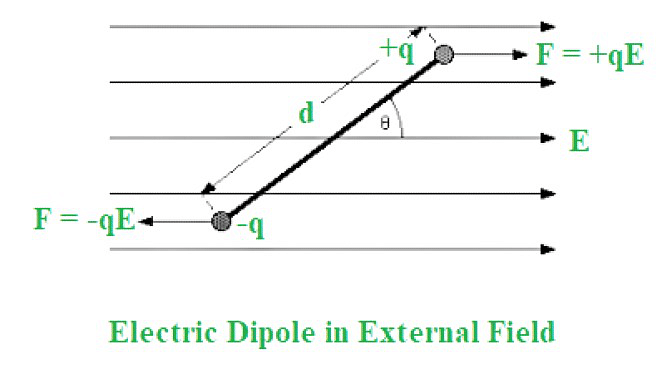
Electric Dipole in External Field

Electric Dipole in External Field

Also check:

CBSE CLASS XII Related Questions

  • 1.

    A rectangular loop of size 5 cm $\times$ 8 cm is lying in the $x$-$y$ plane in a uniform magnetic field $\vec{B} = (2.0\ \text{T})\hat{k}$. The total magnetic flux linked with the loop is:

      • 80 Wb
      • 16 Wb
      • \(8 \times 10^{-2}\) Wb
      • \(8 \times 10^{-3}\) Wb

    • 2.

      Find the ratio $\dfrac{\lambda_\alpha}{\lambda_p}$ of the de Broglie wavelength $\lambda_\alpha$ associated with an alpha particle to the de Broglie wavelength $\lambda_p$ associated with a proton if both are moving with the same velocity.


        • 3.
          A galvanometer of resistance $27 \Omega$ is converted into an ammeter of range (0 – 10 mA) using a resistance of $3 \Omega$. The galvanometer will show full scale deflection for a current of about –

            • 10 mA
            • 100 mA
            • 1 mA
            • 3 mA

          • 4.

            An electron is revolving around a proton in a circular orbit of radius $r$. Using classical physics, prove that the ratio of value of the angular momentum and the value of magnetic moment of electron revolving in the orbit is a constant.


              • 5.
                Two point charges -Q and Q are located at points (d, 0) and (0, d) respectively, in x-y plane. The electric field E at the origin will be:

                  • \(\frac{1}{4\pi\epsilon_0} \frac{\sqrt{2}Q}{d^2} (\hat{i} - \hat{j})\)
                  • \(\frac{1}{4\pi\epsilon_0} \frac{\sqrt{2}Q}{d^2} (-\hat{i} - \hat{j})\)
                  • \(\frac{1}{4\pi\epsilon_0} \frac{Q}{d^2} (\hat{i} - \hat{j})\)
                  • \(\frac{1}{4\pi\epsilon_0} \frac{Q}{d^2} (-\hat{i} - \hat{j})\)

                • 6.
                  An electric field \( \vec{E} = E_0 \hat{i} \) exists in a region of space. Draw three equipotential surfaces in the region.

                    CBSE CLASS XII Previous Year Papers

                    Comments


                    No Comments To Show
