



Content Curator
Ants are eusocial insects of the Formicidae family that belong to the order Hymenoptera, together with wasps and bees.
- In the Cretaceous period, ants evolved from vespoid wasp ancestors.
- Over 13,800 of the estimated 22,000 species have been classified.
- Their geniculate (elbowed) antennae and the characteristic node-like structure that forms their slender waists help to identify them.
- The average ant is around one-millionth the size of a human, but despite their diminutive size, they are extremely complex.
- From egg to adult, these tiny creatures go through a lot of changes in their lifespan.
| Table of Content |
Key Terms: Ants, Arthropoda, Hymenoptera, Life cycle, Formicidae, Reproduction, Mammals, Larva, Pupa, Dissemination
Ant Life Overview
[Click Here for Sample Questions]
Ants are social insects that belong to the order Hymenoptera and the class Arthropoda.
- They come from the world's largest and most ancient insect colony.
- An average ant colony can include up to 20 million individuals, with over 10,000 species.
- Formicidae is the scientific name of ants.
- During the summer, the ants can be found in tropical forests with the rest of the insect community.
- Ants are classified into three types: queens, workers, and males.
- An ant's life cycle can last anywhere from weeks to months, depending on the surroundings.
- Ants live in highly developed and well-organized societies.
- They live in colonies that have well-defined hierarchical systems.
- These insects are a good example of how complex nature can be, and how even the tiniest creatures follow rigid laws.
- For the sake of their queen's and colony's survival, they are tremendously reliant on one another.
Also check:
| Related Concepts | ||
|---|---|---|
| Reproductive Health | Termite Life Cycle | Tissues |
| Vermiculture | Invertebrates | Reproduction in Animals |
Reproduction in Ants
[Click Here for Sample Questions]
Ants are insects which belong to the social system in which the queen and worker ants share tasks.
- Worker ants look for food, brood, and maintain the nest, while queen ants are in charge of reproduction and dissemination.
- When it comes to ant reproduction, it's not the same as when it comes to mammal reproduction.
- Ants, unlike other insects, are unable to reproduce.
- The queen ant is the only female ant that can reproduce; the rest of the female ants are sterile.
- Drone ants are fertile male ants who are able to breed with the queen ant.
Ant Life Cycle
[Click Here for Sample Questions]
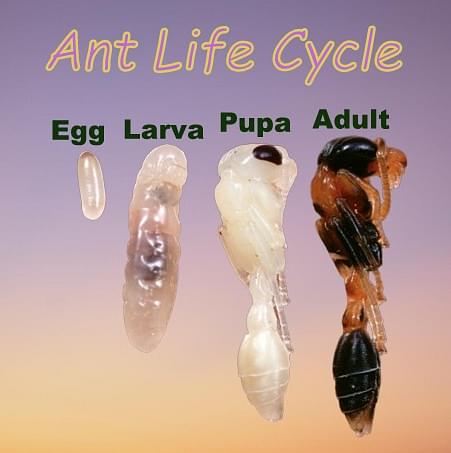
During their lifetime, ants go through a number of physical changes. In the course of its life cycle, an ant goes through a full metamorphosis, which means it has four stages: egg, larva, pupa, and adult.
The following are the stages:
Stage 1: Egg Stage
The female ant lays both fertile and unfertilized eggs after mating.
- Female ants emerge from fertilised eggs, while male ants emerge from unfertilized eggs.
- Ant eggs are very small, oval-shaped, translucent, and white.
- In 7 to 14 days, the eggs hatch.
Stage 2: Larvae Stage
The small eggs hatch into larvae that lack eyes and legs.
- The larvae next go through a number of moulting stages, during which hair begins to grow.
- Because worker ants lack eyes and legs at this stage, their hair is formed like a hook, allowing them to hold larvae ants.
- The larvae moult several times during this stage and feed mostly on adult worker ants.
Stage 3: Pupa Stage
Several moults are required for the ant larvae to reach the pupa stage.
- Physical characteristics including eyes, legs, and wings may begin to emerge.
- The ant's antennae and legs are folded against its body at the pupa stage.
Stage 4 - Adult Stage
After 6 to 10 weeks of development in the pupa stage, the adult ant emerges from the eggs.
- Since their exoskeleton stops ants from growing larger, when an adult hatches, it is fully grown and matured.
- The mature ant is soft and light-coloured at first, but after a few hours, the external part of the ant becomes darker and harder.
- Although ants are recognised for their small size, it's worth noting that they have the ability to lift 20 times their own weight.
- Unlike other insects that die within a few weeks or months, the queen of the Pogonomyrmex Owyhee ant can live for up to 30 years.
- Ants are also known for their cooperation, as a single ant colony can contain up to 360 million ants.
Also check:
| Other Concepts | ||
|---|---|---|
| Difference Between Ligaments and Tendons | Animal Tissue Types | Haplontic Life Cycle |
| Bones | Human Body | Human Life Cycle |
Things to Remember
- Ants are social insects that belong to the order Hymenoptera and the class Arthropoda.
- Formicidae is the scientific name for ants.
- Ants are classified into three types: queens, workers, and males.
- Ant colonies exist in a wide range of sizes and shapes.
- An average ant colony has thousands of individuals.
- Ants are social insects with a social system in which the queen and worker ants share tasks.
- Ants "hear" by sensing vibrations in the ground rather than hearing through their auditory canals.
- Ants use special sensors on their feet and knees to understand signals from their environment.
Sample Questions
Ques. Is Ant a bird or animal? (1 Mark)
Ans. Ants are one of the most common animals on Earth.
Ques. Do ants have ears? (1 Mark)
Ans. Ants do not have ears, and some do not have eyes.
Ques. How long do ants live? (2 Marks)
Ans. The lifespan of ants varies depending on the type of species. Male worker ants die after mating, but female worker ants live for several months. If the environmental circumstances are favourable, the queen ant can survive for decades.
Ques. How can I know if it’s a queen ant or not? (2 Marks)
Ans. Worker ants are often larger than queen ants. Their thorax (middle portion) is substantially larger than the rest of the ant family. Looking for an ant with a larger thorax, or central region, than the rest of the ants is the easiest way to recognize a queen ant. The queen ant’s thorax will be more muscular and intricate, due to the fact that she is born with wings, which she utilises to depart the colony to mate.
Ques. What is the world's smallest ant? (2 Marks)
Ans. Carebara atoma is thought to be one of the smallest ant species on the planet. Minor workers have a length of around one millimetre. Thousands of colonies of the world's tiniest ant, Camponotus gigas, are claimed to be able to live peacefully inside the braincase of the world's largest ant, Camponotus gigas, whose head can measure seven millimetres in width.
Ques. What is the scientific name of an ant? (1 Mark)
Ans. Formicidae is the scientific name for ants.
Ques. Why do ants go into fights? (3 Marks)
Ans. Every ant's life objective is to make sure that its colony lives as long as possible and that its genes are passed down to future generations. To make this happen, they'll have to fight off any competitors who try to grab their supplies or space. Ants from different colonies, even within the same species, fight. Each colony has its distinct chemical odour, allowing all ants to distinguish between friends and foes. Some species and colonies can coexist, however there are a few exceptions. The Argentine ant has colonies that have united to form the world's largest colonies.
Ques. Is it true that all ants are female? (2 Marks)
Ans. Winged late male ants or drones only live for a few months during the mating season, or nuptial flight. This means that the majority of the ants you see during the rest of the year are female. Worker ants are all female, and their sisterhood is responsible for the colony’s smooth operation. The vast majority of eggs hatch into workers, but once the colony is established, the queen produces the next generation of reproductives, which will go on to establish their own colonies.
Ques. Is it true that ants have wings? (2 Marks)
Ans. Male ants and young queen ants fly to mate. After mating, the female ant sheds her wings and begins a new life. Both are reproductive ants that must mate and breed the next generation of ants in order for their colonies to survive. Because at least some individuals of practically every ant species can develop wings and fly, ants with wings can be a common sight at certain times of the year. Swarming ants, often known as winged ants, are ants that swarm in order to breed and reproduce.
Ques. Why do ants like sugar? (2 Marks)
Ans. In nature, ants are omnivores, consuming anything from leaves to fruits to plants. As sugar is an energy source for ants, they gather other ants and take it back to their nest, where it will be used by additional ants. Sugar is essentially an edible kind of energy, and ants are well aware of this, which is why they take advantage of whatever sugar supply they can.
For Latest Updates on Upcoming Board Exams, Click Here: https://t.me/class_10_12_board_updates
Also Read:



Comments