



Content Curator
Aqueous humor is a clear, colorless fluid that fills the anterior and posterior chambers of the eye. Aqueous humor maintains intraocular pressure, provides nutrition, and lubricates the ocular surface.
- Aqueous humor is also called aqueous fluid.
- Aqueous humor is mainly composed of water that is naturally medicated by cells to regulate ocular pressure.
- There should be proper drainage of Aqueous Humor or it may lead to severe complications.
It is made by the lacrimal gland in the eye, flowing continuously from the tear ducts of both eyes.
| Table of Content |
Key Terms: Ocular Pressure, Cornea, lens, Conjunctiva, Drainage, Cilia, Sinus, Tear Ducts
What is Aqueous Humor?
[Click Here for Sample Questions]
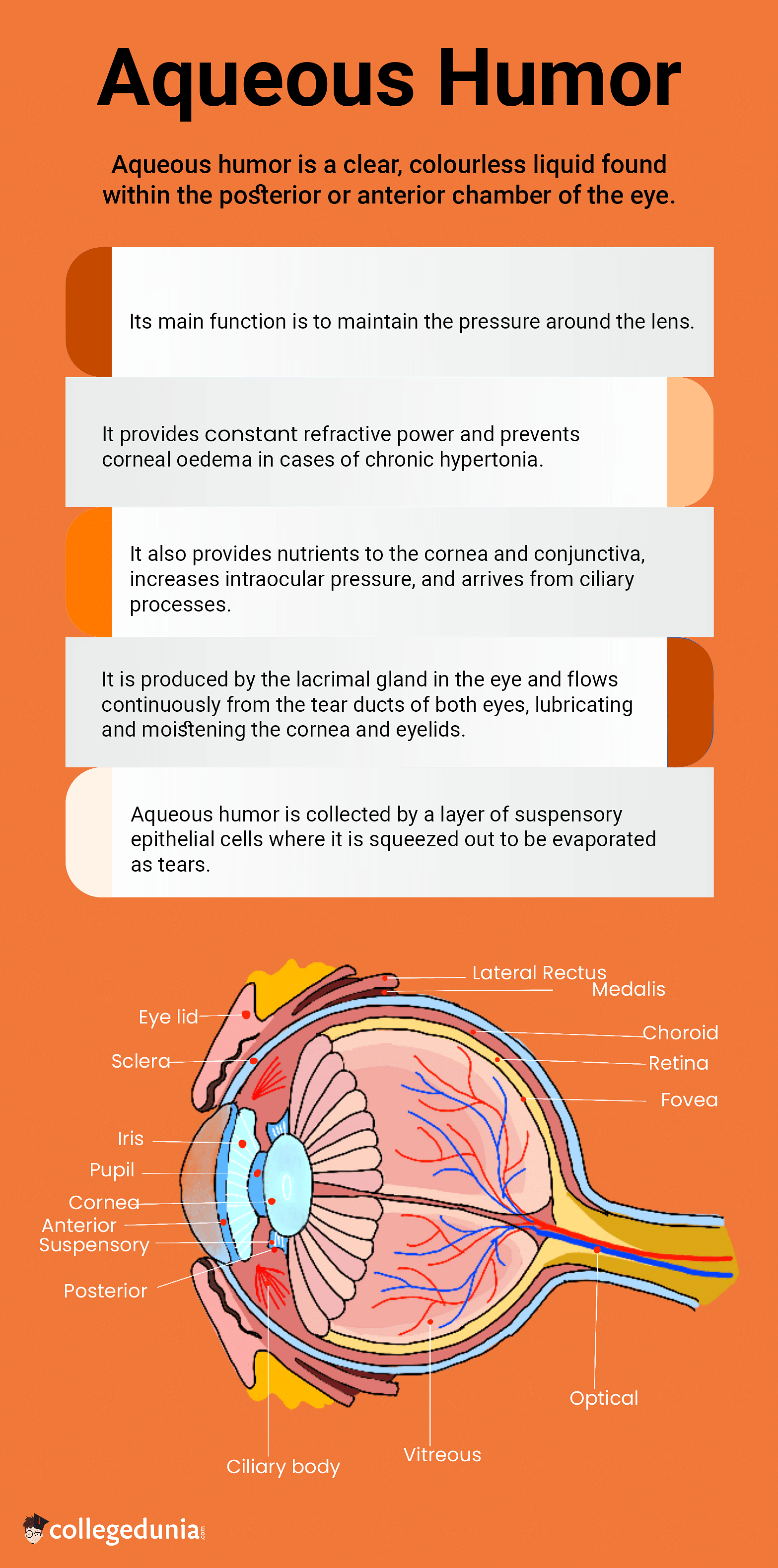
Aqueous humor is a clear, colourless liquid found within the posterior or anterior chamber of the eye.
- Its main function is to maintain the pressure around the lens.
- It provides constant refractive power and prevents corneal oedema in cases of chronic hypertonia.
- It also provides nutrients to the cornea and conjunctiva, increases intraocular pressure, and arrives from ciliary processes.
- It is produced by the lacrimal gland in the eye and flows continuously from the tear ducts of both eyes, lubricating and moistening the cornea and eyelids.
- Aqueous humor is collected by a layer of suspensory epithelial cells where it is squeezed out to be evaporated as tears.
Aqueous Humor
What is Humor?
The term Humor refers to any fluid or semifluid found in the body of a living organism, especially those located in the eyeball (it includes aqueous humor, and vitreous humor).
Also read:
Composition of the Aqueous Humor
[Click Here for Sample Questions]
Aqueous humor is the watery fluid that fills the anterior and posterior chambers of the eye.
- In humans, aqueous Humor is constantly drained from the eye into nearby venous sinuses to maintain ocular homeostasis.
- The aqueous humor is made up mostly of water (98.5%), with smaller proportions of nutrients such as glucose, sodium, potassium and other electrolytes.
- It is also composed of proteins such as albumin and various enzymes; urea; carbon dioxide
- Low molecular weight compounds also help its composition, such as hormones, fatty acids and other metabolites.
- Besides this, lactic acid, immunoglobulin G, ascorbic acid and glucose are also present. These make up the Aqueous Humor.
Aqueous Humor Function
[Click Here for Sample Questions]
Given below are the functions of Aqueous Humor:
- Aqueous Humor facilitates the passage of oxygen to erythrocytes in the capillaries of the choroid by preventing it from diffusing into other tissues that contain no red blood cells, such as orbital fat and ciliary muscle.
- Aqueous Humor also plays an important role in maintaining homeostasis by regulating intraocular pressure (IOP) and acting as a buffer for pH changes due to its high alkaline content.
- The aqueous Humor drains by way of posterior and anterior aqueous veins together with episcleral veins draining into the subfoveal plexus, which forms the central vein of the retina (CVF).
- Due to its physical properties, it is a good vehicle for drugs administered topically to the eye.
- Aqueous Humor also contributes to physiologic tears and the transport of molecules through tear film facilitating their absorption in the cornea and conjunctiva, respectively.
- Aqueous Humor is also used during glaucoma surgery to create an anterior chamber.
How is Aqueous Humor Produced?
[Click Here for Sample Questions]
Aqueous humor is produced by the ciliary body inside your eye and helps to maintain normal intraocular pressure. It also helps to keep oxygenated blood flowing properly, as well as to remove any waste products that are built up in the eye.
The ciliary body and iris both act as sphincters that control the Aqueous Humor. When the sphincter of the pupil constricts, it works in conjunction with the iris to regulate aqueous Humor flow and intraocular pressure. This process is called trabecular outflow.
- Trabecular outflow occurs when the pressure inside the eye (intraocular pressure) increases, such as during exercise or when you are reading a book for long periods.
- In this case, the muscles around your lens contract to force aqueous humor into Schlemm's canal and eventually into your bloodstream where your body will reabsorb it.
- When the pressure in your eye decreases, such as when you are lying down, the muscles around your lens relax and there is no longer enough pressure inside the eye to force aqueous Humor out of Schlemm's canal.
- So aqueous humor continues to be produced in the ciliary body and flows into the space behind Schlemm's canal (retina).
- Here, it will continue to build up over time and eventually be absorbed by your body, depending on how often you blink.
When you read for long periods or do not blink enough, aqueous humor may build up behind your lens instead of being absorbed into your bloodstream. Aqueous humor is generated every minute by the ciliary body, which produces 2.5L.
Aqueous humor is produced by three processes:
- Diffusion
- Ultrafiltration
- The secretion that is active
Diffusion and ultrafiltration are inert activities. The ciliary body's stroma gathers the ultrafiltrated plasma. Aqueous fluid is then regularly emitted from the ciliary body epithelium into the posterior aqueous humor chamber. Na+/K+-ATPases hydrolyze ATP in this active process.
Aqueous humor production is influenced by the sympathetic nervous system. In this way, beta-2 and alpha-2 adrenoceptor stimulation enhance and lowers aqueous humour generation.
Read Also: Blind spot in Eye
Drainage of Aqueous Humor
[Click Here for Sample Questions]
The drainage of Aqueous Humor is done via trabecular meshwork. These are tiny channels in between clusters of cells called trabeculae.
- As fluids pass through these meshworks, they exit from side channels or pores into adjacent spaces between cells where they eventually flow down vessels, leading to the blood sinuses or lacrimal sacs.
- The trabecular meshwork is involved in the aqueous humor drainage system.
- It is a set of delicate cell membranes and spaces that connects the chamber called the episcleral venous sinus with an opening called the canal of Schlemm.
- Aqueous humor travels through these meshworks on its way to the blood sinuses or receptacles.
- This type of drainage system, where cells are arranged in an irregular pattern, is called a non-fenestrated system because there are no pores (or fenestrae) connecting chambers from various directions.
- Aqueous humor flow occurs between cellular layers, which has been estimated at 0.8-1.2 μm/s and involves molecular diffusion.
Read More:
Complications of Aqueous Humor Drainage
[Click Here for Sample Questions]
While this seems like it would be an essential portion of human body systems, there is a risk of complications with aqueous humor drainage that can be quite problematic if allowed to continue unchecked.
- There are several fluids in the eye that can produce problems.
- The aqueous humor is produced in the central portion of the eye and travels out to the periphery where it evaporates, flushes, and drains away.
- This can be problematic in some cases where there is an obstruction within the drainage pathway such as advanced macular degeneration or glaucoma.
If not managed properly, this will result in irreversible damage to surrounding tissues and weaken support systems elsewhere within the body.
Chambers of Eye
[Click Here for Sample Questions]
The most important chambers of the eye are the anterior chamber, vitreous chamber, and posterior chamber
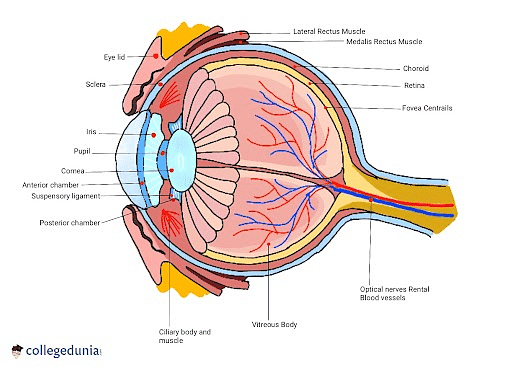
- Anterior Chamber: The anterior chamber is the space between the cornea and the iris, where blood vessels pass into the eye.
- Posterior Chamber: The posterior chamber of the eye is located exactly between the iris, zonule fibres and lens.
- Vitreous Chamber: The vitreous is a gelatinous, transparent substance found in both eyes but primarily in adults. It fills up most of the eyeball space and provides a smooth surface for light to enter when we look at things.
Things to Remember
- Aqueous humor is a clear gel-like fluid found in the space between the cornea and the lens of the eye. It is located between the aqueous humor of the anterior chamber (AC) and the crystalline lens.
- The fluid, which is made up of water, electrolytes, and protein, fills this space to maintain an even thickness for the cornea.
- Aqueous humor also helps to keep a constant volume for intraocular pressure (IOP) inside the eye. This pressure prevents swelling or blurring of images as they focus on the retina.
- The ciliary body continually produces aqueous humor. Aqueous humor is secreted at approximately 2.5–3.3 µl/min in a one-way outflow through the trabecular meshwork into Schlemm's canal.
- Aqueous humor circulates through the canal and drains into the venous sinuses, where it is returned to systemic circulation.
Sample Questions
Ques. Where is the Aqueous Humor found in the eyes? (1 mark)
Ans: Aqueous humor is a clear, colourless fluid that fills the space between the lens and retina of your eye.
Ques. Why is continuous production of aqueous humor necessary? (1 mark)
Ans: Continuous production of aqueous humour is critical to the eye’s shape and size, and the quality of the image it produces.
Ques. What is the function of aqueous humor? (1 mark)
Ans: It is a fluid that helps maintain intraocular pressure, assists in focusing light by the lens and provides nutrients to parts of the eye including the cornea and lens.
Ques. What absorbs the aqueous humor? (1 mark)
Ans: The aqueous humor is typically drained into the Schlemm canal, which can be defined as a venous sinus found near the limbus.
Ques. What are some common causes of high intraocular pressure? (1 mark)
Ans: The most common causes include diabetes mellitus, glaucoma, chronic angle-closure glaucoma, and any other pathologic condition that affects the outflow of aqueous humor from the eye.
Ques. Do Aqueous Humor levels change with age? (1 mark)
Ans: The volume of aqueous humor changes with age. For children, the volume is larger than that of adults. The maximum amount of fluid is reached at around 13 years of age and then increases until adulthood. For instance, in a 60-year-old woman, her aqueous humor has a lower volume than in a 5-year-old boy.
Ques. What is the role of Vitreous Humor? (1 mark)
Ans: Vitreous humour is a jelly-like fluid that fills the back of your eye. It contains proteins, triglycerides and cholesterol but little or no water. A change in vitreous humour from liquid to solid (the result of reducing its temperature) can lead to changes in what we see.
Ques. What are the causes for the decrease in the amount of aqueous humor? (3 marks)
Ans: Conditions related to decreased production include;
- Congenital glaucoma (Primary)
- Increased intraocular pressure (Secondary)
- Increase in size of the iris (Secondary)
- Previous Trauma (Secondary)
Ques. What are the symptoms of a decrease in the amount of aqueous humor? (3 marks)
Ans: Symptoms may include a reduced amount of aqueous humor including the following:
- Pain (In front of the eyes)
- Blurred vision or double vision (Secondary)
- Isolated pain/problems with a particular eye.
- Excessive tearing (Secondary).
Ques. State the major differences between Aqueous and Vitreous Humor? (5 marks)
Ans: The differences between aqueous and vitreous humor are:
| Aqueous Humor | Vitreous Humor |
|---|---|
| Aqueous Humor is a fluid-like substance. | Vitreous Humor is a jelly-like substance. |
| It is found in the anterior and posterior chambers. It is present in the complete length of the cornea and the iris, serving as a reflecting medium. | It can be found in between the lens and the retina, acting as a reflecting medium. |
| It maintains intraocular pressure, protecting the eyes by hindering dust, germs, and several other particles. | It maintains the size and shape of the eyeball, protecting the eye and also staying in the same place because it is placed in the proper position. |
| Aqueous Humor helps to replenish. | Vitreous Humor does not help to replenish. |
| The volume of Aqueous Humor is lower in a single eye. | The volume of Vitreous Humor is higher in a single eye. |
Read Also:



Comments