



Education Journalist | Study Abroad Lead
Fisheye Lens is one of the most unusual lenses available in photography because of the way it creates a spherical, distorted perception of the frame. The subject appears to be seen as by a fish in the way that you would expect a fish to perceive them. A fisheye lens photograph has an extremely wide field of view. Fisheye photography, unlike other lenses that produce images with straight lines of viewpoint, is dependent on specific mapping. This gives the impression of being convex and non-rectilinear. In this article, we will know more about the fisheye lens, its projection, and its applications.
| Table of Content |
Key Terms: Fisheye lens, Focal length, ultra-wide lens, Angle of view, Mapping, image distortion, circular fisheye lens, full frame fisheye lens.
What is Fisheye Lens?
[Click Here for Sample Questions]
A fisheye lens is a part of a camera that is used to take images with extremely wide angles, usually 180 degrees. It captures an image that appears distorted, giving it a more conceptual yet dynamic appearance. Sometimes it is referred to as a "super-wide" or "ultra-wide" lens. The fisheye camera lens is widely known for outdoor photography, especially for adding context to skateboarding or sailing shots. Close-ups of architecture or crowds may also require the use of this lens. The focal length of the lens depends on the projects they are used for.

Fisher Eye Lens Photography
Who Invented Fisheye Lens?
In 1906, an American physicist named Robert W. Wood came up with the term "fisheye”. He detailed the experiment in a paper, in which he assembled a camera in a water-filled pail, beginning with a photographic plate at the bottom. The experiment was designed to simulate how a fish would perceive an ultrawide hemispherical view from beneath the water.
Read More:
Types of Fisheye Lens
[Click Here for Sample Questions]
Fisheye lens can be classified into two types, both of which give a different effect to the image when uses:
Full-frame Fisheye Lens
- In a full-frame fisheye lens shot, the contorted image will occupy the entire frame.
- When measured from corner to corner, these lenses are capable of recording a 180° viewing angle.
- They have a diagonal field of view of 180°.
- The horizontal and vertical viewing angles will be reduced.
Circular Fisheye Lens
- The circular fisheye lens was the first kind of fisheye lenses to be created.
- A black border will encircle the circular shot in a spherical pic.
- They are envisioned in the shape of a circle and are mostly used in skateboard or artistic photography.
- They have a 180° vertical angle of view, as well as a 180° horizontal and diagonal angle of view.
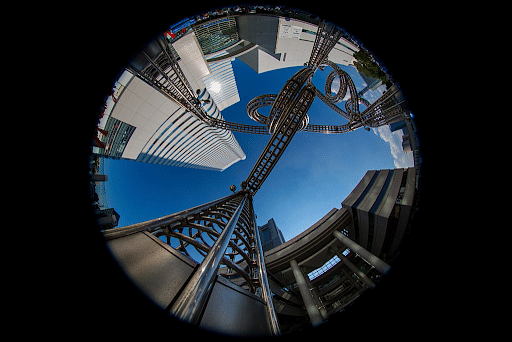
Circular Fisheye Lens
Characteristics of Fisheye Lenses
[Click Here for Sample Questions]
- Focal Length: Circular type focal lengths range from 8mm to 10mm in general. The focal length of full-frame fisheye lenses ranges from 15mm to 16mm.
- Angle of view: Fisheye lenses have a 180° field of view at their widest point.
- Mapping: The mapping functions being used are rectilinear, equal distance, equisolid, isometric perspective, and stereographic.
- Image Distortion: The distortion caused by the fisheye lens in the photographs formed are barrel distortions. The central part of the photograph appears to bulge towards the outside and thus a curvilinear image is formed.
- Depth of Field: Due to its extreme wide-angle, the fisheye lens also has a considerable depth of field.

Image of the top with a Fisheye Lens
Projection of a Fisheye Lens
[Click Here for Sample Questions]
- The distance between both the image's point and center in a fisheye projection is directly proportionate to the accurate angle of separation.
- Fisheye projections are not a single type of transformation projection. It is rather a cluster of transition estimates that are labeled differently by manufacturers. For example equisolid order approximation, equidistant fisheye projection, etc.
- Traditional three-dimensional projections, such as typographical or stereographic projections over rotating images, are no longer common. Timelapse techniques are there to collect views of such projections.
| Projection | Formula |
|---|---|
| Equidistant Fisheye | R = f. |
| Equisolid or equal area fisheye | R = 2f.sinθ2 |
| Orthographic | R = f.sin |
Applications of Fisheye Lenses
[Click Here for Sample Questions]
The applications of fisheye lenses are:
- Fisheye lenses are commonly used in science museums to project the night sky onto the structure's interior.
- Flight numerical simulations are used to create an interactive environment for pilots.
- Many photographers and cinematographers around the world use fisheye lenses to capture close-up action shots while retaining the context background.
- Astronomers use fisheye lenses to collect data on the cloud shield and artificial light.
- Filmmakers and videographers have incredible opportunities when filming with a fisheye lens. They can include more of the natural atmosphere in the shot and bring a different mood.
- Wide-angle and ultra-wide-angle lenses, together with fisheye lenses, are frequently used in action sports photography.
- Fisheye lenses are essential for action sports such as snowboarding, skateboarding, and skiing, whether capturing Point of view or third-person perspective.

Image From a Fisheye Lens
Things to Remember
- A fisheye lens is a type of lens that is used to capture images with extremely wide perspectives, typically 180 degrees.
- This lens has two variants: full-frame and circular.
- In a full-frame shot, the disrupted image will fill the entire frame.
- Meanwhile, a dark frontier will surround the circular picture in a spherical shot.
- The angular extent of a particular scene caught in an image by a camera is described by the angle of view.
- A fisheye photograph has an extremely wide field of view.
- It is dependent on special mapping.
- Filmmakers and videographers have incredible opportunities when filming with a fisheye lens. They can include more of the natural atmosphere in the shot and bring a different mood.
Read more:
Sample Questions
Que. What is the use of fisheye lenses in a film? (3 marks)
Ans. A fisheye lens is used in the film for various purposes like:
- For use in extreme sports
- To give the appearance of gazing through a porthole
- Visuals of a human waking or having problems with unconsciousness are appropriate.
- In order to simulate security footage
Ques. What is the significance of the name “fisheye lens”? (2 marks)
Ans. The term "Fisheye lens" refers to the wide-angle of view produced by these lenses, which is similar to the perception from a fish's eye. Fisheye lenses were initially created for use in astronomy because of their ability to stream the entire sky, but they are now used for a variety of purposes.
Ques. What is meant by ultra-wide-angle lens? (2 marks)
Ans. Everything shorter than 24mm is regarded as an ultra-wide-angle lens. Fisheye lenses and ultra-wide-angle lenses are both types of ultra-wide-angle lenses. They do, however, have a wider field of view than standard ultra-wide-angle lenses.
Ques. Who makes use of fisheye lens? (2 marks)
Ans: A fisheye lens is intended for shooting extremely wide angles, typically 180 degrees. They are popular in wildlife photography, extreme sports photography, and artistic photography.
Ques. Is it possible to zoom with a fisheye lens? (2 marks)
Ans: Fisheye lenses are frequently, but not always, prime lenses. In simple words, no zoom. They also have a larger emphasis on quality, making it easier to shoot in low light.
Ques. What is the distinction between a wide-angle and a fisheye lens? (3 marks)
Ans. Fisheye lenses are also classified as wide-angle lenses, but the difference is in the barrel deformation. A fisheye lens is a super-duper angle lens with an angle of view that ranges from 100 to 180 degrees and captures a perfect circle rather than a rectilinear image because of the lens's visual distortion.
Ques. What is the definition of barrel distortion in a lens? (3 marks)
Ans. Lines that are straight in real life appear to curve inwards when subjected to barrel distortion. Simply looking for parallel lines in the area you are shooting in and seeing if the lines appear parallel in your image is a good way to check for barrel distortion.
Ques. What are the two types of fisheye lenses? (3 marks)
Ans. Fisheye lens can be classified into two types, both of which give a different effect to the image when uses:
Full-frame Fisheye Lens
In a full-frame fisheye lens shot, the contorted image will occupy the entire frame. When measured from corner to corner, these lenses are capable of recording a 180° viewing angle.
Circular Fisheye Lens
The circular fisheye lens was the first kind of fisheye lenses to be created. A black border will encircle the circular shot in a spherical pic.
For Latest Updates on Upcoming Board Exams, Click Here: https://t.me/class_10_12_board_updates
Check-Out:



Comments