



Exams Prep Master
Beta Distribution, in the probability theory, can be described as a continuous probability distribution family. It is defined on the basis of the interval [0, 1]. The concept of Beta distribution also represents the value of probability. Generally, this is a basic statistical concept. For example, you have to finish a complicated task. Now, even if you plan all the necessary steps beforehand, some issues may come up without prior notice and this might hamper your calculated time to finish the work, right? Hence, there you might need to calculate the probability of the time to finish that job. And here comes the concept of the Beta distribution. Here, we will be discussing more about beta distribution along with some important questions.
| Table of Content |
Key takeaways: Beta distribution, probability, probability distribution, beta distribution notation, beta distribution formula.
Also Read: Relations and Functions
Definition of Beta Distribution
[Click Here for Sample Questions]
The Concept of Beta distribution can be defined as the family of continuous probability distribution which is defined on the basis of intervals [0, 1]. It has two positively shaped parameters - α and β, which represents the exponents of a random variable and manage the formation of the distribution.
This process of Beta distribution can be divided into two kinds- the basic distributions are called as Beta distribution of the First Kind, whereas the prime ones are called the beta distribution of the Second Kind.
Also Read: Differentiation and Integration Formula
Examples of Beta Distribution
[Click Here for Sample Questions]
This concept is applicable to a lot of real-life situations, for example-
- For calculating the expected customer reviews after launching new products.
- To calculate the online visitors shopping activities of the online shopping sites.
- To understand and analyze the survival chances of the patients suffering from particular health conditions.
- The probable time for completing a task.
Beta Distribution Notation
[Click Here for Sample Questions]
We know from the definition of Beta distribution, it is based on the interval [0, 1], and is represented by α and β. Now, these are counted as the two positive perimeters that are the exponents of the random variables and manage the formation of the distribution. Therefore, its notation is Beta, which includes α and β and this α and β are basically two real numbers.
Let’s have a look to the following picture to understand better.

Beta Distribution Formulas
[Click Here for Sample Questions]
The behaviour of random variables, limited to the intervals of a particularly measured length in a variety of disciplines, can be measured by the Beta distribution. Hence, we need to understand a few formulas while applying the Beta distribution concept to practical use.
Probability Density Function

Cumulative Density Function

CDF = Bx (α, β)/ B (α, β)
Where,

Moment Generating Function
Sometimes, Beta can be considered as the Moment Generating Function, and in that case-

Expectations
When it comes to the Expected Value of Beta distribution,
Hence, the Beta Variance is-

Also Read:
Properties of Beta Distribution
[Click Here for Sample Questions]
Here we will learn about some properties that satisfy the concept of Beta distribution, for example-
While measuring the Central tendency,
- Mean
- Median
- Mode
- Geometric Mean
- Harmonic Mean
While calculating the statistical dispersion, like-
- Variance
- Geometric variance and covariance
- Mean absolute difference
- Mean absolute deviation around the mean
Also Read: Mean, Median and Mode
Things to Remember
- Beta distribution is defined as the family of continuous probability distribution which is defined on the basis of the interval [0, 1].
- It includes two positively shaped parameters - α and β.
- It is basically a statistical concept of probability.
- The beta distribution is divided into two kinds- the Beta distribution of First Kind, and Beta distribution of the Second Kind.
- Formulas to Remember:
![Formulas to Remember]()
Formulas to Remember

Also Read: Integration by Partial Fractions
Sample Questions
Ques. What is Beta Distribution? (Marks-3)
Ans. The idea of Beta distribution can be defined as the family of continuous probability distribution which is defined on the basis of intervals [0, 1]. It has two positively shaped parameters - α and β, that represents the exponents of a random variable and manage the formation of the distribution. These α and β are two real numbers.
The Beta distribution can be divided into two kinds- the basic distributions are called as Beta distribution of the First Kind, whereas the prime ones are called the beta distribution of the Second Kind.
Ques. Why is Beta Distribution so important? Explain with a real-life example. (Marks-3)
Ans. The concept of Beta Distribution is very important while measuring any probability as it helps us to calculate the behaviour of random variables, limited to the intervals of a particularly measured length in a variety of disciplines.
For example, whenever a new movie is released, the production house needs to get an idea of how the audience will rate the movie. Hence, they need to measure the probable ratings, and for that, they need this concept of the Beta distribution.
Ques. Mention any three examples of real-life applications for Beta Distribution. (Marks-3)
Ans. This concept of Beta distribution can be applicable to a lot of real-life situations, for example-
- To calculate the online visitors shopping activities of the online shopping sites.
- To understand and analyze the survival chances of the patients suffering from particular health conditions.
- The probable time for completing a task.
Ques. What are the PDF and CDF formulas related to Beta distribution? (Marks-4)
Ans. The beta distribution is defined as the family of continuous probability distribution which is defined on the basis of intervals [0, 1]. This includes two positively shaped parameters - α and β. The behaviour of random variables, limited to the intervals of a particularly measured length in a variety of disciplines, can be measured by the Beta distribution.
Probability Density Function
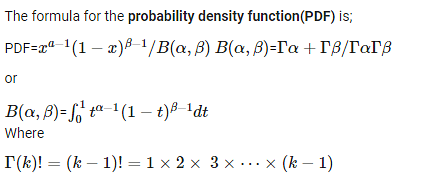
Cumulative Density Function

CDF = Bx (α, β)/ B (α, β)
Where,

Moment Generating Function
Sometimes, Beta can be considered as the Moment Generating Function, and in that case-

Expectations
When it comes to the Expected Value of Beta distribution,
Hence, the Beta Variance is-

Ques. How do you explain the Notation of Beta distribution? (Marks-4)
Ans. Beta Distribution can be described as a continuous probability distribution family. It is defined on the basis of the interval [0, 1]. The concept of Beta distribution also represents the value of probability. Generally, this is a basic statistical concept. It has two positively shaped parameters - α and β, that represents the exponents of a random variable and manage the formation of the distribution. These α and β are two real numbers. We need to keep in mind that the value of α and β should be more than zero.

Ques. What are the formulas for Moment Generating Functions and Expectations for Beta distribution? (Marks-2)
Ans. Moment Generating Function: Beta can also be considered as the Moment Generating Function, and in that case the formula will be-

Expectations: In the case of the Expected Value of Beta distribution, the formula will be –
\(E (X) = \frac{ \alpha} { \alpha + \beta}\)Where,
\(Var (X) = \frac{ \alpha \beta}{ (\alpha + \beta)^2 (\alpha + \beta + 1)}\)Ques. If in a basket there are balls that are defective with a Beta distribution of \(\alpha\)=5 and \(\beta\)=2. Compute the probability of defective balls in the basket from 20% to 30%. (Marks-4)
Ans. We know that, the number of balls defective with a Beta distribution of \(\alpha\)=2 and \(\beta\)=5.
Therefore, if we need to calculate the probability of defective balls from 20% to 30% in the basket we need to apply the Beta probability density function formula.
The formula of Beta probability density function is-
P(x) = \(x^{a-1}(1-x)^{\beta -1}/B(\alpha,\beta )\)
P(0.2\(\leq\)x\(\leq\)0.3)= \(\sum_{0.2}^{0.3}x^{2-1}(1-x)^{5 -1}/B(2 ,5 )\)
=0.235185
Mathematics Related Links:



Comments