



Education Content Expert
Bilateral Symmetry is a type of symmetry found in organisms where the left and right sides of the body are mirror images of each other. This type of symmetry is commonly found in animals, and it is believed to have evolved as a way to improve the organism's ability to move and navigate through their environment.
- The shape and arrangement of the body parts in bilateral symmetrical organisms are specialized for different functions, such as sensing, feeding, and reproduction.
- Some examples of animals with bilateral symmetry include fish, birds, mammals, and insects.
- Bilateral Symmetry is important for the survival and reproduction of these organisms as it allows them to move efficiently, detect and avoid predators, and locate food.
Read More: NCERT Solutions for Class 11 Biology Animal Kingdom
Key Terms: Bilateral Symmetry, Radial Symmetry, Mirror Image, Symmetry, Regeneration, Ecosystem, Taxonomy
What is Symmetry?
[Click Here for Sample Questions]
Symmetry is defined as the property of an object which shows mirror images on each side of the object when an axis of symmetry is drawn.
- An object is said to be symmetrical if it has one or more lines of symmetry.
- In Biology, some organisms are symmetrical as well as asymmetrical.
- Low-level organisms such as amoeba, fungi, sponges, coral, etc., have no lines/axis of symmetry and hence they are asymmetrical.
- However, higher-level organisms exhibit some form of biological symmetry in them.
- They are mainly named Radial Symmetry and Bilateral Symmetry.
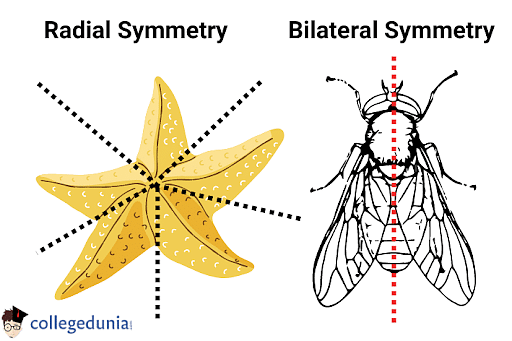
Types of Symmetry
What is Bilateral Symmetry?
[Click Here for Previous Year Questions]
Bilateral Symmetry can be defined as the type of symmetry in which an organism has one line of symmetry dividing it into two halves. This type of symmetry is also known as plane or reflective symmetry, since the two halves are mirror images of each other.
- Bilateral symmetry happens only to the external parts of the organism and not necessarily to the internal parts. Humans, insects, birds, fish, etc., all show bilateral symmetry.
- It is commonly seen in higher-level organisms, where the complexity of the organism causes it to adopt a single line of symmetry so that the organs are well placed in a suitable manner.
- Bilateral symmetry facilitates an organism to have a head and tail region, which helps the organism to concentrate its nervous system in the head region, as well as allows smooth forward movement.
- This is why higher-level organisms have bilateral symmetry since it suits the complex structure of their body.
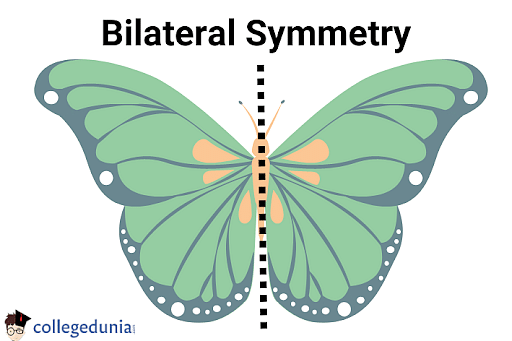
Bilateral Symmetry in Butterfly
A butterfly can be considered the perfect example of a bilateral animal as not only one can divide the body into two halves, but the patterns on each wing of the butterfly are also nearly identical.
Bilateral Symmetry Advantages
The Advantages of Bilateral symmetry are:
- It allows free movement of the organism.
- Visual perception is easier in organism with the bilateral symmetry.
- Streamlined body shape helps in economic energy expenditure of organisms with bilateral symmetry.
- The organism will have a backup mechanism/organs in case of emergency situations.
- Localization of organs occurs in certain regions for efficient orientation of bilateral organisms.
- Forward motion helps bilateral organisms in better reaction to stimulus in the environment.
Read More:
Read More: Animal Kingdom Important Questions
Bilateral Symmetry in Organisms
[Click Here for Sample Questions]
Mostly all marine animals, except for sponges, as well as all vertebrates and invertebrates show bilateral symmetry. Sponges are the only classification of marine animals that has asymmetry.
- Some animals show a certain type of symmetry in their beginning or developing stage but soon change their symmetry as the organism grows up.
- Symmetry is prominent in organisms due to the evolutionary changes in the environment.
- The concept of “Survival of the fittest” plays an important part here, where mutations associated with symmetry helped the organisms in surviving and better adapting to the environment.
- It further helped to carry forward the symmetrical genes to future generations.
- All bilateral organisms are said to have evolved from radial or asymmetrical organisms.
In the case of plants, it is said that the evolution of certain pollinators helped in converting the radially symmetrical plants to bilaterally symmetrical plants, while in the case of animals, the transition occurred due to natural selection and sexual selection, as females tend to mate with males who are more symmetrical in their structure.
Bilateral symmetry is commonly found in higher-level organisms, such as birds, insects, humans, etc. The classification of organisms having bilateral symmetry are:
- Platyhelminthes
- Aschelminthes
- Annelida
- Arthropoda
- Mollusca (except adult snails)
- Echinodermata (except adult forms)
- Hemichordata
- Chordata
Read More: Animal Kingdom MCQs
Characteristics of Bilateral Organisms
[Click Here for Previous Year Questions]
The Characteristics of the Bilateral Organisms are as follows:
- Bilateral organisms have an anterior (head) as well as a posterior (tail) area, a left and right side, and a top (dorsal) and bottom (ventral) area.
- Facial features are present in most organisms.
- Majority of the organisms have a complex nervous system and a developed brain.
- Consumption of food and excretion of waste are at different points.
- All bilateral organisms have forward motion, which means the head is in front of the entire body.
- Most bilateral organisms are streamlined.
What is Radial Symmetry?
[Click Here for Sample Questions]
Radial Symmetry is a type of symmetry found in organisms where the body is symmetrical around a central axis. This type of symmetry is commonly found in invertebrates such as jellyfish, sea anemones, and starfish.
- In organisms with radial symmetry, the body parts are arranged around the central axis in a circular pattern, and this arrangement allows for efficient movement in all directions.
- This type of symmetry is believed to have evolved as an adaptation to a sessile or passively drifting lifestyle, as it allows for efficient feeding and sensing in the water.
- The radial symmetry also allows these organisms to regenerate lost body parts.
- Additionally, radial symmetry is also observed in some plants, such as sunflowers, where the florets are arranged in a circular pattern around the central disk.
- This pattern is considered as an adaptation to maximize the amount of light and pollination.
- Overall, radial symmetry is a unique and important feature in a variety of organisms, and it plays a crucial role in their survival and reproduction in their respective environments.
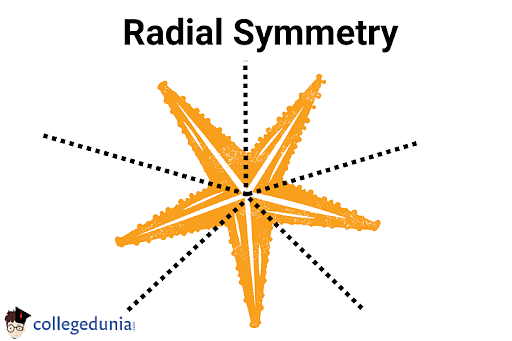
Radial Symmetry in Starfish
Characteristics of Radial Organisms
Characteristics of organisms with radial symmetry are as follows:
- Body parts are arranged around the central axis and are not arranged equally.
- Radial organisms tend to move slowly.
- Generally, radial organisms can regenerate organs.
- They have an oral (with mouth), as well as an aboral side(without mouth)
- They do not have forward movement as compared to bilateral organisms, since they usually do not have a head.
Check More:
Difference between Bilateral and Radial Symmetry
[Click Here for Previous Year Questions]
Radial Symmetry is defined as symmetry when there are many lines of symmetry around the central axis of an organism, while Bilateral symmetry is defined as symmetry where there is one line of symmetry in a single plane, which divides the organism into two equal parts.
The main differences between bilateral symmetry and radial symmetry are:
| Bilateral Symmetry | Radial Symmetry |
|---|---|
| Symmetry in which an organism can be divided into two halves on the left and right sides along the sagittal plane. | Symmetry in which an organism can be divided into two halves on any axis along the central plane. |
| There is only one line of symmetry in the central axis. | There can be more than one line of symmetry in the central axis. |
| Majority of the higher level organisms have bilateral symmetry. | Radial symmetry is mostly found in low-level organisms such as sponges. |
| Leads to the development of head and tail region. | Does not lead to the development of the head and tail region. |
| Body is arranged equally on both the left and right sides. | Body is arranged in regular patterns along the central axis. |
| Examples include humans, insects, fish, birds, etc. | Examples include sponges, starfish, jellyfish, etc., |
Things to Remember
- Bilateral Symmetry is a type of symmetry found in animals where the left and right sides of the body are mirror images of each other.
- Examples of animals with bilateral symmetry include fish, birds, mammals, and insects.
- Bilateral symmetry allows for the specialization of body parts for different functions such as sensing, feeding, and reproduction.
- Radial Symmetry is found in invertebrates such as jellyfish, sea anemones, and starfish, and in some plants such as sunflowers.
- It allows for efficient movement in all directions and regeneration of lost body parts.
- Bilateral symmetry has a single line of symmetry and is seen in higher-level organisms with complex structures.
- Radial symmetry has multiple lines of symmetry around a central axis.
- Both types of symmetry play crucial roles in the survival and reproduction of their respective organisms in their environments.
Previous Years’ Questions
- Bilaterally symmetrical and acoelomate animals are exemplified… (NEET - 2020)
- The animals with bilateral symmetry in young stage, and… (NEET - 2004)
- Which group of animals exhibits bilateral and radial symmetry… (AFMC - 2008)
- The adult animal in this phylum is radially symmetrical… (KCET)
- Consider following features: (a) Organ system level of organisation (b) Bilateral… (NEET - 2019)
- Some salient features and phyla of organisms are given… (AIIMS - 2017)
- Biradial symmetry and lack of cnidoblasts are the… (AFMC - 2008)
- Radial symmetry is found in the flowers of… (NEET - 2016)
- Radial symmetry is, usually, exhibited in animals which… (NEET - 1994)
- The pentaradial symmetry is found in… (OJEE - 2011)
Sample Questions
Ques. What do you mean by Symmetry? (3 Marks)
Ans. Symmetry refers to the property of an object or organism where its parts are arranged in a specific and consistent pattern. Symmetry can be categorized into different types, including bilateral symmetry, radial symmetry, and spherical symmetry.
- Symmetry is believed to have evolved as an adaptation to improve the organism's ability to move and navigate through their environment, and also for efficient feeding, sensing, and reproduction.
- In plants, symmetry is observed in the arrangement of flowers, leaves, or fruits which is considered as adaptation to maximize the amount of light and pollination.
- Symmetry is an important feature in a variety of organisms, and it plays a crucial role in their survival and reproduction in their respective environments.
Ques. What is Bilateral Symmetry? (2 Marks)
Ans. Bilateral symmetry is defined as the symmetry where organisms can be divided into mirror images of two halves along the sagittal plane, or on the left and right side. It is where the left and right sides of an organism are mirror images of each other, and is commonly found in animals.
Ques. What is Radial Symmetry? (2 Marks)
Ans. Radial symmetry is defined as the symmetry where organisms can be divided into mirror images of two halves along any plane in the central axis. It is where the body is symmetrical around a central axis, and is commonly found in invertebrates such as jellyfish and sea anemones.
Ques. What are the characteristics of a bilateral organism? (3 Marks)
Ans. The characteristics of a bilateral organism are:
- All bilateral organisms possess an anterior (head) as well as a posterior (tail) area, a left and right side, and a top (dorsal) and bottom (ventral) area.
- Most bilateral organisms have facial features such as eyes, nose, ears, etc.
- Most bilateral organisms have a complex nervous system and a developed brain due to increasing complexity.
- Various biological activities of the organism occur at different points.
- All bilateral organisms have forward motion, due to the position of the head in front of the entire body.
- Generally, bilateral organisms are streamlined in nature.
Ques. State the differences between bilateral and radial symmetry. (5 Marks)
Ans. The difference between a bilateral and a radial organism are:
- Bilateral organisms have one line of symmetry in their sagittal plane, while radial organisms have multiple lines of symmetry in their central plane
- All bilateral organisms have a head and tail region due to the localization of organs, while radial organisms do not possess a head and tail region
- The organs and structure in a bilateral organism are well-defined and equal, while the radial organisms have their body arranged irregularly.
- All bilateral organisms have forward movement, due to the presence of the head in front of their body, while radial organisms move randomly and slowly because of the absence of a head.
- Bilateral organisms have definite points for consumption and excretion, while radial organisms do not.
Ques. Write the advantages of Bilateral symmetry in organisms. (5 Marks)
Ans. The advantages of bilateral symmetry in organisms are:
- Bilateral symmetry causes the organisms to have a head and tail region, which helps in forward movement. This helps the organisms to react faster to the stimuli around them.
- The streamlined and proportionate structure of the body makes the organism more agile.
- All organs are arranged and aligned equally on both sides.
- Bilateral symmetry is useful for complex organisms, as more complexity requires more specialization and localization of body parts, which can be achieved effectively.
Ques. Why do bilateral organisms have a head and tail region? (3 Marks)
Ans. Bilateral organisms have a head and tail region due to the following reasons:
- The bodies of bilateral organisms are arranged equally on the left and right sides, which leads to the localization of certain organs from the anterior to posterior chain.
- This is done to ensure the occurrence of forward movement in such organisms so that they respond to stimuli better.
- The head and tail regions also provide separate points for consumption and excretion due to increased complexity.
Ques. Give a few examples of organisms having bilateral symmetry. (1 Mark)
Ans. Organisms such as insects, birds, fish, mammals, humans, etc., have bilateral symmetry.
Ques. What are the characteristics of an organism with radial symmetry? (3 Marks)
Ans. The characteristics of an organism with radial symmetry are:
- Organs and body parts are arranged irregularly around the central axis
- The irregular design of their body structure makes them move slowly and randomly
- Most radial organisms can regenerate their body parts if damaged/ destroyed.
- They react slowly as compared to bilateral organisms due to the absence of forward movement.
- All radial organisms have an oral (with mouth), as well as an aboral (without mouth) area.
Ques. Why is symmetry important in organisms? (5 Marks)
Ans. Symmetry is important in the organisms due to the following reasons:
- Symmetry is important to organisms because symmetry helps in bringing balance to the overall structure of the organism and toward the environment.
- Various organisms have different complexity levels and symmetry helps in adapting the organism to the environment and the stimulus around them.
- Symmetry is what defines an organism’s movement in the environment. The two main types of symmetry in organisms are bilateral and radial symmetry.
- Bilateral symmetry helps the organisms to have more visual perception and a more organized body structure, while radial symmetry helps those animals move randomly and in regeneration.
- Symmetry helps the animals in equal distribution of body parts and sense organs. Symmetry helps in bringing the much-needed peace, harmony, order, and balance to nature.
Check-Out:



Comments