



Education Journalist | Study Abroad Lead
Boron is a group-13 element which is formed when oxygen combines with other natural elements. Boron is a naturally occurring compound which is found in coal, sedimentary rocks, seas and some specific soils. It is also formed when rocks containing boron weather themselves out. It can also be found in the form of boric acid vapour from volcanic activities, and other geothermal activities. It has an electronic configuration of [He]2s2 2p1.
| Table of Content |
Keyterms: Element, Oxygen, Coal, Sedimentary rocks, Soil, Boric acid, Aluminium(Al), Gallium(Ga), Indium(In) and Thallium(Tl)
Boron Family
[Click Here for Sample Questions]
The boron family consists of Boron(B), Aluminium(Al), Gallium(Ga), Indium(In) and Thallium(Tl). Boron is the fifth element in the periodic table situated in group 13.
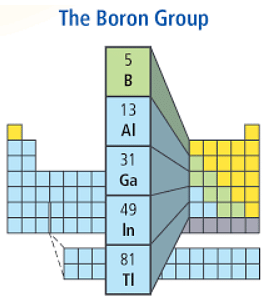
Boron Family
Boron: Boron is a metalloid. It is extremely hard and black in colour. It occurs because of hitting by subatomic particles which are produced from natural radioactivity disrupting the nuclei.
Aluminium: Aluminium is the 3rd most abundant element which is found in Earth’s crust. It is considered as a safe element as it doesn’t contain any toxicity.
Gallium: Gallium is an environmentally friendly element and has the ability to increase metabolism as it has the power to bind itself to iron proteins.
Indium: Indium is the 61st most abundant element found in Earth’s crust and it is used to stimulate the metabolism of the human body.
Thallium: Thallium is very toxic in nature as it seems to be interfering with vital parts of the body and mostly used as a pesticide.

Boron
Also Read:
| Related Articles | ||
|---|---|---|
| Etard Reaction | Common Ion Effect | Sodium Metabisulfite |
| Oxoacids of Sulphur | Ionic Radius | Esters |
| Displacement Reaction | Chemical Reaction | Chemical Kinetics |
Uses of Boron
[Click Here for Sample Questions]
There are various uses of boron. Some are:
- The compounds made from boron have a high energy/mass ratio due to which it is used as rocket fuel.
- The compounds of boron such as boric acid and borax are used in the manufacture of heat-resistant glass, fibreglass and glass wool.
- The aqueous solution of orthoboric acid can also be used as a mild antiseptic instead of borax.
- Borax is used as a flux in soldering metals, which is further used in the manufacture of enamels and glazes for earthenware i.e borax is used to provide a stain-resistant coating to earthenware such as tiles and pottery.
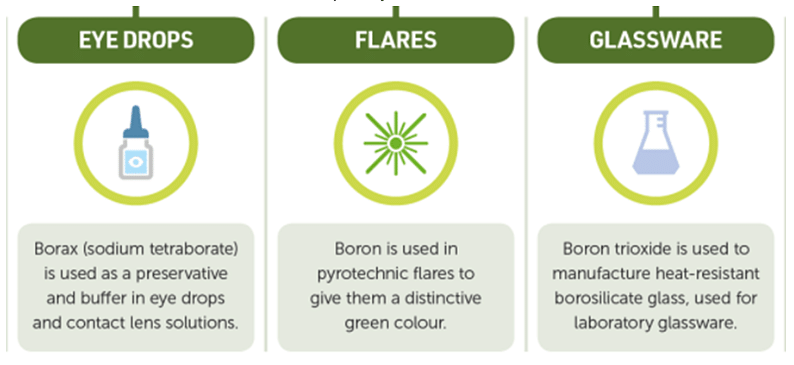
Uses of Boron
- The various compounds of boron in the market are ulexite, boric acid, borax, colemanite, sodium perborate, kernite, orthoboric acid, calcium borate and boron hydrides.
- Some expensive metals such as Molybdenum, chromium, tungsten can be replaced by boron in the manufacturing of special hard steels.
Properties of Boron
[Click Here for Sample Questions]
Properties of Boron are listed below.
Physical Properties
- Boron is hard and black coloured solid.
- It is the first element of group 13 elements, hence the group name is “Boron Family”.
- It is a non-metallic element which is present in the p block of the periodic table.
- It has a solid and hard crystalline lattice, which results in its high melting point.
Chemical Properties
- Boron is unreactive in its crystalline form.
- Some boron-containing compounds such as boric acids and a few borates are soluble in water and in other biological fluids like blood when it has low levels of concentration.
- Boron has a small size due to which the sum of its first three ionisation enthalpies is very high.
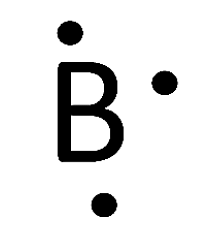
Lewis dot structure of Boron
Things to Remember
[Click Here for Sample Questions]
- Boron has the highest melting and boiling point of the metalloids.
- The boron-10 isotope is used as a neutron absorber in many nuclear reactors and it is also a part of emergency shutdown systems.
- Boron is a refractory solid which has low density and low electrical conductivity.
- It has a hard crystalline lattice as it has a high melting point. Pure boron is dark amorphous powder.
- The fibres of boron have a high tensile strength and are used to make bullet-proof vests. It is used in making aircrafts as it is extremely lightweight in nature.
- Due to low electrical conductivity of boron, it is a good semiconductor and used in making several electronic gadgets.
Also Read:
Sample Questions
Ques. Why is the melting point of boron the highest? (2 Marks)
Ans. Boron has a high melting point as the structure of boron consists of crystalline structure called “icosahedrons” which is a 20 faced polygon that is closely packed which allows a large amount of heat to break down. The electronic configuration makes it a different element from others as it has 3 electrons in its outermost shell.
Ques. Why does the electronegativity of boron increase after aluminium? (2 Marks)
Ans. The electronegativity of boron increases after aluminium because in the electronic configuration, there is a presence of d and f electrons which increases the size but at the same time also increases the nuclear charge because d and f electrons have poor shielding effect. Therefore, the force of attraction increases.
Ques. Is boron radioactive? (3 Marks)
Ans. A radioactive isotope is the isotope of boron that splits up and emits radiation. The isotope of boron ranges from 7B to 21B out of which only 10B and 11B are stable. The other isotopes can be found in slightest traces. Hence, boron-10 is the isotope which absorbs low energy neutrons and is used for making protective shields which is further to be used in the nuclear industry.
Ques. Boron is unable to form BF63- ion. Explain. (2 Marks)
Ans. Boron doesn’t form BF63- ions due to its small size and non-availability of d-orbitals. So, boron is considered to have anomalous properties among all the group 13 elements. Boron is bound to increase its octet and the maximum covalency boron can have cannot exceed 4.
Ques. Why is boric acid considered a weak acid? (2 Marks)
Ans. Boric acid B(OH)3 cannot release H+ ions on its own. It gets OH- ions from a water molecule so that its octet gets filled and then in return it releases H+, since it has no H+ ion to release on its own. Therefore, it is considered as a weak acid.
Ques. What are the uses of boric acid? (3 Marks)
Ans. Uses of boric acid are as follows:
- It is a topical agent which is used as an antimicrobial agent.
- It can be added to various dusting powders for anti-infective action.
- It is used as an antiseptic for minor cuts or burns.
- It is used to prepare boroglycerine glycerite and is also used as a suppository base.
- It is used in dusting powders, ointments, lotions, antiseptic creams etc, and is only meant for application to mucus membrane, skin or eye.
Ques. Is boric acid a protic acid? Comment. (2 Marks)
Ans. Protic acids are those which ionises in water to give protons. Boric acid in the contact of water doesn’t behave as a protic acid as it doesn’t ionise to give protons.
B(OH)3 + 2H2O -> H2BO2- + H3O+
Rather, it behaves like a lewis acid and a weak monobasic acid.
Ques. Describe the atomic structure of Boron. (3 Marks)
Ans. The atomic number of boron is 5. The nucleus of boron has six neutrons and five positively charged protons. Five electrons occupy the free electron shells and revolve around the nucleus. The stability of valence electrons describes the physical and chemical properties of the element. Boron is a metalloid as it shows the characteristics of both metals and non-metals is placed in period 2, group 13 and the p-block of the periodic table.
Ques. How can we treat boron deficiency in plants? (3 Marks)
Ans. Boron acts as a supplement for plants which helps them in their exponential growth, yield and quality of crops. If the soil is deficient in boron, it can be altered with the help of fertilisers of boron such as borax, boric acid on the basis of testing of soil and requirements of crop. In neutral soils, it is most available for uptake by plants, instead it is less available in acidic or alkaline soil. Most commonly, the deficiency of boron can be seen in sandy soils that possess low organic matter content.
Ques. Explain the bone health benefits of boron. (3 Marks)
Ans. Boron can affect the bones through some mechanism. It was found that supplements of boron decrease the amount of magnesium and calcium that was not present in the urine. The supplements of boron also increase the level of estrogen and testosterone. Supplements that contain boron have the ability to improve bone density. Hence, boron is an essential part of keeping our bones strong along with it there is also the possibility of improving the functioning of the brain.
Ques. What is boron carbide used for? (2 Marks)
Ans. Boron carbide is a crystalline compound of boron and carbon. It is an extremely hard and produced material and is being used for polishing and wear-resistant products. It is a very hard ceramic made up of boron and carbon, hence, this material is useful in making tank armours, bulletproof vests and different purposes in industries.
Ques. Why is boron added to steel? (2 Marks)
Ans. Boron is added to steel to increase hardness drastically. Because of these properties, boron-containing carbon steels are used in situations where the base steel melts the majority of requirements, such as wear resistance but the hardenability is insufficient.
Ques. How much does the boron carbide cost? (2 Marks)
Ans. As the process of manufacturing of boron carbide requires a significant amount of energy and time, boron carbide products may be upto 10 times more costlier than others. The boron carbide ceramic is a less durable material which is currently dominating the market.
For Latest Updates on Upcoming Board Exams, Click Here: https://t.me/class_10_12_board_updates
Check-Out:



Comments