



Education Content Expert
Circuit Breaker is an electrical switch designed to protect an electric circuit from overcurrent or short circuits. It helps in regulating the current by stopping it automatically. It stops the electric current in a circuit if it reaches its maximum limit. A circuit breaker can be thus recognized as a safety device. Circuit breakers are made in different sizes depending on their application. Small breakers are used to protect low-current circuits like households and large switchgear are used to protect high-voltage circuits working for an entire city. The general use of a circuit breaker is abbreviated as Over the Current Protection Device (OCPD).
Read More: NCERT Solutions for Class 7 Science Electric Current and its Effects
| Table of Content |
Key Terms: Circuit Breaker, Electrical Switch, Electrodes, Fuse, Arc Extinguisher, Electric Circuit, Air Circuit Breaker
What is Circuit Breaker?
[Click Here for Sample Questions]
Circuit Breakers are electrical safety devices designed to protect electric circuits from overloading and short circuit conditions.
- Circuit Breakers perform the same function as fuses but are not destroyed when activated.
- Unlike fuses, they don’t require replacing and can simply be reset once the fault has been recognized.
- A circuit breaker will open the circuit to prevent overload, and potential damage, like fires.
- They contain a switch to return to the closed position once they have been flipped.
Read More:
| Relevant Concepts | ||
|---|---|---|
| Electric Current and Circuit | Circuit Diagram | Types of Circuits |
| Current Electricity | Electric Power | Difference Between Voltage and Current |
Advantages of Circuit Breaker
The advantages of a circuit breaker are
- It protects from the excessive flow of current which can cause damage.
- Circuit Breakers can be reset anytime as it is in a form of a switch.
- Circuit breakers are very reliable.
Disadvantages of Circuit Breaker
The disadvantages of a circuit breaker are:
- Circuit Breakers’ installation and maintenance are expensive.
- A circuit Breaker reacts slower compared to a fuse.
Working Principle of Circuit Breaker
[Click Here for Sample Questions]
Circuit Breaker is made in such a manner that it can sense current. It is equipped to provide overload and short-circuit protection. If the current is flowing more than the capacity, it will automatically get tripped.
- Circuit Breaker consists of two contacts namely Fixed Contacts and Moving Contacts.
- When the circuit is closed and the contacts touch each other and carry the current.
- These contacts carrying the current are knowns as electrodes.
- The switching and maintenance of the system are done by closing or opening the arms of the circuit breaker.
- One can open the circuit breaker by applying a little pressure on the trigger.
- When there is a problem with the current in any part of the system, it energizes the trip coil, leading to the parts moving away from each other.
- This leads to the opening of the circuit.
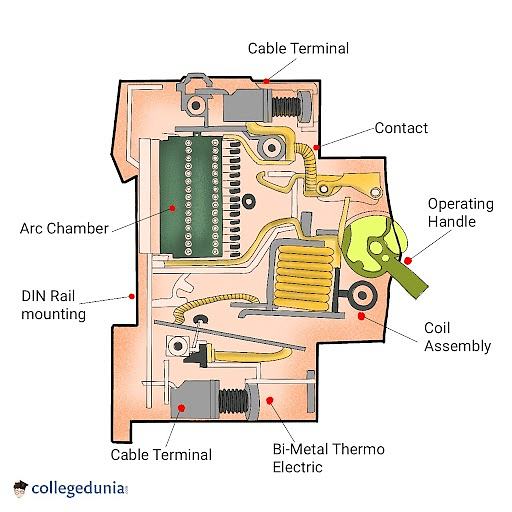
Circuit Breaker
Read More: Working Principle of an Electrical Fuse
Types of Circuit Breakers
[Click Here for Sample Questions]
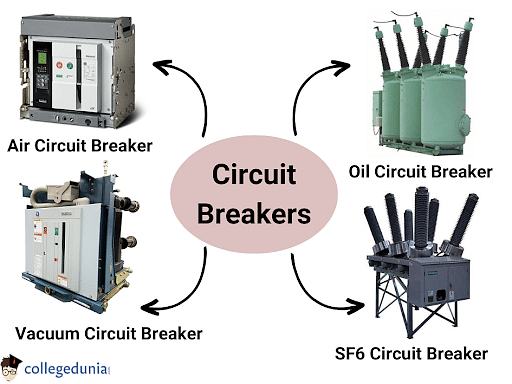
There are mainly four types of Circuit breakers:
- Air Circuit Breaker
- Vacuum Circuit Breaker
- Oil Circuit Breaker
- SF6 Circuit Breaker
All these types of circuit breakers function on a slightly different working principle and are employed in different sectors depending upon their advantages and disadvantages.
Air Circuit Breaker
[Click Here for Sample Questions]
Air Circuit Breaker is air-based and is also known as Air Blast Breaker. The arc extinguisher that is used is a high-pressure air blast. It works in the air at atmospheric pressure. In this way, it can protect the connected electric circuits. The blast valve opens the contact up if the current flow has a problem.
There are three types of Air Circuit Breaker:
- Axial blast type
- Cross blast type
- Radial blast type
Advantages of Air Circuit Breaker
- There is no risk of fire.
- As the dielectric strength increases faster, it leads to contacts having less gap in between.
- There is no need for arcing products.
- Since the arcing time and energy are small, frequent operations can be done.
- The interrupting current has no effect.
Disadvantages of Air Circuit Breaker
- In the air circuit breaker, the maintenance of the compressor is important.
- The variation of voltages can be harmful.
- The arc extinguishers used have inferior properties.
Air Circuit Breaker
Read More: Difference between Fuse and Circuit Breaker
SF6 Circuit Breakers
[Click Here for Sample Questions]
Sulfur hexafluoride circuit breaker has sulfur hexafluoride as the arc extinguishing medium. This gas can attract free electrons. The gas flows through the chamber affecting the arc when the circuit contacts are opened. SF6 generates immobile negative ions when the free electrons are absorbed. The insulating strength of the medium should be increased for the arc extinguisher to extinguish completely. In the arc chamber, fixed and moving contacts are along with the gas.
Advantages of SF6 Circuit Breaker
- The property of the arc extinguisher is very good.
- The interruption of the current is large as the gas in SF6 is three times greater than air.
- SF6 is good for the environment as well as there is no concept of exhausting.
- SF6 is suitable for difficult conditions as well such as in coal mines.
Disadvantages of SF6 Circuit Breaker
- The gas used in SF6 is expensive.
- SF6 needs maintenance after every use.
Vacuum Circuit Breaker
[Click Here for Sample Questions]
In vacuum circuit breakers, the arc extinguishing medium is the vacuum. The insulation of this circuit breaker is very good. There is ionization of the metal vapors when the vacuum is opened, forming an arc. The arc shield is mounted in the vacuum chamber along with the moving and fixed contacts.
Advantages of Vacuum Circuit Breaker
- The energy that the arc releases are low.
- It is strong enough to face lightning strikes.
- Little or no maintenance is required.
Oil Circuit Breakers
[Click Here for Sample Questions]
In this circuit, oil is used as the arc extinguishing medium. The contacts are opened in the oil when the arc strikes. It leads to the evaporation of oil into hydrogen gas. A hydrogen gas bubble surrounds the arc region. The arc is cooled down because of the Hydrogen gas which has a high thermal conductivity.
Oil circuit breakers are of two types:
- Bulk Oil Circuit Breakers
- Low Oil Circuit Breakers
Advantages of Oil Circuit Breaker
- The oil Circuit Breaker acts like an insulator between the earth and the live wires.
- It has a cooling property which is very good.
Disadvantages of Oil Circuit Breaker
- It can cause a fire hazard.
- It's difficult for arcing products to escape.
Check-Out:
| Related Topics | ||
|---|---|---|
| Electrical Energy and Power | Induced Voltage Formula | How is Voltage related to Resistance? |
| Unit of Electricity | Difference Between Power and Energy | Resistor |
Things to Remember
- Circuit Breaker is the most integral part of an electric circuit.
- It protects the devices from short-circuiting, overcurrent, and any sort of damage.
- Circuit Breaker consists of two contacts namely Fixed and Moving contacts.
- There are four types of Circuit Breakers which are Air Circuit Breakers, Vacuum Circuit Breakers, SF6 Circuit breakers, and Oil Circuit Breakers.
- Air Circuit breaker is of three types namely Axial blast type, Cross blast type, and Radial blast type.
- SF6 and Vacuum Circuit breakers are the most reliable and extensively used Circuit Breakers in today’s times.
Sample Questions
Ques. What is a Circuit Breaker? (2 Marks)
Ans. A circuit breaker is a switching device that interrupts faults or abnormal currents. It offers protection by tripping and cutting off the supply to load in case of fault. It is mainly designed to close or open an electrical circuit, thus protecting the electrical system from damage. Circuit breakers are used in different kinds of loads in industries, buildings, commercial complexes, hotels, etc.
Ques. How many Circuit Breakers are there? (2 Marks)
Ans. There are four types of Circuit Breakers which are as follows:
- Air Circuit Breakers
- Vacuum Circuit Breakers
- Oil Circuit Breakers
- SF6 Circuit Breakers
Ques. What is meant by Circuit Trips? (2 Marks)
Ans. A circuit trip is a condition when the internal sensor of the circuit becomes overheated, and the breaker shuts off the power to prevent further overheating. When a circuit trips, it means it is likely to be overloaded with electricity from too many appliances.
Ques. What is the difference between a Switch and a Circuit Breaker? (2 Marks)
Ans. Switches are not automatic as they need to be turned on or off manually while circuit breakers just trip off on certain conditions. Switches require the users to cut off the power supply to a certain area while circuit breakers are more preventive in nature.
Ques. What is the main purpose of a circuit breaker? (2 Marks)
Ans. A circuit breaker is an electrical switch that protects a line of electricity from overloading, or short-circuiting. A circuit breaker stops the flow of electricity instantly when it detects one of these problems and resets the flow of electricity with the flick of a switch.
Ques. What are the different types of Air Circuit breakers? (1 Mark)
Ans. There are three types of Air Circuit Breakers:
- Axial Blast Type
- Cross Blast Type
- Radial Blast Type
Ques. Which one is better- a Fuse or a Circuit Breaker? (2 Marks)
Ans. Circuit breakers offer more safety features such as GFCI and arc-fault reduction technology which is not offered by fuses and fuse boxes. Though fuses are not unsafe, it depends on how they are used and how much power is being supplied to the electrical system. For instance, a few fuse boxes cannot handle the higher energy demands of new homes and all their appliances.
Ques. How to tell if the circuit breaker has gone bad? (2 Marks)
Ans. The signs that a breaker has gone bad are listed as follows
- It will look old with a lot of wear and tear.
- The wires might be burned and old.
- It may smell burnt when opened.
Ques. What are the advantages of a Circuit Breaker? (2 Marks)
Ans. The advantages of a circuit breaker are
- It protects from the excessive flow of current which can cause damage.
- Circuit Breakers can be reset anytime as it is in a form of a switch.
- They are very reliable.
Ques. What are the advantages of the SF6 Circuit Breaker? (2 Marks)
Ans. The advantages of the SF6 circuit are
- The property of the arc extinguisher is very good.
- The interruption of the current is large as the gas in SF6 is three times greater than the air circuit breaker.
- SF6 is good for the environment as well as there is no concept of exhaust and the maintenance is low.
- SF6 is suitable for difficult conditions as well such as in coal mines.
Ques. What are the disadvantages of a Circuit Breaker? (2 Marks)
Ans. The disadvantages of a circuit breaker are
- The installation and maintenance of circuit breakers are expensive.
- They react slower than a fuse.
Ques. Explain the advantages of an Air Circuit breaker. (3 Marks)
Ans. The advantages of an air circuit breaker are
- There is no risk of fire.
- As the dielectric strength increases faster, it leads to contacts having less gap in between.
- There is no need for arcing products.
- The arcing time and energy are small, so frequent operations can be done.
- The interrupting current has no effect.
Check-Out:



Comments