



Content Curator
Difference between AC and DC Generator is that AC generator converts mechanical energy into electrical energy (alternative emf) while DC generator converts mechanical energy into direct current. Machines that can convert electrical energy into mechanical energy are called Generator. It is basically of two types: AC generator and DC generator. AC generator creates an alternating current that periodically reverses direction. Whereas, in a DC generator a direct current flows in one direction.
Key Terms: AC Generator, DC Generator, Mechanical Energy, Electrical Energy, Sinusoidal Output Waveform, Faraday’s Law
What is Alternating Current (AC) Generator?
[Click Here for Sample Questions]
The machine that converts mechanical energy into alternating current electricity is known as Alternating Current or AC generator. It works on the principle of EMI (Electromagnetic Induction). An ac generator converts mechanical energy into alternating electrical energy. The electrical energy generated in the ac generator is of the sinusoidal output waveform. Gas turbines, steam turbines, and combustion engines are some of the machines which usually supply mechanical energy.
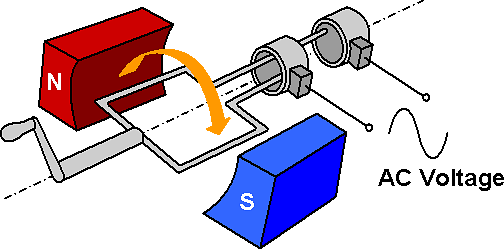
According to the principle of Faraday’s law of electromagnetic induction, an electromotive force or voltage is generated in a current-carrying conductor that cuts a uniform magnetic field can either be accomplished by turning a conducting loop in a static magnetic field, or by pivoting the magnetic field that contains the stationary conductor.
Advantages of AC Generator
Disadvantages of AC Generator
|
Also Check: SI Units in Physics
What is Direct Current (DC) Generator?
[Click Here for Sample Questions]
The machine which converts mechanical energy into the direct current electricity is known as Direct Current or DC generator. It works on the principle of energetically induced EMF (Electromotive force). A direct current generator is an electrical machine whose main function is to convert mechanical energy into direct current electricity.
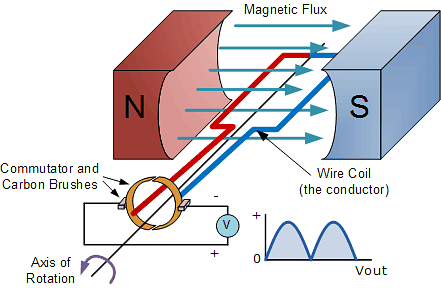
The Principle of DC Generator can be expressed as:
- Based on the Electromagnetic Induction of Faraday laws, an emf will be generated when the conductors emit magnetic flux. The electromotive force generated through the magnetic flux will allow the current to flow in one direction when the circuit of the conductor is closed.
- According to the Faraday law of electromagnetic induction, we know that when a current-carrying conductor is set in a changing magnetic field, an electromotive force will be induced in the conductor. According to Fleming’s right-hand rule, the direction of the induced current shifts whenever the direction of movement of the conductor changes.
- For example, consider an armature moving in a clockwise direction and a conductor at the left going upwards. Whenever the armature coil completes its half rotation, the direction of the movement of the conductor will be changed into a downward direction.
- Hence, the direction of the current in every armature coil will be changed. However, using a split ring commutator, whenever the reversal of current occurs the connections of the armature conductors get reversed. Hence, we get unidirectional or one-directional current at the terminals.
Advantages of DC Generator
Disadvantages DC Generator
|
Also Check:
| Chapter Related Links | ||
|---|---|---|
| Electric Current and Circuit | Magnetic Fields and Field Lines | Heating Effect of Electric Current |
| Resistors in series | Ohm’s Law | Difference between Resistance and Resistivity |
Difference between AC and DC Generator
[Click Here for Sample Questions]
AC generator flows in opposite directions periodically, whereas the DC generator current flows in one direction only. This is just the one difference between both the generators.
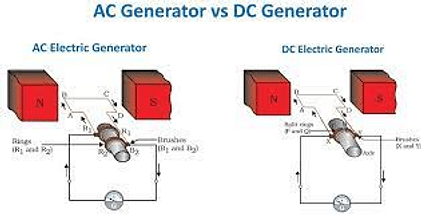
The Differences between AC and DC generators on various parameters include:
| Points of Difference | AC Generator | DC Generator |
|---|---|---|
| Output Power | It generates alternating current electric power | It produces direct current electric power |
| Rings | Slip-rings | Split-ring commutators |
| Induction Current | Its output current can be induced either through the stator or in the rotor | Its output current is induced in rotor part only |
| Current Direction | It flows in opposite directions periodically | It flows in one direction only |
| Commutator | They don't have commutators | It has commutators through which the current flows in one direction only |
| Transmission and Distribution | Distribution of output is easy | Difficult to distribute the output |
| Efficiency | Loss of energy is less | Losses in DC generator are less sufficient due to sparking |
| Maintenance | Require less | It requires frequent maintenance |
| Types | Rotating field Single-phase, three-phase, or Rotating armature | Permanent magnet, Separately-excited, Self-excited |
| Voltage Distribution | Uses of transformer for ac voltage distribution | Transformers are not used |
| Voltage level | Generate very high voltage | Generate fewer voltages |
Note: Despite differences between the generators, there are some similarities between the two. Both the two generators work on the relative motion of the coil and generate electricity using the magnetic field.
Also Read: NCERT Solutions for Class 6 to 12 PDFs
Things to Remember
- AC Generator basically works on the principle of EMI (Electromagnetic Induction).
- An AC generator converts mechanical energy into alternating electrical energy.
- There are fewer energy losses in AC generators as compared to DC generators.
- Production of large or excessive power using the AC generator can be unsafe.
- DC Generator works on the principle of energetically induced EMF (Electromotive force).
- A direct current generator is an electrical machine whose main function is to convert mechanical energy into direct current electricity.
- The current in the DC generator started flowing in the winding due to the presence of resistance resulting in a copper loss.
Sample Questions
Ques. What are AC generators? (2 marks)
Ans. The machine converts mechanical energy into alternating current electricity is known as Alternating Current or AC generator. It generates the current into a sinusoidal output waveform. It is also known as alternators and is classified as per the construction of the rotor.
Ques. Where are AC and DC generators used? (2 marks)
Ans. Ac generators are used in our home electrical appliances and in small motors such as vacuum cleaners, juicers, and food mixers. Whereas, the direct current generators are used in large power electric motors such as those used in subway systems, steam turbines, etc.
Ques. Is it a battery AC or DC? (2 marks)
Ans. Batteries and electronic devices such as television, computers, and DVD players work on DC electricity - once an AC current enters a device, it is converted into a direct current. A normal battery supplies around 1.5 volts of direct current.
Ques. Which is the better AC or DC generator? (2 marks)
Ans. AC generators are more efficient than DC as the energy losses in alternating current are very less. DCs are less efficient due to the sparking and other losses of copper, eddy current, mechanical, and hysteresis.
Ques. What are the main parts of a DC generator? (1 mark)
Ans. Stator, Rotor, Armature Windings, Yoke, Poles, Pole Shoe, Commutator, and Brushes are some of the components of DC generators.
Ques. What is the advantage of AC over DC? (2 marks)
Ans. It can be used as a step up and step down AC generator in transformers and due to its step-up feature, the transmission link might get thinner. There are fewer energy losses in Ac generators as compared to DC generators.
Ques. What are the types of AC generators? (1 mark)
Ans. There are mainly two types of AC generators and they are:
- Synchronous generators
- Induction generators
Ques. How can one convert an A.C. into a D.C. generator? (1 mark)
Ans. An A.C. generator can be transformed into a D.C. generator by replacing the solid ring arrangement with a split ring arrangement.
Ques. State Fleming’s right-Hand Rule. Give the principle and construction of the AC generator with a simple diagram. (4 marks)
Ans. As per Fleming’s right-hand rule, when the thumb and the central finger of the right hand are kept perpendicular to each other, the thumb exhibits the direction of motion of the conductor, the first finger the direction of the magnetic field the time when the current induced is in the direction of the central finger.

Principle: AC generator works on the principle of electromagnetic induction. The induced current is produced as soon as the current is produced.
Construction: A generator consists of mainly four parts, namely coil, magnets, slip rings, and brushes like an electric motor.
Coil: A large number of insulated copper wires wound on a rectangular frame.
Magnets: A large permanent magnet to provide a strong magnetic field.
Slip rings: Two solid rings connected at the two ends of the coil are used to convey the current produced to the outside circuit.
Brushes: Two carbon brushes remain in sliding contact with slip rings.
Previous Years’ Questions
Ques. State one main difference between A.C and D.C and explain why A.C is preferred over D.C for long-range transmission of electric power? Name one source each of D.C and A.C. (2014) (1 mark)
Ans. The difference between A.C. and D.C. is that the alternating current (A.C.) converts its direction periodically whereas the direct current (D.C.) always flows in one direction.
Secondly, A.C. is preferred over D.C. because it can be transmitted over long distances without much loss of energy.
- DC source: Battery
- AC source: AC Generator
Ques. State what Faraday’s First Law of Electromagnetic Induction means. (2 marks)
Ans. Faraday's first law of electromagnetic induction claims that the flux of the given magnetic field passing through a close looped area changes, as emf is produced. The flux can be changed in multiple ways. In some cases as well, the EMF remains present as long as the flux keeps changing.
Ques. What is the basic principle of an AC generator? (3 marks)
Ans. According to the principle of Faraday’s law of electromagnetic induction, an electromotive force or voltage is generated in a current-carrying conductor. When an armature rotates between the magnetic poles upon the perpendicular axis of the magnetic field, the flux linkage of the armature changes continuously. Due to this, an emf will be induced in the armature.
Previous Year Questions Related to AC and DC Generators
- The instantaneous values of alternating current and voltages in a circuit … (NEET 2012)
- The AC supply gives 30 Vrms … (JIPMER 2003)
- An alternating voltage of 220 V, 50 Hz frequency … (VITEEE 2018)
- RMS value of AC is … (VITEEE 2006)
For Latest Updates on Upcoming Board Exams, Click Here: https://t.me/class_10_12_board_updates
Check-Out:



Comments