



Content Writer
Classification of Animal Kingdom helps identify many animals with various shapes and structures. With over a million animal species identified to date, the necessity for categorization becomes even more critical.
- Classification of Animal Kingdom helps in understanding the ecosystem systematically.
- It helps in defining and placing newly described species in a logical order.
- Taxonomy is the process of classifying organisms systematically.
- Every species has been divided into five kingdoms, one of which being Kingdom Animalia, or the Animal Kingdom.
- Animalia's members are further divided into Phyla, Classes, Orders, Families, and Genuses, depending on the characteristics.
- The arrangement of cells and symmetry of the body is the basis of the classification of organisms.
Key Terms: Classification of Animal Kingdom, Phyla, Classes, Orders, Families, Genuses, Animal Kingdom, Organisms, Non-Chordates, Chordates, Vertebrates, Reptiles, Amphibians, Mammalia
Classification of Animal Kingdom
[Click Here for Sample Questions]
Animals are multicellular eukaryotic creatures that absorb food into their bodies and grow from blastula embryos. More than 1.2 million species have been identified in the animal kingdom.
- Comparative patterns of development and bodily features are used to classify animals.
- Behaviour, metabolic processes, and ancestry are other methods used to classify animal species into phyla.
- The process of classifying organisms into different hierarchies is called taxonomy.
- The presence or absence of a notochord is the main point of classification of the animal kingdom.
- Animals are classified on the basis of digestive or reproductive systems.
- The characteristics of notochord are similar to that of cartilage.
- It appears in the shape of the rod.
Classification of Animal Kingdom is divided into two categories of Non-Chordates and the Chordates
Non-Chordates
Non-chordates are animals that lack the rod-like structure in their bodies. Their phylum comprises creatures from the phyla Porifera, Hemichordata, Echinodermata, Mollusca, Arthropoda, Annelida, Aschelminthes, Platyhelminthes, Ctenophora, and Coelenterata.
- They are all regarded as members of the non-chordates category.
- The circulatory systems of these species are in open form.
- They tend to use both sexual and asexual reproduction.
Characteristics of Non-Chordates
Non-chordates have the following general characteristics:
- They are essentially pseudocoelomate, coelomate, triploblastic, or cylindrical creatures.
- Fertilization occurs indefinitely, although certain species have been shown to have internal fertilization.
- Most of the time, precise sexual differentiation among group members is impossible.
- The non-chordates breathe by using their body surface, trachea, or gills.
Example of Non-ChordatesExample: Saccoglossus and Balanoglossus are two well-known phylum examples. |
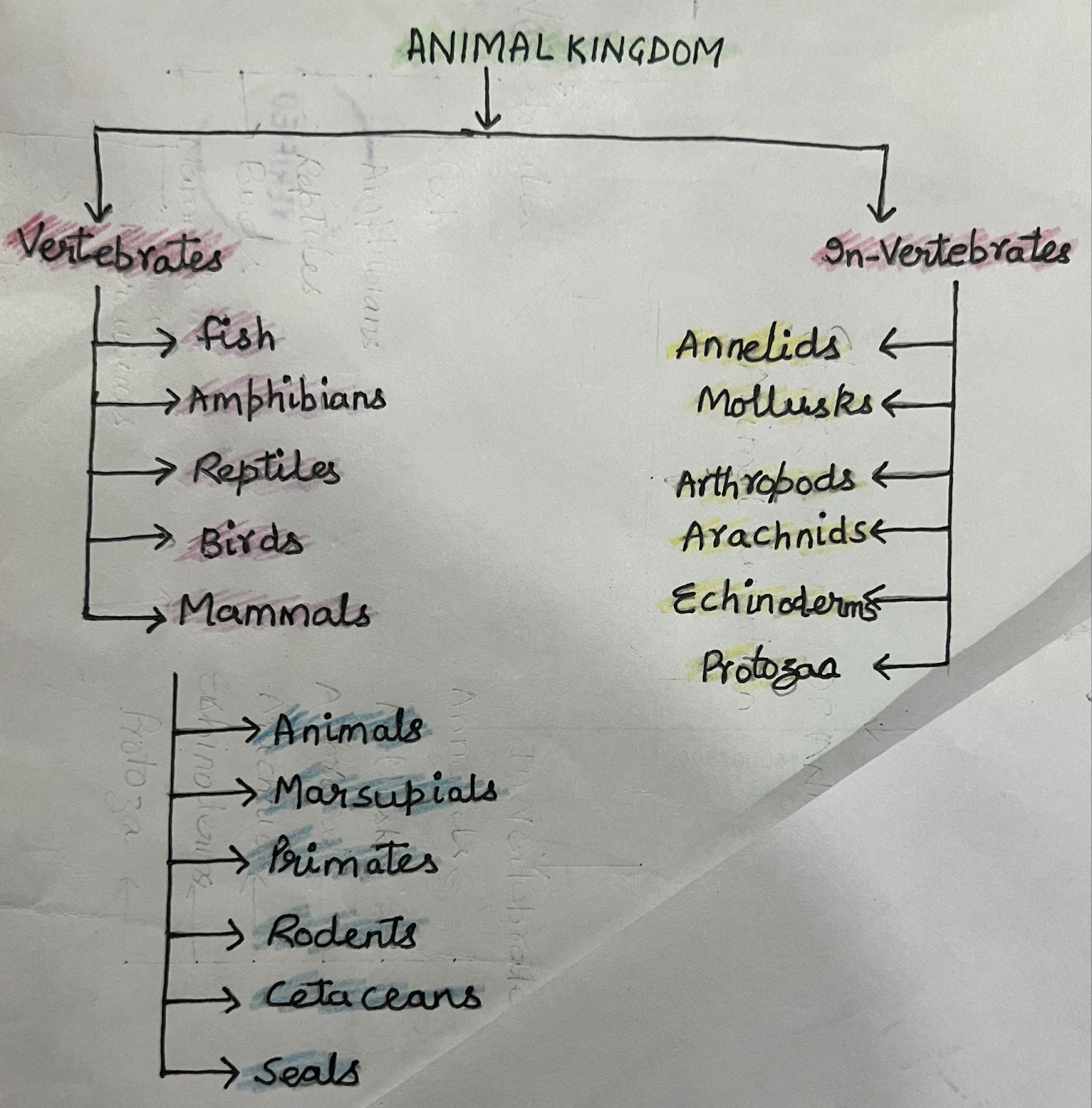
Classification of Animal Kingdom
Read More:
| Chapter Related Topics | ||
|---|---|---|
| Biological Classification | Eubacteria | economic importance of fungi |
| Mycology | where do microorganisms live | |
Chordates
Chordates are animal bodies that have a notochord present at any time during their lives. Pharyngeal gill slits and a hollow nerve cord are distinguished members of this group.
- These animals have a number of fundamental features, including:
- They are symmetrical on both sides with triploblastic, and coelomate with organ-system organisation.
- Chordates have a tail that is in the shape of post-anal.
- The circulatory system in the human body is closed.
- The notochord is found only in the larval tail of certain Phylum Chordata members.
- It is present throughout their lives from head to tail region in others.
- Chordates are divided into numerous sub-groups, with Protochordates being one of the earliest to emerge.
Types of Chordates
Urochordata, Cephalochordata, and Vertebrata are the three subphyla of the Chordata phylum.
- Subphylum Urochordata
Urochordata is a subphylum of the phylum ubphylum. It's also known as Tunicata, which refers to aquatic creatures. These creatures have a leathery coating around their bodies (similar to a tunic, hence the name).
- Larvae are free-swimming, and the notochord is only found in the larvae's tails.
- After resting on the bottom, they convert into sessile adults.
- Hermaphrodites are the most common kind.
Example of Subphylum UrochordataExample: Ascidians, Doliolum, Oikopleura, and other species are examples. |
- Subphylum Cephalochordata
Cephalochordata is a subphylum of the phylum Cephalochordata. It mostly comprises of tiny, fish-like aquatic creatures with a notochord that runs the length of their bodies.
- The creatures also have a big pharynx with many gill slits.
- The sexes of members of this subphylum are distinct.
Example of Subphylum CephalochordataExample: Amphioxus or lancelet are two examples. |
- Subphylum Vertebrata
Vertebrata is a subphylum of the Vertebrata phylum. The notochord is present in the embryonic stages of this subphylum and is replaced by a vertebral column in adulthood.
- They have a heart with two, three, or four chambers, paired appendages for movement, and kidneys for excretion or osmoregulation.
Read More: Difference Between Frog and Toad
Vertebrates Classification
[Click Here for Sample Questions]
Vertebrates are classified into five groups in the subphylum Vertebrata. All animal species that have evolved a vertebral column as well as an internal skeleton belong to these five groups of vertebrates.
- There are approximately 66,000 vertebrate species in the phylum Chordata.
- Vertebrates are distinguished by bilateral symmetry, coelomic, triploblastic bodies, and complex tissue.
Characteristics of Vertebrates
The important characteristics of vertebrates are as follows:
- For body mobility, the presence of a genuine vertebral column and internal skeleton with muscle attachment sites is important.
- A muscular front-side heart has two, three, or four chambers.
- Kidneys are responsible for excretion as well as osmoregulation.
- Fins or limbs are examples of paired appendages.
- During the embryonic stage, the notochord is present in vertebrate.
- Vertebrates happen to be the only chordates with a central nervous system that includes a brain.
Classification of Vertebrates
Vertebrates are classified as follows:
Pisces (Fishes)
Fish are defined as "gill-bearing aquatic craniate creatures that lack digits on their limbs." This class has the most varied and extensive range of vertebrates, with about 30,000 species.
- 41% of the population lives in fresh water, 58 percent resides in the sea region.
- The remaining 1% travels between the two.
- The species' body structure typically follows the head, trunk, and tail pattern.
- All fishes lack fins, which are divided into two types: paired and unpaired fins.
- Paired fins consists of pelvic and pectoral fins.
- Unpaired fins consists of anal, caudal and dorsal fins.
Amphibia
Amphibians are animals that can live on land and in water and are known for having a "double existence." Caecilians, toads, frogs, and salamanders are among the almost 3,900 species that make up this animal group.
- Amphibians are unable to regulate their body temperature.
- Their skin types limit the range of conditions in which they may live, from damp to hot.
- They need both gills and lungs as they breathe with gills during the larval stage and with lungs when they reach maturity.
Read More:
| Class 12 Biology Related Concepts | ||
|---|---|---|
| fungus life cycle | Mycorrhiza | Prions |
| Cyanobacteria | Heterotrophic Bacteria | Saprophytes |
Reptilia
All turtles, crocodiles, lizards, and snakes on the planet are classified as reptiles. Reptilia is a class of animals that includes almost a thousand species on the globe. They're further broken down into the following categories:
- Testudines are approximately 3000 species of tortoises, terrapins and turtles.
- Squamata are about 9150 species of worm lizards and snakes.
- Sphenodontia ( 2 tuatara species)
- Crocodilia are 23 species of gharial, alligators, caiman, and crocodiles
Class Aves (Birds)
These are cold-blooded, bipedal feathery creatures that can maintain a consistent body temperature range. The appendages on the front of their bodies are fashioned like wings.
- Most creatures in this class can fly high into the sky, though there are a few exceptions.
- There are almost 9,000 species in the Aves class.
Mammalia
This category includes warm-blooded animals with hair on their bodies and the ability to make milk. This group of mammals is the only one that feeds milk to their offspring.
- There are almost 4,000 mammal species on the planet.
- Humans, Koalas, cows, and other animals are regarded to be part of this group.
Things to Remember
- Classification of Animal Kingdoms is classified on the basis of the presence of notochord.
- Most organisms belonging to this category are eukaryotic in nature.
- These type of organisms cannot produce their own food.
- Tissue level refers to cells performing similar functions within the tissues.
- The classification is also based on the process of fertilisation.
Sample Questions
Ques: Which classification of algae has mannitol as the reserve food material? (1 mark)
Ans: The Phaeophyceae group or what is commonly called the brown algae has mannitol as the reserve food material.
Ques: In the plant kingdom, does heterospory have any evolutionary significance? (2 marks)
Ans: Pteridophytes are a kind of plant that falls between bryophytes and gymnosperms. Homosporous pteridophytes are homosporous, while heterosporous pteridophytes are found later in life. Gymnosperms are heterosporous, while bryophytes are homosporous.
Ques: Discuss the evolutionary connection between Cycas and any other plant group? (4 marks)
Ans: Cycas is a kind of palm-like evergreen plant. It shares a phylogenetic tree with the pteridophyte. Among the evolutionary characteristics are:
- When an embryo is immature, it sheds its seed.
- Growth is slow.
- Wood that is monocyclic.
- There isn't much secondary growth.
- Megasporophylls that look like leaves.
- Physics should be circulated.
- Leaf bases that don't go away.
- Microsporangia are arranged in well-defined archegonia.
Ques: Which plants have mycorrhizal and coralloid roots? What exactly do these words imply? (2 marks)
Ans: Mycorrhiza is a symbiotic relationship between fungi and vascular plant roots. Conifers such as Pinus, Cedrus, and others have a mycorrhizal relationship. In Cycas, there are coralloid roots. Coralloid roots extend above the ground and are found in clusters at the base of the stem. It has a greenish colour and a dichotomous branching pattern.
Ques. What is mammalia? (2 marks)
Ans. Mammalia includes warm-blooded animals with hair on their bodies and the ability to make milk. This group of mammals is the only one that feeds milk to their offspring, and there are almost 4,000 mammal species on the planet. Humans, Koalas, cows, and other animals are regarded to be part of this group.
Ques. What are the characteristics of Non-chordata? (3 marks)
Ans. The characteristics of Non-chordata are as follows:
- They are essentially pseudocoelomate, coelomate, triploblastic, or cylindrical creatures.
- Fertilization occurs indefinitely, although certain species have been shown to have internal fertilization.
- Most of the time, precise sexual differentiation among group members is impossible.
- The non-chordates breathe by using their body surface, trachea, or gills.
Ques: Discuss the importance of Algae? (4 marks)
Ans: The importance of algae are as follows:
- Algae are economically significant in a variety of ways, as mentioned below:
- Aids in the fixation of carbon dioxide.
- In a food chain, they are the most basic producers.
- There is an increased amount of dissolved oxygen in the environment.
- Algae come in a variety of types and are utilised as a food source.
- They provide crude oil as well as a variety of medicinal and industrial goods utilised by humans.
Ques: Name the characteristics of the vertebrates? (4 marks)
Ans. The following are some of the most significant traits of vertebrates:
- An actual vertebral column and internal skeleton with muscle attachment sites are necessary for bodily motion.
- A front-side cardiac muscle contains two, three, or four chambers.
- Osmoregulation and excretion are handled by the kidneys.
- Pairs of appendages include fins and limbs.
- In vertebrates, the notochord is present during the embryonic period.
- As it happens, the only chordates possessing a central nervous system with a brain are vertebrates.
Ques. Name different types of chordata? (3 marks)
Ans. The different types of chordata are as follows:
- Subphylum Urochordata: The phylum ubphylum contains the subphylum urocordata. It also goes by the name Tunicata, which describes aquatic animals.
- Subphylum Cephalochordata: Within the phylum Cephalochordata lies the subphylum Cephalochordata. It is largely made up of small aquatic animals that resemble fish and have a notochord that runs the length of their bodies.
- Subphylum Vertebrata: Within the phylum Vertebrata is the subphylum Vertebrata. In this subphylum, the notochord is present during the embryonic stages and is replaced by the vertebral column at adulthood.
Ques. Name different catregories of reptilia? (3 marks)
Ans. The different categories of reptilia are as follows:
- Testudines are approximately 3000 species of tortoises, terrapins and turtles.
- Squamata are about 9150 species of worm lizards and snakes.
- Sphenodontia ( 2 tuatara species)
- Crocodilia are 23 species of gharial, alligators, caiman, and crocodiles
Ques. What is the difference between Non-Chordata and Chordata? (3 marks)
Ans. The difference between Non-Chordata and Chordata are as follows:
| Non-Chordata | Chordata |
|---|---|
| Notochord are absent in these organisms. | Notochord are present in these organisms. |
| They are either cold-blooded or warm blooded animals. | They are cold-blooded animals. |
| Respiration occur through lungs or gills. | Respiration take place through trachea. |
Read Also:



Comments