



Education Content Expert
Conservation of Momentum is a fundamental law of Physics that states that the momentum of a system remains constant if no external force acts on the system. The momentum of a body is calculated as p = mv.
- In Newtonian mechanics, the mass and velocity of a body are combined to form momentum, precisely linear momentum or translational momentum.
- Momentum has both a magnitude and a direction and is thus a vector quantity.
- Momentum is embodied in Newton's First Law of Motion or Law of Inertia.
- Law of Conservation of Momentum is amply supported by experiments and can even be analytically derived.
Conservation of Momentum Formula is given as:
| m1u1 + m2u2 = m1v1 + m2v2 |
Read More: NCERT Solutions for Class 11 Physics Laws of Motion
Key Terms: Conservation of Momentum, Linear Momentum, Momentum, Force, Velocity, Collision, System of Bodies, Mass
What is Conservation of Momentum?
[Click Here for Sample Questions]
Momentum is defined as a measurement of mass in motion. Momentum of a body is calculated by multiplying its mass by its velocity, i.e.
| p = mv |
When two bodies interact with each other without the presence of an external, unbalanced force, conservation of momentum is observed. Thus, the combined momentum of a system remains unchanged.
Example: Consider an example, When two balls are going in the same direction, they collide. The balls collided with each other in this case because they were going in the same direction and not due to any external, unbalanced force.

During a collision, no external force is acting on the system. The only force acting on each ball is the reaction force due to another ball. The magnitude of these reaction forces is the same and the direction is opposite, hence they will cancel out each other.

Here, FBA = FAB
After the collision, the balls will be separated from each other and move with velocities v1 and v2 respectively.
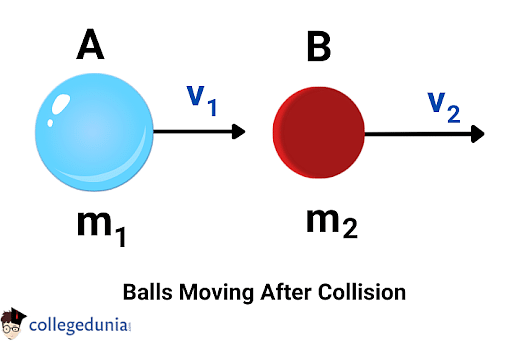
- In such a case, the overall momentum of the balls before the impact and after will be equal.
- As a result, throughout the balls' contact, their complete momentum (momentum of a system) was conserved.
Unit of Momentum
The CGS unit of momentum is g cm/s, while the SI unit is kg m/s. In translational motion, each body particle moves in the same direction.
Read More:
Conservation of Linear Momentum
[Click Here for Previous Year Questions]
Newton's Second Law of Motion, which stipulates that in an isolated system, the total momentum stays constant, forms the foundation for the conservation of linear momentum. Here linear momentum is taken into account while discussing the translational motion.
- The linear momentum of a moving body is the product of its mass and velocity.
- The direction of Linear momentum is the same as the direction of the body's velocity.
For example, a bullet fired from our hand may not harm somebody, while a bullet fired from a gun may do so. Even though the bullet's mass is the same in all scenarios, because:
- When fired from a gun, its velocity drastically changes, thus
- Momentum increases rapidly making it more dangerous that may cause harm.
Conservation of Momentum Formula
[Click Here for Sample Questions]
Mathematically, Law of Conservation of Momentum can be written as:
- Ptotal before Collision = m1u1 + m2u2
- Ptotal after Collision = m1v1 + m2v2
Hence, Conservation of Momentum Formula is given as:
| m1u1 + m2u2 = m1v1 + m2v2 |
Here,
- m1 and m2 are the masses of two bodies that collide with each other.
- u1 and u2 are their initial velocities before they collide.
- v1 and v2 are the final velocities of the bodies after the collision.
When no external force is acting on the system, even while the momentum of each particle varies, the total momentum of the system does not change.
Read Also: Types of Forces
Consider an example
When two cars collide head-on, then,
- Momentum is transmitted from one to the other, but the force is so great that the car's structure can no longer support it, which is why the cars crash.
- Given that their weights are equal if the automobiles could withstand the force and the collision was elastic, they would both travel in opposite directions.
Conservation of Momentum Example
[Click Here for Previous Year Questions]
Take a balloon as an example of Conservation of Momentum.
- Gas particles are moving quickly and colliding with the balloon's walls.
- The particles are moving faster and get slowed down after collisions. As a result, the total momentum of the system remains unchanged.
Therefore, the balloon doesn't vary in size even though, if we add external energy by heating it, the balloon should expand because doing so would increase the particles' momentum and, consequently, the force that they exert on the balloon's walls.
Read More: Laws of Motion Class 11 Important Questions
Law of Conservation of Momentum
[Click Here for Sample Questions]
Law of Conservation of Momentum concerns the overall momentum of the bodies interacting with one another without being affected by an external, unbalanced force.
- According to the law of conservation of momentum, when two or more bodies interact, the vector sum of their linear momenta is unaffected by their reaction.
- Given that the system of bodies should not be under the influence of any outside influences that are out of balance.
Applications of Law of Conservation of Momentum
[Click Here for Previous Year Questions]
Following are the applications of the Law of Conservation of Momentum:
- Firearm's Recoil: When a bullet is shot from a gun, the weapon recoils in the opposite direction of the bullet and it harms the arm of the shooter. To prevent injury, the shooter should maintain a firm grip on the pistol. According to the rule of conservation of momentum, the gun will recoil in the opposite direction.
- Fireman Pressure: The fireman experiences high momentum motion in the opposite direction to that of the water streaming forward from the hose of the firefighting vehicle. Therefore, the fireman needs to use a lot of force to hold the hose properly. The law of conservation of momentum is followed by the rearward push on the hose.
- Rocket taking off from the Surface: While taking off, the chemicals are burnt in the fuel to produce high velocity. The gasses released from the nozzle of the rocket push it downward with the same velocity that pushes the rocket upward.
Check More:
Things to Remember
- Conservation of Momentum states that the system’s momentum remains constant if no external force is applied to it.
- The momentum of a body is determined by multiplying its mass by its speed.
- Momentum has both magnitude and direction thus it is a vector quantity.
- Conservation of momentum is observed when the body interacts with one another without the help of an unbalanced external force.
- Conservation of Momentum Formula is m1u1 + m2u2 = m1v1 + m2v2.
- The vector sum of two or more bodies' linear momenta is unaffected by their reaction when they interact.
Previous Years’ Questions
- A circular disc is rotating about its own axis. An external… (CBSE CLASS XII)
- A shell of mass 10 kg is moving with a velocity of… (WBJEE - 2008)
- The position of both an electron and helium atom is known… (NEET - 1998)
- A body of mass M kg initially at rest explodes into three… (AMUEEE - 1999)
- Identify the wrong statement… (AMUEEE - 2009)
- System shown in figure is in equilibrium and at rest. The spring… (JEE Advanced - 2006)
- The orbital angular momentum of an electron in 2s-orbital is… (JEE Advanced - 1996)
- A rocket is about to launch upwards from its platform. The… (TS EAMCET - 2018)
- Two carts of masses 200kg and 300kg on horizontal rails… (Chhattisgarh PMT - 2007)
- A heavy ball is thrown on a rough horizontal surface… (JIPMER - 1998)
Sample Questions
Ques. If two bodies X and Y of the same mass collide with each other, and the body X exerts a Force of 1000 N on body Y in the right direction, then how much Force will body Y exert on Body X, and in which direction? (2 Marks)
Ans. According to the conservation of momentum, when two bodies interact/ collide with each other, they have an equal and opposite reaction to each other. Therefore, body Y will also exert 1000 N force on Body X in the opposite direction, i.e., in the left direction.
Ques. State True or False: In the launch of rockets, the conservation of linear momentum is observed. Explain. (2 Marks)
Ans. It is true because momentum conservation is perfectly demonstrated by the rocket's launch. Since the system's mass is not constant in this case, fuel is ejected from the rocket to provide thrust. The rocket moves upward by pushing the exhaust gas downward with the help of the burned fuel.
Ques. What is Law of Conservation of Momentum? (3 Marks)
Ans. Law of Conservation of Momentum states that if there is no external force acting on the colliding objects, the total momentum before and after the collision will be the same. Final momentum minus initial momentum is zero, implying that the Final and initial momentum are the same. Thus,
M1U1 + M2U2= M1V1 + M2V2
Ques. A 12kg ball is thrown right at 20m/s and collides with a 28kg ball while in the air. What was the velocity of the second ball if the balls collided and fell straight down to the ground? (3 Marks)
Ans. We are aware that the total horizontal momentum would be zero if the balls had fallen straight down after the collision. Rather than any leftover horizontal momentum, the only motion is brought about by gravity. The starting and final momentum values must be equal for momentum to be conserved. The starting horizontal momentum must also be zero if the end horizontal momentum is zero.
- pi = pf
- m1v1+m2v2 = m1v3+m2v4
In the given situation, the final momentum is going to be zero.
Therefore, m1v1+m2v2 = 0
Use the given values for the mass of each ball and the initial velocity of the first ball to find the initial velocity of the second.
⇒ (12kg) × (20m/s) + (28kg) × v2=0
⇒ (240N) + (28kg) × (v2) = 0
⇒ (28kg) × (v2) =−240N
v2= −(240N/28kg) = −8.6 m/s
∴ The velocity of the second ball is -8.6 m/s.
The negative sign tells us the second ball is traveling in the opposite direction as the first, meaning it must be moving left.
Ques. A body of variable mass is initially traveling at a speed of 5 m/s and then accelerates to 10 m/s over time. If the body is moving without the assistance of any external force, what is the new mass? (3 Marks)
Ans. Since there is no outside force acting on the body, momentum is still preserved. Let the new mass is ‘m2’.
Then,
m1v1 = m2v2.
m1 = 5 kg, v2 = 10 m/s,
and v1 = 5 m/s.
Put the values in the above formula
⇒ (5 kg) x (5 m/s) = m2 x 10 m/s
m2 = 2.5 kg
∴ The new mass of a body is 2.5 Kg.
Ques. Two objects, each weighing 2 kg and 7 kg, are traveling at speeds of 2 m/s and 7 m/s, respectively. What is the system's overall momentum? Expressed in kg/s. (3 Marks)
Ans. Since both bodies are traveling at a constant speed, they both have momentum.
The sum of the momenta of the bodies makes up the system's momentum.
Thus, total momentum equals
M1U1 + M2U2
= (2 kg) x (2 m/s) + (7 kg) x (7 m/s),
= 53 kg/s.
Therefore, the total momentum of the system is equal to 53 kg/s.
Ques. A 3kg ball is thrown west at 20m/s and collides with a 14kg ball while in the air. Determine the velocity of the second if the ball collides and fell straight down to the ground. (3 Marks)
Ans. We know that the total horizontal momentum would be zero if the balls had fallen straight down after the collision. The only motion is brought about by gravity. For momentum to be conserved, starting and final momentum would be equal. If the end horizontal momentum is zero, then the starting horizontal momentum must also be zero.
- pi = pf
- m1v1+m2v2 = m1v3+m2v4
In the given situation, the final momentum is going to be zero.
Therefore, m1v1+m2v2 = 0
Use the given values for the mass of each ball and the initial velocity of the first ball to find the initial velocity of the second.
⇒ (3 kg) × (20 m/s) + (14 kg) v2=0
⇒ (60N) + (14 kg) × (v2) = 0
⇒ (14 kg) × (v2) = −60N
v2 = −(60N/14kg) = −4.3m/s
∴ The velocity of the second ball is -4.3 m/s.
Note: The negative sign tells us the second ball is traveling in the opposite direction as the first, meaning it must be moving east.
Ques. A 10kg ball moving at 15 ms strikes a 20kg ball at rest. After the collision, the 10kg ball is moving with a velocity of 8 m/s. Find the velocity of the second ball. (3 Marks)
Ans. This is an elastic collision. Therefore, by using the law of conservation of momentum to equate the initial and final terms, we get
m1v1 initial + m2v2 initial=m1v1 final + m2v2 final
Putting the given values to solve for v2final.
⇒ (10 kg) × (15 m/s) + (20 kg) × (0 ms) = (10 kg) × (8 m/s) + (12 kg) × (v2final)
⇒ 150 kgm/s + 0 kgm/s = (80 kgm/s) + (20 kg) × (v2 final)
⇒ 150 kgm/s − 80 kgm/s = 20 kg × (v2 final)
⇒ 70 kgm/s = 20 kg × v2 final
⇒ 70 kgm/s × 20 kg = v2 final
v2 final = 3.5 m/s
∴ The velocity of the second ball is 3.5 m/s.
Ques. A 20kg object moves to the right at 40m/s. It collides head-on with a 40kg object moving to the left at 20m/s. Which statement is correct? (3 Marks)
Ans. The total momentum before the collision is equal to the momentum of each object added together, according to the Law of Conservation of momentum.
- P = mv
- 20kg × (40m/s) = 80kgm/s
We know that moving in the opposite direction means that the object has a negative velocity
40 kg × (20m/s) = −80 kgm/s
Total momentum = 80 kgm/s + (−80 kgm/s) = 0 kgm/s
The total momentum at the conclusion must be equal to the total momentum at the beginning, according to the law of conservation of momentum. Since there was no momentum in the beginning, there would also be no momentum at the conclusion.
Ques. A ball of mass 5 kg is moving with a velocity of 10 m/s and collides with a ball of mass 4kg moving in the same direction at 4 m/s. If the collision is elastic, find their velocities after the collision. (3 Marks)
Ans. Let the velocity of a 5 kg ball after the collision be v1 and v2 of a 4 kg ball.
From the law of conservation of momentum,
Velocityapproach = Velocityseparation
10 m/s - 4 m/s = v2 - v1
⇒ v2 - v1 = 6 m/s …(1)
Apply conservation of momentum,
m1(v)initial + m2(v)initial = m1v1 + m2v2
⇒ [5 kg x 10 m/s + 4 kg x 4 m/s] = 10v1 + 4v2
⇒ 66 m/s = 10v1 + 4v2
⇒ 5v1 + 2v2 = 33 m/s …(2)
Solving eq (1) and (2) we get,
v1 = 3 m/s and v2 = 9 m/s
∴ The velocity of a 5 kg ball is 3 m/s and 9 m/s of the 4 kg ball after the collision.
For Latest Updates on Upcoming Board Exams, Click Here: https://t.me/class_10_12_board_updates
Check-Out:



Comments