



Content Curator
Conservation laws in Physics are a principle based on experiments and observation, which cannot be proved. Some of the conserved quantities other than the main four (energy, mass, linear and angular momentum) are called spin, strangeness, baryon number, and so on.
The initial law of conservation of energy states that energy can neither be created nor be destroyed but only change from one form to another over time and remains constant. Similarly, many other laws are considered.
| Table of Content |
Keyterms: Energy, Mass, Linear and angular momentum, Initial law, Conservation, Spin, Strangeness, Baryon number
Read Also: Faraday’s Law of Electromagnetic Induction
What are Conservation Laws in Physics?
[Click Here for Sample Questions]
Conservation laws are explained below for your understanding:
Law Of Conservation Of Energy
This law states that, when a system is isolated from its surroundings, the energy of the system is always conserved.
- Energy is always constant with respect to time.
- Energy can only transform from one form to another.
- The overall energy of the universe is never unchanged.
Examples: Kinetic energy, potential energy, chemical energy, and mechanical energy.
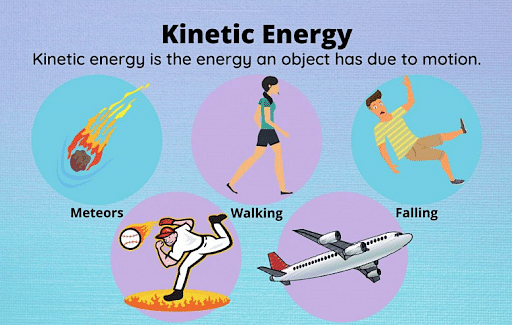
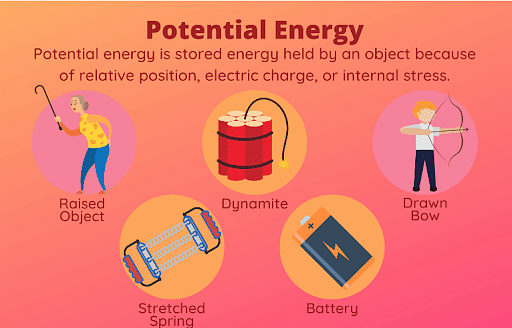
Examples of Kinetic and Potential Energy
Law of Conservation of Mass
This law states that mass can neither be destroyed nor be created in a chemical reaction.
- Atoms rearrange themselves in different fashions among different molecules, in a chemical reaction, hence the mass remains constant.
- Since the mass remains constant, the total reactant mass and the total product mass remain the same.
- Chemical reactions can be both exothermic and endothermic.
Example: Carbon, being both solid and gas, holds the same mass and doesn’t change with the matter.
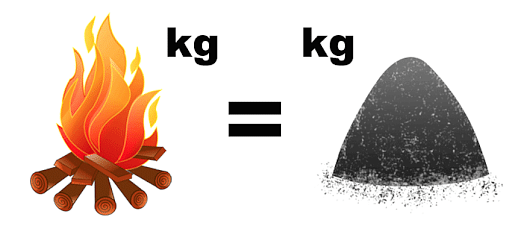
Example of Law of Conservation of Mass
Law of Conservation of Linear Momentum
This law states that in an isolated system when two objects collide the momentum of the system remains constant. The total linear momentum before and after the interaction remains the same.
Example: The gravitational force on the moon and the earth remains the same.
Law of Conservation of Angular Momentum
This law states that the total angular momentum of a system does not change and is conserved when the net external torque acting upon the system is null.
Example: A spin achieved by a skater on ice, Isotropy of space explains this law.
Read More:
Derivations of Conservation Laws:
[Click Here for Previous Year Questions]
Here are some Derivations of Conservation Laws:
Mechanical Energy = Potential energy + kinetic energy
E = U+K
- Potential energy is given by U = mgh, where m is mass, h is height and g is the gravity of earth.
- Kinetic energy is given by K =1/2 mv2, it is the energy of the body in motion.
Consider a freely falling body,
The force exerted on the body is F= mg
Now, if the body falling is from height H, the potential energy is U1= mgH…(1)
The kinetic energy here is 0 as its speed is 0 and due to height.
Now, potential energy at time t and height h is, U2 = mgh …(2)
Comparing (1) and (2)… change in potential energy (\(\bigtriangleup\)U)= U1-U2.
Considering the same body falling with speed v1
F= ma and a (acceleration due to gravity) = v *dv/dx
F = m.v dv/dx
Now on integration on both sides,
\(\int F.dx=\int_{v1}^{v2}m.vdv\)
Here, F= mg and v1 and v2 is 0 and v respectively,
\(\int mg.dx=\int_{0}^{v}m.vdv\)
mgx = 1/2mv2
Let x be the displacement of the body, x = H-h
mg(H-h) = ½ mv2 = \(\bigtriangleup\)K
On comparing \(\bigtriangleup\)K and \(\bigtriangleup\)U, we infer that
\(\bigtriangleup\)K = -\(\bigtriangleup\)U…(3)
\(\bigtriangleup\)E = \(\bigtriangleup\)U+\(\bigtriangleup\)K
On substituting (3)
\(\bigtriangleup\)E = 0, states that energy is conserved.
Equation for Law of conservation of mass
E= mc2, c is the speed of light.
Read Also:
Things to Remember
- The general laws of conservation include, energy, mass, linear momentum and angular momentum.
- Conservation laws basically deal with the fundamental forces of nature.
- The energy produced in conservation of mass is similar to Einstein’s theory, E= mc2
- Acceleration due to gravity on the moon is 1/6th than that of the earth.
- The chemical reaction typically means atoms rearranging themselves among different molecules.
- The law of conservation of angular momentum explains the isotropy of space.
Read More: Energy Consideration Important Notes
Previous Year Questions
- A planet in a distant solar system is 10 times more massive …
- The speed of earth’s rotation about its axis is …
- At what height above the …
- Which of the following is true for rays coming from infinity? [DUET 2006]
- A point source of light S, placed at a distance L in front of the centre of a plane mirror … [DUET 2000]
- A girl of height 150 cm with her eye level at 140cm … [KCET 2019]
- A given ray of light suffers minimum deviation in an equilateral prism … [NEET 2001]
- A biconvex lens has a radius of curvature of magnitude 20 cm. Which one of the … [NEET 2011]
- Read the following statements … [AMUEEE 2009]
- The nearest star to our solar system … [AMUEEE 2009]
- The volume of a cube in … [DUET 2006]
- What is dimensional formula of thermal conductivity … [DUET 2006]
- In the formula …
- Two planets are revolving around the earth with velocities …
- Earth is revolving around the sun …
- Imagine a new planet having the same density …
Sample Questions
Ques. A body with mass of 5kg is dropped from a height of 70m; if the velocity of the body is 10m/s, and gravity is 10m/s2, find the kinetic energy? (2 Marks)
Ans. Kinetic energy = 1/2mv2
= 1/2 x 5 x 102
Kinetic energy = 250 J
Ques. How can we conserve energy? (2 Marks)
Ans. When it comes to conserving energy it not only means saving it but also means preserving it, using it less, using it only when needed. So energy as we know cannot be created or destroyed, and can only change form, so use it wisely and replace the exhausted resources with renewable ones.
Ques. What is the velocity of a body with a mass 80 kg and kinetic energy being 4 1600J? (2 Marks)
Ans. Mass = 80 kg
Kinetic Energy = 1600 J
KE = ½ mv2
1600 = ½ 80 x v2
1600/40 = v2
v = √40 = 6.32 m/s
Ques. Find the potential energy if m= 20kg and height = 34cm. (2 Marks)
Ans. Height = 34cm = 0.34m
U = mgh
U = 20x9.81x0.34
Acceleration due to gravity = 9.81m/s2
Therefore, potential energy U = 66.7 J
Ques. List a few examples of law of conservation of momentum. (2 Marks)
Ans. Examples of law of conservation of momentum are:
- Newton’s cradle
- Rockets in motion
- Air-filled balloons
- Bullet fired from a gun
- Collision between two hockey pucks
Ques. Give examples of conservation of energy. (2 Marks)
Ans. Here are some examples of conservation of energy.
- Electrical energy is converted into sound energy, in speakers.
- Mechanical energy is converted into electrical energy.
- Sound energy is converted into electrical energy, in a generator.
- Hydroelectric power plants.
- In batteries, chemical energy is converted to electrical energy in turn converted to light and heat
Ques. A pendulum with a mass of 50kg reaches a height of 5m. Find the velocity at the bottom point in oscillation? (3 Marks)
Ans. Step 1: for the potential energy at the height of 5m.
PE = mgh
PE = (50)(10)(5) = 2500J
This must be equal to the maximum kinetic energy of the object.
KE = ½mv2
2500J = ½mv2
Step 2: Now solve for v.
9720J = ½(50) v2
v = 10m/s
Ques. Consider two bodies with masses 2kg and 4kg at rest. The body 4kg moves towards the east with a velocity of 10 m/s. Find the velocity of the body with 2kg with respect to ground. (2 Marks)
Ans. m1 = 2kg
m2 = 4kg
v1 = ?
v2 = 10m/s
According to the law of conservation of momentum,
P (initial) = 0, as the cars are at rest
P (final) = p1 + p2
P (final) = m1.v1 + m2.v2
= 2 x v1 + 4x10
P (initial) = P (final)
0 = 2v1+40
v1 = 20m/s
Check Out:



Comments