



Education Journalist | Study Abroad Lead
Conventional and Non-conventional sources of energy are the two important classifications of energy sources. Conventional sources of energy are non-renewable while non-conventional sources are renewable in nature. Energy refers to the ability of any physical system to perform work. Energy comes from various sources and is used by us daily to do work. The various types of energy include Electrical Energy, Potential Energy, Kinetic Energy, Thermal Energy, Nuclear Energy, Chemical Energy, etc. To do physical work, we use muscular energy, electrical energy is used for operating multiple appliances, chemical energy is used to cook the food, and much more.
Key Takeaways: Conventional Sources of Energy, Non-conventional Sources of Energy, Energy, Coal, Fuel, Petroleum, Natural Gas, Oil
Sources of Energy
[Click Here for Sample Questions]
Energy is an important component of our economic infrastructure. The sources or resources of energy are necessary for mankind. It is an important commodity for a developing economy. Majorly, there are two sources of energy which are mainly classified as:

Conventional and Non-Conventional Sources of Energy
Read More:
Conventional Sources of Energy
[Click Here for Sample Questions]
The non-renewable sources of energy that are present in a limited quantity in nature, apart from hydroelectric power, are known as conventional sources of energy.
- These sources are being consumed by humans for many years.
- These energy sources take over hundreds of years to be formed.
- Hence, if they get depleted once, they can't be generated rapidly again to sustain the rate of consumption.
- It is further classified into commercial and non-commercial energy sources.
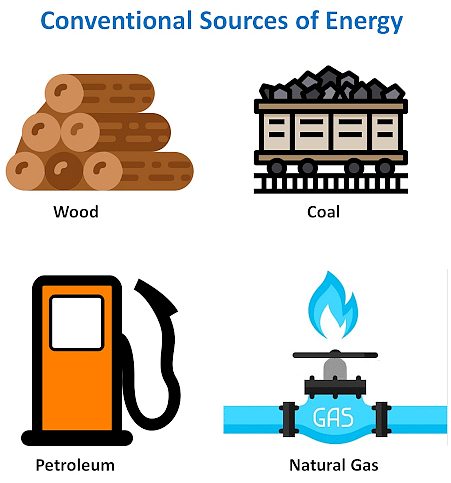
Conventional Sources of Energy
Commercial Energy Sources
The main commercial energy sources are electricity, coal, and petroleum. These are commercial as a person who consumes them i.e. the consumer needs to pay a certain price in order to buy them.
Electricity
Electricity is a common kind of energy that is used for commercial and domestic purposes. It has a flow of electrons in a direction. It is mainly used in most electrical appliances such as T.V, fridges, air conditioning, and washing machines. Electricity can be generated using nuclear power, fossil fuels, and many other renewable alternatives. The major sources through which power is generated are:
-
Hydroelectric power
The power produced by the flow of water in dams is known as hydroelectric power. The water that flows is captured and is then transformed into electricity. Water is stored in a reservoir, from where it flows through a turbine. The turbine then activates a generator, producing electricity.
-
Nuclear Power
Nuclear Power Plants make use of fuel known as Uranium. This is less expensive and more affordable as compared to coal. Various nuclear power plants are found in Kota (Rajasthan), Kaiga (Karnataka), Kalpakkam (Chennai), and Naroura (UP). Nuclear Power is mainly used in nuclear fusion, nuclear fission, and nuclear decay reactions.
-
Thermal Power
At various places, thermal power is produced at power stations by using coal and oil. Thermal power is an important source of electric current. Thermal power is produced by converting fuel into heat. It is done using specially designed furnaces and thermal generators. In a thermal power plant, fuel is burnt for boiling water, and steam is produced. This steam is then spun in a turbine that is connected to a generator that forms electricity.
Coal
Coal is the most prominent energy source. Huge coal deposits are found in various regions of India such as Madhya Pradesh, Orissa, Bihar, Bengal, and Jharkhand.
- Coal is formed when the dead plant matter is accumulated and decayed into peat.
- Through the application of heat and pressure for over a million years, coal is formed.
- It is mainly composed of Carbon. Other elements such as Sulphur, Oxygen, Nitrogen, and Hydrogen are present in coal in varying amounts.
Natural Gas and Oil
Natural gas is a vital source of energy while oil is widely considered liquid gold.
- It is a crucial source of energy in India. Oil is mainly used in automobiles, ships, trains, and planes.
- Oil is mainly found in regions of Gujarat, Mumbai, and Assam.
- When a large number of tiny plants and animals die and are trapped at the bottom of the sea under multiple layers of decomposing plant and animal matter and are then exposed to pressure and heat.
- Natural gas is used for many purposes such as the generation of electricity, heating, and cooking of food.
Non-commercial Energy Sources
The energy sources that are freely available are considered non-commercial energy sources. Some examples of these types of sources are firewood, dried dung, straw, etc.
Non-conventional Energy Sources
[Click Here for Sample Questions]
Generally, renewable sources of energy are referred to as non-conventional sources of energy. These sources are easily replenished through various natural processes. Some examples of these energy sources are wind energy, bioenergy, tidal energy, and solar energy. They can not be easily exhausted and can also be produced regularly at a constant rate so that they can be used again and again. These sources of energy do not pollute nature and are less expensive.
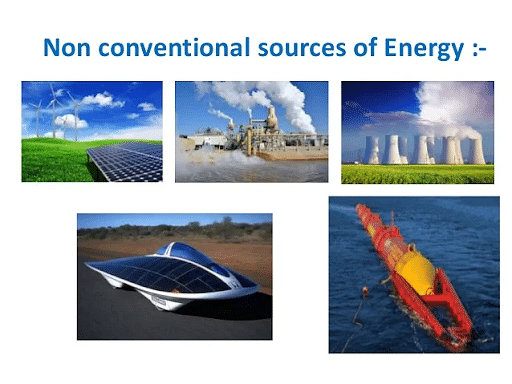
Non-conventional energy sources
Solar Energy
The energy produced by the light of the sun is known as solar energy. On the basis of the type of electricity to be produced, various photovoltaic cells are exposed to the sunlight. Solar energy is used for the distillation of water and for cooking purposes.
Wind Energy
The energy that is generated by harnessing the power of the wind is known as wind energy. It is mostly used to operate water pumps for the purpose of irrigation.
Tidal Energy
The energy produced by the tidal waves of the sea is known as tidal energy. Due to the lack of cost-effective technology, this course is yet to be explored.
Difference between Conventional and Non-Conventional Sources of Energy
[Click Here for Sample Questions]
The differences between conventional and non-conventional sources of energy are as tabulated below:
| Conventional Sources of Energy | Non-conventional Sources of Energy |
|---|---|
| Conventional Sources of Energy are also referred to as non-renewable sources of energy. | Non-conventional Sources of Energy are also referred to as renewable sources of energy. |
| They have both industrial and commercial purposes. | They are mostly used for household purposes. |
| The conventional energy sources are not abundantly present. They are in a limited quantity. | Non-Conventional sources of energy are abundantly available in nature. |
| Conventional Sources of Energy have been used by humans for a long time. | Non-Conventional energy sources are still in the development phase and are being explored recently over the past few years. |
| These sources of energy can be completely exhausted as they are being over consumed except for hydel power. | These sources of energy cannot be completely exhausted. |
| These resources are not easily replenished. They take over millions of years to form. | These sources are replenished naturally through natural processes. |
| Conventional Energy Sources cause pollution. | Non-conventional Sources of Energy don't cause pollution. |
| For example: Fossil fuels, coal, etc. | For example: solar energy, biomass, and wind energy |
Read More:
| Sources of Energy – Important Concepts | ||
|---|---|---|
| Solar cooker | Fuel Types | Effects of burning fossil fuels |
| Wave energy formula | Solar Car | Energy Consumption Formula |
Things to Remember
- Energy is an important component of our economic infrastructure. Conventional and Non-conventional sources of energy are two classifications of energy sources.
- Non-renewable sources of energy that are present in a limited quantity in nature, apart from hydroelectric power, are known as conventional sources of energy.
- Non-conventional sources of energy are the sources that are easily replenished through various natural processes.
- Commercial sources of energy are those sources that a consumer needs to pay a certain price in order to buy them.
Sample Questions
Ques. What are the conventional sources of energy? (5 marks)
Ans. Conventional energy sources are the natural sources of energy that have been in use regularly for many years and are therefore accepted as fuel to produce light, heat, electricity, and food. The conventional sources of energy include cow dung cake, fossil fuels, firewood, etc. Of all these sources, fossil fuel is the widely recognized conventional source. This fuel is formed by the dead remains of animals and plants that are buried deep inside the birth and get decomposed over time. These fossil fuels are natural gas, oil, coal, etc.
Conventional sources of energy are usually also known as non-renewable sources as they are accumulated and created over many years, once they are consumed or exploited. As these resources have been widely used, their reserves have depleted and alternatives for these sources are harder to find.
Ques. What are the advantages and disadvantages of non-conventional sources of energy? (5 marks)
Ans. The advantages of non-conventional energy sources are:
- They are inexhaustible.
- They do not pollute the surroundings or the environment.
- They are affordable.
- They are easy to use.
- Nuclear power emits a large amount of energy.
The disadvantages of non-conventional sources of energy are:
- Nuclear energy also generates a lot of radioactive waste.
- These sources are relatively expensive to consume.
- Windmills are expensive to set up and also contribute to noise pollution.
- Windmills also disturb TV and radio broadcasts and are also harmful to the birds.
Ques. What are the disadvantages of conventional sources of energy? (5 marks)
Ans. Some of the limitations of conventional sources of energy are:
- They cause certain health problems = When these resources are burnt, harmful gases are emitted from them which causes many respiratory problems. The burning of these sources pollutes water, land, as well as the air we breathe.
- They form hazardous byproducts = Conventional sources of energy also form many byproducts that cause various problems. When we burn coal, ash is formed as a byproduct. This ash puts people and plants nearby at risk. It is hazardous to the health of humans.
- We are dependent on them = For a long time, humans have been using conventional sources of energy. Therefore we have become very dependent on these sources. Hence, switching to environmentally friendly renewable sources of energy is becoming increasingly difficult for us. The sources take over centuries to form and there has been a consistent rise in the consumption of these resources. Hence the dependency on these resources will prove to be harmful to us as they are depleting fast and not forming fast enough.
- These sources are depleting = The conventional sources of energy are vanishing slowly. As they take billions of years to form, future generations will have to bear harmful consequences if they are depleted.
- They also harm the environment = When the cargo ships and oil tankers are spilled in the water bodies, it has deadly consequences. The animals are therefore at risk. The health of humans is also negatively affected due to this. The oxides that are released by the burning of conventional energy sources make the rain acidic and also cause harm to human beings and wildlife. It can also cause harmful greenhouse gas emissions, the generation of waste, pollution, and the depletion of the ozone layer.
Ques. Give examples of conventional and non-conventional sources of energy. (5 marks)
Ans. The non-renewable energy sources or the conventional sources of energy are the ones that are available in a limited quantity. Some of the examples of conventional sources are:
- Coal is mainly formed from the dead decay of vegetation. It is primarily made up of carbon and has minor traces of other elements such as oxygen, nitrogen, sulphur, and hydrogen.
- Petroleum is also known as crude oil. It is a fuel source that occurs naturally in nature and is refined into various types. They are mainly formed as a result of strong temperature and high pressure on the decaying and dead matter of organisms.
- Natural gas is a hydrocarbon gas containing methane along with little traces of helium, hydrogen sulfide, nitrogen, and carbon dioxide. It is a natural gas that affects the environment severely. After burning actual gas in products we obtain Sulphur dioxide and carbon monoxide that are even more hazardous.
Non-Conventional sources of energy are more sustainable and are significantly less hazardous to the environment. Examples of non-conventional sources of energy are:
- Hydropower is generated through a natural or an artificial flow of water. The most popular type of hydropower is developed through reservoirs and hydroelectric dams. Dams are built on top of rivers that have a decent flow of water. The natural water flow is used to drive turbines connected further to the generators. When rotation of turbines takes place, electricity is produced through the generator and is later stored for consumption.
- Solar power is derived from solar energy which is a clean energy resource. It has a great scope. Solar panels are formed of photovoltaic cells that can convert light into electricity. Many panels are placed in a location that is ideal where sunlight directly falls on them during the daytime. Solar panels are also increasingly in use in households as a primary electricity source. It is also used commercially in solar farms.
- Wind turbines or windmills are located in regions with a constant and strong flow of wind. Wind farms are the places where many wind turbines are placed to generate electricity. These turbines have larger blades that are connected to generators. When the flow of wind is more, the blades are in a rotation motion, and electricity is formed. The electricity produced by the wind turbine is directly proportional to the cube of wind speed.
Ques. What is the other name of non-conventional sources? (5 marks)
Ans. Non-conventional sources of energy are also known as renewable energy sources. These are the energy sources that are constantly renewed by natural processes. Some examples of non-conventional sources of energy are wind energy, solar energy, biofuels, and hydropower. They are renewable in nature and can be generated again. They produce little to no pollution when compared to the traditional sources of energy. They are an effective choice as they are cost-effective.
They do have a higher initial cost of set-up. The majority of the energy originates from wind and the sun either directly or indirectly. They can not be depleted and that is why they are known as renewable energy sources. They do not cause any pollution and don't generate any waste.
Ques. Why should we adopt non-conventional sources of energy? (5 marks)
Ans. Non-conventional sources of energy should be adopted for use because of many reasons. Some of them are:
- They can not be exhausted easily.
- They have a lower cost of consumption and can be ideally used to meet the ever-increasing demands of the growing population.
- If we use non-conventional sources of energy, we can save energy resources for the next generation.
- They are easily renewable.
Ques. Write a short note on solar energy. (5 marks)
Ans. Solar energy can be harnessed by converting solar energy into electrical energy directly in solar plants. Through the process of photosynthesis, green plants absorb the energy from the sun and then convert it into the form of chemical energy. It is a vital non-conventional source of energy. It does not cause pollution and gives an environmentally friendly output. They are also abundantly available in nature.
Solar energy has many uses. Some of them are:
- A solar cooker is used to direct the solar heat into a secondary reflector inside the kitchen area. The reflector focuses the heat on the vessel's bottom. Solar cookers also have a glass plate covering. They are widely used in developing world areas.
- Solar heaters also make use of solar energy in order to heat water instead of using electricity or gas.
- Solar cells also use the power from the sun in order to generate electricity that is converted from solar energy.
Ques. Write a short note on biomass. (5 marks)
Ans. Biomass is a conventional source of energy. It is also known as a renewable resource that is derived from animal and plant waste. The energy from biomass is released by burning as the chemical bonds of organic molecules that are formed are broken down during the process of photosynthesis. Biomass fuels can be directly used or they can be transformed into some more convenient form.
Sources of Biomass
- Biomass is formed through the byproducts from agricultural crops, the timber industry, raw material from the forests, and major parts of wood and household waste.
- Solid biomass fuels are also a source of biomass. The sources include wood pellets, wood logs, animal dung or animal waste, agricultural waste such as stalks and plant debris, urban waste such as cardboard, combustible materials, paper, and aquatic plants such as kelp and water hyacinths.
Advantages of biomass energy
The advantages of biomass are:
- When biomass is burnt, there is no increase in the carbon dioxide present in the atmosphere. This is because biomass is initially formed from the carbon dioxide present in the atmosphere and it releases the same amount of carbon dioxide once it is burnt.
- It is an important energy source and is widely recognized and used fuel after oil, coal, and natural gas.
- It is a renewable source of energy and is available on earth in abundance.
- It is found in the form of cattle dung, city garbage, agricultural residues, etc.
- In the form of biogas, bioenergy is derived from biomass.
Ques. Write a short note on geothermal energy. (5 marks)
Ans. The natural heat from the Earth's interior is referred to as geothermal energy. It is used to generate electricity and heat the buildings. On Earth, we have volcanoes, geysers, methane under the water in seas and oceans, and hot springs. Due to this, the core of the Earth is very hot and this can be used to make geothermal energy.
Geothermal resource generally comes under three major categories which are:
- Geopressurized zones
- Hot rock zones
- Hydrothermal convection zones
On a commercial basis, only geo-pressurized zones are being exploited.
Environmental impact of geothermal energy
- Geothermal energy poses many environmental problems that include emissions of gas, site noise, and other disturbances at the site of drilling.
- The steam formed has a gas of hydrogen sulfide. This gas has a rotten egg-like odor. This can contribute to air pollution.
- The minerals present in the steam are also toxic to fish. They can cause corrosion in other equipment such as pipes. This can lead to a need for constant maintenance of this equipment.
Read More:



Comments