



Content Curator
Distance traveled formula gives us the length of the path traveled by an object in a specific time moving with a particular speed or velocity. Traveling or covering a certain amount of distance is a part of our day-to-day lives. Even when people are at home, then too, they cover a certain amount of distance from day tonight.
- Distance is nothing but the length of the path we have covered while walking or traveling.
- The distance traveled by an object can be in kilometers, meters, etc.
| Table of Content |
Key Terms: Distance, Displacement, Velocity, Speed, Acceleration, Time, Scalar and Vector, Unit of distance traveled.
Also check: Potential Energy
The Concept of Distance
[Click Here for Sample Questions]
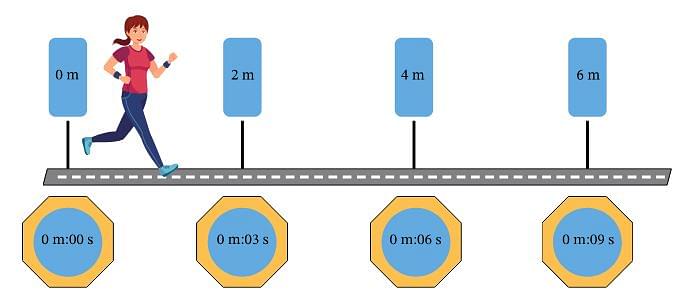
The path covered by a body to get from a starting point to an endpoint in a certain period of time, at a specific velocity is known as the distance traveled by that body.
- If seen from the point of view of natural sciences and specifically physics, distance traveled needs to be measured.
- Consequently, it can be measured with the help of the distance traveled formula.
- Distance is calculated with consideration of speed and time utilized while covering a certain distance.
- Hence, speed or velocity, and time are both important components of the distance traveled formula.
- Observe how this relation is situated in the formula.
The video below explains this:
Distance Traveled Formula Detailed Video Explanation:
Uses and Applications of Distance Traveled Formula
[Click Here for Sample Questions]
The uses and applications of the distance traveled formula is
- It is used to calculate the distance traveled by a body in a particular time moving with a particular speed or velocity.
- It tells us about the length of the path covered by a body to reach its destination.
- Knowing the speed or velocity of the body, we can calculate the distance traveled by that body at a particular time.
- For example, we can calculate the distance traveled by a car in a specific time moving at a particular speed.
Also check: Helmholtz Equation
Distance Traveled Formula
[Click Here for Sample Questions]
Distance traveled is measured in relation to time and velocity. In fact, time and velocity are multiplied together to calculate the distance traveled. The equation is written as:
d = v x t
Where
- d = distance traveled by an object
- v = velocity or speed of the object
- t = time is taken by the body to cover the distance
If a body is moving with constant acceleration, then equations of motion can be used to calculate the distance traveled by the body. Some equations of motion are:
S = ut + 1/2 at2
v2 = u2 + 2as
Where
- S = distance or displacement of the body
- t = time is taken by the body
- u = initial velocity or speed of the body
- v = final velocity of the speed of the body
- a = constant acceleration
Distance Traveled in nth second
Consider a body having initial velocity u moving with constant acceleration a, then the distance traveled by that body in nth second is given by
Snth = u + a(n – 1/2)
Physics Related Links:
Solved Examples
[Click Here for Sample Questions]
Ques. Calculate the distance traveled by a car traveling at a constant velocity of 30 m/s in 80 seconds.
Sol. Given
- Velocity or speed of the car, v = 30 m/s
- Time taken, t = 80 seconds
Let d be the distance traveled by car in time t, then using the distance traveled formula, we get
d = v x t
⇒ d = 30 x 80
⇒ d = 2400 m.
Hence, the distance traveled by a car traveling at a constant velocity of 30 m/s in 80 seconds is 2400 m.
Ques. Calculate the speed of an object that travels 1200 meters uniformly in 60 seconds.
Sol. Given
- Distance traveled by the object, d = 1200 m
- Time taken, t = 60 seconds
Let v be the speed of the object, then using the distance traveled formula, we get
d = v x t
⇒ v = d/t
⇒ v = 1200/60
⇒ v = 20 m/s
Therefore, the speed of an object that travels 1200 meters uniformly in 60 seconds is 20 m/s.
Ques. A heavily loaded truck travels at a velocity of 60 miles per hour. Calculate the total time taken by the truck to travel a distance of 200 miles.
Sol. Given
- The velocity of the truck, v = 60 miles/hour
- Distance traveled by truck, d = 200 miles
Let t be the time taken by the truck, then using the distance traveled formula, we get
d = v x t
⇒ t = d/v
⇒ t = 200/60
⇒ t = 3.33 hour
Hence, the total time taken by the truck to travel a distance of 200 miles is 3.33 hours or 3 hours 20 minutes..
Things to Remember
- Distance traveled is defined as the length of the path covered by a body at a particular time..
- The distance travel formula in terms of speed and time is given by
d = v x t
- Displacement is the shortest path to the final destination from the initial point.
- Distance traveled by a body is a scalar quantity, while the displacement of the body is a vector quantity.
- Distance traveled by a body can also be calculated using equations of motion
S = ut + 1/2 at2
v2 = u2 + 2as
Also check: Difference Between Equinox and Solstice
Sample Questions
Ques. Lilly is driving a scooter with a speed of 6 km/hr for 2hr. Calculate the distance traveled by her. (2 marks)
Ans. Velocity and time are already given to us in this question. What needs to be known is the distance traveled by Lilly. Thus, we will directly put the values into the formula.
Given values: v = 6km/hr ; t = 2 hr
Distance traveled i.e., d =?
Distance traveled formula:
d = v × t
d = 6 km/hr × 2 hr
d = 12km
Ques. A man has covered a distance of 80 miles in 4 hours. Calculate the speed of the bike. (2 marks)
Ans. Distance traveled (d) and time is already provided.
Given:
d = 80 miles; t = 4 hours; v = let us find out the velocity by putting the values into the Distance traveled formula. v = d/t
v = 80/4
v = 20 miles/hr.
Hence, the speed of the bike is 20 miles/hr.
Ques. In a cycling race, a cyclist is moving at a speed of 2 km/hr. He has to cover a distance of 5 km. Calculate the time will he need to reach his destiny. (2 marks)
Ans. Given
- Speed of the cyclist, v = 2 km/hr
- Distance to be covered by the cyclist, d = 5 km
The time required to cover the given distance is given by
t = d/v
⇒ t = 5 / 2 = 2.5 hr
Therefore, the time taken by the Cyclist to cover a distance of 5 km with a speed of 2km/hr is 2.5 hours.
Ques. During an experiment, a signal from a spaceship reached the ground station in five minutes. What was the distance traveled by the spaceship from the ground station? The signal travels at the speed of light, that is, 3 × 10⁸ m s-1. (2 marks)
Ans. Given
- The time is taken by the signal to reach the ground station, t = 5 minutes = 300 seconds
- Speed of the signal, v = 3 x 10⁸ m/s
The distance travelled by the signal to reach the ground station from the spaceship is given by
d = v x t
Therefore, the distance travelled by the signal, d = 3 x 108 x 300
⇒ d = 9 x 10¹⁰ m or d = 9 x 10⁷ km
Ques. A bus starting from rest moves with a velocity of 12m/s for 2 minutes. Calculate the distance traveled by bus. (3 marks)
Ans. Time and velocity are already given to us in this question. Velocity is 12m/s and time is 2 minutes. Now, we have to calculate the distance bus traveled by directly putting these values in the distance traveled formula.
Already given,
v = 12 m/s; t = 2 minutes
In this question as well, time is given in minutes, and velocity is in seconds. Therefore, we will first convert the minutes of time into seconds.
Converting minutes into seconds by multiplying by 60. (1 minute = 60 seconds)
t = 2 x 60
t = 120 seconds.
Putting these values into the distance traveled formula…
d = v x t
d = 12m x 120
d = 1,440 m
Henceforth, the distance traveled by bus at a velocity of 12m/s in 2 minutes is 1,440 m.
Ques. The distance traveled by an object is directly proportional to the time taken. Its acceleration: (2 marks)
(a) increases
(b) decreases
(c) becomes zero
(d) remains constant
Ans. Option (c ) becomes zero is the correct answer.
Explanation: velocity is directly proportional to time. But, only when there is no external force to act upon it. If an external force is absent then, 'a' i.e., acceleration of the object becomes zero. Hence, the distance traveled by an object is directly proportional to the time taken. Its acceleration becomes zero.
Ques. The distance traveled by an object is directly proportional to the time taken. Its speed: (2 marks)
(a) increases
(b) decreases
(c) becomes zero
(d) remains constant
Ans. Option (d) remains constant is the correct answer.
Explanation: velocity is directly proportional to time. But, only when there is no external force to act upon it. If an external force is absent then, 'a' i.e., acceleration of the object becomes zero. Yet, speed cannot become zero because if that happens then the object will stop moving. Therefore, its speed remains constant and option d is the correct answer.
Ques. What does the odometer of an automobile measure? (2 marks)
Ans. The odometer is a device. The odometer of an automobile computes the distance covered by a vehicle or an automobile while traveling. In simple words, it is used to calculate the distance traveled. In fact, it uses the distance traveled formula only.
Ques. What can you say about the motion of an object whose distance-time graph is a straight line parallel to the time axis? (1 mark)
Ans. If the distance-time graph is represented as a straight line and that too, is parallel to the time axis, the body is considered to be at rest and not moving.
Ques. When the distance traveled by an object is simply proportional to the time taken for traveling. The object is said to travel with a …? (1 mark)
Ans. When the distance traveled by an object is simply proportional to the time taken for traveling. The object is said to travel at a uniform speed.
Also Read:



Comments