



Exams Prep Master
The Solanaceae family is often referred to as the potato family. It is a family of angiosperms. The plants of this family grow everywhere in the world, from the temperate zone to the tropical zone. It includes vegetables, medicinal plants, a number of spices and agricultural crops, and others. Moreover, the floral formula constitutes the floral symmetry, ovary position, number of parts, insertion, connotation, and adnation of a flower. Before discussing the floral formula of Solanaceae, let’s first have a recap of what is a floral formula and all the terms related to the floral formula.
Also read:- Taxonomic Hierarchy of Plants and Animals
| Table of Content |
Key Terms : Floral Formula, Solanaceae, flowers, stamens, calyx, root system
What is Floral Formula?
[Click Here for Sample Questions]
A floral formula is a symbolic representation of a specific flower of a particular family. In a floral formula, a variety of symbols are used each of which has biological meaning. A floral formula, in brief, tells about the family to which the flower belongs.

Terms and Symbols used in a Floral Formula
[Click Here for Previous Years Questions]
- Firstly, whether the flower is bracteate, ebracteate, or bracteaolate is shown by an appropriate symbol.
- The flower’s symmetry is then expressed using the position of the floral whorls in relation to the mother axis. Flowers can be organized in a variety of ways, including poly symmetric (actinomorphic), dissymmetric, monosymmetric (zygomorphic), asymmetric, and spirally. As a result, particular symbols in the floral formula are used to identify flowers with differing symmetry.
- The flower’s sex is then represented to indicate whether the flower is heterosexual or bisexual.
- Then, sequentially various floral parts are symbolised starting from calyx, corolla, androecium and ending with gynoecium.
- If a particular floral part (from the ones mentioned above) is unified together then the letter symbolizing it is written within brackets. While if it is free then no brackets are used. Drawing a curve from the top of the letters represents adnation between the floral whorls.
- A line is drawn above, below or in front of the letter ‘G’ to depict the position of the ovary.

Also read: Asexual Reproduction
Scientific Classification of Solanaceae
[Click Here for Sample Questions]
-
Kingdom: Plantae
-
Subkingdom: Tracheobionta
-
Super Division: Spermatophyta
-
Division: Magnoliophyta
-
Class: Magnoliopsida
-
Subclass: Asteridae
-
Order: Solanales
-
Family: Solanaceae
| Important Topics | ||
|---|---|---|
| Tap Root System | Fibrous Root System | Inflorescence |
| Vegetative Characters of Solanaceae | Vegetative Characters of Liliaceae | tendril |
Floral Formula of Family Solanaceae
[Click Here for Previous Years Questions]
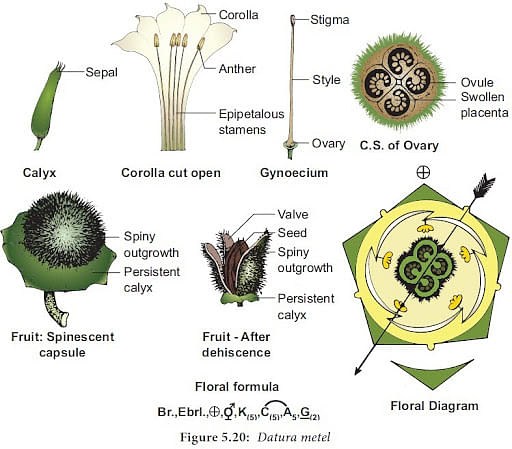
The flower is bracteate or ebracteolate, actinomorphic (radial) and bisexual. The other floral parts-

-
Calyx- sepals 5 in number, gamosepallous (united)
-
Corolla – 5 petals, gamopetallous
-
Androecium- 5 stamens, polyandrous (free) epipetalous (attached to petals)
-
Gynoecium- bicarpellary ( two carpels), syncarpous (united) superior ovary.
Characteristics of Family Solanaceae
[Click Here for Sample Questions]
-
Solanaceae family consists of a variety of herbs, shrubs and also small trees.
-
This family consists of 90 groups and about 3000 species.
-
They have a tap root system with regular branching.
-
The stem is aerial, branched, erect, mostly herbaceous, cylindrical, hairy or glabrous.
-
The leaves are simple alternate with reticulate venation. Sometimes the leaves are transformed into spines.
-
They exhibit entomophilous pollination (pollinated by insects).
-
They are propagated in the form of seeds or fruits (dehisced or intact).
-
Axillary or cymose type of inflorescence. The flowers can be present either singly or in groups.
-
Flower is either Bracteate or ebracteolate, actinomorphic, and generally hermaphrodite. The flower is pentamerous and hypogynous.
-
The fruit formation in members of the Solanaceae family takes place either in the form of fruits, as in tomatoes and capsicum, or in the form of berries, as in Lycium and datura.
-
Seeds are mostly endospermic. The seed is curved or straight and bears two cotyledons.
Also read: difference between radicle and plumule
Economic Importance of Family Solanaceae
[Click Here for Previous Years Questions]
The family Solanaceae is a family of many plants which have high nutritional and medicinal value. Some of these plants are used for the ornamental purpose as well.
-
The fruits and products of many of these plants are consumed as vegetables all around the world, e.g, tomatoes, eggplants, potatoes, capsicum and etc.
-
The plants of Solanaceae have many medicinal uses and are used in the treatment of various disorders. These plants give many alkaloids which are beneficial but some are toxic too. Some of the important alkaloids are tropane, nicotine, capsaicin, solanine, hyoscyamine, etc. Attropa belladonna, Withania somnifera (ashwagandha), and Datura are used as medicines. Tobacco is another commercially important plant of this family.
-
Some of their flowers are used as ornaments. E.g- Lycium, Petunia, Cestrum, Attropa, Solanum, etc.

Also read: Economic Importance of Solanaceae
Things to Remember
[Click Here for Previous Years Questions]
-
The floral formula of a flower gives a detailed information about the symmetry, sex, and the types and shapes of the floral parts.
-
It is a symbolic representation written in the form of an equation where each symbol carries a specific meaning.
-
Flowers of Family Solanaceae are usually bracteate or ebracteolate, actinomorphic, hermaphrodite, pentamerous, and hypogynous.
-
There are 5 sepal (gamosepallous) and 5 petals (gamopetallous).
-
In the Androecium, there are 5 stamens which are polyandrous and attached to the petals.
-
In the gynoecium, there are two carpels which are syncarpous and the ovary is superior.
-
Datura, Attropa belladonna, Withania somnifera (ashwagandha) are used in medicines. While potato, eggplant, capsicum and tomatoes are consumed as food. Flowers of Lycium and Solanum are used as ornaments and decorative items in many other ceremonies and rituals.
Related Articles:
Previous Years Questions
- Which one of the following plants belongs to the Family Apocynaceae?….[COMEDK UGET 2009]
- Madhunashini is the popular name for…..[COMEDK UGET 2006]
- The roots that originate from the base of the stem are… [ NEET 2020]
- Bicarpellary gynoecium and oblique ovary occurs in...[ NEET 2001]
- Tetradynamous conditions occur in….[ NEET 2001]
- In which of the following plant sunken stomata are found...[ NEET 2001]
- What is the eye of potato?…[ NEET 2001]
- Edible part of banana...[ NEET 2001]
- Which is correct pair for edible part?….[ NEET 2001]
- Coconut fruit is a….[ NEET 2017]
- Commercial cork is obtained from… [NEET 1991]
- Botanical name of cauliflower is…. [NEET 1991]
- Banana is...[JKCET 2007]
- Tricarpellary syncarpous superior ovary is….[JKCET 2007]
- The edible part in hesperidium fruit is...[JKCET 2007]
- The bladders of Utricularia and pitchers of….[JKCET 2004]
- Phylloclades are...[JKCET 2004]
Sample Questions
Ques: What is a floral formula? (2 marks)
Ans: A floral formula is a symbolic representation of a specific flower of a particular family. The floral formula of a flower gives a piece of detailed information about the symmetry, sex, and the types and shapes of the floral parts.
Ques: What are different types of symmetry present in different flowers? (2 marks)
Ans: Flowers show a variety of symmetries. Some flowers are symmetrical while some are not symmetrical. The symmetrical flowers are categorized further as bilateral and radial. Bilateral flowers have a single plane of symmetry while radial ones have multiple planes of symmetry.
Ques: What do you mean by actinomorphic symmetry? (1 mark)
Ans: The flowers with radial symmetry are known as actinomorphic flowers. They have more than one plane of symmetry.
Ques: How are members of Solanaceae pollinated and propagated? (2 marks)
Ans: Cross-pollination in flowers of Solanaceae occurs by insects. This mode of pollination is referred to as entomophilous pollination. The flowers either bear fruits or berries which are usually propagated by humans or animals.
Ques: In brief, explain the characteristics of Androecium and Gynoecium in the flowers of Solanaceae. (2 marks)
Ans: The various characters of Androecium and Gynoecium in flowers of Solanaceae are discussed below-
| Androecium | Gynoecium |
|---|---|
| 1. Stamens are 5 in number. | 1. They are 2 carpels in the Gynoecium. |
| 2. Stamens are polyandrous(free). | 2. Carpels are syncarpous (united). |
| 3. Stamens are attached to petals (epipetalous). | 3. The ovary is superior. |
Ques: Discuss the economic importance of Family Solanaceae. (2 marks)
Ans: Many nutritional and medicinal plants belong to the family Solanaceae. Potatoes, eggplants, tomatoes, capsicum are some of the edible vegetables grown all over the world. Datura, Attropa belladonna, Withania somnifera (ashwagandha) are used in medicines. Some flowers like Lycium, Petunia, Cestrum, Attropa, and Solanum are used as ornaments or as decorative items in ceremonies and rituals.
Ques: Describe the root and shoot systems of Family Solanaceae. (1 mark)
Ans: The roots of Solanaceae are in tap root form. The shoots areaerial, branched, erect, mostly herbaceous, cylindrical, hairy or, glabrous.
Do Check Out:



Comments