



Education Journalist | Study Abroad Lead
Gadolinium is the 66th element in the Periodic Table, with over 13 natural isotopes and a wide range of applications. This element, abbreviated as Gd, belongs to the lanthanides division. This chemical element is known for its malleability, solubility, ductility, and great thermal stability. Because of its chemical and physical qualities, Gadolinium is preferred above others in key, booming industries such as technology and medical sciences. In this article, we will learn about the fundamentals of Gadolinium's properties, applications, and other fascinating facts about it.
| Table of Content |
Keyterms: Gadolinium, Periodic table, Isotopes, Malleability, Solubility, Ductility, Thermal stability, Metallurgy
What is Gadolinium?
[Click Here for Sample Questions]
Gadolinium (the symbol for the element is Gd) was discovered in 1880. Gadolinium is a silvery-white lanthanide metal that is found in the 66th position of the f-block and the 6th row of the Periodic Table when it is not oxidized. The atomic number of the element is 64. Gadolinium is used in nuclear reactors, radiography, electronic device production, metallurgy, and a variety of other areas of technology, arts and science, engineering, and medicine.

Gadolinium
Read More:
| Related Topics | ||
|---|---|---|
| Praseodymium | Promethium | Raney nickel |
| Neodymium | Dysprosium | Lanthanum |
| Holmium | Colour transition elements | Lawrencium |
Physical Properties of Gadolinium
[Click Here for Sample Questions]
- It has a solid structure at 20°C STP (Standard Conditions for Temperature and Pressure).
- Gadolinium is found in the Periodic Table at position 66, f-Block, 6th row, and is classified as a lanthanide.
- Although the toxicity is said to be lesser, it causes skin and eye irritation in humans.
- Gadolinium has no discernible effect on animals or plants.
- A bright silvery-white metal that is soft to the touch.
- Gadolinite, the element's principal mineral, is named after it.
- Gadolinium is both malleable and ductile.
- The element is found at a concentration of 5.2 parts per million in the earth's crust.
- One of the most uncommon metals on the planet.
- The crystal structure is HCP (Hexagonal Close Packing).
- High-temperature resistance is excellent.
- 13 isotopes of Gadolinium are coming from nature and 27 manmade isotopes.
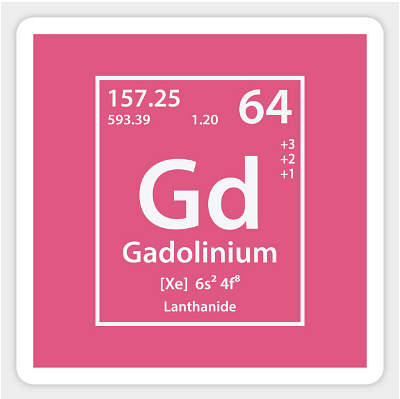
Gadolinium Element
- At ambient temperature, it is paramagnetic, but when exposed to colder temperatures (beyond 20°C), it becomes ferromagnetic.
- Primordial isotopes include gadolinium.
- As a result of its chemical reaction with sulphur, boron, selenium, nitrogen, carbon, arsenic, phosphorus, and silicon, the element Gadolinium produces binary compounds.
Chemical Properties of Gadolinium
[Click Here for Sample Questions]
- Gadolinium has a molecular weight of 157.25 g/mol-1.
- 64 is the atomic number.
- Each shell has a different number of electrons: 2, 8, 18, 25, 9, and 2.
- The boiling point is 3273°C at 5923°F, and the density (g / cm3) is 3546 K 7.90.
- Gadolinium has the electronic structure [Xe] 4f7 5d1 6s2.
- During the compound state, a trivalent bond is formed.
- 157.92411 g/mol is the precise and monoisotopic mass value.
- The molar heat capacity of Gadolinium is estimated to be 37.03 J/(molK).
- Other dilute acid forms are very reactive with it.
- There is only one Covalently-bonded unit available.
- The Curie Point is believed to have a temperature of 17°C.
- At 2395°F, 1586 K, Gadolinium has a melting temperature of 1313°C.
- Gadolinium has been Canonicalized.
- The element is unreactive with oxygen, but when exposed to wet air, it tarnishes and forms a coating of gadolinium(III) oxide (Gd2O3) to prevent further oxidation.

Atomic Structure of Gadolinium
Existence and isotopes of Gadolinium
[Click Here for Sample Questions]
- Gadolinium has six main isotopes: 154Gd, 155Gd, 156Gd, 157Gd, 158Gd, and 160Gd. There are around 29 distinct radioactive isotopes for Gd, with 152Gd being the naturally occurring isotope with the highest stability.
- It's worth noting that Gadolinium's major method of disintegration is beta decay at higher atomic masses, with the end product being a terbium isotope.
- Even though the precise amount of Gadolinium produced changes from year to year, it is expected to be around 400 tonnes each year.
- Due to its extreme reactivity, the metal is not found in the natural environment.
- Gadolinium is a lanthanide that can be found in mineral oxides like bastnäsite and monazite.
- Even the mineral Gadolinite has only a small amount of Gadolinium. 'Lepersonnite-(Gd)' is one of the most important minerals related to Gadolinium, and it is highly rare.
- India, Sri Lanka, the United States of America, China, and Brazil are among the significant countries where the estimated reserve value for Gadolinium exceeds one million dollars.
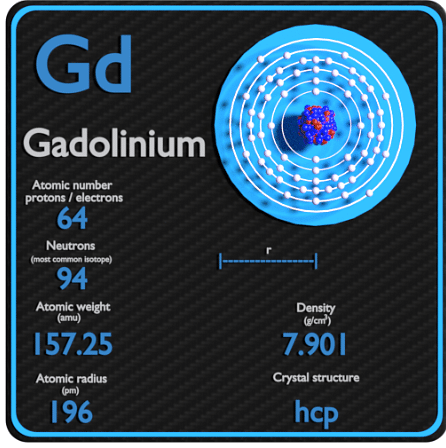
Existence and isotopes of Gadolinium
Uses of Gadolinium
[Click Here for Sample Questions]
- Gadolinium is employed in microwave applications and is also used in the form of phosphorous in color television sets.
- Gadolinium alloys are used in the production of magnetic and electronic devices such as video recorders.
- These are commonly employed as control rods in nuclear power reactors at nuclear power facilities.
- Gadolinium, Gd is a widely used isotope in tumor treatment and neutron therapy.
- Gadolinium gallium garnet is used to make diamond-like imitations.
- Because of its high resistivity, the metal is also employed in many high-temperature electronics.
Things to Remember
- Gadolinium is a silvery-white lanthanide metal that is found in the 66th position of the f-block and the 6th row of the Periodic Table when it is not oxidized.
- Jean Charles Galissard de Marignac,' a Swiss chemist, discovered Gadolinium via spectroscopic line detection over the molecule Gadolinia.
- Gadolinium is both malleable and ductile.
- The element is found at a concentration of 5.2 parts per million in the earth's crust.
- The molar heat capacity of Gadolinium is estimated to be 37.03 J/(molK).
- Other dilute acid forms are very reactive with it.
- Gadolinium has six main isotopes: 154Gd, 155Gd, 156Gd, 157Gd, 158Gd, and 160Gd.
- There are around 29 distinct radioactive isotopes for Gd, with 152Gd being the naturally occurring isotope with the highest stability.
- Gadolinium, Gd is a widely used isotope in tumor treatment and neutron therapy.
Also Read:
Sample Questions
Ques. What is Gadolinium's Biological Function? (1 mark)
Ans. Gadolinium has no biological purpose aside from being a useful resource in the field of biomedicine. Furthermore, Gd3+ is the only reason that MRI Gadolinium Contrast agents are possible.
Ques. Give the Gadolinium Young's, Shear's, and Bulk Modulus values. (3 marks)
Ans. The Young's Modulus is 54.8 GPa,
while the Shear is 21.8 GPa and
the Bulk Modulus rate of gadolinium is 37.9 GPa.
Ques. Is there a link between Gadolinium use and any diseases or medical conditions? (2 marks)
Ans. Yes. Nephrogenic Fibrosing Dermopathy, Renal Insufficiency, Acute Kidney Injury, and other Kidney-related ailments are all possibilities by the use of Gadolinium.
Ques. Explain how the two mineral oxides monazite and bastnäsite are used to make Gadolinium. (5 marks)
Ans. The oxide minerals monazite and bastnäsite are transformed into soluble sulfates and chlorides employing acids such as sulfuric and hydrochloric solutions.
Caustic soda, which has a pH of 3 to 4, is employed to somewhat neutralize the acidic filtrates.
The solution is now treated with ammonium oxalate, which converts it to soluble oxalates, which are subsequently converted back to oxides by heating the combination.
The oxide is dissolved in nitric acid and then treated with magnesium nitrate.
The salts are then processed using the ion-exchange technique, yielding Samarium, Europium, and Gadolinium.
Finally, Gadolinium is separated in an argon atmosphere by heating the component with calcium.
Ques. Mention the issue that may arise as a result of the use of gadolinium contrast in MRI. (3 marks)
Ans. When Gadolinium Contrast is used in MRI, an uncommon but significant medical condition termed Nephrogenic Fibrosing Dermopathy or Nephrogenic Systemic Fibrosis can occur (NSF). This is a disorder that is similar to scleroderma and scleromyxedema that is caused by extended exposure to Gadolinium-based contrast MRI. The severity of the reaction or outcome of employing Gadolinium Contrast varies depending on the patient's hypersensitivity and the duration of exposure (acute or chronic).
Ques. Describe some uses of Gadolinium. (3 marks)
Ans. Some uses of Gadolinium are:
- Gadolinium is employed in microwave applications and is also used in the form of phosphorous in color television sets.
- Gadolinium alloys are used in the production of magnetic and electronic devices such as video recorders.
- These are commonly employed as control rods in nuclear power reactors at nuclear power facilities.
- Gadolinium Gd is a widely used isotope in tumor treatment and neutron therapy.
Ques. State a few chemical properties of Gadolinium. (5 marks)
Ans. Some chemical properties of Gadolinium are:
- Gadolinium has a molecular weight of 157.25 g/mol-1.
- 64 is its atomic number.
- The boiling point of Gadolinium is 3273°C at 5923°F, and the density (g / cm3) is 3546 K 7.90.
- Gadolinium has the electronic structure [Xe] 4f7 5d1 6s2.
- The molar heat capacity is estimated to be 37.03 J/(molK).
- At 2395°F, 1586 K, Gadolinium has a melting temperature of 1313°C.
For Latest Updates on Upcoming Board Exams, Click Here: https://t.me/class_10_12_board_updates
Check-Out:



Comments