



Education Journalist | Study Abroad Lead
Promethium is a rare-earth metal with a beta radius. Because it is very radioactive and uncommon, it has received little attention. Promethium salts have a pink or red colour that emit a mild blue-green glow into the surrounding air. Promethium has no effect on living organisms and is mildly harmful due to its high radioactivity. Animal tests revealed that it became localised on the surface of bones, from where it can only be slowly removed. Because promethium is almost non-existent in nature, it poses little environmental risk. Because of its high radioactivity, it must be handled with caution.
| Table of Content |
Keyterms: Promethium, Rare earth metal, Beta radius, Radioactivity, Lanthanide, Beta radiation, Isotopes, Rare metal, Promethium salts
What is Promethium?
[Click Here for Sample Questions]
The element Promethium is denoted by the symbol Pm. Promethium is a rare earth metal and a lanthanide. All promethium isotopes are radioactive in nature. Beta radiation is emitted by promethium metal. Because it is a rare metal, its chemical and physical properties remain unknown. Promethium salts are pink or red in colour and emit a mild blue-green light into the surrounding air. Mariinsky discovered promethium metal in 19
Promethium
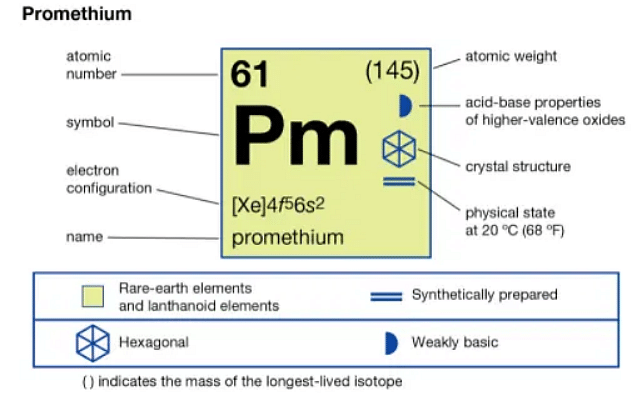
- Electronic configuration-Xe4f56s2
- The atomic number of promethium- 61
- The atomic mass of promethium- 145gmol-1
Read More:
| Related Topics | ||
|---|---|---|
| Neodymium | Dysprosium | Lanthanum |
| Holmium | Colour transition elements | Lawrencium |
Physical Properties of Promethium
[Click Here for Sample Questions]
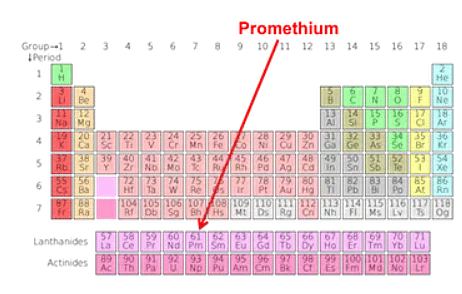
Promethium is an f-block element of the lanthanide group and period 6. At 20°C, it is solid.
Melting Point: -1042°C, 1908°F, 1315 K
Boiling Point.: 3000°C, 5432°F, 3273 K
Promethium has a density of -7.26
Promethium
Chemical Properties of Promethium
[Click Here for Sample Questions]
Promethium is a lanthanide that, when mixed with other elements, generates salts. It has a single stable oxidation state of +3.
Because traces of the element are extremely rare in nature, promethium-147 is normally produced by hitting enriched uranium with thermal neutrons.
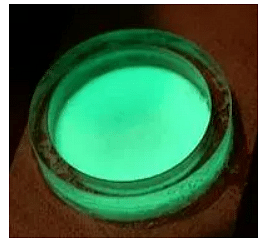
Promethium salts have a pink or red colour that emits a mild blue-green glow into the surrounding air.

Chemical Properties of Promethium
Promethium: Uses
[Click Here for Sample Questions]
- Except for promethium-147, which may be obtained outside labs, most promethium is utilised primarily for research. It is available in milligramme amounts as oxide or chloride. This isotope does not release gamma rays, and its radiation has a shallow penetration depth into materials and a lengthy half-life.
- Promethium has been used as a pacemaker. Some signal lights employ a bright paint containing a phosphor that absorbs the beta radiation released by promethium-147 and emits light. The beta particles released by promethium-147 are turned into electric current in atomic batteries by sandwiching a tiny promethium source between two semiconductor plates. These batteries have a lifespan of around five years.
- Promethium is frequently used to determine the thickness of materials by calculating the quantity of radiation emitted by a promethium source as it travels through the sample. Portable X-ray sources and supplemental heat or power sources for space missions and satellites are possible uses.
Promethium in Periodic table
Precautions to Take
[Click Here for Sample Questions]
- Promethium serves no biological use. Promethium-147 will release gamma rays that are detrimental to all life forms during its beta decay. Promethium-147 interactions with tiny levels are not harmful if proper safeguards are taken. Gloves, footwear coverings, safety glasses, and an outer layer of removable protective gear should be utilised in general.
- Promethium has a strong influence on bone tissue. A sealed promethium-147 is not dangerous. However, if the packaging is compromised, promethium becomes hazardous to the environment and individuals. If radioactive contamination is found, the polluted area should be cleansed with water and soap.
Things to Remember
- HR 465, a strange star in the Andromeda galaxy, has a lot of Promethium. It is very radioactive and uncommon, and little is known about it: its chemical and physical characteristics are poorly defined.
- Because promethium is almost non-existent in nature, it poses little environmental risk. Because of its high radioactivity, it must be handled with caution.
- Electronic configuration-Xe4f56s2
- The atomic number of promethium- 61
- The atomic mass of promethium- 145gmol-1
Also Read:
Sample Questions
Ques. Where can you find promethium? (2 marks)
Ans. No measurable amounts of promethium have been discovered in the earth's crust. It is found in trace amounts in uranium minerals as a byproduct of uranium decay. Promethium can be produced as a byproduct of uranium fission. Isotopes: Promethium has 29 different half-lives, with mass numbers ranging from 130 to 158.
Ques. Is promethium the most powerful metal? (2 marks)
Ans. Volatile promethium is employed as a power source since it can both consume and create electricity. Promethium is known as "man's strongest metal." (In actual life, tungsten is the strongest native metal, steel is the strongest alloy, and chromium is the hardest metal.)
Ques. Is promethium man-made? (2 marks)
Ans. It does not occur naturally on Earth. Although it is unknown how, a star in the Andromeda galaxy has been discovered to create promethium. Promethium is created by bombarding neutrons, deuterons, and alpha particles with neodymium and praseodymium.
For Latest Updates on Upcoming Board Exams, Click Here: https://t.me/class_10_12_board_updates
Check-Out:



Comments