



Education Journalist | Study Abroad Lead
Holmium is a chemical element which is a rare-earth metal of the lanthanide series of the periodic table. It is the 67th element of the periodic table being a white-coloured, silvery textured soft material that has some unusual magnetic characteristics. It is moderately hard and is relatively stable in the air.
| Table of Content |
Key Terms: Holmium, Periodic Classification of Elements, Absorption Spectra, Lanthanides, Isotopes, Air, Erbium oxide, Absorption, d and f block elements
Discovery of Holmium
[Click Here for Sample Questions]
Holmium (Ho) was discovered by Jacques-Louis Soret and Marc Delafontaine in 1878 when they saw an absorption band which diverged from its normal type. While he was working on erbia earth (erbium oxide). Per Teodor Cleve, a Swedish chemist, discovered Holmium using various instruments analyze a sample by separating its components into a spectrum in 1879 and was the first to isolate it.

Holmium
Also Read:
| Related Articles | ||
|---|---|---|
| Cadmium | Neodymium | Praseodymium |
| Fermium | Seaborgium | Selenium |
| Niobium | Palladium | Plutonium |
Structure of Holmium
[Click Here for Sample Questions]
Holmium is a part of the lanthanide series and commonly has a ground state structure like [Xe] 6s2 4f (n). Due to the lower principal quantum number of the 4f orbitals, they have radii that are closer to the center of the atom than the 5d orbitals, and so they tend to become part of the core of the atom.

Holmium Electronic Configuration
The general characteristic across the lanthanides is that as the number of protons increases with the increase in atomic number you fill up the 4f orbitals, and gradually change the size of the core. The 5s and 5p become so low that they become a part of the Xenon core. But the 4f electrons are distributed in such a way that they lie inside the radii associated with the 5s and 5p, so they would be relied upon to have less screening, and be all the more profoundly bound. The angular momentum makes a difference as the 5s and 5p orbitals actually penetrate more deeply into the core and thus they are filled in the Xe core while the 4f orbitals do not penetrate that deep.
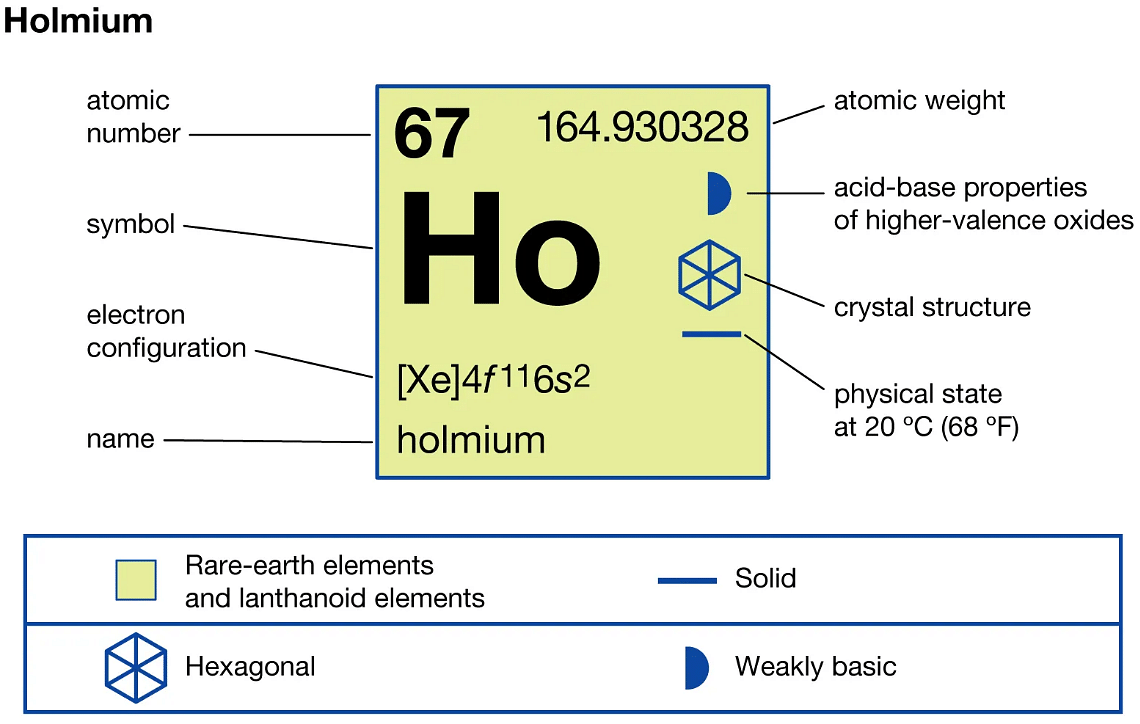
Structure of Holmium
The 6s orbitals are occupied and the screening force due to the tightly bound core, including the 4f orbitals, is winning out at the radius of the 6s orbitals, making them preferable to the 5d. The last two electrons prefer to stay a bit far away.
Chemical Properties of Holmium
[Click Here for Sample Questions]
The chemical properties of Holmium are tabulated below.
| Atomic number | 67 |
| Atomic mass | 164.9 g.mol -1 |
| Electronegativity according to Pauling | 1.2 |
| Density | 8.8 g.cm-3 at 20°C |
| Melting point | 1474 °C |
| Boiling point | 2695 °C |
| Van Der Waals radius | unknown |
| Ionic radius | unknown |
| Isotopes | 4 |
| Electronic shell | [Xe] 4f11 6s2 |
| Energy of first ionization | 580 kJ.mol -1 |
| Energy of second ionization | 1136.6 kJ.mol -1 |
| Standard potential | - 2.32 V |
Production of Holmium
[Click Here for Sample Questions]
Pure holmium can be extracted through the reaction of holmium fluoride with calcium metal.
2HoF3 + 3Ca → 2Ho + 3CaF2
Commercially, it is extracted mainly from monazite or gadolinite ores with sodium hydroxide, hydrochloric acid or sulfuric acid through ion exchange chromatography or solvent extraction techniques.
Chemical Reactions
[Click Here for Sample Questions]
The following are some of the chemical reactions of Holmium.
Reaction of Holmium with Acids
Holmium dissolves readily in dilute sulphuric acid, forming Ho(III) ions and hydrogen gas, H2. The yellow color of the solution has been suggested to be mostly [Ho(H2O)9]3+
2 Ho(s) + 3 H2SO4(aq) → 2 Ho3+(aq) + 3 SO42−(aq) + 3 H2(g)
Reaction of Holmium with Air
Holmium reacts slowly with O2 at room temperature, and burns readily, forming holmium(III) oxide, Ho2O3.
4 Ho(s) + 3 O2(g) → 2 Ho2O3(s)
Reaction of Holmium with Halogens
Holmium reacts with all the halogens, forming the corresponding holmium(III) halides.
2 Ho(s) + 3 F2(g) → 2 HoF3(s) [pink]
2 Ho(s) + 3 Cl2(g) → 2 HoCl3(s) [yellow]
2 Ho(s) + 3 Br2(g) → 2 HoBr3(s) [yellow]
2 Ho(s) + 3 I2(g) → 2 HoI3(s) [yellow]
Reaction of Holmium with Water
Holmium reacts slowly with cold water, forming holmium hydroxide, Ho(OH)3, and hydrogen gas (H2).
2 Ho(s) + 6 H2O(g) → 2 Ho(OH)3(aq) + 3 H2(g)
Uses of Holmium
[Click Here for Sample Questions]
Because of its extraordinary magnetic properties, holmium is utilized as an alloy for the creation of magnets and as a flux concentrator for high magnetic fields. Holmia (holmium oxide) is utilized in glass for yellow or red shading and cubic zirconia. Holmium isotopes absorb neutrons and are utilized in atomic reactor control bars. Likewise, Holmium is utilized in solid-state lasers for harmless operations treating malignant growths and kidney stones.

Holmium Laser
Lasers have been utilized to cure kidney-related illnesses with the use of Ruby laser. Since its pulse rate power was not controllable, Ruby laser faced many hardships. Likewise, CO? lasers were utilized but were not fruitful either due to the fact that they lacked a fiber optic delivery system. The solid state lasers came to the rescue with Q-switched Nd: YAG lasers that offered pulse control and fiber optic delivery methods. All the more explicitly, Holmium lasers gave an excellent performance with a high achievement rate for patients, making it the most favoured laser for lithotripsy which is the process by which kidney stones are broken into an adequate number of particles that can go through with urine.

Kidney Stone
YAG lasers consist of rare-earth Holmium particles doped in a YAG crystal. It just so happens, Holmium lasers are extremely effective in their delivering energy as they can be tuned to water absorption wavelengths since water is the abundant molecule in the human body. Holmium lasers track down their purposes across different clinical fields. Specifically, they have been utilized for warming and cutting tissues really.
Things to Remember
[Click Here for Sample Questions]
- Holmium isn't normally found as a free component in nature.
- Holmium oxide (Holmia) shows two drastically various shadings: yellow under regular light and pink under fluorescent lighting!
- Holmium has clinical applications: Holmium lasers emit light of a frequency that doesn't harm vision, accordingly, one of its clinical purposes is for medical treatment of the eyes.
- Most of the cutting edge lasers which are actually solid-state lasers are used to treat certain cancers. They need Holmium to crack yttrium aluminium crystals.
- The lasers can be utilized to disintegrate growths with just minor tissue harm; a patient with early stage bladder cancer can be discharged in a day from the hospital without a general anaesthetic.
Also Read:
Sample Questions
Ques. Why is holmium used as a neutron poison in nuclear reactors? [3 Marks]
Ans. Holmium is employed as a burnable poison, which possesses high neutron absorption cross-section that are converted into materials of relatively low absorption cross-section because of the results of neutron absorption in nuclear reactors. Thanks to the burn-up of the poison material, the negative reactivity of the burnable poison decreases over core life.
As a burnable poison, it is stacked into the center alongside the new fuel. As the fuel is drained, more neutrons are required for the chain response. Simultaneously the holmium is burned up by absorbing neutrons. These will quite often follow together, keeping up with a similar core reactivity which allows more uranium fuel to be stacked toward the starting which broadens the center life. The holmium neutralizes the excess reactivity of the uranium, and the holmium catches fire gradually over core life.
Ques. Describe the magnetic property of Holmium. [2 Marks]
Ans. Holmium acts as a strong paramagnet when the temperature is above 133 K (−140 °C, or −220 °F). At that point the metal behaves antiferromagnetically, thus forming a basal plane spiral structure. At the temperature of 19 K (−254 °C, or −425 °F) the magnetic moments face along the c-axis lifting out of the basal plane by some 10°, forming a conical ferrimagnetic structure.
Ques. What are some of the isotopes of Holmium? [2 Marks]
Ans. Holmium-165 is a stable naturally occurring isotope. There are 35 radioactive isotopes barring nuclear isomers, that range from holmium-140 to holmium-175 and the half-lives range from 4.1 milliseconds (holmium-141) to 4,570 years (holmium-163).
Ques. What are some of the uses of Holmium [2 Marks]
Ans. When placed within high-strength magnets, Holmium is used to create the strongest artificially-generated magnetic fields, such as a magnetic flux concentrator (also called a magnetic pole piece). The element is also used in nuclear control rods as it can absorb nuclear fission-bred neutrons. Holmium oxide which is also known as Holmia is used as a yellow glass colouring.
Ques. What are the classical methods of separation and purification of Holmium? [2 Marks]
Ans. The separation and purification of the element were done through classical methods of fractional crystallization and precipitation, but the solvent-solvent extraction and therefore the ion-exchange technologies which acts as a “chemical sponge” and is predicated upon the electrical attraction of ions to get rid of a specific contaminant or selectively attract have made available kilogram quantities of highly pure holmium oxide. The metal is obtained by the metallothermic reduction of the anhydrous fluoride HoF3 with calcium and it obtains a close-packed hexagonal structure with a = 3.5778 Å and c = 5.6178 Å at room temperature.
Ques. What are the various therapeutic applications of the medical isotope holmium-166? [2 Marks]
Ans. The medical isotope of Holmium, 166Ho is used in the treatment of tumors and also for internal radiotherapy. In direct intratumoral treatment, the radioactive compound is injected with a needle directly into the tumor and it can be found in the 166Ho-labeled chitosan complex that comes from the outer skeleton of shellfish, including crab, lobster, and shrimp has been studied in different types of tumors such as brain, liver and prostate cancer.
Ques. What are the sources where Holmium is found? [2 Marks]
Ans. Majority of holmium production comes from the rare earth mines in Inner Mongolia in China, which is responsible for 97% of all the rare earth elements. The major ores of holmium are rare earth minerals such as monazite and gadolinite. Holmium can be present in as much as 0.5% in monazite. Holmium is extracted from the ores that are processed for the containing yttrium. Other countries which contain deposits of rare earth ores include the USA, Brazil, India, Greenland and Tanzania. The vast reserves of holmium are estimated within the region of 400,000 tonnes with an annual production of 10 tonnes per year.
Ques. Write short notes on Holmium [2 Marks]
Ans. It is a soft silvery-white metal which is moderately reactive, reacts slowly with water and acids and is stable in dry air. It has extraordinary magnetic properties and is used in working with strong magnetic fields. Holmium is also used in certain alloys, and as a doping-agent in laser crystals. Holmium is a “burnable neutron-eater”, meaning that it can absorb neutrons in nuclear reactors, but is slowly consumed in the process of doing so.
Ques. How is Holmium used in prostate surgery? [5 Marks]
Ans. Holmium laser enucleation of the prostate (HoLEP) is a treatment for an enlarged prostate involving minimal damage of body tissue. This procedure uses a Holmium laser to remove the tissue which blocks urine flow through the prostate and then a separate instrument is used to cut the prostate tissue into easily removable fragments. HoLEP does not require any incisions and is similar to open prostate surgery. It removes the entire portion of the prostate which blocks urine flow and can be an option to treat a severely enlarged prostate.
The treatment provides a lasting solution for benign prostatic hyperplasia (BPH or prostate enlargement). HoLEP also preserves removed tissue in order that it is often examined within the laboratory for other conditions, including prostatic adenocarcinoma. As with other sorts of prostate laser surgery, HoLEP offers faster recovery and symptom relief compared with traditional prostate surgery. Rarely, re-treatment with HoLEP could also be needed for urinary symptoms.
For Latest Updates on Upcoming Board Exams, Click Here: https://t.me/class_10_12_board_updates
Check-Out:



Comments