



Content Curator
Gluteus muscles (or glutes) are a group of muscles that form the buttocks and help in thigh movement. They are present in the gluteal area that lies over the proximal section of the femur and the posterior side of the pelvic girdle.
The gluteal region are a group of muscles found in the buttocks. These muscles are as follows:
- Gluteus maximus
- Gluteus medius
- Gluteus minimus
The three muscles start from the ilium and sacrum, and they attach to the femur. The gluteal muscles are the most superficial set of muscles in the posterior hip and thigh. The gluteal muscles work on the hip joint to help the thigh abduct, extend, and some also help with adduction, external rotation, and internal rotation of the thigh.
| Table of Content |
Key Terms: Gluteus, Gluteus maximus, Gluteus medius, Gluteus minimus, Femur, Pelvis, Locomotion, Muscles, Gluteal Region
Gluteus Muscles
[Click Here for Sample Questions]
The Gluteus muscle is a group of large fleshy pelvic muscles, that runs from the back of the hipbone (pelvic girdle).
- It goes all the way to down to the greater trochanter, the bony protuberance at the top of the femur (thighbone).
- The muscles originate from the ilium and sacrum.
- They are present in the gluteal region, which is a region that lies over the proximal section of the femur and the posterior side of the pelvic girdle.
- Also known as glutes, they form the buttocks in the human body.
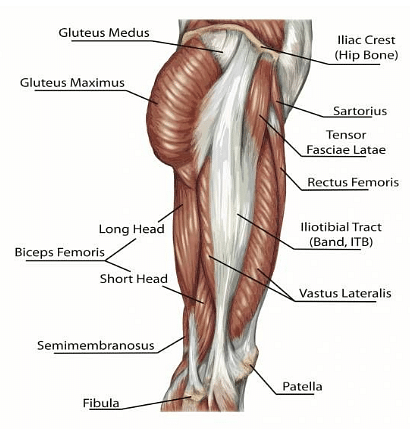
Anatomy of the Gluteus Muscles
There are three types of gluteus muscles in the human body -
- Gluteus Maximus
- Gluteus Medius
- Gluteus Minimus
Tensor fasciae latae is another muscle, other than the three main ones present in the glutes region.
Also Check:
| Topic-Related Concepts | ||
|---|---|---|
| Muscular Tissue | Sliding Filament Theory | Difference between Cardiac Muscle and Skeletal Muscle |
| Disorders Muscular and Skeletal System | Cardiac Muscle | Deltoid Muscle |
Gluteus Muscles Classification
[Click Here for Previous Year Questions]
Gluteus muscles can be classified into two broad categories: Superficial Abductors and Extenders and Deep Lateral Rotators. These muscle groups are required to move the lower limb attached to the hip joint. These two muscles work together to form glutes.
Superficial Abductors and Extenders
Main function of these muscles are to carry out the abduction and extension of the femur bone. The muscles that make up this group are the gluteus maximus, gluteus medius, gluteus minimus and fascia lata.
Deep Lateral Rotators
These muscles' primary purpose is to perform the lateral rotation of the femur. They also provide stability to the hip’s ball and socket joint. These muscles get inserted into the greater trochanter of the femur after originating in the pelvic area.
Muscles present in this class are gemellus superior, gemellus inferior, quadratus femoris, obturator internus and, piriformis. Both of these muscle groups are required for the movement of the lower limb attached to the hip joint.
Read more: Difference between Cell and Tissue
Gluteal Muscle Function
[Click Here for Sample Questions]
Major functions of the gluteus muscles in the human body are as follows -
- Helps in locomotion and extends the hip.
- Aids in balancing the body.
- Stabilize the upper body part and pelvis.
- Assist in the movement of the lower limb of the body.
- Assist in thigh abduction, extension and rotation.
- Through the iliotibial tract, it supports the knee when it is stretched.
Read Also: Bones of Legs
Gluteus Muscle Types
[Click Here for Previous Year Questions]
Three muscles that form the Glutes are:
Gluteus Maximus
Gluteus Maximus is the largest and most superficial muscle of the gluteus region. It provides the majority of the shape of the buttocks.
- The thoracolumbar fascia, the gluteus surface of the ilium, the posterolateral portion of the sacrum and coccyx, the sacrotuberous filament, and gluteal aponeurosis all serve as the origin of this muscle.
- The lower, deeper muscular fibres of this muscle insert on the gluteal tuberosity of the femur, while the higher, superficial fibres attach to the iliotibial tract.
- The muscular branches of the inferior gluteal and superior gluteal arteries supply this muscle with blood.
Gluteus Maximus Function
The functions of the Gluteus Maximus include:
- Acts as an important muscle for daily activities and sports performances.
- Helps in the external rotation of the thigh.
- Provides support to the pelvis which in turn assists in maintaining posture.
- The lower part performs abduction for the limb while the upper fibres are involved in the abduction of the hip joint.
- It acts as a tensor for fascia lata.
Check Also: Largest Organ in Human Body
Gluteus Medius
Gluteus Medius lies directly under the gluteus maximus, between the gluteus maximus and gluteus minimus.
- It is located on the pelvic surface, where the gluteal aponeurosis covers two-thirds of it, and the gluteus maximus covers the remaining third.
- It is radiating and dense in nature. It starts between the anterior and posterior gluteal lines on the ilium's gluteal surface. It then gets inserted into the trochanter of the femur.
- The greater trochanter of the femur on which it rests and the tendon are separated from one another by a bursa.
Gluteus Medius Function
The functions of the Gluteus Medius include:
- Helps in internal rotation and abduction of the thigh at the hip joint.
- During the gait cycle, the muscles help in the stabilization of the pelvic and trunk region.
- Lateral rotation of the limb is assisted by the posterior fibre of the muscle.
- Stabilize the pelvis on the coronal plate.
- Aids in medial rotation of the lower limb.
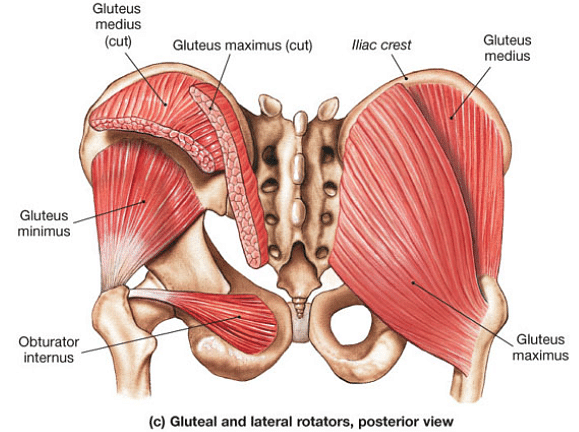
Gluteus Muscle types
Gluteus minimus
Gluteus Minimus lies just below the gluteus medius, it is the smallest gluteal muscle.
- It comes from the ilium's gluteal surface, which is located between the inferior and anterior gluteal lines.
- It then forms a tendon and gets inserted into the greater trochanter of the femur. Between the tendon and the greater trochanter, there is a bursa.
- The muscle's maximal strength and abduction are provided by its fan-shaped structure.
- It originates on the ilium's gluteal surface. It works in coordination with the gluteus medius to carry out its functions.
Gluteus Minimus Function
The function of the Gluteus Minimus include:
- Along with the gluteus medius, it helps in the internal rotation of the thigh.
- It contributes to the stabilization of the pelvis.
- Its additional fibres help in hip flexing.
- They avoid capsular impingement of the hip joint capsule.
- High abduction of the thigh is also performed by this muscle.
Tensor Fasciae Latae
Tensor Fasciae Latae is a fusiform muscle present in the anterolateral thigh region.
- It is formed from the outside portion of the anterior iliac and the superior iliac spine. It gets directly inserted into the fascia lata.
- It forms the iliotibial tract along with the gluteus maximus and gluteus aponeurosis.
Function of Tensor Fasciae Latae
- The thigh gets abducted at the hip joint by this muscle.
- It helps in the external rotation of the legs at the knee joints.
- In the gait cycle, it also supports other movements.
- Contributes to the stabilization of hips and knee joints, as it crosses them.
Check More:
| Chapter Related Topics | ||
|---|---|---|
| Central nervous system | Types of Joints | Pelvic Bones |
| Control and coordination | Blood vessels | Blood |
Gluteus Muscles Disorders
[Click Here for Sample Questions]
Many lower limb issues can arise because of the weak gluteus muscles. Other muscles and tissues may become overburdened if any problems arise in these muscles. Some of the most common gluteus muscle disorders are as follows -
- Greater Trochanteric Pain Syndrome (GTPS): Greater trochanteric pain syndrome causes pain on the outside of the hip by overuse and stress of the concerned muscles.
- Gluteal Tendinopathy: Gluteal tendinopathy is the tendon disorder of the gluteal region. Tendon tissues of the hips break down leading to pain in the hip. It is common in older women.
- Patellofemoral Pain Syndrome (PFPS): In patellofemoral pain syndrome, the pain is around and under the patella. It is caused by problems between the kneecap and the femur. The kneecap cartilage gets damaged due to an injury or overuse.
- Iliotibial Band Syndrome: In iliotibial band syndrome the connective tissues from the pelvic bone to the shinbone become tight. Connective tissues rub against the thigh bone causing pain.
- Trochanteric Bursitis: In trochanteric bursitis the bursa at the greater trochanter gets inflamed in this condition. Affect the hip’s outer area and the upper leg’s outside part.
- Trendelenburg Gait: Defective hip abductor mechanism leads to a formation of an abnormal gait in this condition.
- Deep Gluteal Syndrome (DGS): Deep gluteal syndrome condition causes pain and numbness in the buttock and the posterior thigh. Primary causes are injury or inflammation of the associated structures of the area. It occurs in a non-discogenic sciatic nerve entrapment in the subgluteal area.
Check-Out:
| More Important Concepts | ||
|---|---|---|
| Connective Tissues | Red Muscle Fibres and White Muscle Fibres | Difference between Bones and Cartilage |
| Difference between Ligaments and Tendons | Ligament | Skeletal System |
Things to Remember
- The gluteus muscle is a group of muscles present in the buttock region which acts on the hip joint and aids in the abduction and extension of the thigh.
- The gluteus muscles are of three types - Gluteus maximus, Gluteus medius, Gluteus minimus.
- Gluteus muscles can be categorized into two broad categories - Superficial Abductors and Extenders and Deep Lateral Rotators.
- These muscles function to help stabilise the upper body and pelvis, aid in locomotion and extend the hip.
- Greater Trochanteric Pain Syndrome (GTPS), Gluteal Tendinopathy, Deep Gluteal Syndrome, Patellofemoral Pain Syndrome, and Trochanteric Bursitis are some common disorders related to the gluteus muscles.
Previous Year Questions
- Calcium is important in skeletal muscle contraction because it...[NEET 2018]
- Colle's fracture is associated with...[BHU UET 2009]
- A deltoid ridge occurs in...[NEET 1990]
- Number of cervical vertebrae in camel is...[NEET 1990]
- Stimulation of a muscle fiber by a motor neuron occurs at….[NEET 2014]
- In human body which one of the following is an atomically correct ?...[NEET 2007]
- Which one of the following items gives its correct total number?...[NEET 2008]
- During strenuous exercise glucose is converted into...[BHU UET 2005]
- ATPase enzyme needed for muscle contraction is located in -[NEET 2004]
- Inter-articulated disc is found in...[BHU UET 2005]
Sample Questions
Ques. How many types of gluteus muscles are present in the human body? (1 mark)
Ans. The human body has Gluteus maximus, Gluteus medius, Gluteus minimus and Tensor fasciae latae present as gluteus muscles.
Ques. What are some common disorders associated with gluteus muscles? (2 marks)
Ans. Common disorders associated with gluteus muscles are Greater Trochanteric Pain Syndrome (GTPS), Patellofemoral Pain Syndrome (PFPS), Iliotibial Band Syndrome and Trochanteric Bursitis.
Ques. What are the functions of gluteal muscles? (2 marks)
Ans. These muscles facilitate the stabilisation of the upper body and pelvis, as well as in locomotion and hip extension. The gluteal muscles act on the hip joint, primarily to aid in thigh abduction and extension, but some also aid in thigh adduction, external rotation, and internal rotation.
Ques. What variations are observed in the gluteus medius? (1 mark)
Ans. Some of the muscle's tendons are not tightly connected to the piriformis and some of the tendon's fibres make little to no contribution to the development of the strong tendon are variations observed in the gluteus medius.
Ques. What is the tensor fasciae latae muscle? (3 marks)
Ans. Tensor fasciae latae is a fusiform muscle located on the anterolateral side of the thigh.
- It arises from the anterior iliac crest's outer lip and the anterior superior iliac spine.
- It then runs distally to attach to the fascia lata.
- The iliotibial tract is a horizontal band formed by the tensor fasciae latae, gluteus maximus muscle, and gluteal aponeurosis.
- The iliotibial tract extends to the tibia's lateral condyle and the patellar retinaculum.
Ques. How is blood supplied to the Gluteal muscle? (3 marks)
Ans. The superior and inferior gluteal arteries, which are divisions of the internal iliac artery, supply blood to the gluteal muscles.
- The internal iliac artery's major branch, the superior gluteal artery, emerges from its posterior division. It has superficial and deep branches that nourish the tensor fasciae latae and the gluteus maximus, medius, and minimus muscles.
- The internal iliac artery's anterior division is where the inferior gluteal artery is born. Only the gluteus maximus receives blood from this artery.
Ques. How gluteus muscles can be categorised? (2 marks)
Ans. Gluteus muscles can be categorised as followed:
- Superficial Abductors and Extenders: These are the muscles that make up the tensor fascia lata as well as the gluteal maximus, gluteus medius, and gluteus minimus. These muscles' primary function is to perform femoral abduction and extension.
- Deep Lateral Rotators: These muscles primarily function to rotate the femur laterally. They support the hip's ball and socket joint. These muscles all originate in the pelvic area and attach to the femoral greater trochanter.
Ques. What is the function of the Gluteus maximus? (4 marks)
Ans. The gluteus maximus muscle is vital for daily activities, explosive athletic performance, and the stability of certain joints in the body.
- It serves as our strongest hip extensor
- They are the primary thigh extensors.
- They are mainly responsible for lateral thigh rotation.
- It functions as a tensor for the fascia lata.
- It aids in posture maintenance by providing support to the pelvis; it is easily visible in an erect posture.
- The lower half of the muscle is responsible for limb abduction, whereas the upper fibre of the gluteus muscle is responsible for hip joint abduction.
Ques. What happens in Patellofemoral Pain Syndrome (PFPS)? (4 marks)
Ans. Patellofemoral pain syndrome (PFPS), also known as runner's knee or jumper's knee, is a type of knee pain.
This medical issue causes pain beneath or near the kneecap (patella). PFPS can affect one or both knees. It has an impact on both children and adults.
In most cases, the pain worsens with activity or after long periods of sitting with the knees bent. Patellofemoral pain syndrome can affect anyone.
Females and athletes, including children and young adults, are more likely to develop PFPS. People who participate in sports that require a lot of running, jumping, or squatting are more likely to develop PFPS. Others may develop PFPS if they walk or sit for long periods of time, kneel, or climb stairs.
Ques. What are the signs and symptoms of gluteal tendinopathy? (5 marks)
Ans. Moderate to severe hip pain is the most noticeable symptom of gluteal tendinopathy. This pain radiates down the outside of your leg to the knee or lower leg.
You could also have lower back, groyne pain, or gluteal pain. The pain usually begins at the greater trochanter, which is located at the top of your thighbone.
This area may be sensitive to touch.
The discomfort may be aggravated if you:
- Climb a flight of stairs or walk up a hill.
- In the morning, get out of bed.
- Lie down on your side.
- Sit for an extended period of time or cross-legged.
- Stand on one leg, as if you were putting on a pair of pants.
Read More:



Comments