



Content Curator
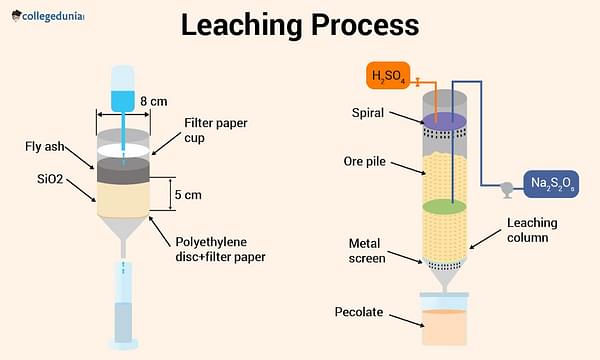
The leaching process shows the release of both organic and inorganic radionuclides or pollutants from a solid to a liquid state when they are influenced by various processes such as mineral dissolution, complexation, and desorption.
- Leaching is one of the important processes involved in the field of metallurgy.
- The process of Leaching is used to concentrate the ore.
- The ore of the metal is made to react with a suitable chemical reagent.
- This leads to the dissolution of only the metal, leaving behind the impurities which remain undissolved.
- The solution so obtained is a compound of the metal that can be further processed to extract the pure metal.
There are many different types of leaching processes, which are mainly categorized based on the reagents utilized, Such as
- Cyanide leaching (e.g. gold and silver)
- Ammonia leaching (e.g. crushed ore)
- Alkali leaching (e.g. bauxite ore)
- Acid leaching (e.g. sulphide ore).
| Table of Content |
Key Terms: Leaching process, Bauxite, Sodium hydroxide, Noble metals, Aqueous solutions, Heap leaching, In-suit leaching
What is the Leaching Process?
[Click Here for Sample Questions]
Leaching is the process by which a solute is detached or extracted from its carrier substance using a solvent.
- Leaching is a natural process that scientists have adapted for a range of applications with various methods.
- Specific extraction procedures are determined by the solubility properties of the sorbent material, such as concentration, distribution, type, and size.
- Leaching can occur naturally as seen from substances in plants (both inorganic and organic), solute leaching in soil, and organic material decomposition.
- Leaching can be used to improve water quality and remove contaminants.
- It can also be used to dispose of harmful waste products such as fly ash or rare earth elements (REEs).
Also Read:
| Related Concepts | ||
|---|---|---|
| Saturated Hydrocarbon | Condensation polymerization | Uses of Carbonyl Compounds |
| Dinitrogen uses and properties | Hydrogen Spectrum | Nomenclature of coordination compounds |
Leaching Process Examples
[Click Here for Sample Questions]
The following are the examples of leaching process
Leaching of Bauxite
An example of a leaching process is the leaching of bauxite or Al2O3.2H2O with concentrated and heated sodium hydroxide. The concentrated NaOH here prefers to dissolve the aluminium contained in the provided bauxite, but not the impurities such as SiO2, TiO2, and Fe2O3.
The chemical reaction of this leaching process is as follows
\(Al_2O_3.2H_2O+2NaOH \:\: \longrightarrow \:\: 2NaAlO_2 + 3H_2O\)
Leaching of the Noble Metals
Another example of this process would be the leaching of noble metals such as gold and silver using dilute aqueous solutions of sodium cyanide or potassium cyanide in the presence of air. The chemical reaction for silver leaching can be provided by
\(Ag_2S+4NaCN \:\: \longrightarrow \:\: 2Na[Ag(CN)_2] + Na_2S\)
Because of heavy rainfalls, the leaching process also causes the loss of nutrients in the soil.
Types of Leaching Process
[Click Here for Sample Questions]
The different types of leaching processes used in metallurgy for industrial purposes are given below.
Heap Leaching
Heap leaching is a popular process for obtaining low-grade minerals such as copper, gold, silver, and uranium.
- The ore is crushed, collected, and charged to a heap during this process.
- All of this takes place in a container with an impermeable coating.
- The lixiviant is then added and diffused across the heap.
- It is finally collected and pumped out to be processed further.
- The commonly demonstrated lixiviants used in heap-leaching processes are sulphuric acid and cyanide salts.
In-situ Leaching
In-situ leaching, also known as in-situ recovery or solution mining, is a mining method that uses boreholes drilled into a deposit to recover minerals such as copper and uranium.
- In situ leaching works by dissolving minerals that are naturally present in the solid state.
- In-situ leach mining involves injecting a lixiviant into the ore body through a borehole.
- It circulates through the porous rock dissolving the ore and is retrieved through a second borehole.
- The lixiviant varies depending on the ore deposit: for salt deposits, the leachate can be fresh water into which salts can dissolve easily.
- In most cases, acids are required to increase the solubility of the ore minerals in the solution.
- The lixiviant for uranium ores may include acid or sodium bicarbonate.
Tank Leaching and VAT Leaching
They are the processes that need the ores to be deposited in vats or large tanks containing leaching solutions. These processes are used to extract metals from their ores.
Advantages and Disadvantages of Leaching Process
[Click Here for Sample Questions]
The following are the advantages and disadvantages of the Leaching Process
Advantages of the Leaching Process
The advantages of the leaching process are
- It helps in the extraction of metals and minerals from ore.
- The process is simple to carry out.
- It uses less energy.
- When compared to other mining methods, it has a lower environmental effect.
- The leaching chamber is easily transportable to the excavated trench.
Disadvantages of the Leaching Process
The disadvantages of the leaching process are
- This process causes soil acidification, which has a variety of harmful effects.
- Water might get contaminated if the process is not followed properly.
- It can be a slow process, requiring more time.
- Many hazardous waste products are produced, which must be handled carefully.
Things to Remember
- Leaching is the process by which a solute is detached or extracted from its carrier substance using a solvent.
- It is a natural process.
- It can be used to improve water quality and remove contaminants.
- It can cause the loss of nutrients in the soil.
- Heap leaching is a popular process for obtaining low-grade minerals such as copper, gold, silver, and uranium.
- In-situ leaching process uses boreholes drilled into a deposit to recover minerals such as copper and uranium.
Also Read:
Sample Questions
Ques. What is called leaching? (2 Marks)
Ans. In the extraction of substances from solids, the leaching process is used. This is done by dissolving the substance in a liquid. This can be accomplished by an industrial or natural method.
Ques. What is the difference between bauxite and alumina? (2 Marks)
Ans. Bauxite is the ore of Aluminium having the chemical formula Al2O3. 3H2O while alumina is an oxide of aluminium with the chemical formula Al2O3.
Ques. What is the difference between Heap leaching and Tank leaching? (3 Marks)
Ans.
| Heap leaching | Tank leaching |
|---|---|
| Heap leaching is the Method of stacking the concentrated ore into a Heap on a semi-permeable pad, irrigating the ore with a suitable reagent and collecting the dissolved metallic solution that seeps in through the Heap. | In-tank leaching the ore is put into large-sized tanks also known as vats, the chemical reagent is then added which causes the metal to separate from the other impurities. |
| Thus process is used to extract metals from low-grade ores which cannot be processed by other means, such as uranium, copper, nickel, etc. | This method is mostly used to extract industrial metals such as copper, gold, aluminium and others as it is cost-effective and requires comparatively less effort. |
Ques. In the Mac Arthur-Forrest cyanide process which metal is leached and which reagent is used? (2 Marks)
Ans. In the Mac Arthur-Forrest cyanide process, the metal that is purified is silver and the reagent used is sodium cyanide.
Ques. What is In- situ leaching? (2 Marks)
Ans. Holes are drilled into the deposit, in order to make pathways for the solution to penetrate. The lixiviant is then pumped into the deposit, making contact with the ore, and the resulting solution is then collected and processed.
Ques. What is chemical leaching? (2 Marks)
Ans. In chemical leaching, the solid mixture contains the inert insoluble carrier A and the solute B. In an ideal chemical leaching process, the solvent, (reagent) to be used is added to the solid mixture such that all of the solute is dissolved in the solvent but the carrier particles remain undissolved.
Ques. Which metal cannot be extracted by the leaching process? (2 Marks)
Ans. Mercury cannot be extracted by the leaching process because, unlike gold or copper, mercury is inert to a large variety of reagents and hence its leaching is rarely possible.
Ques. How are leaching processes classified depending on the type of reagent used? (2 Marks)
Ans. Depending upon the type of suitable reagents chosen for a particular ore, the leaching process is classified into the following categories;-
Cyanide leaching (e.g. gold and silver), Ammonia leaching (e.g. crushed ore), Alkali leaching (e.g. bauxite ore), Acid leaching (e.g. sulfide ore).
Ques. How is the process of Leaching beneficial? (2 marks)
Ans. The leaching process is beneficial in the following ways:-
- This process is easy to execute, maintain and handle.
- It does not produce any harmful gaseous pollutants.
Ques. What are the challenges faced during the process of Leaching? (2 Marks)
Ans. Though cost-effective and easy to execute the process, still the leaching process has some challenges in the metallurgical extraction process. Some of these are:-
- The effluents that are left behind after the leaching are highly acidic and difficult to handle and store.
- These effluents can be highly toxic in nature which can pose a serious threat to the environment as well as the people working in the leaching process.
For Latest Updates on Upcoming Board Exams, Click Here: https://t.me/class_10_12_board_updates
Also Read:



Comments