



Education Journalist | Study Abroad Lead
The chemical formula used to denote Iron III Oxide is Fe2O3 which is mined from the iron ore Hematite. The valency of Iron metal is 2 and 3. Here, we will understand the concept of iron III oxide, structure, properties and uses.
| Table of Content |
Keyterms: Iron, Oxide, Hematite, Metal, Valence electrons, Ferric oxide, Applied Chemistry, Ferric
What is Iron (III) Oxide (Fe2O3)?
[Click Here for Sample Questions]
A very well known term for Fe2O3 is rust, but in chemistry, it is often considered an ill-defined term. When the iron metal is combined with 2 valencies, it is known as ferrous and when it is combined with 3 valencies, it is called ferric. The International Union of Pure and Applied Chemistry (IUPAC) has named this Ferric Oxide. To balance properly with the valence electrons, they bond together naturally in the neutral state.
Also Read:
| Related Articles | ||
|---|---|---|
| Types of Titration | Difference Between Acid and Base | Acid Test |
| Red Phosphorus | Group 15 Element | Group 16 Element |
| Nucleic Acids | Lewis Acid | Arrhenius Acid |
Physical Properties of Iron III Oxide (Fe2O3)
[Click Here for Sample Questions]
The main physical properties of Iron III Oxide (Fe2O3) are tabulated below for your reference,
| Fe2O3 | Iron (III) Oxide or Ferric Oxide |
| Molecular Weight | 159.69 g/mol |
| Density | 5.242 g/cm3 |
| Canonical Smiles | O=[Fe]-O-[Fe]=O |
| Melting point | 1566oC |
| Colour | Brownish Red (Venetian red) |
| Solubility in Water | Insoluble |
| Crystal Structure | Rhombohedral |
| Heat Capacity | 103.9 J/mol-K |
| Form | Powder |
| Odour | Odourless |
| pH | 6.0 - 7.0 |
Chemical properties of Iron III Oxide (Fe2O3)
[Click Here for Sample Questions]
The Iron III oxide is basic and it turns into a weak base when dissolved with water making ferric hydroxide (Fe(OH)3).
Fe2O3 + 3H2O → 2Fe(OH)3
It can be also observed that it exhibits its alkaline properties when reacted with an acid to form an inorganic salt and water as the end product of the acid-base reaction. The chemical equation is provided below for your reference.
3 Fe2O3 + H2 → 2 Fe3O4 + H2O
It exerts an exothermic thermite reaction with Aluminium and the chemical equation is as follows
2Al + Fe2O3 → 2Fe + Al2O3
Iron III Oxide is insoluble in water but reacts strongly with strong acids, preferably hydrochloric and sulphuric acids. It also actively reacts with chelating agents’ solutions like Ethylene Diamine Tetraacetic acid, oxalic acid, malic acid, nitrilotriacetic acid etc., And heating ferric oxide with other carbonates and metal oxides results in the end product called ferrates.
ZnO + Fe2O3 → Zn(FeO2)2
Reducing metal oxides with any of the reducing agents like carbon gives pure metal under the process of carbothermal reduction. The chemical equation for the same is,
Fe2O3 + 3CO → 2Fe + 3CO2
Preparation of Iron III Oxide (Fe2O3)
[Click Here for Sample Questions]
The name Iron III Oxide itself tells that it is formed when Iron undergoes oxidation. It can be prepared in the laboratory with the sodium bicarbonate solution electrolyte. Using an inert electrode and an iron cathode, the hydrated ferric oxide is prepared which is again dehydrated at around 200 degrees celsius to convert into solid Iron (III) oxide in the form of a powder. The chemical equation is as follows,
4Fe + 3O2 + 2H2O → 4FeO(OH)
Dehydrating FeO(OH) under 200oC gives Iron (III) Oxide,
2FeO(OH) → Fe2O3 + H2O
Structure of Iron III Oxide (Fe2O3)
[Click Here for Sample Questions]
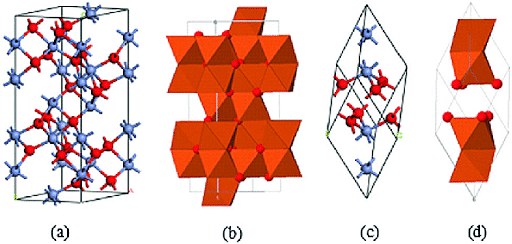
The chemical formula for Iron III Oxide is Fe2O3, which indicates that it has three oxygen atoms and two iron atoms. It is also known that the oxidation state of Iron III Oxide is +3. The formation of bonds between Iron and oxygen is completely dependent on the difference of electronegativity between a metal (Fe) and a nonmetal (O2). Whenever there is a bond formed between a metal and non-metal using the difference of electronegativity, it is called an Ionic bond. The canonical smile on how the atoms are connected is given below in the figure.
The Rhombohedral crystal structure of Iron III oxide is provided with the figure for your reference.
Uses of Iron III Oxide
[Click Here for Sample Questions]
Iron Industry - It is the primary feedstock for the steel and iron manufacturing industry. They are used as the primary component for Iron, steel and their alloy production.
- Polishing: The fine powder of ferric oxide is often called the Jewellers’ rouge or the red rouge as it is used to put the final polish of the metallic jewels and lenses. It is used mostly for cosmetic purposes here as it cuts more smoothly and finely than the modern rouges available currently and it provides the superior finish expected by the jeweller.
- Pigmentation: Ferric oxide is used as pigments under different tags like “pigment brown 6”, “pigment brown 7” which are approved by the US Food and Drug Administration (FDA). They are widely used as pigments for dental composites including titanium oxides.
- Photocatalysis: For solar water oxidation, the alpha ferric oxide is represented as a photoanode where researchers have found that the performance of the water quality is enhanced using nanostructuring and surface functionalization
- Medicine: A lotion made from Iron III Oxide is used to treat mild itchiness and this 0.5% of ferric oxide acts as an antipruritic.
Also Read:
Sample Questions
Ques: What is the correct name for Fe2O3? (1 mark)
Ans: It is called ferric oxide or Iron (III) oxide according to the International Union of Pure and Applied Chemistry (IUPAC).
Ques: Is Fe2O3 called rust? (1 mark)
Ans: Iron in the presence of moisture combines with the oxygen in the air to form a brown coloured solid powder which is called rust.
Ques: What is Fe2O3 made of? (1 mark)
Ans: Fe2O3 is made up of three oxygen atoms and two iron atoms. The oxidation state of Fe2O3 is +3.
Ques: What type of bond is found in Fe2O3? (1 mark)
Ans: Iron is a metal and oxygen is a non-metal. And the bond between a metal and a non-metal can be done through the Ionic bond only.
Ques: Is Fe2O3 basic or acid? (1 mark)
Ans: Usually, the oxides of Iron, Aluminium and tin are amphoteric and they exhibit both acidic and basic characters. But when the pH value is considered, it is tagged as basic as its pH falls between 6.0 - 6.9.
Ques: How does the form of Fe2O3 exist? (1 mark)
Ans: Fe2O3 exists in the form of powder which has a brownish-red colour and is odourless.
Ques: Is Iron oxide used in food? (1 mark)
Ans: Yes, Iron oxide is used as industrial food pigments because of its rich brownish-red colour. It is used in making sweets, olives and colouring the food and many other purposes.
Ques: Is Fe2O3 soluble in water? (1 mark)
Ans: Yes, Fe2O3 is insoluble in water but reacts strongly with strong acids. The water solubility of iron compounds increases when the pH of the iron compound goes down.
Ques: Is Fe2O3 a salt? (1 mark)
Ans: Technically, Fe2O3 is a salt that is produced by the reaction of iron and water. The end product is obtained in the form of a brownish-red powder which is technically a salt.
Ques: Why is Fe2O3 called Jewellers’ rouge? (1 mark)
Ans: The fine powder of ferric oxide is often called the Jewellers’ rouge or the red rouge as it is used to put the final polish of the metallic jewels and lenses.
For Latest Updates on Upcoming Board Exams, Click Here: https://t.me/class_10_12_board_updates
Check-Out:



Comments