



Education Content Expert
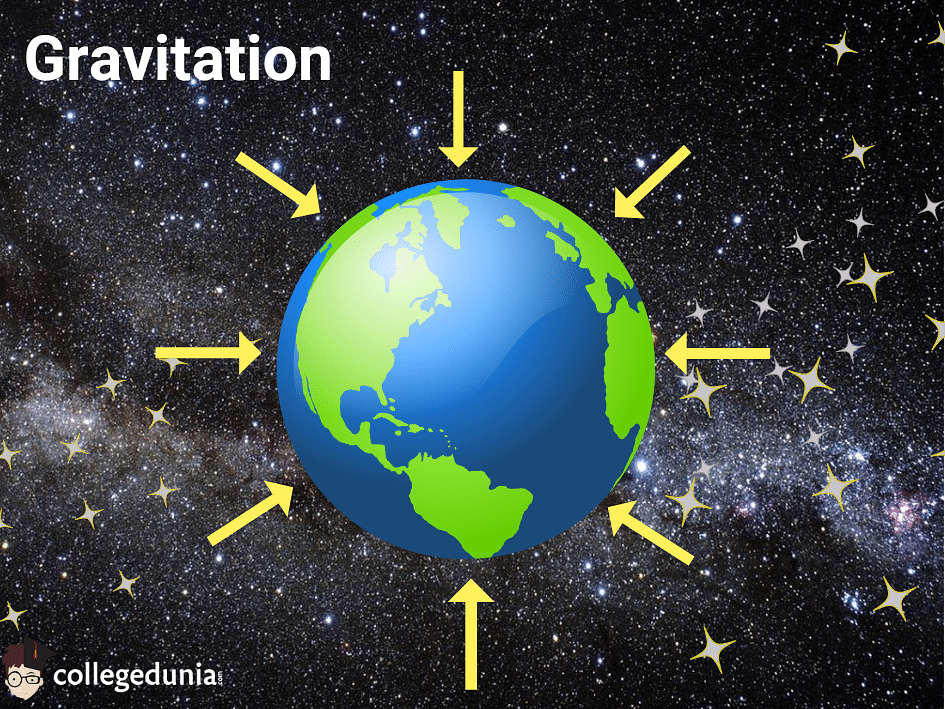
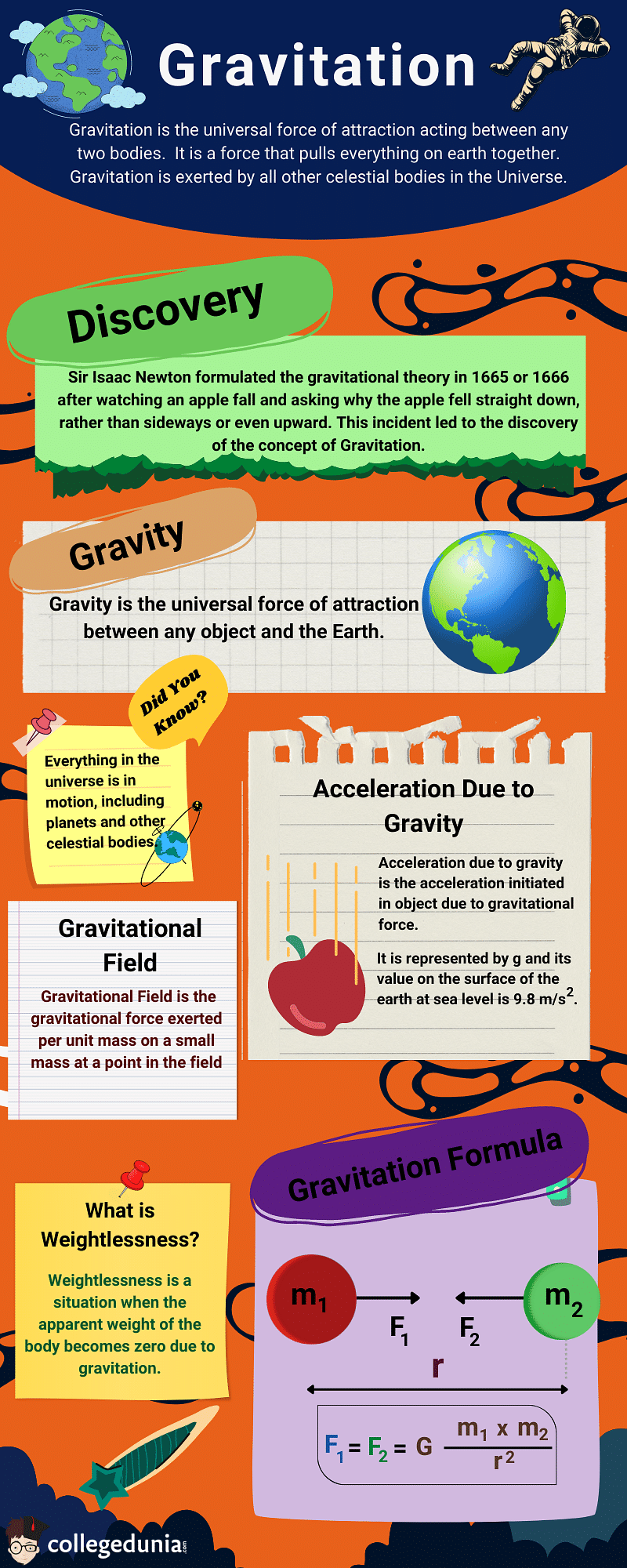
Gravitation is the universal force of attraction acting between any two bodies.
- Gravitation is the force that pulls everything on earth together.
- It is also referred to as Gravity.
- Sir Isaac Newton established the concept of Gravitation.
- It is a natural phenomenon that attracts all matter and energy, including planets, stars, galaxies, and even light.
- The weight of all physical objects on earth is determined by gravity.
- In simpler terms, it is the force of attraction exerted by the bodies of different objects on one another due to their masses.
Gravitation Formula is given as
| \(F_g = \frac{Gm_1m_2}{r^2}\) |
Here, F is the gravitational force, m1 and m2 are the masses of the two bodies and r2 is the distance between their center points.
Read More: NCERT Solutions for Class 11 Physics Gravitation
Related Links
Key Terms: Gravitation, Gravity, Newton's Law of Universal Gravitation, Kepler’s Law, Gravitational Acceleration, Gravitational Force
What is Gravitation?
[Click Here for Sample Questions]
Gravitation is the force of attraction between any two objects in the universe.
- Everything in the universe is attracted to something else with some force.
- However, it can not be detected due to the weak nature of this force.
Gravitation Detailed Video Explanation
The gravitational force is weak due to the large separation distance.
- Sir Isaac Newton proposed the universal law of gravitation in 1680.
- He stated that gravity is caused by the attraction of objects toward the earth.
Read More:
Gravitation Formula
[Click Here for Previous Years’ Questions]
Sir Issac Newton thoroughly researched the forces at work on different particles and articulated his findings. This is known as Newton's Law of Universal Gravitation.
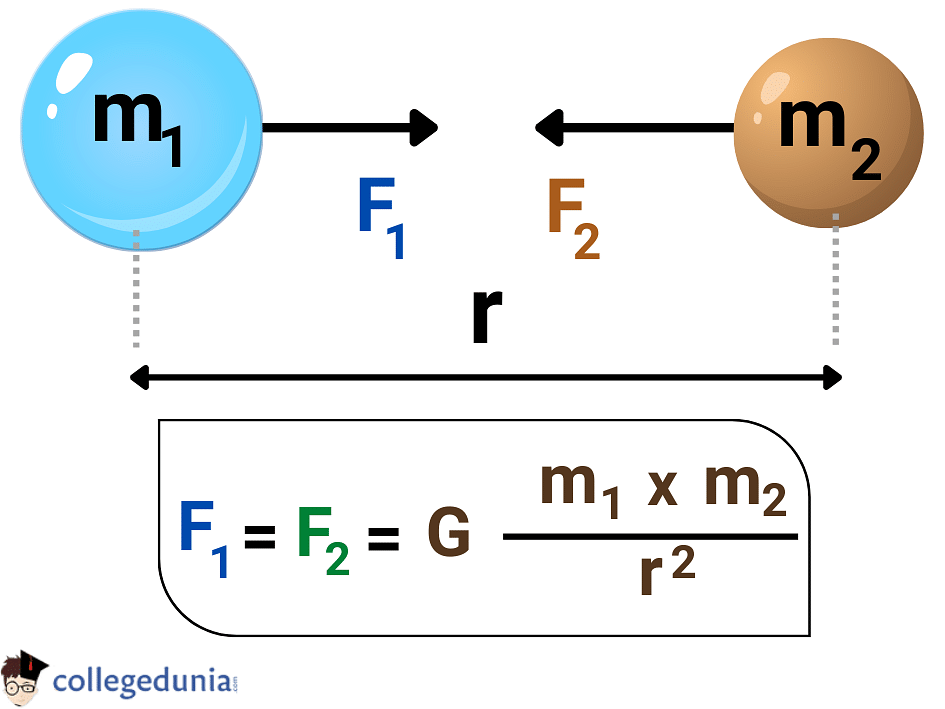
The universal law of gravitation states that
| "The force of attraction between any two particles in the universe is exactly proportional to the product of their masses and inversely proportional to the square of their distance." |
The equation for Newton’s Law of Gravity or the Gravitation Formula is given as:
| \(F_g = \frac{Gm_1m_2}{r^2}\) |
Where
- G refers to the gravitational constant which is equal to 6.67 × 10 -11m3/kg.s2
- m1 and m2 denote the masses of the two objects.
- r refers to the distance between two objects' centers.
- Fg is the gravitational force between m1 and m2.
Gravitation Formula
Read More: Gravitation MCQs
What is Gravitational Force?
[Click Here for Sample Questions]
Gravitational Force is the universal force of attraction acting between any two objects with mass.
- Gravitational Force is the most fundamental natural force.
- It is the inherent attractive force between two bodies.
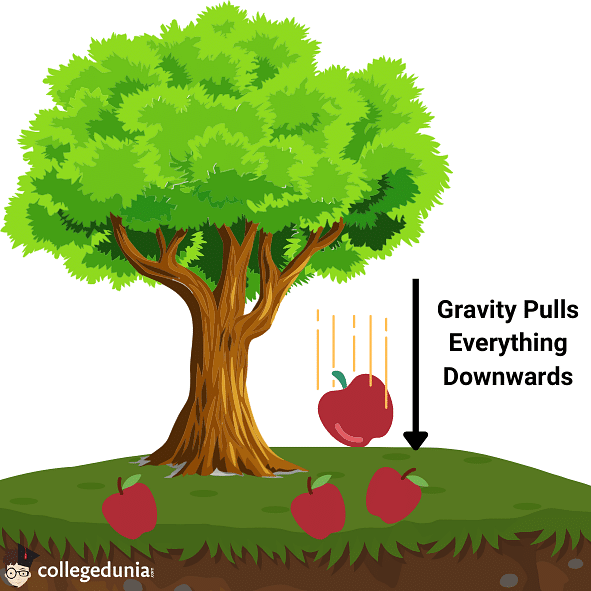
- Gravitational pulls objects to the center of the Earth.
- This force also controls the motion of the planets and the Moon.
- Gravitational Force is commonly described as attractive because it constantly attracts masses to one another while never separating them.
- This demonstrates how everything in the universe, including us, pulls on everything else.
Gravity
Gravitational Acceleration
[Click Here for Previous Years’ Questions]
Gravitational Acceleration is defined as the rate at which the velocity of a body falling freely toward the earth increases. Gravity's Acceleration is independent of an object's form, size, and mass. It is represented by the letter g.
The relationship between g and G is given as:
| g = GM/R2 |
- The letter G represents the gravitational constant.
- M denotes the Earth's mass.
- R denotes the radius of the Earth.
The object's mass does not affect acceleration due to the gravity equation (m). When two bodies of different masses descend simultaneously, their acceleration is the same.
Gravitation
Read More: Gravitational Acceleration Formula
Kepler's Laws
[Click Here for Sample Questions]
Kepler’s Laws of Planetary Motion are three scientific laws that illustrate the motion of planets around the sun.
- Kepler’s First Law (Law of Elliptical Orbit): According to Kepler's first law, all planets rotate around the Sun in a path described as an ellipse.
- Kepler’s Second Law (Law of Areal Velocities): A line drawn from the Sun to any planet will cover an equal space area in equal time intervals, according to Kepler's second law.
- Kepler’s Second Law (Law of Periods): According to Kepler's third law, the square of any planet's duration of revolution around the Sun is equal to the cube of the mean distance from the Sun.
Read More: Gravitation Important Questions
Gravitation Formulas
[Click Here for Previous Years’ Questions]
All the important formulas of Gravitation are as follows:
Gravitational Force
According to Newton's Law of gravitation, the force between two point masses is given by
| F = [Gm1m2] / r2 |
Where
- G is the gravitational constant.
- The direction of the force will be an attraction.
Gravitational Potential
The gravitational field is the region surrounding a mass or group of masses that have the potential to exert gravitational pull-on other masses.
(I) For Point Charge: v = -GM/r
(II) For Circular Ring: v = - GM / √ (R2+X2)
- X is the radius of the ring
- R is the distance from the ring
(III) For Thin Circular Disc: v = - 2GM / R2 (√ (R2+x2−X))
(IV) For Uniform Thin Spherical Shell:
- Vout = -GM/r
- Vsurface = -GM/R
- Vin = -GM/R
Gravitational Acceleration
Gravitational Acceleration can be calculated using the given formula:
| g = GM/r2 |
Variation of g
The variation of g with respect to depth and height is calculated as:
- Variation of g with Depth: ginside ≈ g(1 – h/R)
- Variation of g with Height: goutside ≈ g(1 – 2h/R)
- Effect of Non-Spherical Earth Shape on g: g at pole > g at the equator (Since Re - Rp ≈ 21km)
- Effect of Earth Rotation on Apparent Weight: mg’θ = mg = mw2Rcos2θ
Read More: Value of G
Value of Velocity
The value of orbital and escape velocity is calculated as:
- Orbital velocity of the satellite: Vo = √GM/R
- Escape Velocity: Ve = √2GM/R
Kepler's Law
- First law: Elliptical orbit with the Sun at one of the focus.
- Second Law: Areal velocity is constant (dA/dt =0)
- Third Law: T2 ∝ R3
Solved Examples on Gravitation Formula
[Click Here for Sample Questions]
Here are a few solved examples on Gravitation Formulas to understand the concept better:
Example 1: Determine the gravitational force given that the two masses are 30kg and 50kg separated by a distance of 4m. (G = 6.67259 x 10⁻¹¹ N m2/kg2)
Solution: According to the question,
- m1 = 30 kg
- m2 = 50 kg
- r = 4m
- G = 6.67259 x 10⁻¹¹ N m2/kg2
Using the Universal Gravitation Formula,
F = [Gm1m2]/ r2
Fg = [6.673 ×10–11 × 30 × 50] / 16
F = 62.55 x 10⁻¹¹N
Thus, the gravitational force is 62.55 x 10⁻¹¹N.
Example 2: What will be the acceleration due to gravity for an object placed at the surface of the Earth if the radius of the Moon is 1.74 × 10⁶ m and its mass is given as 7.35 × 10²² kg.
Solution: According to the question,
- Radius of the moon (r) = 1.74 × 10⁶m = 1740000 m
- r2 = 3.0276 × 10¹²m
- Mass of moon = 7.35 × 10²² kg
Using the acceleration due to gravity formula,
g = GM/r2
Substituting the values, we get
g = (6.673 x 10⁻¹¹)(7.35 × 10²²) / 3.0276 × 1012 = (4.905 ×10¹²)/(3.0276 × 1012)
g = 1.620 m/s2
Thus, the acceleration due to gravity is 1.620 m/s2.
Check More:
Important Topics for JEE MainAs per JEE Main;2024 Session 1, important topics included in the Gravitation are as follows:
Some of the important questions from JEE Main 2024 Session 1 are given below: 1. At what distance above and below the surface of the earth a body will have same weight? (take radius of earth as .) 2. A planet takes 200 days to complete one revolution around the Sun. If the distance of the planet from Sun is reduced to one fourth of the original distance, how many days will it take to complete one revolution? |
Things to Remember
- Gravitation is the universal force of attraction between any two objects with mass or energy.
- The weight of physical objects on earth is the product of their mass and acceleration due to the gravity of the Earth.
- According to Newton’s law of gravitation, gravity is inversely proportional to the square of the distance between the centers of mass.
- Gravity is directly proportional to the product of the masses of the given objects.
- Gravitation Formula is given as \(F_g = \frac{Gm_1m_2}{r^2}\).
- Gravitational Acceleration decreases when one climbs or falls from the Earth's surface.
- Kepler discovered the three laws of planetary motion that describe the motion of planets around the sun.
Previous Years’ Questions
- The force of gravitation is… (AIIMS 2007)
- Law of gravitation is not applicable if A) Velocity of… (COMEDK UGET 2000)
- If suddenly the gravitational force of attraction between earth… (JMI-EEE 2005)
- Two astronauts are floating in gravitational free space after… (NEET 2017)
- The acceleration due to gravity at a height h above the earth… (AP EAPCET)
- A black hole is an object whose gravitational field is so strong… (NEET 2014)
- If the gravitational force between two objects were proportional… (NEET 1994)
- The acceleration due to gravity at a height of 1km above the earth… (NEET 2017)
- Gravitational acceleration on the surface of a planet is…
- Calculate the acceleration due to gravity on the surface of a… (AMUEEE 2012)
Sample Questions
Ques. What will be the gravitational force if the mass of two bodies is 80 kg and 200 kg respectively and they are separated by a distance of 6m? (3 Marks)
Ans. Given that,
- m1 = 80 kg
- m2 = 100 kg
- r = 6 m
- G = 6.67259 x 10⁻¹¹ N m2/kg2
Using the Universal Gravitation Formula,
F = [Gm1m2]/ r2
F = [6.673×10–11× 80 × 100] / 36
F = 148.28×10⁻¹¹ N
Thus, the gravitational force is 148.28 × 10⁻¹¹ N.
Ques. State Newton's law of gravitation. (3 Marks)
Ans. According to Newton's Law of Universal Gravitation, every particle in the cosmos attracts every other particle with a force that is directly proportional to the product of the masses and inversely proportional to the square of the distance between them.
\(F_g = \frac{Gm_1m_2}{r^2}\)
Where
- F denotes the gravitational force between two bodies.
- m1 represents the mass of the first object.
- m2 represents the mass of the second object.
- r is the distance between two objects' centres.
- G denotes the universal gravitational constant (G = 6.67 × 10 –11m3/kg.s2).
Ques. What will be the gravitational acceleration on earth, whose mass is 6 x 1024 kg and whose radius is approximately 6378 km at the equator? (3 Marks)
Ans. Given that,
- M = 6 x 1024 kg
- R = 6378000 m
- G = 6.67259 x 10⁻¹¹ N m2/kg2
Using the gravity acceleration formula,
g = GM/r2
g = [6.67 x 10⁻¹¹ Nm2/kg2 x 6*1024kg] /(6378000m)2
g = 9.807 m/s2
Thus, the gravitational acceleration on earth is 9.807m/s2.
Ques. List the properties of Gravitational Force. (3 Marks)
Ans. The characteristics of gravitational force are listed as follows:
- The gravitational force has always been an enticing force that draws two things together rather than away.
- The gravitational force is a long-distance force between two objects regardless of their medium.
- The gravitational force always works along the line connecting the centers of two objects, thus the phrase "central force."
- The gravitational force is proportional to the object's weight.
- Even when the objects are not in physical touch, gravitational pull occurs.
Ques. Explain Kepler's laws. (3 Marks)
Ans. Kepler's rules of planetary motion are three principles that describe the motion of planets around the Sun in astronomy.
- First Law: The law of orbits is Kepler's first law. According to Kepler's first law, "All the planets rotate around the sun in elliptical orbits with the sun at one of the foci".
- Second Law: The law of equal areas is Kepler's second law. According to Kepler's second law, "the radius vector extended from the sun to the planet sweeps out equal areas in equal intervals of time."
- Third Law: The law of periods is Kepler's third law. According to Kepler's third law, "the square of the period of rotation of a planet around the sun in an elliptical orbit is precisely equal to the cube of its semi-major axis."
Ques. Why does the Moon not crash with Earth? (2 Marks)
Ans. The forces of speed and gravity keep the Moon in a stable orbit around the Earth. The Moon floats through the sky, unaffected by gravity. The Moon, on the other hand, is held in orbit by gravity. This is why the Moon never collides with Earth.
Ques. What is the location of the Center of Gravity? (3 Marks)
Ans. The center of gravity is a hypothesized place in the body where the body's whole weight is supposed to be concentrated. The center of gravity is crucial to understand because it anticipates the behavior of a moving body when exerted by gravity, and it is also useful in constructing static structures such as buildings and bridges.
Ques. What effect does the Center of Gravity have on the balance? (3 Marks)
Ans. Objects' stability is affected by their center of gravity. The lower the object's center of gravity (G), the more stable it is. The taller it is, the more likely it is that the thing may collapse over if pushed. Racing vehicles have extremely low centers of gravity, allowing them to turn quickly without tipping over.
Ques. What factors influence a body's escape speed from the Earth:
(A) Body's weight
(B) Point from which it is projected
(C) Projection direction
(D) Elevation of the point from where the body is launched. (3 Marks)
Ans. (B) Point from which it is projected.
The escape velocity is independent of the projection direction and body mass. It is determined by the gravitational potential at the location from which the body is projected. Because gravitational potential varies somewhat with Height and latitude, escape velocity varies slightly with the point from which it is projected.
Ques. What are the advantages and disadvantages of Gravitational Force? (5 Marks)
Ans. The advantages and disadvantages of gravitational force are as follows:
Advantages of Gravitational Force
- Gravity generates waterfalls, which aid in the generation of energy.
- Gravity also creates rain, which is necessary for the Earth's ecosystem to be balanced for living organisms.
Disadvantages of Gravitational Force
- The gravity of the Earth may draw big objects from space known as asteroids. If these asteroids hit the Earth's atmosphere, they can cause significant catastrophic damage. Because of their bulk, large asteroids draw more attention and wreak more harm.
- Gravity causes an item to fall from greater heights, resulting in numerous deadly mishaps for humans.
Ques. What are Gravitational Field Intensity and Gravitational Field Strength? (2 Marks)
Ans. The force felt by a unit mass at any point in a gravitational field shows the strength of the gravitational field at that point. It is aimed at the particle responsible for the field's formation.
Check-Out:



Comments